
Puck, 1877-08-08 · page 3 of 16
Puck — August 8, 1877 — page 3: what you’re looking at
What you’re looking at
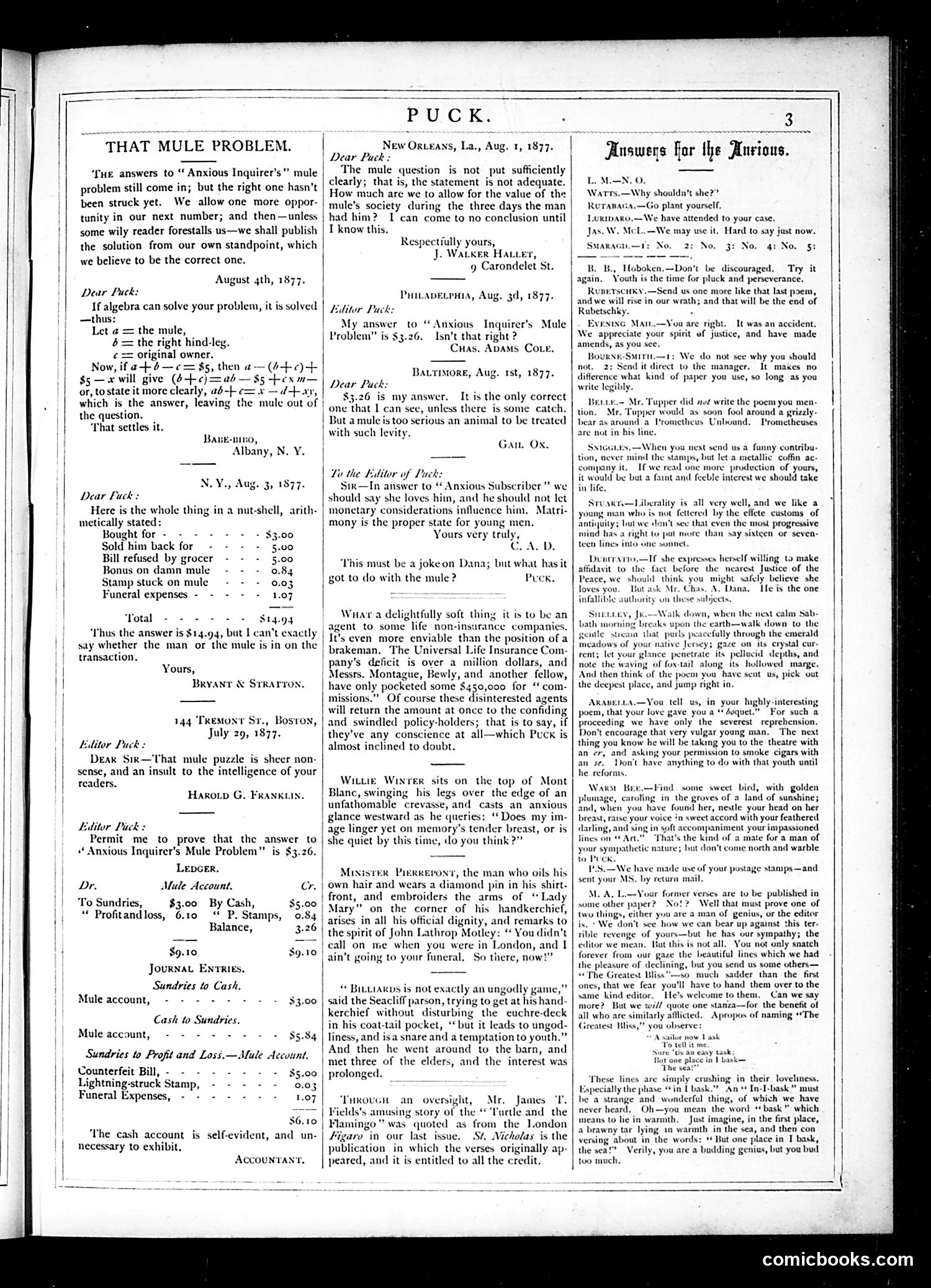
This page is primarily a letters-to-editor section titled "Answers for the Anxious" rather than featuring political cartoons. The content consists of humorous responses to reader inquiries on various topics: a woman asking "Wouldn't she?", marital advice, poetry composition feedback, and insurance/financial matters. One recurring item is "The Mule Problem"—multiple letters debate an algebraic puzzle about settling accounts involving a mule's purchase and expenses. Readers propose competing solutions, with one accountant declaring their answer "self-evident and necessary to exhibit." The section also includes a satirical piece about "Minister Pierpont," a man with his hair and wears a diamond pin, used as social commentary. Overall, this page reflects *Puck*'s mix of satire and reader engagement rather than single political cartoons.
📄 Transcribed text from this page (OCR, searchable)
Machine-transcribed from the original scan — historical spelling and the odd misread are preserved.
THAT MULE PROBLEM. ‘THe answers to “ Anxious Inquirer's” mule problem still come in; but the right one hasn't been struck yet. We allow one more oppor- tunity in our next number; and then—unless some wily reader forestalls us—we shall publish the solution from our own standpoint, which we believe to be the correct one. August 4th, 1877. Dear Puck: If algebra can solve your problem, it is solved —thus: Let a = the mule, 6 = the right hind-leg. ¢ = original owner. Now, if a4 —c= $5, then a—(4--e)-4 $5 —x will give (6--e) = ab — $5 ex m— or, tostate it more clearly, ab-} c= x —d-+-ay, which is the answer, leaving the mule out of the question. ‘That settles it. Bane-nino, Albany, N. Y. N.Y., Aug. 3, 1877 Dear Fuck: Here is the whole thing in a nut-shell, arith- metically stated: Bought for - - - - - Sold him back for - - Bill refused by grocer - Bonus on damn mule - Stamp stuck on mule - Funeral expenses - - - $3.00 5.00 5.00 0.84 0.03 1.07 Yotal - - - + + + St4.94 ‘Thus the answer is $14.94, but I can’t exactly say whether the man or the mule is in on the transaction. Yours, Bryant & Srrarron, 144 Tremont Sr., Bostos, | July 29, 1877. Editor Puck : Deak Sik—That mule puzzle is sheer non- sense, and an insult to the intelligence of your readers. HARroip G. FRANKLIN. Liditer Pack : Permit me to prove that the answer to Anxious Inquirer’s Mule Problem” is $3.26. Lepcer. Dr. Mule Account, ‘To Sundries, $3.00 By Cash, “ Profitandloss, 6.10 “ P. Stamps, Balance, cr. $5.00 0.84 3.26 | $9.10 $9.10 Journat Entries. Sundries to Cash. Mule account, - - - - - - Cash to Sundries. Mule account, - - - - - - - - Sundries to Profit and Loss.—Mule Account. Counterfeit Bill,- - - - - - Lightning-struck Stamp, - “« «= Funeral Expenses, - = = - = - = $5.00 0.03 1.07 $6.10 evident, and un- ‘The cash account is self- necessary to exhibit. ACCOUNTANT, PUCK. Ew “Onceins) La., ug Dear Puck: The mule question is not put sufficiently clearly; that is, the statement is not adequate. How much are we to allow for the value of th mule’s society during the three days the man had him? I can come to no conclusion until I know this. Respectiully yours, J. Waker Hate 9 Carondelet St. . 1, 1877. Piitavecema, Aug. 34, 1877. Editor Puck: My answer to ‘Anxious Inquirer's Mule Problem” is $3.26. Isn't that right ? Cuas. Apams Cote. Batrimore, Aug. rst, 1877. Dear Puc $3.26 is my answer, It is the only correct one that I can sec, unless there is some catch. But a mulcis too serious an animal to be treated with such levity. | Gaw Ox. | | Yo the Editor of Puck Sik—In answer to Anxious Subscriber” we should say she loves him, and he should not let monetary considerations influence him. Matri- mony is the proper state for young men. Yours very truly, AL DY ‘This must be a jokeon Dana; but what has it got to do with the mule? Puck. Wuar a delightfully soft thing it is to be an agent to some life non-insurance companies. It's even more enviable than the position of a brakeman. The Universal Life Insurance Com- pany’s deficit is over a million dollars, and Messrs. Montague, Bewly, and another fellow, have only pocketed some $450,000 for “com: missions.” Of course these disinterested agents | will return the amount at once to the confiding and swindled policy-holders; that is to say, if they’ve any conscience at all—which Puck is almost inclined to doubt. Wittig Winrer sits on the top of Mont | Blanc, swinging his legs over the edge of an | unfathomable crevasse, and casts an anxious | glance westward as he queries: “Does my im- | age linger yet on memory’s tender breast, or is | she quiet by this time, do you think ?” MinisveR Pierreront, the man who oils his own hair and wears a diamond pin in his shirt- | front, and embroiders the arms of ‘Lady Mary” on the corner of his handkerchief, | arises in all his official dignity, and remarks to the spirit of John Lathrop Motley: “ You didn't call on me when you were in London, and 1 | ain't going to your funeral, So there, now!” i} “ BiLLiakps is not exactly an ungodly game,” | said the Seacliff parson, trying to get at his hand- kerchief without disturbing the euchre-deck in his coat-tail pocket, ‘but it leads to ungod- liness, and isa snare and a temptation to youth.” | And then he went around to the barn, and | | met three of the elders, and the interest was | | prolonged. | ‘Turoven an oversight, Mr. James ‘I. | Fields's amusing story of the ‘Turtle and the | Flamingo” was quoted as from the London Figaro in our last issue, St. Nicholas is the publication in which the verses originally ap peared, and it is entitled to all the credit. 3 Answers or the Auvious. MAN. O. Warts.—Why shouldn't she?” Ruranaca.—Go plant yourself, LURIDARO.—We have attended to your case. Jas. W, McL.—We may use it, Hard to say just now. Smaracp.—t: No. 2: No. 3: No. 4: No. §: 3: B. B., Hoboken.—Don't be discouraged. Try it again, Youth is the time for pluck and perseverance. Runerscuky.—Send us one more like that last poem, and we will rise in our wrath; and that will be the end of Rubetschky. : EvexinG Matt.—You are right, It was an accident. We appreciate your spirit of justice, and have made amends, as you see. Bourxe-Sairit.—t: We do not see why you should Send it direct to the manager. It’ makes no what kind of paper you use, so long as you Ben ier did of write the poem you men- tion. Mr. Tupper would as soon fool around a grizzly. bear as around a Vrometheus Unbound. Prometheuses are not in bis line, Sy1cuLes,—When you neat send us a funny contribu- tion, never mind the stamps, but let a metallic coffin ac- company it, If we read one more prodvetion of yours, it would be but a faint and feeble interest we should take in life, Srvakty—Liberality is all very well, and we like a young man who is not fettered by the effete customs of Antiquity; but we don’t see that even the most progressive mind has a right to put more than say sixteen or seven- teen lines into une sonnet. Dentrarto.—If she expresses herself willing to make affidavit to the fact before the Peace, we should think you might safely L loves you. ask Mr. Chas. A. Dana, He is the one infallible authority un these subjects, Suen bath m LY, Jk.—Walk down, when the next calm Sab- ning breaks upon the earth—walk down to the stucain that puils peacefully through the emerald ey; gaze on its crystal cur- rent; let your glance penetrate its pellucid depths, and note the waving of fox-tail along its hollowed marge. And then think of the pocm you have sent us, pick out the deepest place, and jump fight in, meadows of y Akawetta.—You tell us, in your highly-interesting poem, that your love gave you a doquet.” For such a proceeding we have only the severest reprehension. Don't encourage that very vulgar young man. The next thing you know he will be taking you to the theatre with an ¢r, and asking your permission to smoke cigars with an se. Don't have anything to do with that youth until he reforms. Wars Bre.—Find sweet bied, with golden plumage, carofing in the groves of a land of sunshine; and, when you have found her, nestle your head on her breast, raise your voice in sweet accord with your feathered nd sing in soft accompaniment your impassioned ines on Art.” ‘That's the kind of a mate for a man of your sympathetic nature; but don’t come north and warble .—We have made use of your postage stamps—and sent your MS. by return mail, M.A, L.—Your for ¢ other paper? two things, either ye is. “We d verses are to be published in Well that must prove one of are a man of genius, or the editor see how we can bear up against this ter- ible revenge of yours—but he has our sympathy; the editor we mean. But this is not all, You not only snatch forever from our gaze the beautiful lines which we had the pleasure of declining, but you send us some others— “The Greatest Bliss""—so_ much sadder than the first ones, that we fear you'll have to hand them over to the same kind editor, He's welcome to them. Can we say more? But we wil? quote one stanza—for the benefit of all who are similarly aillicted. Apropos of naming “The Greatest Bliss,”” you observ A sail To te Sure “tis Rat one The seai lines are simply crushing in their loveliness. Especially the phase ¢ in I bask.” An‘ In-I-bask ” must be a strange and wonderful thing, of which we have never heard. Oh—you mean the word bask” which means to lic in warmth. Just imagine, in the first place, a brawny tar lying in warmth in the sea, and then con versing about in the words: But one place in I bask, the sea!” Verily, you are a budding genius, but you bud too much, comicbooks.com