
Puck, 1877-08-08 · page 11 of 16
Puck — August 8, 1877 — page 11: what you’re looking at
What you’re looking at
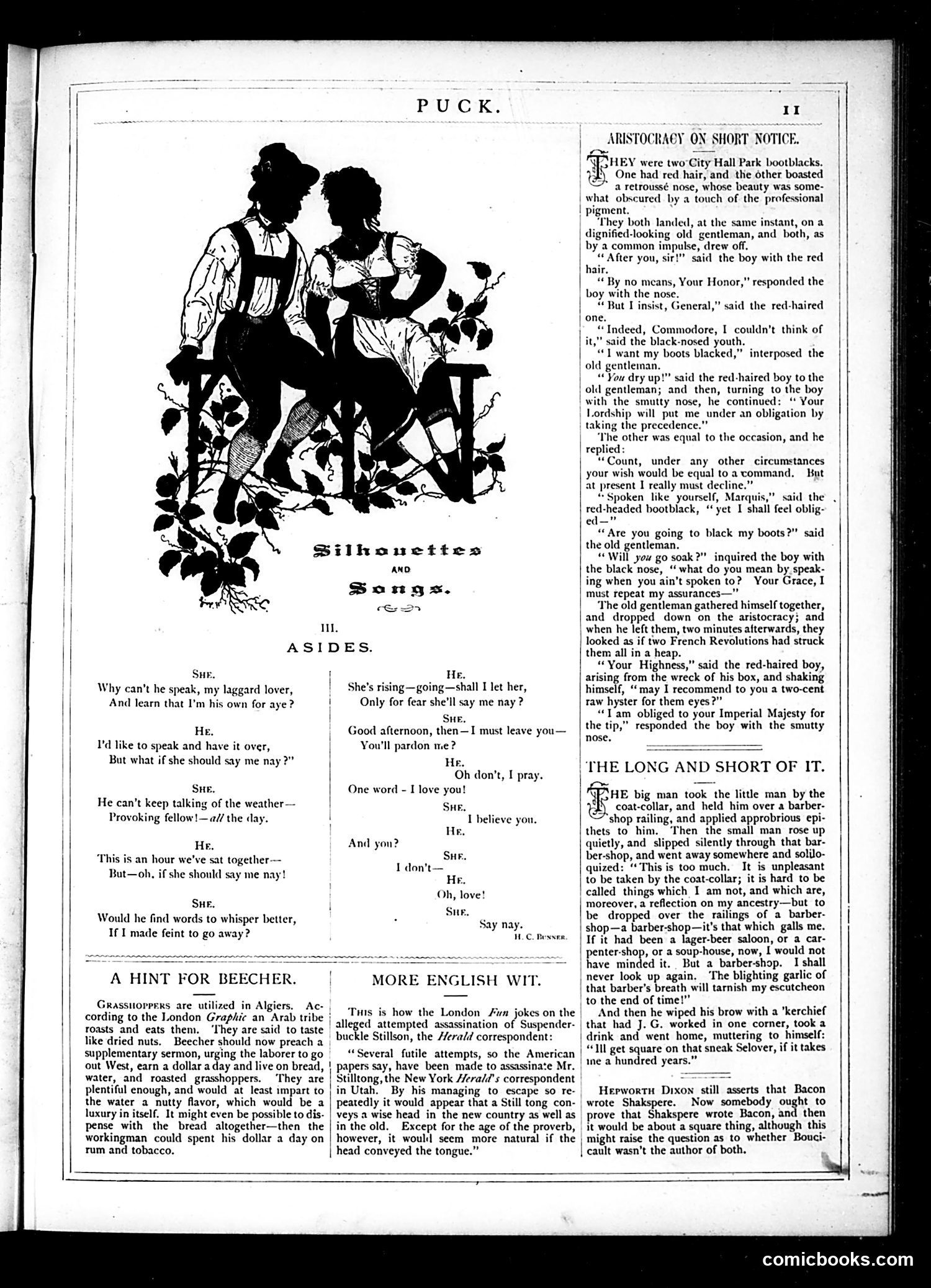
This silhouette cartoon depicts two working-class men meeting a dignified old gentleman. The satire mocks American social pretension: one man has red hair, the other a "retrousse nose" (turned-up nose)—physical markers of lower-class status that the text suggests they're trying to conceal to appear aristocratic. The dialogue shows the men attempting to claim noble standing ("Your Honor," "General") while the old gentleman responds with dry wit, exposing their obvious fraud. The humor targets Americans who adopt fake aristocratic airs despite obvious working-class origins, suggesting that true nobility cannot be instantly improvised or hidden beneath superficial claims of rank. This reflects Puck's recurring theme of satirizing American social climbing and false gentility.
📄 Transcribed text from this page (OCR, searchable)
Machine-transcribed from the original scan — historical spelling and the odd misread are preserved.
Silhouettes AND Sanygx. Sea il. ASI Sur. Why can't he speak, my laggard lover, And learn that I’m his own for aye? He. I'd like to speak and have it over, But what if she should say me nay ?” SHE. He can’t keep talking of the weather— Provoking fellow!—a// the day. He. is an hour we've sat together — But—oh, if she should say me nay! Sue. Would he find words to whisper better, If I made feint to go away? A HINT FOR BEECHER. Grassuioppers are utilized in Algiers. Ac- cording to the London Graphic an Arab tribe j roasts and eats them. ‘They are said to taste like dried nuts. Beecher should now preach a supplementary sermon, urging the laborer to go out West, earn a dollar aday and live on bread, water, and roasted grasshoppers. ‘They are plentiful enough, and would at least impart to the water a nutty flavor, which would be a luxury in itself. It might even be possible to dis- pense with the bread altogether—then the DES. He. She's rising—going—shall I let her, Only for fear she'll say me nay ? SHE. Good afternoon, then—I must leave you— You'll pardon me? He. Oh don’t, I pray. One word - I love you! Sue. I believe you. He. And yon? Sue. 1 don't— He. Oh, love! Sur. Say nay. H.C. Besser. MORE ENGLISH WIT. Tis is how the London Fun jokes on the | alleged attempted assassination of Suspender- buckle Stillson, the /fera/d correspondent: “Several futile attempts, so the American ' papers say, have been made to assassinate Mr. | Stilltong, the New York /era/d’s correspondent in Utah. By his managing to escape so re- peatedly it would appear that a Still tong con- veys a wise head in the new country as well as in the old. Except for the age of the proverb, II | ARISTOCRA€Y ON SHORT NOTICE. Pa a retroussé nose, whose beauty was some- at obscured by a touch of the professional | pigment. "They both landed, at the same instant, on a | dignified-looking old gentleman, and both, as by a common impulse, drew off. “After you, sir!” said the boy with the red hair, “By no means, Your Honor,” responded the boy with the nose. | “But I insist, General,” said the red-haired | one. “Indeed, Commodore, I couldn't think of said the black-nosed youth. “1 want my boots blacked,” interposed the | old gentleman. | «You dry up!” said the red-haired boy to the | old gentleman; and then, turning to the boy with the smutty nose, he continued: ‘“ Your Lordship will put me under an obligation by taking the precedence.” ‘The other was equal to the occasion, and he replied: “Count, under any other circumstances your wish would be equal toa command. Bat at present I really must decline.” “Spoken like yourself, Marquis,” said the red-headed bootblack, ‘yet I shall feel oblig- ed” “Are you going to black my boots?” said the old gentleman. “Will you go soak ?” inquired the boy with the black’nose, “ what do you mean by. speak- ing when you ain't spoken to? Your Grace, I must repeat my assurances—"" ‘The old gentleman gathered himself together, and dropped down on the aristocracy; and when he left them, two minutes afterwards, they looked as if two French Revolutions had struck them all in a heap. “Your Highness,” said the red-haired boy, arising from the wreck of his box, and shaking himself, ‘may I recommend to you a two-cent raw hyster for them eyes?” “Tam obliged to your Imperial Majesty for the tip,” responded the boy with the smutty | nose, | THE LONG AND SHORT OF IT. | NJGHE big man took the little man by the Sy coat-collar, and held him over a barber- ae railing, and applied approbrious epi- | thets to him. Then the small man rose up quietly, and slipped silently through that bar- ber-shop, and went away somewhere and solilo- quized: “This is too much. It is unpleasant to be taken by the coat-collar; it is hard to be | called things which I am not, and which are, moreover, a reflection on my ancestry—but to |e dropped over the railings of a barber- | shop—a barber-shop—it’s that which galls me. | If it had been a lager-beer saloon, or a car- | penter-shop, or a soup-house, now, I would not have minded it. But a barber-shop. I shall never look up again. ‘The blighting garlic of that barber's breath will tarnish my escutcheon to the end of time!” And then he wiped his brow with a 'kerchief that had J. G. worked in one corner, took a | drink and went home, muttering to himself: | ‘Ill get square on that sneak Selover, if it takes ine a hundred years.” Hepwortn Dixon still asserts that Bacon wrote Shakspere. Now somebody ought to prove that Shakspere wrote Bacon, and then it would be about a square thing, although this workingman could spent his dollar a day on | however, it would seem more natural if the | might raise the question as to whether Bouci- rum and tobacco. | head conveyed the tongue.” | cault wasn’t the author of both, comicbooks.com