
Puck, 1877-08-08 · page 2 of 16
Puck — August 8, 1877 — page 2: what you’re looking at
What you’re looking at
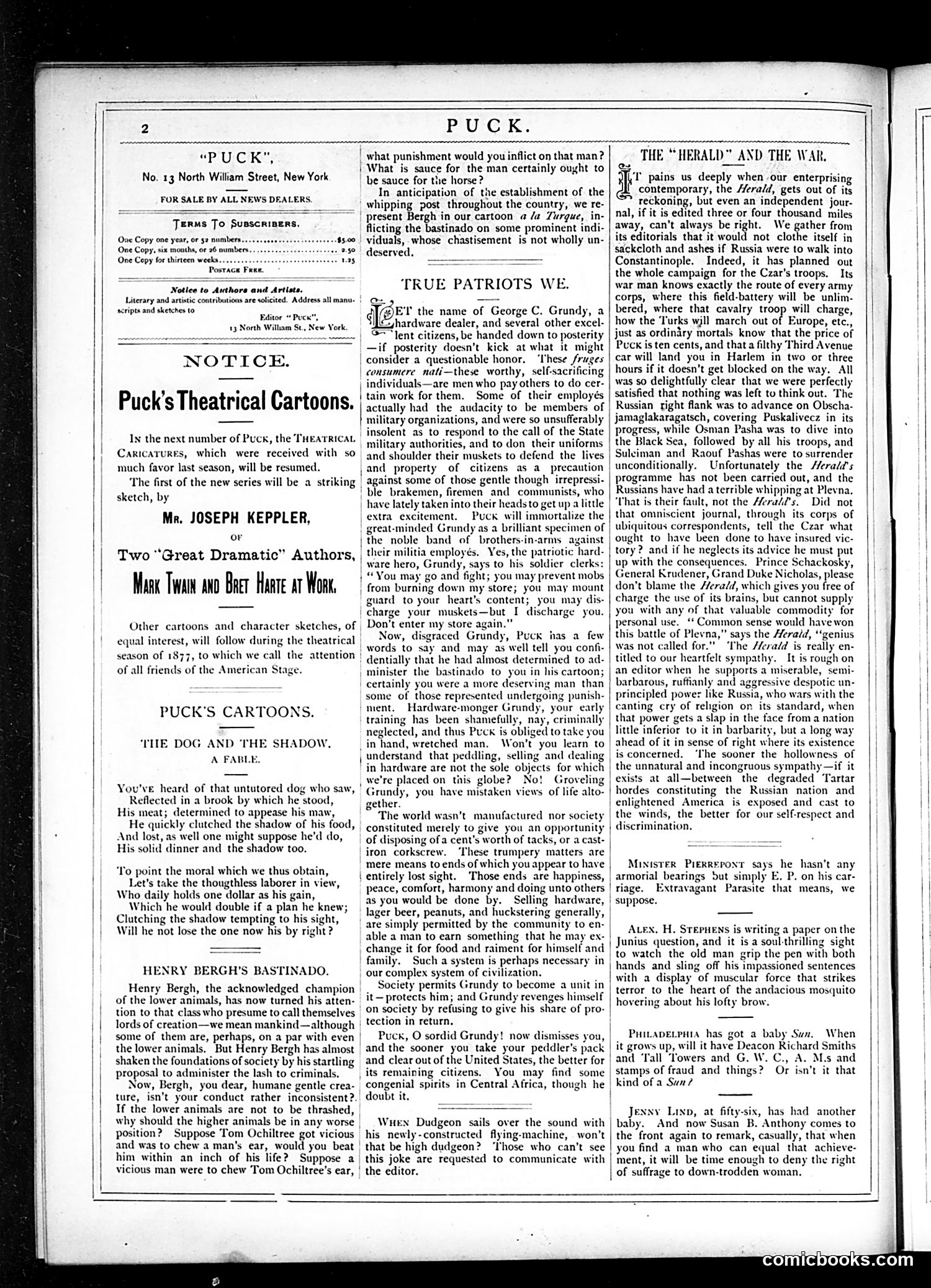
This editorial section critiques how the *New York Herald* newspaper covered the Russo-Japanese War. The author argues the *Herald* has grown obsessed with following Czar Nicholas II's military campaigns, planning routes for "every army corps" and predicting cavalry charges with suspicious precision. The satire suggests the *Herald* overstepped from journalism into propaganda, essentially fighting the war alongside Russia through its coverage. The piece mocks the newspaper's claimed omniscience about battle strategy while criticizing its uncritical cheerleading for Russian military interests—presenting this as dangerous bias that misleads American readers about a foreign conflict. This reflects broader Progressive-era skepticism toward yellow journalism and corporate newspaper influence on public opinion.
📄 Transcribed text from this page (OCR, searchable)
Machine-transcribed from the original scan — historical spelling and the odd misread are preserved.
PUCK. “PUCK", No. 13 North William Street, New York FOR SALE BY ALL NEWS DEALERS. Terms To Sunscriners. One Copy one year, oF $2 numbers... One Copy, six mouths, or 26 aumbers. ‘One Cepy for thirteen weeks. Literary and artistic contributions are solicited. Address all manu- scripts and aketches to Editor “ Pus 13 North Willsam Se NOTICE. Puck's Theatrical Cartoons. In the next number of Puck, the THEATRICAL Caricatures, which were received with so much favor last season, will be resumed. ‘The first of the new series will be a striking sketch, by Me. JOSEPH KEPPLER, or Two “Great Dramatic” Authors, Marx Twa ano Baer Haare at Wonr, Other cartoons and character sketches, of equal interest, will follow during the theatrical season of 1877, to which we call the attention of all friends of the American Stage. PUCK’S CARTOONS. ‘THE DOG AND ‘THE SHADOW. A FABLE, You've heard of that untutored dog who saw, Reflected in a brook by which he stood, His meat; determined to appease his maw, He quickly clutched the shadow of his food, And lost, as well one might suppose he'd do, His solid dinner and the shadow too. ‘To point the moral which we thus obtain, Let's take the thougthless laborer in view, Who daily holds one dollar as his gain, Which he would double if a plan he knew; Clutching the shadow tempting to ight, Will he not lose the one now his by right? HENRY BERGH'S BASTINADO. Henry Bergh, the acknowledged champion of the lower animals, has now turned his atten- tion to that class who presume to call themselves lords of creation—we mean mankind—although some of them are, perhaps, on a par with even the lower animals. But Henry Bergh has almost shaken the foundations of society by his startling proposal to administer the lash to criminals. Now, Bergh, you dear, humane gentle crea- ture, isn’t your conduct rather inconsistent?. af the lower animals are not to be thrashed, why position? Suppose ‘Tom Ochiltree got vicious and was to chew a man’s ear, would you beat him within an inch of his life? Suppose a vicious man were to chew Tom Ochiltree’s ear, should the higher animals be in any worse | what punishment would you inflict on that man? | What is sauce for the man certainly ought to be sauce for the horse? In anticipation of the establishment of the whipping post throughout the country, we re- present Bergh in our cartoon @ /a Zurgue, in- flicting the bastinado on some prominent indi- viduals, whose chastisement is not wholly un- deserved, TRUE PATRIOTS WE. ram oe ert the name of George C. Grundy, a l¢hardware dealer, and several other excel- "lent citizens, be handed down to posterity —if posterity doesn’t kick at what it might consider a questionable honor. ‘These fruges consumere nati—these worthy, self-sacrificing individuals—are men who pay others to do cer- | tain work for them. Some of their employés actually had the audacity to be members of military organizations, and were so unsufferably insolent as to respond to the call of the State military authorities, and to don their uniforms and shoulder their muskets to defend the lives ; and property of citizens as a_ precaution against some of those gentle though irrepressi- ble brakemen, firemen and communists, who have lately taken into their heads to get up a little extra excitement. Puck will immortalize the great-minded Grundy as a brilliant specimen of | the noble band of brothers-in-arms against their militia employés. Yes, the patriotic hard- ware hero, Grundy, says to his soldier clerks: | “You may go and fight; you may prevent mobs from burning down my store; you may mount guard to your heart’s content; you may dis- charge your muskets—but I discharge you. Don't enter my store again, Now, disgraced Grundy, Puck has a few words to say and may as well tell you confi- dentially that he had almost determined to ad- minister the bastinado to you in his cartoon; certainly you were a more deserving man than some of those represented undergoing punish- ment. Hardware-monger Grundy, your early training has been shamefully, nay, criminally neglected, and thus Puck is obliged to take you in hand, wretched man. Won't you learn to | understand that peddling, selling and dealing in hardware are not the sole objects for which | we're placed on this globe? No! Groveling Grundy, you have mistaken views of life alto- gether. The world wasn’t manufactured nor society constituted merely to give you an opportunity of disposing of a cent’s worth of tacks, or a cast- iron corkscrew. ‘These trumpery matters are mere means to ends of which you appear to have \ entirely lost sight. ‘Those ends are happiness, peace, comfort, harmony and doing unto others as you would be done by. Selling hardware, lager beer, peanuts, and huckstering generally, are simply permitted by the community to en- able a man to earn something that he may ex- change it for food and raiment for himself and family. Such a system is perhaps necessary in our complex system of civilization. Society permits Grundy to become a unit in it— protects him; and Grundy revenges himself on society by refusing to give his share of pro- | | tection in return, | Puck, O sordid Grundy! now dismisses you, and the sooner you take your peddler’s pack and clear out of the United States, the better for its remaining citizens. You may find some congenial spirits in Central Africa, though he doubt it. Wuewn Dudgeon sails over the sound with his newly-constructed flying-machine, won't that be high dudgeon? ‘I'hose who can’t see this joke are requested to communicate with | the editor. é THE “HERALD” AND THE WAR. o pains us deeply when our enterprising contemporary, the Hera/d, gets out of its reckoning, but even an independent jour- nal, if it is edited three or four thousand miles away, can't always be right. We gather from its editorials that it would not clothe itself in sackcloth and ashes if Russia were to walk into Constantinople. Indeed, it has planned out the whole campaign for the Czar’s troops. Its war man knows exactly the route of every army corps, where this field-battery will be unlim- bered, where that cavalry troop will charge, | how the Turks wjll march out of Europe, etc., just as ordinary mortals know that the price of Puck is ten cents, and that a filthy Third Avenue car will land you in Harlem in two or three | hours if it doesn’t get blocked on the way. All was so delightfully clear that we were perfectly | satisfied that nothing was left to think out. The Russian right flank was to advance on Obscha- | jamaglakaragatsch, covering Puskalivecz in its | progress, while Osman Pasha was to dive into | the Black Sea, followed by all his troops, and | Suleiman and Raouf Pashas were to surrender unconditionally. Unfortunately the /era/d’s programme has not been carried out, and the sussians have had a terrible whipping at Plevna, ‘That is their fault, not the Herad/’s. Did not that omniscient journal, through its corps of | ubiquitous correspondents, tell the Czar what ought to have been done to have insured vic- tory? and if he neglects its advice he must put up with the consequences. Prince Schackosky, General Krudener, Grand Duke Nicholas, please don’t blame the Heradd, which gives you free of charge the use of its brains, but cannot supply you with any of that valuable commodity for personal use. “ Common sense would havewon this battle of Plevna,” says the Hera/d, “genius was not called for.” The //era/d is really titled to our heartfelt sympathy. It is rough on an editor when he supports a miserable, semi- barbarous, ruffianly and aggressive despotic un- principled power like Russia, who wars with the canting cry of religion on its standard, when that power gets a slap in the face from a nation little inferior to it in barbarity, but a long way ahead of it in sense of right where its existence is concerned. ‘Ihe sooner the hollowness of the unnatural and incongruous sympathy —if it exists at all—between the degraded ‘Tartar hordes constituting the Russian nation and enlightened America is exposed and cast to inds, the better for our self-respect and mination, Minister Pierrepont says he hasn’t any armorial bearings but simply E. P. on his car- | riage. Extravagant Parasite that means, we | suppose. ALEX, H. Srepuens is writing a paper on the | Junius question, and it isa soul-thrilling sight | to watch the old man grip the pen with both | hands and sling off his impassioned sentences | with a display of muscular force that strikes | terror to the heart of the andacious mosquito hovering about his lofty brow. Puitapenraia has got a baby Sux, When | it grows up, will it have Deacon Richard Smiths | and ‘Tall Towers and G. W.C., A. M.s and stamps of fraud and things? Or isn't it that kind of a Sun? i} xy Lip, at fifty-six, has had another baby. And now Susan B. Anthony comes to the front again to remark, casually, that when | you find a man who can equal that achieve- | ment, it will be time enough to deny the right | of suffrage to down-trodden woman.