
Puck, 1877-08-08 · page 12 of 16
Puck — August 8, 1877 — page 12: what you’re looking at
What you’re looking at
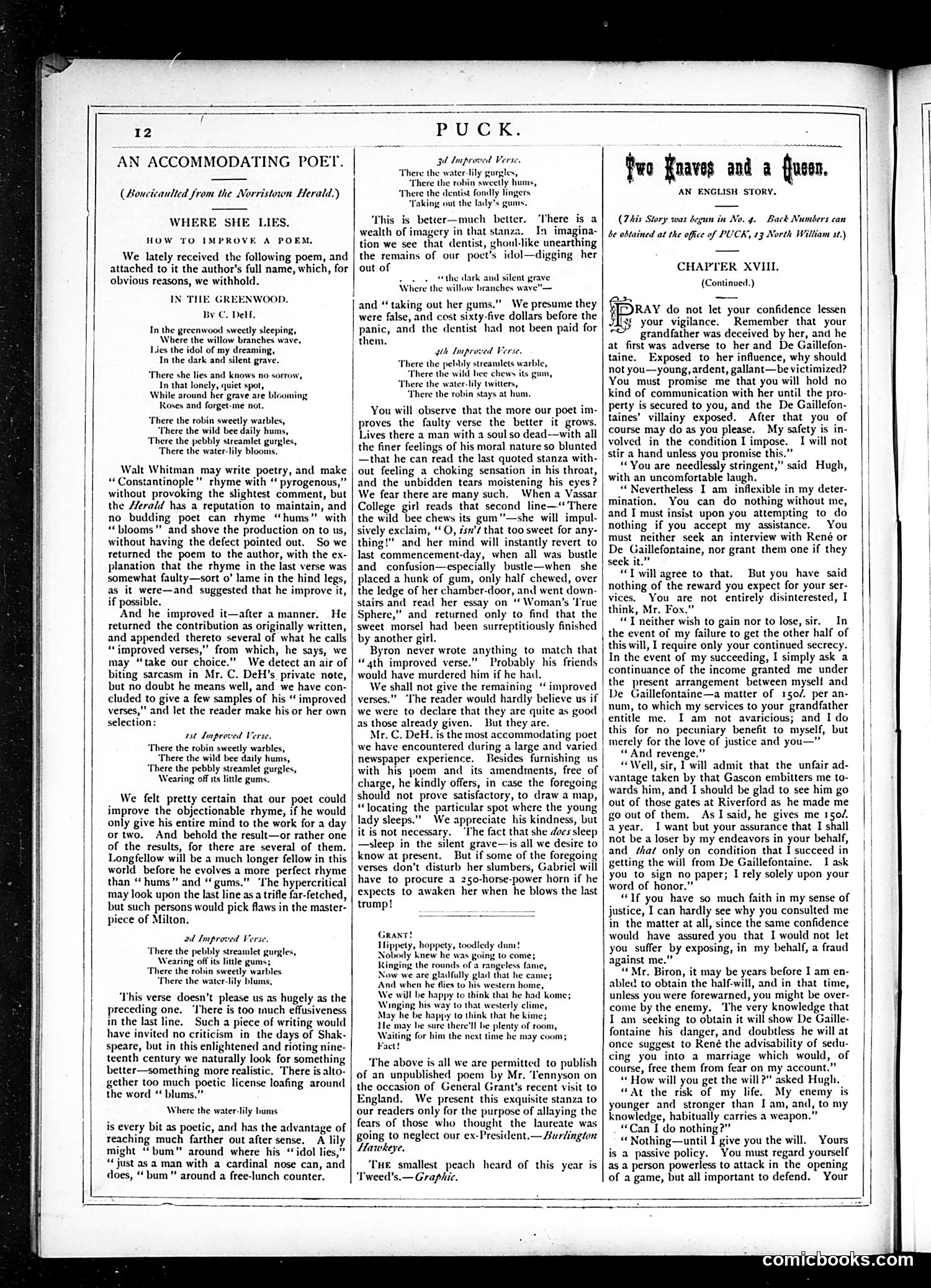
This page is primarily **literary content**, not a political cartoon. It contains: 1. **"An Accommodating Poet"** — a humorous article about poet improvements, criticizing a poem called "Where She Lies" by C. Delt from the *Norristown Herald*. The piece sarcastically praises an editor's "improvements" to weak verses. 2. **"Two Knaves and a Queen"** — a serialized story (Chapter XVIII), featuring dialogue between characters discussing confidentiality, blackmail, and marriage arrangements. The plot involves secrets, coercion, and financial pressure. The satire targets **pretentious amateur poetry** and journalistic editing practices. The story content suggests melodramatic fiction typical of the era's serialized narratives. **No specific political figures or events are clearly referenced** on this visible page.
📄 Transcribed text from this page (OCR, searchable)
Machine-transcribed from the original scan — historical spelling and the odd misread are preserved.
12 AN ACCOMMODATING POET. (Boucicaulted from the Norristown Herald.) WHERE SHE LIES. HOW TO IMPROVE A POEM, We lately received the following poem, and attached to it the author’s full name, which, for obvious reasons, we withhold. IN THE GREENWOOD. By C. Delf. In the greenwood sweetly sleeping, Where the willow branches wave, Lies the idol of my dreaming, In the dark and silent grave. There she lies and knows no sorrow, In that lonely, quiet spot, While around her grave are blooming Roses and forget:me not. ‘There the robin sweetly warbles, ‘There the wild bee daily hums, There the pebbly streamlet gurgles, ‘There the water-lily blooms. Walt Whitman may write poetry, and make “Constantinople” rhyme with “ pyrogenous,” without provoking the slightest comment, but the Herald has a reputation to maintain, and no budding poet can rhyme “hums” with “blooms” and shove the production on to us, without having the defect pointed out. So we returned the poem to the author, with the ex- planation that the rhyme in the last verse was somewhat faulty—sort 0’ lame in the hind legs, as it were—and suggested that he improve it, if possible. And he improved it—after a manner. He returned the contribution as originally written, and appended thereto several of what he calls “improved verses,” from which, he says, we may “take our choice.” We detect an air of biting sarcasm in Mr. C. DeH’s private note, but no doubt he means well, and we have con- cluded to give a few samples of his “ improved verses,” and let the reader make his or her own selection: ast Improved Verse. ‘There the robin sweetly warbles, ‘There the wild bee daily hums, ‘There the pebbly streamlet gurgles, Wearing off its little gums. We felt pretty certain that our poet could improve the objectionable rhyme, if he would only give his entire mind to the work for a day or two. And behold the result—or rather one of the results, for there are several of them. Longfellow will be a much longer fellow in this world before he evolves a more perfect rhyme than “hums” and ‘ gums.” ‘I'he hypercritical may look upon the last line as a trifle far-fetched, but such persons would pick flaws in the master- piece of Milton. 2d Improved Verse. ‘There the pebbly streamlet gurgles, Wearing off its little gums; ‘There the robin sweetly warbles ‘There the water-lily blums, is verse doesn’t please us as hugely as the preceding one. ‘There is too much effusiveness in the last line. Such a piece of writing would have invited no cri m in the days of Shak- speare, but in this enlightened and rioting nine- teenth century we naturally look for something better—something more realistic. There is alto- gether too much poetic license loafing around the word ‘ blums.”” Where the water-lily bums is every bit as poetic, and has the advantage of reaching much farther out after sense. A lily might “bum” around where his “idol lies,” “just as a man with a cardinal nose can, and 3d Improved Verse. ‘There the water-lily gurgles, here the robin sweetly hums, There the dentist fondly fi Taking out the lady's gums, ‘This is betcer—much better. ‘There is a wealth of imagery in that stanza, In imagina tion we see that dentist, ghoul-like unearthing the remains of our poct’s idol—digging her out of ‘ “the dark and silent grave Where the willow branches wave”— and “taking out her gums.” We presume they were false, and cost sixty-five dollars before the panic, and the dentist had not been paid for them. th Improved ¥ ‘There the peldbly streamlets warble, here the wild hee chews its gum, re the water-lily twitters, There the robin stays at hum, se. | ¥ou will observe that the more our poet im- proves the faulty verse the better it grows. | Lives there a man with a soul so dead—with all the finer feelings of his moral nature so blunted | —that he can read the last quoted stanza with- out feeling a choking sensation in his throat, | and the unbidden tears moistening his eyes? | We fear there are many such. When a Vassar College girl reads that second line—There | the wild bee chews its gum”—she will impul- sively exclaim, ‘ O, isn'/ that too sweet for any- thing!” and her mind will instantly revert to last commencement-day, when all was bustle and confusion—especially bustle—when she placed a hunk of gum, only half chewed, over the ledge of her chamber-door, and went down- | stairs and read her essay on “ Woman's ‘True | Sphere,” and returned only to find that the sweet morsel had been surreptitiously finished | by another girl. Byron never wrote anything to match that “4th improved verse.” Probably his friends would have murdered him if he had. | We shall not give the remaining “ improved | verses.” ‘Ihe reader would hardly believe us if we were to declare that they are quite as good as those already given. But they are. Mr. C. DeH. is the most accommodating poet we have encountered during a large and varied newspaper experience. Besides furnishing us with his poem and its amendments, free of charge, he kindly offers, in case the foregoing should not prove satisfactory, to draw a map, | locating the particular spot where the young lady sleeps.” We appreciate his kindness, but it is not necessary. ‘The fact that she does sleep | | —sleep in the silent grave—is all we desire to know at present. But if some of the forego verses don’t disturb her slumbers, Gabriel will have to procure a 25o-horse-power horn if he expects to awaken her when he blows the last trump! Grant! Hippety, hoppety, toodledy dum! Nobody knew he was going to come; Ringing the rounds of a rangeless fame, Now we are glalfully glad that he came And when he flies to his western home, We will be happy to think that he had kome; Winging his way to that westerly clime, May he be happy to think that he kime; He may he sure there'll he plenty of room Waiting for him the next time he may cot Fae The above is all we are permitted to publish of an unpublished poem by Mr. ‘Tennyson on the occasion of General Grant's recent visit to England. We present this exquisite stanza to our readers only for the purpose of allaying the fears of those who thought the laureate was going to neglect our ex-President.— Burlington Hawkeye. ‘THe smallest peach heard of this year is | a year. does, “ bum” around a free-lunch counter. ‘T'weed's.— Graphic. feo foaves and a queen, AN ENGLISH STORY. (This Story was begun in No. 4. Back Numbers can be obtained at the office of PUCK, 13 North William st.) CHAPTER XVIII. (Continued.) fray do not let your confidence lessen JMy your vigilance. Remember that your grandfather was deceived by her, and he at first was adverse to her and De Gaillefon- taine. Exposed to her influence, why should not you—young, ardent, gallant—be victimized? You must promise me that you will hold no kind of communication with her until the pro- perty is secured to you, and the De Gaillefon- taines’ villainy exposed. After that you of course may do as you please. My safety is in- volved in the condition I impose. I will not stir a hand unless you promise this.” “You are neediessly stringent,” said Hugh, with an uncomfortable laugh. “Nevertheless I am inflexible in my deter- mination. You can do nothing without me, and I must insist upon you attempting to do nothing if you accept my assistance. You must neither seek an interview with René or De Gaillefontaine, nor grant them one if they seek it.” “Twill agree to that. But you have said nothing of the reward you expect for your ser- vices. You are not entirely disinterested, I think, Mr. Fox.” “T neither wish to gain nor to lose, sir. In the event of my failure to get the other half of this will, I require only your continued secrecy. In the event of my succeeding, I simply ask a continuance of the income granted me under the present arrangement between myself and De Gaillefontaine—a matter of 150/. per an- num, to which my services to your grandfather entitle me. I am not avaricious; and I do this for no pecuniary benefit to myself, but merely for the love of justice and you—” “And revenge “Well, sir, I will admit that the unfair ad- vantage taken by that Gascon embitters me to- wards him, and I should be glad to see him go out of those gates at Riverford as he made me go out of them. As I said, he gives me 150/. I want but your assurance that I shall not be a loser by my endeavors in your behalf, | and “hat only on condition that I succeed in getting the will from De Gaillefontaine. I ask you to sign no paper; I rely solely upon your word of honor.” “If you have so much faith in my sense of justice, I can hardly see why you consulted me in the matter at all, since the same confidence would have assured you that I would not let you suffer by exposing, in my behalf, a fraud against me.” “Mr. Biron, it may be years before I am en- abled to obtain the half-will, and in that time, unless you were forewarned, you might be over- come by the enemy. ‘The very knowledge that 1 am seeking to obtain it will show De Gaille- fontaine his danger, and doubtless he will at once suggest to René the advisability of sedu- cing you into a marriage which would, of course, free them from fear on my account.” “ How will you get the will?” asked Hugh. “At the risk of my life. My enemy is younger and stronger than I am, and, to my knowledge, habitually carries a weapon.” “Can I do nothing?” “ Nothing—until I give you the will. Yours is a passive policy. You must regard yourself as a person powerless to attack in the opening of a game, but all important to defend. Your