
Puck, 1877-08-08 · page 10 of 16
Puck — August 8, 1877 — page 10: what you’re looking at
What you’re looking at
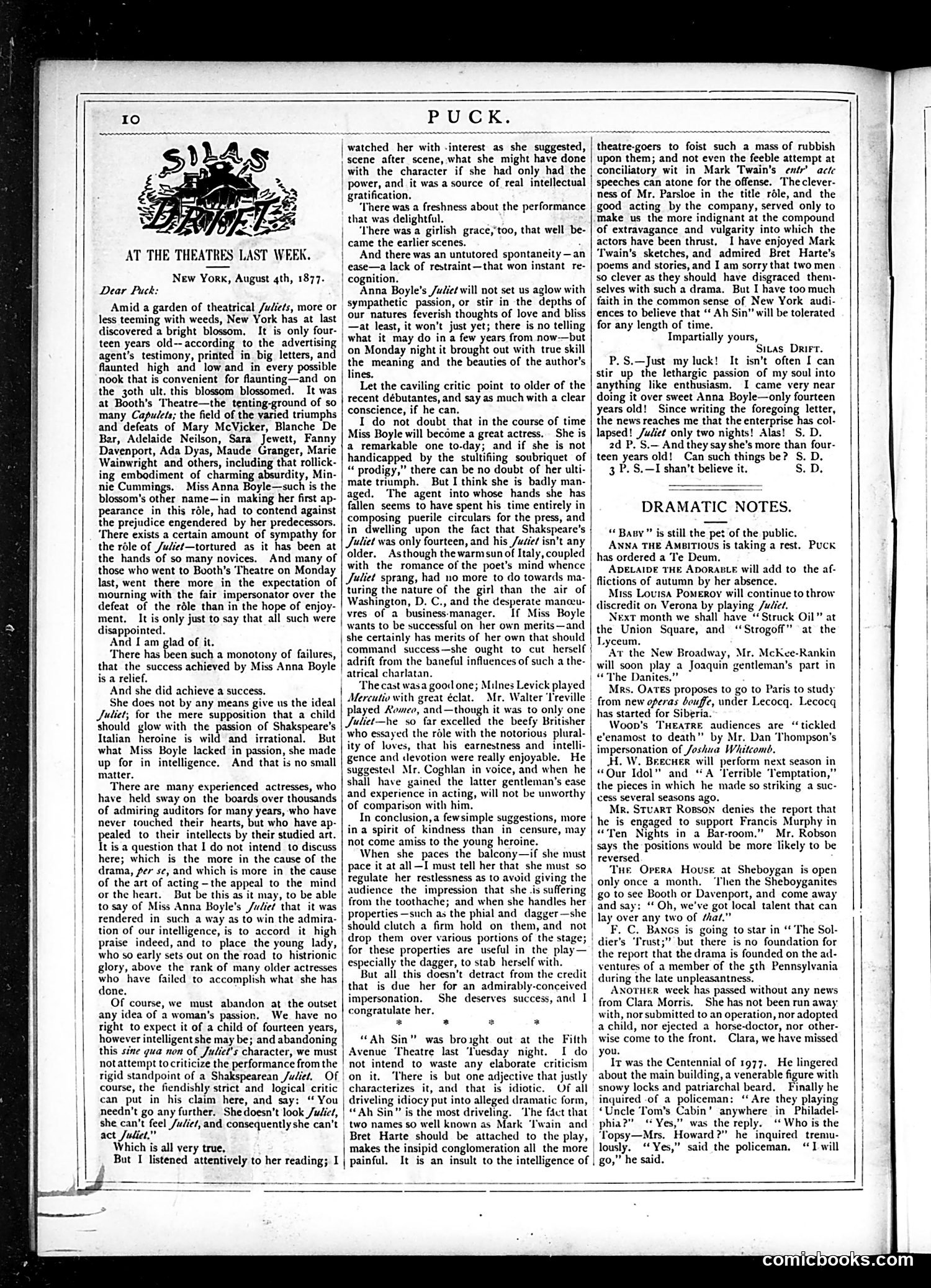
This page contains theatrical criticism and dramatic notes from Puck magazine (New York, August 4th, 1877), not a political cartoon. The main content is a letter ("Dear Puck") critiquing Miss Anna Boyle's performance in "Juliet" at Booth's Theatre. The critic argues that while Boyle's acting showed promise and genuine talent, the production itself was poorly conceived. The letter defends Boyle against those who attended expecting her to fail, praising her natural ability despite the play's weak staging and the fact that she was only fourteen years old. The "Dramatic Notes" section briefly mentions upcoming theatrical productions and cast changes in New York theaters during the 1877 season.
📄 Transcribed text from this page (OCR, searchable)
Machine-transcribed from the original scan — historical spelling and the odd misread are preserved.
AT THE THEATRES LAST WEEK. New York, August 4th, 1877. Dear Puck: Amid a garden of theatrical /u/ie/s, more or less teeming with weeds, New York has at last discovered a bright blossom, It is only four- teen years old-- according to the advertising agent's testimony, printed in big letters, and flaunted high and low and in every possible nook that is convenient for flaunting—and on the 3oth ult. this blossom blossomed. It was at Booth’s Theatre—the tenting-ground of so many Capu/ets; the field of the varied triumphs and defeats of Mary McVicker, Blanche De Bar, Adelaide Neilson, Sara Jewett, Fanny Davenport, Ada Dyas, Maude Granger, Marie Wainwright and others, including that rollick- ing embodiment of charming absurdity, Min- nie Cummings. Miss Anna Boyle—such is the blossom’s other name—in making her first ap- pearance in this réle, had to contend against the prejudice engendered by her predecessors. ‘There exists a certain amount of sympathy for the réle of /udiet—tortured as it has been at the hands of so many novices. And many of those who went to Booth’s Theatre on Monday last, went there more in the expectation of mourning with the fair impersonator over the defeat of the rdle than in the hope of enjoy- ment. It is only just to say that all such were disappointed. And I am glad of it. ‘There has been such a monotony of failures, that the success achieved by Miss Anna Boyle is a relief. And she did achieve a success. She does not by any means give us the ideal Juliet; for the mere supposition that a child should glow with the ion of Shakspeare’s Italian heroine is wild and irrational. But what Miss Boyle lacked in passion, she made up for in intelligence. And that is no small matter. ‘There are many experienced actresses, who have held sway on the boards over thousands of admiring auditors for many years, who have never touched their hearts, but who have ap- aled to their intellects by their studied art. it is a question that 1 do not intend to discuss here; which is the more in the cause of the drama, fer se, and which is more in the cause of the art of acting -—the appeal to the mind or the heart. But be this as it may, to be able to say of Miss Anna Boyle’s /wlie? that it was rendered in such a way as to win the admira- tion of our intelligence, is to accord it high praise indeed, and to place the young lady, who so early sets out on the road to histrion glory, above the rank of many older actresses who have failed to accomplish what she has done. Of course, we must abandon at the outset any idea of a woman's passion. We have no right to expect it of a child of fourteen years, however intelligent she may be; and abandoning this sine qua non of Juliel’s character, we must not attempt to criticize the performance from the rigid standpoint of a Shakspearean Juliet, Of course, the fiendishly strict and logical critic can put in his claim here, and say: “ You needn't go any further. She doesn't look Ju/ict, she can’t feel Judie, and consequently she can’t act Julies Which is all very true, But I listened attentively to her reading; I watched her with -interest_as she suggested, | scene after scene, what she might have done | with the character if she had only had the power, and it was a source of real intellectual gratification. ‘There was a freshness about the performance that was delightful. | ‘There was a girlish grace,too, that well be- came the earlier scenes. 4 | And there was an untutored spontaneity —ar | ease—a lack of restraint—that won instant re- | cognition. Anna Boyle’s /uéiet will not set us aglow with sympathetic passion, or stir in the depths of our natures feverish thoughts of love and bliss —at least, it won’t just yet; there is no telling | what it may do in a few years from now—but on Monday night it brought out with true skill the meaning and the beauties of the author's lines. Let the caviling critic point to older of the recent débutantes, and say as much with a clear conscience, if he can. I do not doubt that in the course of time Miss Boyle will become a great actress. She is a remarkable one to-day; and if she is not handicapped by the stultifiing soubriquet of “ prodigy,” there can be no doubt of her ulti- mate triumph. But I think she is badly man- aged. ‘The agent into whose hands she has fallen seems to have spent his time entirely in composing puerile circulars for the press, and in dwelling upon the fact that Shakspeare’s { Juliet was only fourteen, and his /usiet isn’t any older. Asthough the warmsunof Italy, coupled with the romance of the poet’s mind whence Juliet sprang, had no more to do towards ma- turing the nature of the girl than the air of Washington, D. C., and the desperate manau- vres of a business-manager. If Miss Boyle wants to be successful on her own merits—and she certainly has merits of her own that should command success—she ought to cut herself | adrift from the baneful influences of such a the- atrical charlatan. ‘The cast wasa good one; Milnes Levick played Mercutio with great éclat. Mr. Walter ‘'reville played Romeo, and—though it was to only one Juliet—he so far excelled the beefy Britisher | who essayed the role with the notorious plural- ity of loves, that his earnestness and _ intelli- gence and devotion were really enjoyable. He suggested Mr. Coghlan in voice, and when he shall have gained the latter gentleman’s ease and experience in acting, will not be unworthy of comparison with him. | In conclusion, a fewsimple suggestions, more in a spirit of kindness than in censure, may not come amiss to the young heroine. When she paces the balcony—if she must pace it at all—I must tell her that she must so | regulate her restlessness as to avoid giving the audience the impression that she .is suffering from the toothache; and when she handles her | properties —such as the phial and dagger —she | | should clutch a firm hold on them, and not drop them over various portions of the stage; for these properties are useful in the play— especially the dagger, to stab herself with. But all this doesn’t detract from the credit that is due her for an admirably-conceived impersonation. She deserves success, and I | congratulate her. * 2 = = “Ah Sin” was broight out at the Filth Avenue Theatre last ‘Tuesday night. I do not intend to waste any elaborate criticism on it. ‘There is but one adjective that justly characterizes it, and that is idiotic. Of all driveling idiocy put into alleged dramatic form, “Ah Sin” is the most driveling. ‘Ihe fact that two names so well known as Mark ‘I'wain and Bret Harte should be attached to the play, makes the insipid conglomeration all the more | | painful. It is an insult to the intelligence of | theatre-goers to foist such a mass of rubbish upon them; and not even the feeble attempt at conciliatory wit in Mark Twain's entr’ acte speeches can atone for the offense. Theclever- ness of Mr. Parsloe in the title réle, and the good acting by the company, served only to make us the more indignant at the compound of extravagance and vulgarity into which the actors have been thrust, I have enjoyed Mark ‘Twain's sketches, and admired Bret Harte’s poems and stories, and I am sorry that two men so clever as they should have disgraced them- selves with such a drama. But I have too much faith in the common sense of New York audi- ences to believe that ‘* Ah Sin’ will be tolerated for any length of time. Impartially yours, Sivas Drirt. P. S.—Just my luck! It isn’t often I can stir up the lethargic passion of my soul into anything like enthusiasm. I came very near doing it over sweet Anna Boyle—only fourteen years old! Since writing the foregoing letter, the news reaches me that the enterprise has col- lapsed! /udiet only two nights! Alas! S. D. 2d P.’S.— And they say she’s more than four- teen years old! Can such things be? S. D. 3 P. S.—I shan’t believe it. Ss. D, DRAMATIC NOTES. “ Bany ” is still the pet of the public. ANNA THE Aeitious is taking a rest. Puck has ordered a ‘Te Deum, ADELAIDE THE Aporabte will add to the af- flictions of autumn by her absence. Miss Louisa Pomeroy will continue to throw discredit on Verona by playing /uliet. Next month we shall have “Struck Oil” at the Union Square, and ‘“Strogoff” at the Lyceum. Av the New Broadway, Mr. MckKee-Rankin will soon play a Joaquin gentleman’s part in “The Danites.” Mrs. Oates proposes to go to Paris to study from new operas beuffe, under Lecocq. Lecocq has started for Siberia. Woon's THEATRE audiences are “tickled e’enamost to death” by Mr. Dan Thompson's impersonation of Joshua Whitcomb. H.W. Beecuer will perform next season in “Our Idol” and “A ‘Terrible Temptation,” the pieces in which he made so striking a suc- cess several seasons ago. Mr. Stuart Rosson denies the report that he is engaged to support Francis Murphy in “Ten Nights in a Bar-room.” Mr. Robson says the positions would be more likely to be reversed ‘Tue Opera House at Sheboygan is open only once a month. ‘Then the Sheboyganites go to see Booth or Davenport, and come away | and say: ‘¢ Oh, we've got local talent that can lay over any two of “hat.” F. C. Banos is going to star in “ The Sol- dier’s ‘Trust; but there is no foundation for the report that the drama is founded on the ad- ventures of a member of the sth Pennsylvania during the late unpleasantness. ANOTHER week has passed without any news from Clara Morris, She has not been run away with, nor submitted to an operation, nor adopted a child, nor ejected a horse-doctor, nor other- wise come to the front. Clara, we have missed ennial of 1977. He lingered about the main building, a venerable figure with snowy locks and patriarchal beard. Finally he inquired -of a policeman: “Are they playing “Uncle Tom’s Cabin’ anywhere in Philadel- phia?” “Yes,” was the reply.“ Who is the ‘Yopsy—Mrs. Howard?” he inquired tremu- lously. “Yes,” said the policeman, “Iwill go,” he said.