
A complete issue · 16 pages · 1877
Puck — August 1, 1877
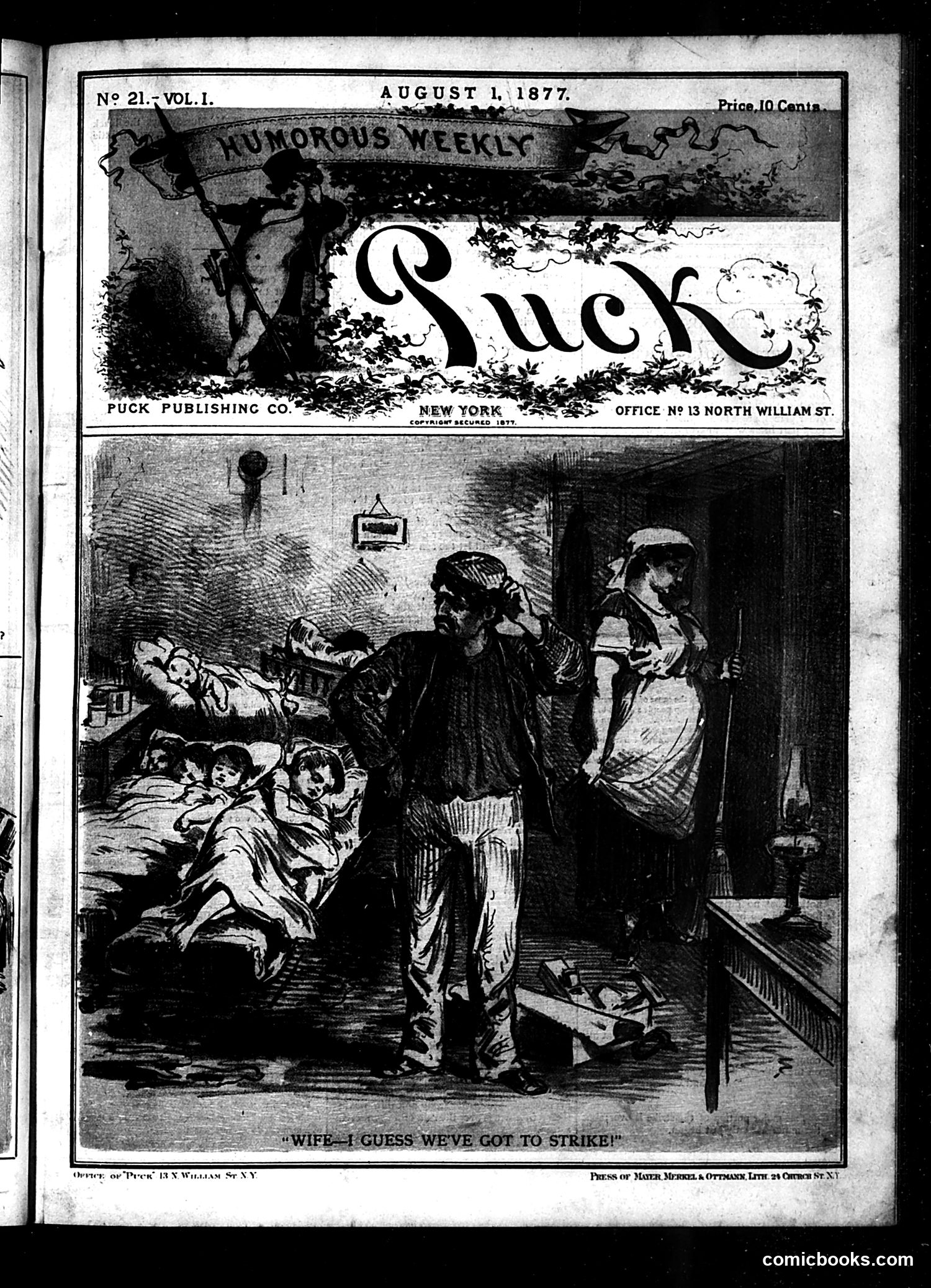
The main cartoon, captioned "Wife—I Guess We've Got to Strike!", depicts a domestic interior scene. A man in work clothes stands centrally while a woman gestures emphatically from a doorway. Children appear on a bed in the background, and the room looks sparse and modest. This satirizes labor strikes of the 1870s, particularly the recent railroad strikes of 1877. The cartoon jokes that if workers must strike for better conditions, their wives and families will also "strike"—refuse to work or manage the household—because they suffer the economic consequences of lost wages. It's political commentary on how labor disputes impact families and domestic life, using the double meaning of "strike" (labor action versus domestic refusal) for satirical effect.
This Puck cartoon satirizes the destructive labor violence during what appears to be a significant railroad strike. The editorial framing suggests the violence—including "murder" and "looting mobs"—represents anarchist influence threatening the nation's economic stability. The cartoon likely depicts the chaos of a major labor dispute, possibly the Pullman Strike (1894) or similar period unrest. Puck positions striking workers and radical agitators as threats to social order, blaming them for deaths and property destruction rather than examining labor conditions or management practices. The "railroad to ruin" metaphor suggests unchecked labor radicalism will destroy American prosperity. This reflects Puck's generally pro-business, anti-radical stance during turbulent industrial-era labor conflicts, when strikes often turned violent and sparked genuine public fear about anarchism and social collapse.
This page is primarily **advice column content**, not political cartoons. The main feature, "That Mule Problem," presents readers' solutions to an arithmetic puzzle from the previous week about purchasing a mule. The only substantive non-advice content is "My Adventures in the Strike Region," a first-person narrative about traveling to Chicago during labor unrest. The author describes visiting the Palmer House and encountering striking workers, noting sympathies with labor while remaining somewhat detached. The page reflects **1877 labor tensions**—likely referencing the Great Railroad Strike—through this personal account rather than editorial cartoon. The dominant content is humorous reader correspondence about mathematics, typical of Puck's mix of satire and audience participation.
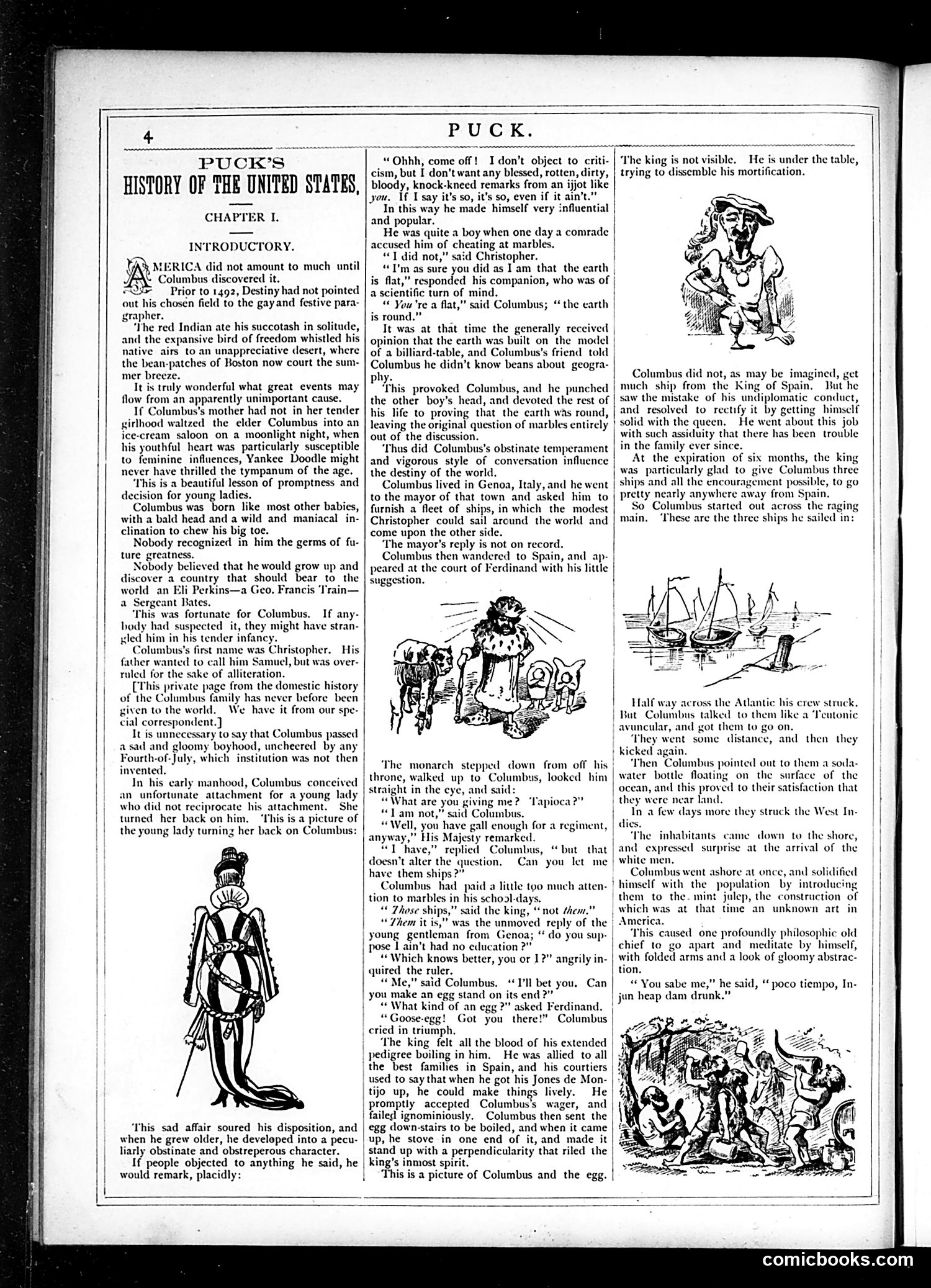
This page presents a **satirical history of Columbus** through Puck magazine's humorous lens. The text mocks Columbus's temperament and diplomatic failures, depicting him as quarrelsome and prone to conflict—notably with the Spanish king over resources and recognition. The cartoons illustrate absurdist anecdotes: Columbus arguing with a boy about marbles and geography, bickering over eggs with King Ferdinand, and conflicts with crew members during his voyage. **The satire's point**: Rather than presenting Columbus as a heroic explorer, Puck portrays him as a cantankerous, difficult personality whose success came *despite* his obstinate nature. This irreverent treatment exemplifies Puck's tendency to deflate historical figures' dignity through comedic reframing.
This page from Puck contains two distinct articles: "How She Did It" (left column) and what appears to be a continued narrative or article (right column). "How She Did It" is a satirical story about a woman traveling through the Alleghanies who impresses a young man with her musical knowledge and refined taste. The satire mocks pretentious artistic appreciation—she strategically name-drops composers (Wagner, Tannhäuser, Lohengrin) and demonstrates ostentatious cultural authority to manipulate the man's admiration, despite admitting she doesn't actually know these subjects well. The humor targets both affected intellectualism and gullible male vanity in late 19th-century society. The right column continues an unrelated narrative involving prophecy and civilization's advance, mentioning specific geographical references like Ceylon and Brazil regarding gemstones.
This page contains three satirical pieces rather than a single cartoon: **"The Honey-Bee"** is a poem by James Vawkow celebrating the industrious bee as a symbol of honest labor and worthy example. **"Jones Junction"** satirizes American political and social conditions, criticizing excessive taxation and its destructive effects on production and commerce. The author argues that punitive tax policies harm economic productivity rather than serve the public interest. **"Fitznoodle in America XIX"** appears to be an ongoing serial satirizing a foreign visitor's observations of American life, discussing travel challenges and the peculiarities of American accommodations and customs. The page mixes verse, political commentary, and travel satire—typical of Puck's format combining humor with social criticism.
This page contains a short story titled "The American Casablanca" (credited to the N.Y. Sun) depicting drama aboard a revenue cutter named the Grant. The narrative focuses on Webb C. Hayes, a young officer, who must navigate conflict between the ship's captain and crew while managing navigational challenges near dangerous coastal lights. The text emphasizes Hayes's competence and emotional restraint under pressure—virtues Puck celebrates. The story appears designed to humorously illustrate administrative bureaucracy and inter-departmental tension aboard government vessels, using the maritime setting as satire for broader governmental inefficiency and competing interests. The bottom section includes "Puck's Personal Intelligence," brief gossip items about public figures including California millionaire John H. Lace.
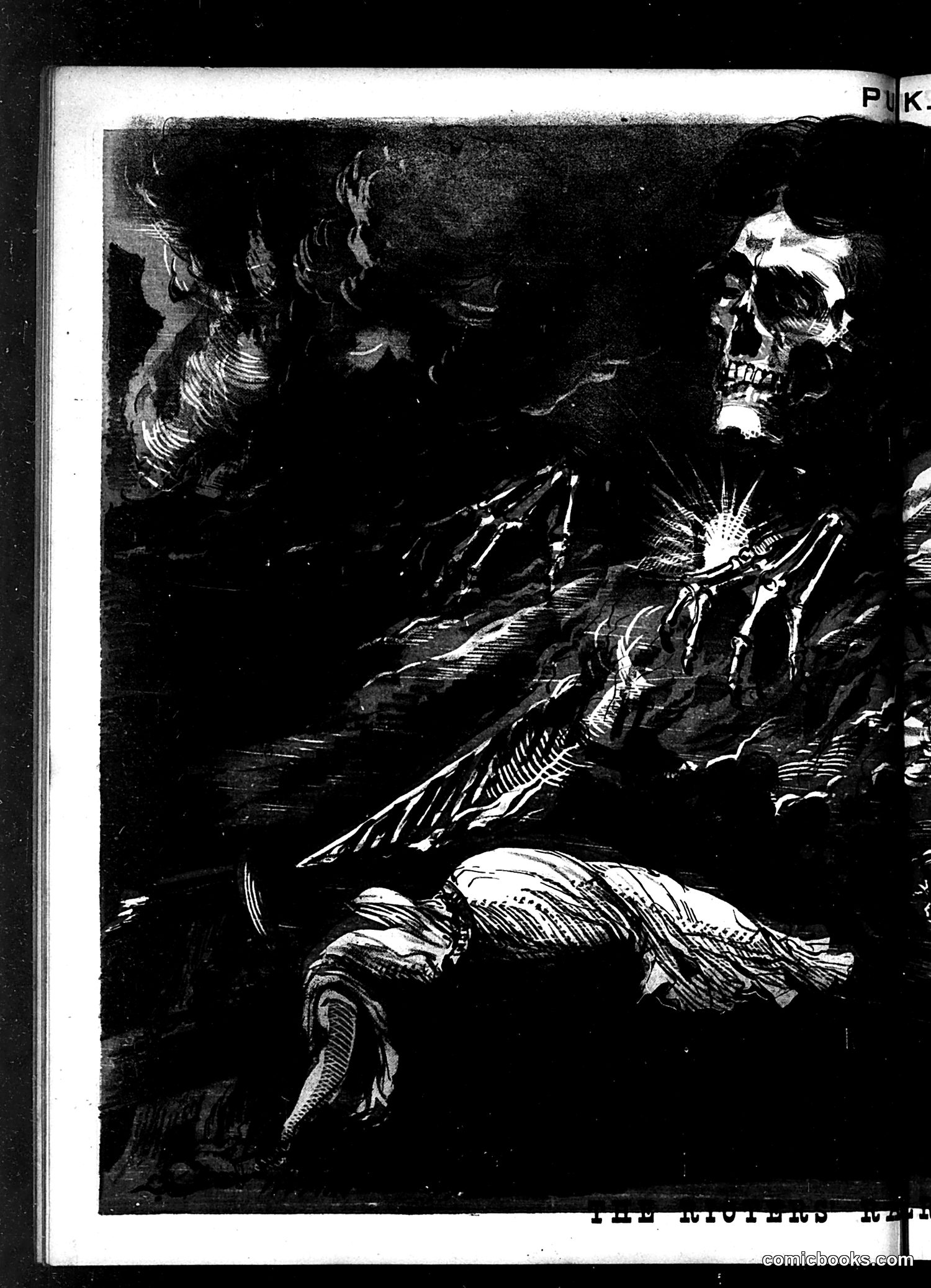
This appears to be a memento mori (death reminder) illustration, likely from the late 19th or early 20th century. The image shows a skeletal figure in military dress on the right, with what appears to be fallen soldiers or bodies below, and shadowy figures (possibly military or political leaders) observing from the left. The skeleton wearing military regalia represents death personified as war itself. The composition critiques militarism and warfare's human cost—showing death as the true commander presiding over conflict. Without clear text identifying specific figures or dating information visible in this OCR'd excerpt, I cannot definitively name which conflict or political figures are referenced. However, the style and subject matter suggest anti-war satire typical of Puck's social commentary. The dramatic chiaroscuro emphasizes the darkness of military violence.
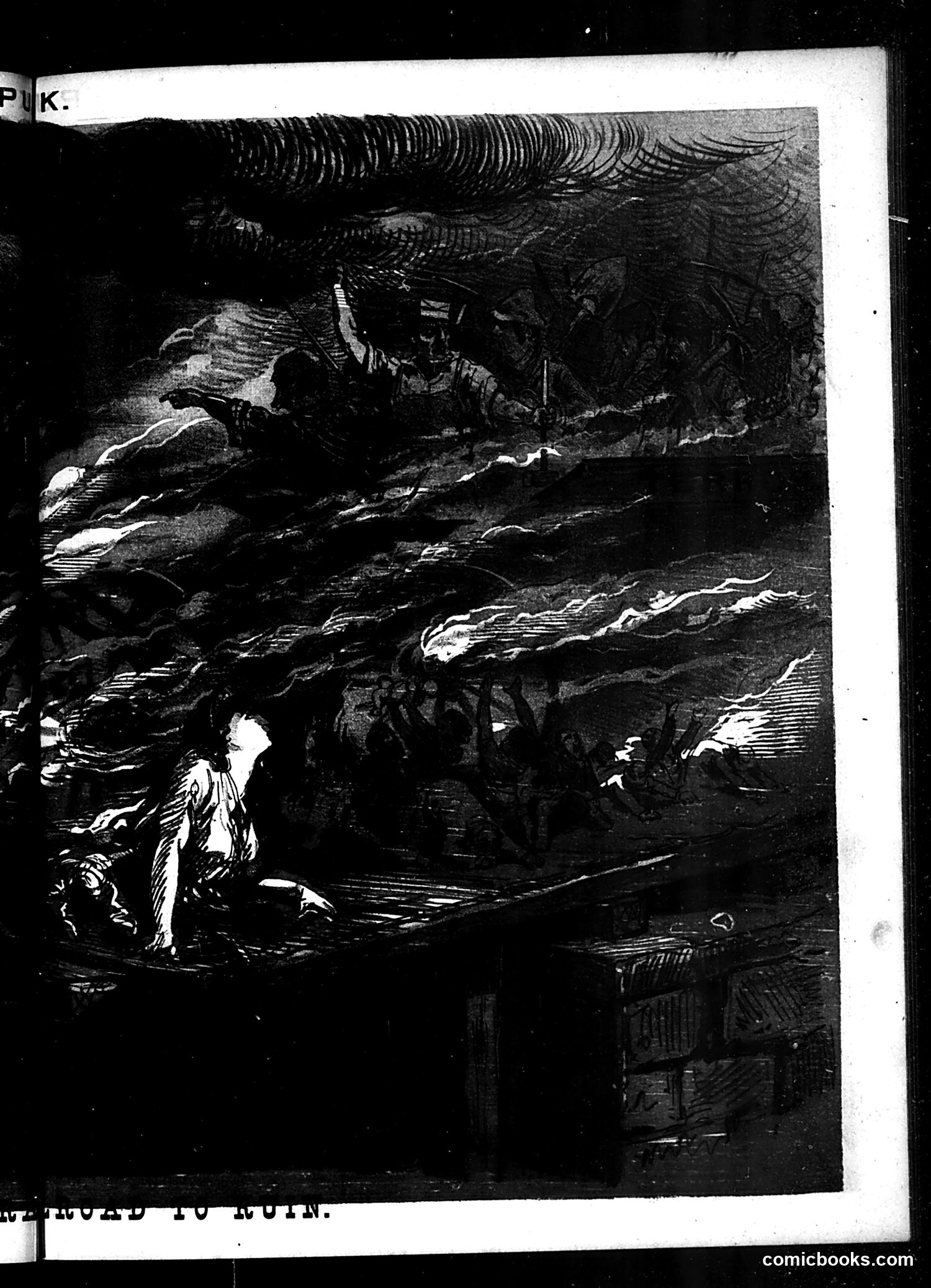
I can see this is a dramatic black and white engraving from Puck magazine, but the OCR text appears blank or illegible, making it difficult to identify the specific figures or political references with certainty. The image depicts what appears to be a classical or mythological scene with multiple human figures in various poses—some reclining, others in dynamic positions. The style suggests allegory or satire, typical of Puck's approach. The dramatic lighting and composition evoke classical art traditions often used in political commentary. Without legible text identifying the figures or context, I cannot confidently explain which political figures, events, or social commentary this cartoon references. To accurately interpret this page's satirical meaning for modern readers, I would need clearer text or additional identifying information visible in the source material.
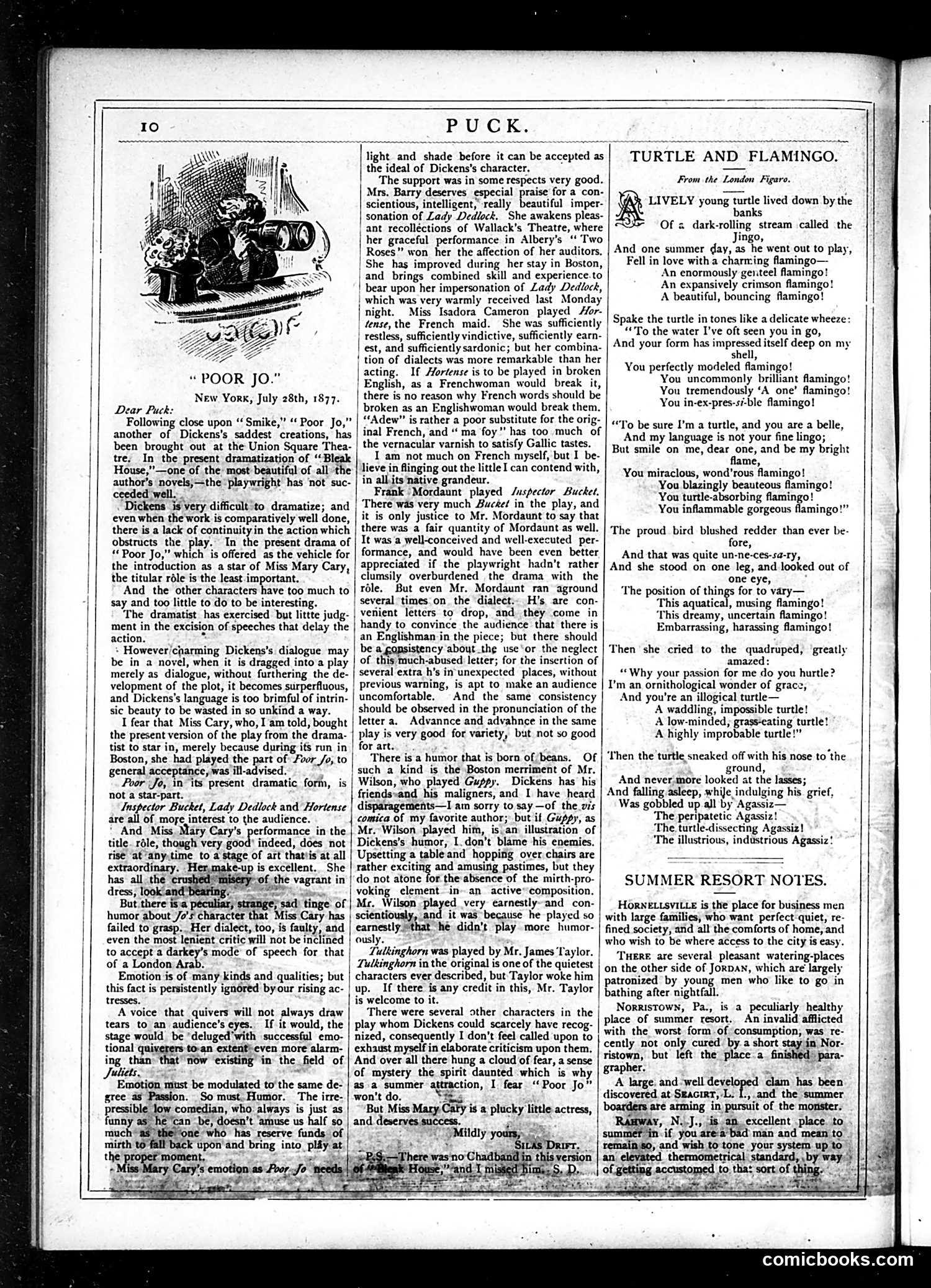
The cartoon labeled "Poor Jo" depicts a disheveled character, likely referencing Charles Dickens' character Jo from *Bleak House*—a homeless boy repeatedly told to "move on" by authorities. The accompanying article critiques the theatrical dramatization of Dickens' work, particularly *Bleak House*, noting that while the play captures certain elements, it struggles with adapting Dickens' complex social commentary into stage format. The satirical point appears to be commentary on how theatrical adaptations oversimplify or sentimentalize Dickens' critiques of social injustice and class inequality. "Poor Jo" becomes a symbol of tragic inevitability—a victim of society who cannot escape his circumstances—making this both a literary criticism and social commentary on Victorian poverty and institutional indifference.
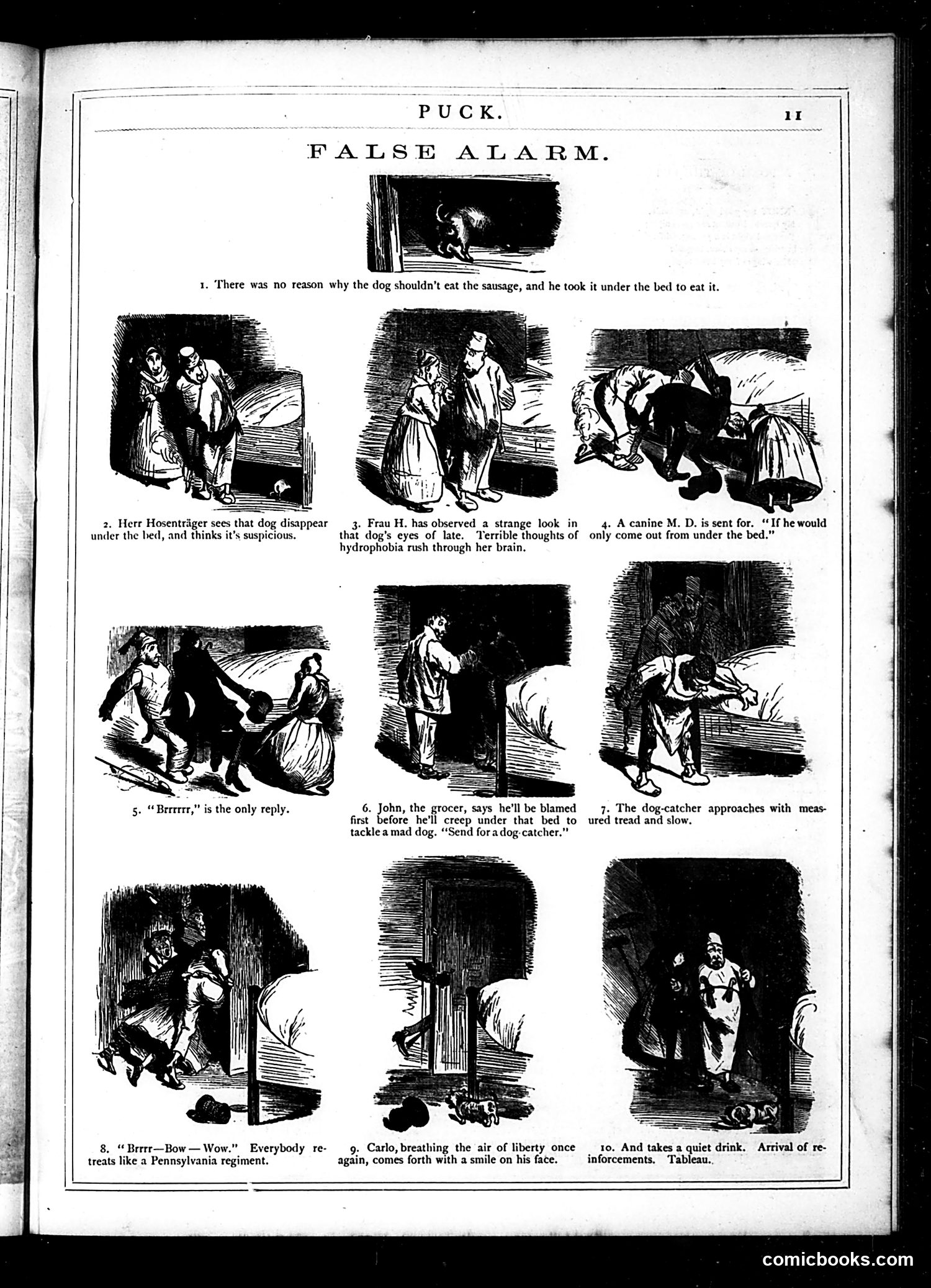
This is a sequential comic strip satirizing German immigrant anxieties in America. The narrative follows a household's paranoid discovery of a dog under the bed: 1. A dog hides under a bed to eat sausage 2. Herr Hosenträger grows suspicious 3. Frau H. imagines hydrophobia 4. They summon a dog catcher 5-10. The household panics with increasingly absurd reactions ("Herrr" screams, a "Pennsylvania regiment" mobilizes), until the dog catcher arrives and simply retrieves the dog for a quiet drink The satire mocks German-American immigrants' overreaction to minor incidents and their tendency toward dramatic, militaristic responses. The "Pennsylvania regiment" reference suggests exaggerated civic mobilization. The humor derives from the mundane reality versus the hysteria it generates.
This page contains primarily **literary content**, not political cartoons. It includes: 1. **"Good Night: A Poem of the Future"** — a sentimental poem about saying goodnight to a bride, with four stanzas 2. **"Two Knaves and a Queen: An English Story"** — Chapter XVIII of a serialized fiction piece 3. **"A Tramp's View of Idleness"** — a dialogue piece satirizing wealthy idleness, where a tramp confronts a lazy gentleman about how the wealthy avoid work while poor men labor The tramp section offers social commentary typical of Puck's satirical approach, highlighting class disparities and hypocrisy around work and leisure. The remainder is entertainment rather than political satire. There are no visible political cartoons on this page.
This is a text-heavy page from a Puck magazine story or serial (the narrative appears to continue from previous pages). The dialogue involves characters named Hugh, Fox, Mr. Brown, and Madame de Gaillefontaine discussing property disputes, family secrets, and inheritance claims. The content appears to be a serialized fiction story rather than a political cartoon. References include acquiring a Gaillefontaine estate, complications involving a granddaughter's will, and mysterious documents. The specific historical context—which real events or society figures this might satirize—is unclear from this page alone without additional context about the publication date and preceding narrative. The text suggests social satire typical of Puck regarding aristocracy, property disputes, and hidden family matters, but without more context, specific targets cannot be confidently identified.
This page contains primarily text articles and satirical commentary rather than a major political cartoon. The visible illustration at bottom ("Puck's Archanizes") shows a small figure amid classical ruins or debris. The text includes several short satirical pieces mocking contemporary issues: a section on "Vague Feminine Chronology" jokes about women's uncertainty regarding their own ages, while other brief items satirize topics like Italian brigands wearing fashionable collars, old maids' claims to youth, and naming conventions ("sweetesplesugaroffia"). The main body text appears to be a humorous legal anecdote about breach of promise and marriage disputes. Overall, this page demonstrates Puck's characteristic approach: biting social commentary on gender, class, and contemporary manners through short witty observations rather than elaborate political cartooning.
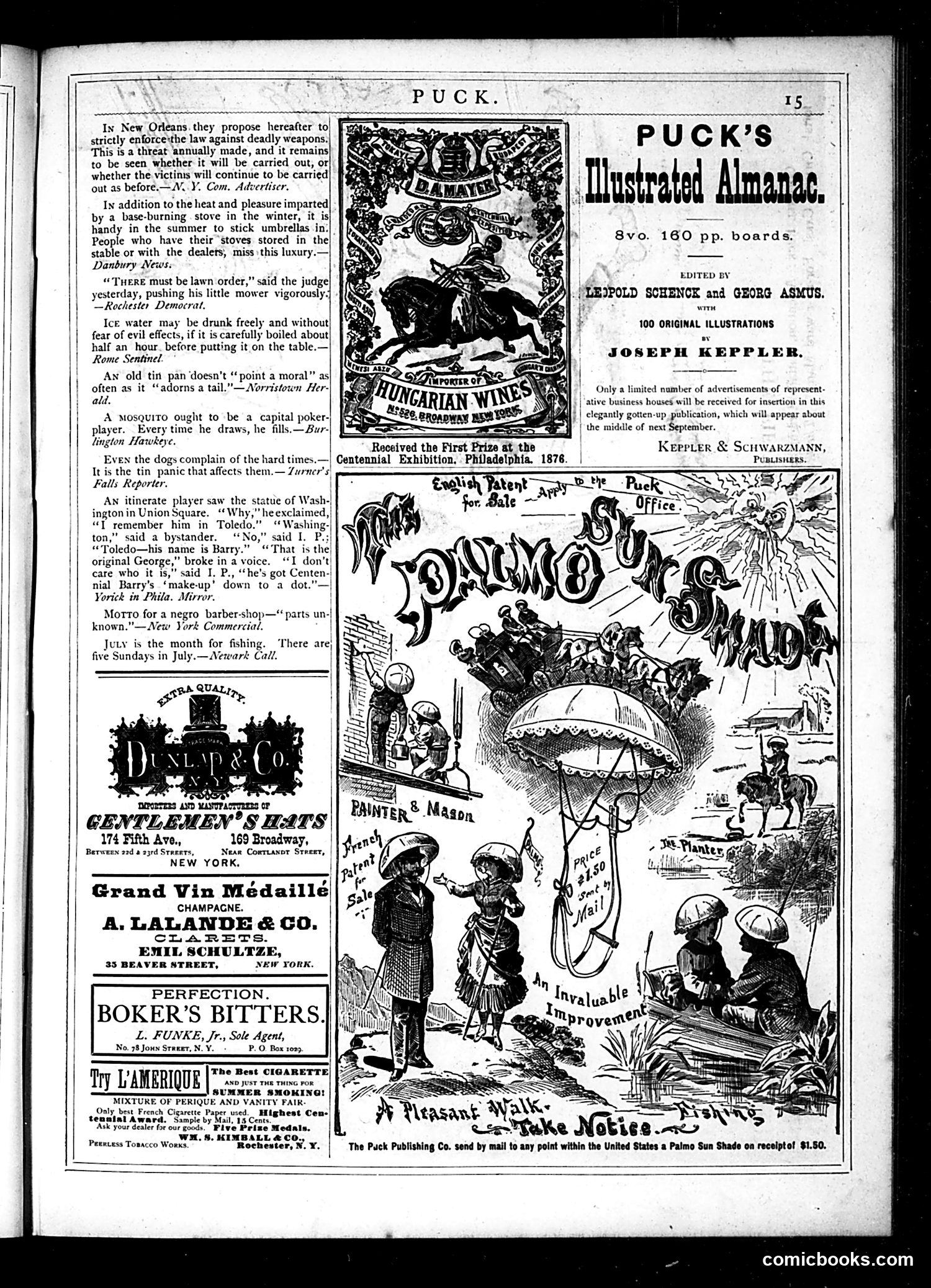
This page is primarily **advertising and promotional content** rather than political satire. The main illustration, titled "Donimo's Shade," depicts a humorous scene of people using parasols and umbrellas outdoors—likely advertising or satirizing a commercial product or service related to sun protection. The left column contains brief humorous anecdotes and snippets (jokes about New Orleans heat, dogs complaining, a barber-shop motto). The advertisements include gentlemen's hats, champagne, and Boker's Bitters—typical 19th-century commercial products. The central image showing people with umbrellas appears to be the page's main cartoon, though its specific satirical target or commercial purpose is **unclear from the text alone**. The illustration style is characteristic of Puck's satirical aesthetic, but this particular page emphasizes commerce over political commentary.
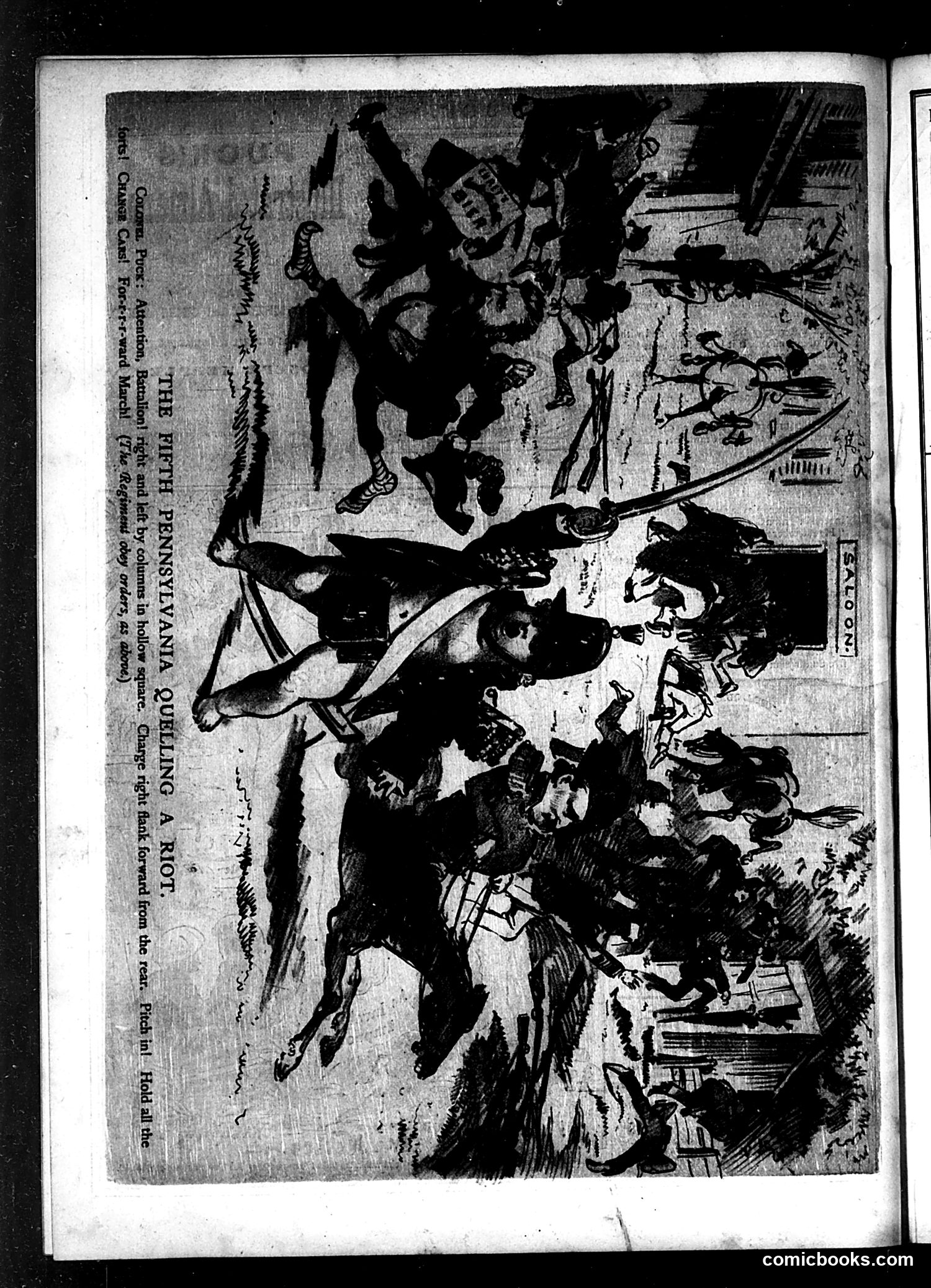
This appears to be a satirical cartoon from Puck magazine depicting a chaotic scene of political figures in conflict. The image shows what looks like a violent confrontation or struggle between multiple characters rendered in dark silhouettes and dramatic poses. The text references "THE BIRTH PENNSYLVANIAN GUILLOTINE: A RIOT" and mentions "Colonel" and "Harrisburg," suggesting this relates to Pennsylvania state politics and possibly violent conflict in that state's capital. However, without clearer visibility of individual figure details or a readable publication date, I cannot confidently identify the specific politicians involved or the exact historical event being satirized. The composition suggests commentary on political violence or disorder in Pennsylvania governance during the Gilded Age or Progressive Era, but the specific incident remains unclear from this reproduction.