
Puck, 1877-08-01 · page 12 of 16
Puck — August 1, 1877 — page 12: what you’re looking at
What you’re looking at
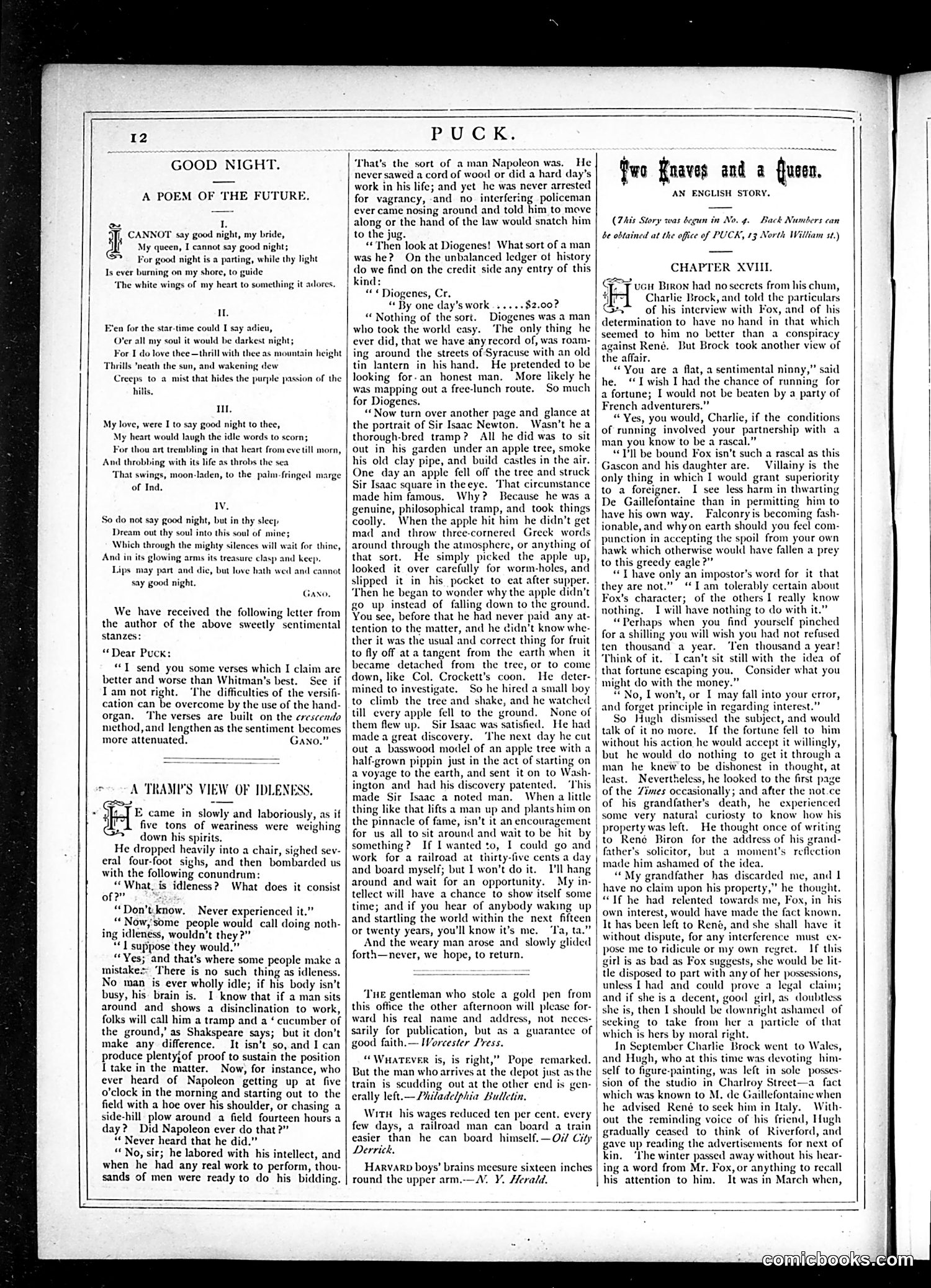
This page contains primarily **literary content**, not political cartoons. It includes: 1. **"Good Night: A Poem of the Future"** — a sentimental poem about saying goodnight to a bride, with four stanzas 2. **"Two Knaves and a Queen: An English Story"** — Chapter XVIII of a serialized fiction piece 3. **"A Tramp's View of Idleness"** — a dialogue piece satirizing wealthy idleness, where a tramp confronts a lazy gentleman about how the wealthy avoid work while poor men labor The tramp section offers social commentary typical of Puck's satirical approach, highlighting class disparities and hypocrisy around work and leisure. The remainder is entertainment rather than political satire. There are no visible political cartoons on this page.
📄 Transcribed text from this page (OCR, searchable)
Machine-transcribed from the original scan — historical spelling and the odd misread are preserved.
GOOD NIGH’ A POEM OF THE FUTURE. tf NOT say good night, my bride My queen, I cannot say good night; For good night is a parting, while thy light Is ever burning on my shore, to guide ‘The white wings of my heart to something it adores. E'en for the star-time could I say adieu, Over all my soul it would be darkest night; For I do love thee—thrill with thee as mountain height Thrills ‘neath the sun, and wakening d Creeps to a mist that hides the purple passion of the hilis. Ml. My love, were I to say good night to thee, My heart would laugh the idle words to scorn; For thou art trembling in that heart from eve till morn, And throbbing with its life as throbs the sea ‘That swings, moon-laden, to the palm-fringed marge of Ind. IV. So do not say good night, but in thy sleep, Dream out thy soul into this soul of mine; ich through the mighty silences will wait for thine, And in its glowing arms its treasure clasp and k Lips may part and die, but love hath wed and cannot say good night. Gano, We have received the following letter from the author of the above sweetly sentimental stanzes: “Dear Puck: “1 send you some verses which I claim are better and worse than Whitman's best. See if Tam not right. he difficulties of the versifi- cation can be overcome by the use of the hand- organ. ‘The verses are built on the crescendo method, and lengthen as the sentiment becomes more attenuated. Gano.” A TRAMI’S V) : LE came in slowly and laboriously, as if five tons of weariness were weighing down his spirits. He dropped heavily into a chair, sighed sev- eral four-foot sighs, and then bombarded us with the following conundrum: Pies idleness? What does it consist ol Z “Don’t know. Never experienced it.” __ “ Now,'some people would call doing noth- ing idleness, wouldn’t they ?” “1 suppose they would.” “Yes; and that’s where some people mal mistakes: There is no such thing as idleness. No man is ever wholly idle; if his body isn’t busy, his brain is. I know that if a man sits around and shows a disinclination to work, folks will call him a tramp and a ‘ cucumber of the ground,’ as Shakspeare says; but it don’t make any difference. It isn’t so, and I can produce plentyjof proof to sustain the position I take in the matter. Now, for instance, who ever heard of Napoleon getting up at five o'clock in the morning and starting out to the field with a hoe over his shoulder, or chasing a side-hill_ plow around a field fourteen hours a day? Did Napoleon ever do that?” “Never heard that he did.” “No, sir; he labored with his intellect, and when he had any real work to perform, thou- sands of men were ready to do his bidding. PUCK. | rat's the sort of aman Napoleon was. He never sawed a cord of wood or did a hard day’ work in his life; and yet he was never arrested for vagrancy, and no interfering policeman ever came nosing around and told him to move along or the hand of the law would snatch him to the jug. “Then look at Diogenes! What sort of a man was he? On the unbalanced ledger of history do we find on the credit side any entry of this | kind: “Diogenes, Cr. “ By one day's work......$2.00? “ Nothing of the sort. Diogenes was a man who took the world casy. ‘The only thing he | ever did, that we have any record of, was roam: | ing around the streets of Syracuse with an old | tin lantern in his hand. He pretended to be looking for-an honest man. More likely he was mapping out a free-lunch route. So much for Diogenes. «Now turn over another page and glance at the portrait of Sir Isaac Newton. Wasn’t he a thorough-bred tramp? All he did was to sit out in his garden under an apple tree, smoke his old clay pipe, and build castles in the air. One day an apple fell off the tree and struck Sir Isaac square in the eye. at circumstance made him famous. Why? Because he was a genuine, philosophical tramp, and took things coolly. When the apple hit him he didn’t get mad and throw three-cornered Greek words | around through the atmosphere, or anything of that sort. He simply picked the apple up, | looked it over carefully for worm-holes, and slipped it in his pocket to eat after supper. | ‘Then he began to wonder why the apple didn’t go up instead of falling down to the ground. You see, before that he had never paid any at- tention to the matter, and he didn’t know whe- ther it was the usual and correct thing for fruit to fly off ata tangent from the earth when it became detached from the tree, or to come } down, like Col. Crockett’s coon, He deter- | mined to investigate. So he hired a small boy | to climb the tree and shake, and he watched till every apple fell to the ground. None of them flew up. Sir Isaac was satisfied. He had made a great discovery. ‘he next day he cut out a basswood model of an apple tree with a half-grown pippin just in the act of starting on a voyage to the earth, and sent it on to Wash- ington and_had his discovery patented. ‘This | made Sir Isaac a noted man. When a little thing like that lifts a man up and plants him on the pinnacle of fame, isn’t it an encouragement for us all to sit around and wait to be hit by something? If I wanted t0, I could go and | work for a railroad at thirty-five cents a day and board myself; but I won’t do it. I'll hang around and wait for an opportunity. My in- tellect will have a chance to show itself some time; and if you hear of anybody waking up and startling the world within the next fifteen or twenty years, you'll know it’s me. ‘Ta, ta.” And the weary man arose and slowly glided forth—never, we hope, to return. ‘Tue gentleman who stole a gold pen from this office the other afternoon will please for- ward his real name and address, not neces- sarily for publication, but as a guarantee of good faith.— Worcester Press. “Wuatever is, is right,” Pope remarked But the man who arrives at the depot just as the train is scudding out at the other end is gen- erally left.— Philadelphia Bulletin. Wit his wages reduced ten per cent. every few days, a railroad man can board a train easier than he can board himself.—Oi/ City Derrick. Harvarp boys’ brains meesure sixteen inches | property was left. | to René Biron for the address of his grand- | which w round the upper arm.-—. Y. Herald. fwo Knaves and a ffueen, AN ENGLISH STORY. (This Story be obtained at the office of PUCK, 13 North William st.) vas begun in No. ¢. Back Numbers can CHAPTER XVIII. nd told the particulars interview with Fox, and of his determination to have no hand in that which seemed to him no better than a conspiracy gainst René. But Brock took another view of the affair. “You are a flat, a sentimental ninny,” said he. “I wish I had the chance of running for a fortune; I would not be beaten by a party of French adventurers.” “Yes, you would, Charlie, if the conditions of running involved your partnership with a man you know to be a rascal.” “Tl be bound Fox isn’t such a rascal as this Gascon and his daughter are. Villainy is the only thing in which I would grant superiority to a foreigner. I see less harm in thwarting De Gaillefontaine than in permitting him to have his own way. Falconry is becoming fash- ionable, and why on earth should you feel com- punction in accepting the spoil from your own hawk which otherwise would have fallen a prey to this greedy eagle?” “T have only an impostor’s word for it that they are not.” “Tam tolerably certain about Fox’s character; of the others I really know nothing. I will have nothing to do with it.” “Perhaps when you find yourself pinched for a shilling you will wish you had not refused ten thousand a year. ‘Ten thousand a year! ‘Think of it. I can't sit still with the idea of that fortune escaping you. Consider what you ight do with the money.” "No, I won't, or I may fall into your error, | and forget principle in regarding interest.” So Hugh dismissed the subject, and would talk of itno more. If the fortune fell to him without his action he would accept it willingly, but he would do nothing to get it through a man he knew to be dishonest in thought, at least. Nevertheless, he looked to the first pa of the Zimes occasionally; and after the not of his grandfather’s death, he experienced some very natural curiosty to know how his He thought once of writing father's solicitor, but a moment's reflection made him ashamed of the idea. “My grandfather has discarded me, and I have no claim upon his property,” he thought. “Tf he had relented towards me, Fox, in his own interest, would have made the fact known. It has been left to René, and she shall have it without dispute, for any interference must cx- pose me to ridicule or my own regret. If this girl is as bad as Fox suggests, she would be lit- tle disposed to part with any of her possessions, unless [had and could prove a legal claim; and if she is a decent, good girl, as doubtless is, then I should be downright ashamed of to take from her a particle of that hers by moral right. In September Charlie Brock went to Wales, and Hugh, who at this time devoting him- self to figure-painting, was left in sole posses- sion of the studio in Charlroy Street—a fact s known to M, de Gaillefontaine when he advised René to seek him in It With- out the reminding voice of his friend, Hugh gradually ceased to think of Riverford, and gave up reading the advertisements for next of kin, ‘The winter passed away without his hear- ing a word from Mr. Fox, or anything to recall his attention to him. It was in March when,