
Puck, 1877-08-01 · page 5 of 16
Puck — August 1, 1877 — page 5: what you’re looking at
What you’re looking at
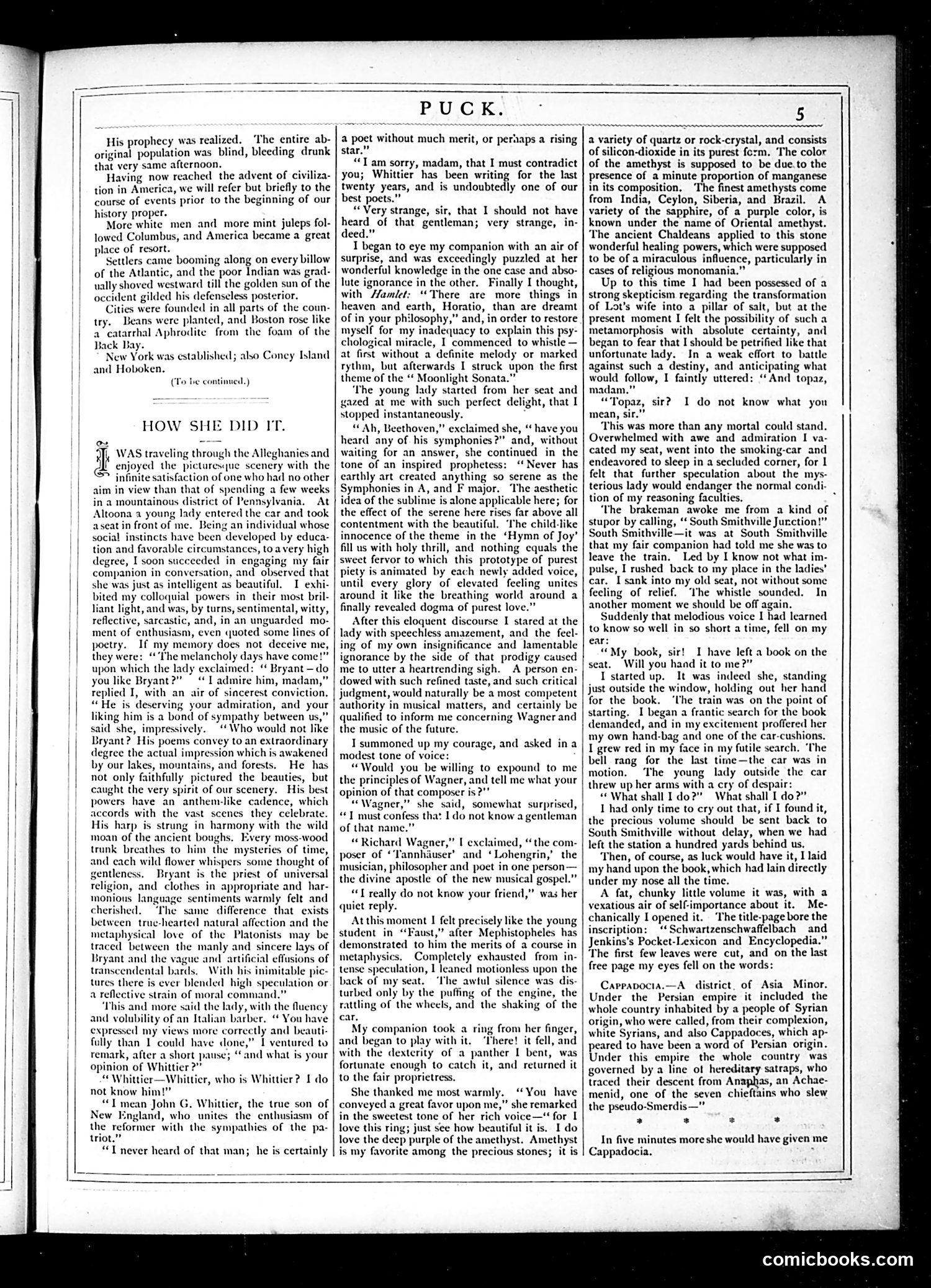
This page from Puck contains two distinct articles: "How She Did It" (left column) and what appears to be a continued narrative or article (right column). "How She Did It" is a satirical story about a woman traveling through the Alleghanies who impresses a young man with her musical knowledge and refined taste. The satire mocks pretentious artistic appreciation—she strategically name-drops composers (Wagner, Tannhäuser, Lohengrin) and demonstrates ostentatious cultural authority to manipulate the man's admiration, despite admitting she doesn't actually know these subjects well. The humor targets both affected intellectualism and gullible male vanity in late 19th-century society. The right column continues an unrelated narrative involving prophecy and civilization's advance, mentioning specific geographical references like Ceylon and Brazil regarding gemstones.
📄 Transcribed text from this page (OCR, searchable)
Machine-transcribed from the original scan — historical spelling and the odd misread are preserved.
His prophecy was realized. ‘The entire ab- original population was blind, bleeding drunk that very same afternoon. _ Having now reached the advent of civiliza- tion in America, we will refer but briefly to the course of events prior to the beginning of our history proper. . More white men and more mint juleps fol- lowed Columbus, and America became a great place of resort. . 7 Settlers came booming along on every billow of the Atlantic, and the poor Indian was grad- ually shoved westward till the golden sun of the ident gilded his defenseless posterior. Cities were founded in all parts of the coun- try. Beans were planted, and Boston rose like a eatarrhal Aphrodite from the foam of the Back Bay. New York was established; also Concy Island and Hoboken. (To be continued.) HOW SHE DID IT. es — Bh WAS traveling through the Alleghanies and enjoyed the picturesque scenery with the S> infinite satisfaction of one who had no other aim in view than that of spending a few weeks in a mountainous district of Pennsylvani: At Altoona a young lady entered the car and took aseat in front of me. Being an individual whose social instincts have been developed by educa- tion and favorable circumstances, to avery high degree, I soon sticceeded in engaging my fair companion in conversation, and observed that she was just as intelligent as beautiful. I exhi bited my colloquial powers in their most bril- liant light, and was, by turns, sentimental, witty, reflective, sarcastic, and, in an unguarded mo- ment of enthusiasm, even quoted some lines of poetry. If my memory does not deceive me, they were: ‘The melancholy days have come!” upon which the lady exclaimed: ‘ Bryant —do you like Bryant?” “I admire him, madam,” replied I, with an air of sincerest conviction, “He is deserving your admiration, and your liking him is a bond of sympathy between us,” said she, impressively. Bryant? His poems convey to an extraordinary degree the actual impression which is awakened by our lakes, mountains, and forests. He has not only faithfully pictured the beauties, but caught the very spirit of our scenery. His best powers have an anthem-like cadence, which accords with the vast scenes they celebrate. His harp is strung in harmony with the wild moan of the ancient boughs. F noss-wood trunk breathes to him the mysteries of time, and each wild flower whispers some thought of gentleness. Bryant is the priest of universal religion, and clothes in appropriate and har- monious language sentiments warmly felt and cherished, “The same difference that exists between true-hearted natural affection and the metaphysi love of the Platonists may be traced between the manly and sincere lays of Bryant and the vague and artificial effusions of transcendental bards. With his inimitable pic- tures there is ever blended high speculation or a reflective strain of moral command,” ‘This and more said the lady, with the Nuency and volubility of an Italian barber, “ You hav expressed my views more correctly and beauti- fully than 1 could have done,” 1 ventured to rk, after a short pause; “and what is your opinion of Whittier ?” “ Whittier—Whittier, who is Whittier? I do not know him!”" “T mean John G. Whittier, the true son of New England, who unites the enthusiasm of the reformer with the sympathies of the pa- triot. “T never heard of that man; he is certainly “Who would not like | a poet without much merit, or pernaps a rising star.” “Tam sorry, madam, that I must contradict you; Whittier has been writing for the last twenty years, and is undoubtedly one of our best poets.” “Very strange, sir, that I should not have heard of that gentleman; very strange, in- deed.” I began to eye my companion with an air of surprise, and was exceedingly puzzled at her wonderful knowledge in the one case and abso- lute ignorance in the other. Finally I thought, with Hamlet: “There are more things in heaven and earth, Horatio, than are dreamt of in your philosophy,” and, in order to restore myself for my inadequacy to explain this psy- chol miracle, I commenced to whistle — ithout a definite melody or marked rythm, but afterwards I struck upon the first theme of the “ Moonlight Sonata.” ‘The young lady started from her seat and gazed at me with such perfect delight, that I stopped instantaneously. “Ah, Beethoven,” exclaimed she, “ hav: heard any of his symphonies?” and, wi waiting for an answer, she continued in the tone of an inspired prophetess: ‘ Never has earthly art created anything so serene as the Symphonies in A, and F major. ‘The aesthetic idea of the sublime is alone applicable here; for the effect of the serene here rises far above all contentment with the beautiful. ‘I'he child-like innocence of the theme in the ‘Hymn of Joy’ fill us with holy thrill, and nothing equals the t fervor to which this prototype of purest piety is animated by each newly added voice, until every glory of elevated feeling unites around it like the breathing world around a finally revealed dogma of purest love.” After this eloquent discourse I stared at the lady with speechless amazement, and the feel- ing of my own insignificance and lamentable ignorance by the side of that prodigy caused me to utter a heartrending sigh. A person en- dowed with such refined taste, and such critical judgment, would naturally be a most competent authority in musical matters, and certainly be qualified to inform me concerning Wagner and the music of the future. I summoned up my courage, and asked ina modest tone of voi “Would you be willing to expound to me the principles of Wagner, and tell me what your opinion of that composer is ?"” “Wagner,” she said, somewhat surprised, “T must confess tha: I do not know a gentleman of that name.” “Richard Wagner,” [ exclaimed, “the com- poser of ‘‘Tannhiuser’ and ‘Lohengrin,’ the musician, philosopher and poet in one person— the divine apostle of the new musical gospel.” “T really do not know your friend,” was her quiet reply. Atthis moment I felt precisely like the young student in “Faust,” after Mephistopheles has demonstrated to him the merits of a course in metaphysics. Completely exhausted from in- tense speculation, I leaned motionless upon the back of my seat. ‘I'he awtul silence was dis- turbed only by the puffing of the engine, the rattling of the wheels, and the shaking of the car, My companion took a ring from her finger, and began to play with it. ‘There! it fell, and with the dexterity of a panther I bent, was fortunate enough to catch it, and returned it to the fair proprietress. he thanked me most warmly. ‘You have conveyed a great favor upon me,” she remarked in th est tone of her rich voice—‘ for I love this ring; just see how beautiful it is. I do love the deep purple of the amethyst. Amethyst is my favorite among the precious stones; it is a variety of quartz or rock-crystal, and consists of silicon-dioxide in its purest form. The color of the amethyst is supposed to be due.to the presence of a minute proportion of manganese in its composition. The finest amethysts come from India, Ceylon, Siberia, and Brazil. A variety of the sapphire, of a purple color, is known under the name of Oriental amethyst. ‘The ancient Chaldeans applied to this stone wonderful healing powers, which were supposed to be of a miraculous influence, particularly in cases of religious monomania.” Up to this time I had been possessed of a strong skepticism regarding the transformation of Lot’s wife into a pillar of salt, but at the present moment I felt the possibility of such a metamorphosis with absolute certainty, and began to fear that I should be petrified like that unfortunate lady. In a weak effort to battle against such a destiny, and anticipating what would follow, I faintly uttered: “And topaz, madam.” “Topaz, sir? mean, sir.” This was more than any mortal could stand. Overwhelmed with awe and admiration I va- cated my seat, went into the smoking-car and endeavored to sleep in a secluded corner, for 1 felt that further speculation about the mys- terious lady would endanger the normal conc tion of my reasoning faculties. ‘The brakeman awoke me from a kind of stupor by calling, “ South Smithville Junction South Smithville—it was at South Smithville that my fair companion had told me she was to leave the train. Led by I know not what im- pulse, I rushed back to my place in the ladi car. I sank into my old seat, not without some feeling of relief. ‘he whistle sounded. In another moment we should be off again. Suddenly that melodious voice I had learned to know so well in so short a time, fell on my ear: “My book, sir! I have left a book on the seat, Will you hand it to me?” I started up. It was indeed she, standing just outside the window, holding out her hand for the book. ‘the train was on the point of starting. I began a frantic search for the book demanded, and in my excitement proffered her my own hand-bag and one of the car-cushions, I grew red in my face in my futile search. ‘The bell rang for the last time—the car was in motion. ‘The young lady outside the car threw up her arms with a cry of despair: “«« What shall I do?” What shall I do?” 1 had only time to cry out that, if I found it, the precious volume should be sent back to South Smithville without delay, when we had left the station a hundred yards behind us. Then, of course, as luck would have it, I laid my hand upon the book, which had lain directly under my nose all the time. A fat, chunky little volume it was, with a vexatious air of self-importance about it. Me- chanically L opened it. ‘The title-page bore the inscription: “* Schwartzenschwaffelbach and Jenkins's Pocket-Lexicon and Encyclopedia.” The first few leaves were cut, and on the last free page my eyes fell on the words: I do not know what you Cappapocia.—A_ district, of Asia Minor. Under the Persian empire it included the whole country inhabited by a people of Syrian origin, who were called, from their complexion, white Syrians, and also Cappadoces, which ap- peared to have been a word of Persian origin. Under this empire the whole country was governed by a line of hereditary satraps, who traced their descent from Anaphas, an Achae- menid, one of the seven chieftains who slew the pseudo-Smerdis—' 2 * * * In five minutes more she would have given me Cappadocia. : comicbooks.com