
Puck, 1877-08-01 · page 3 of 16
Puck — August 1, 1877 — page 3: what you’re looking at
What you’re looking at
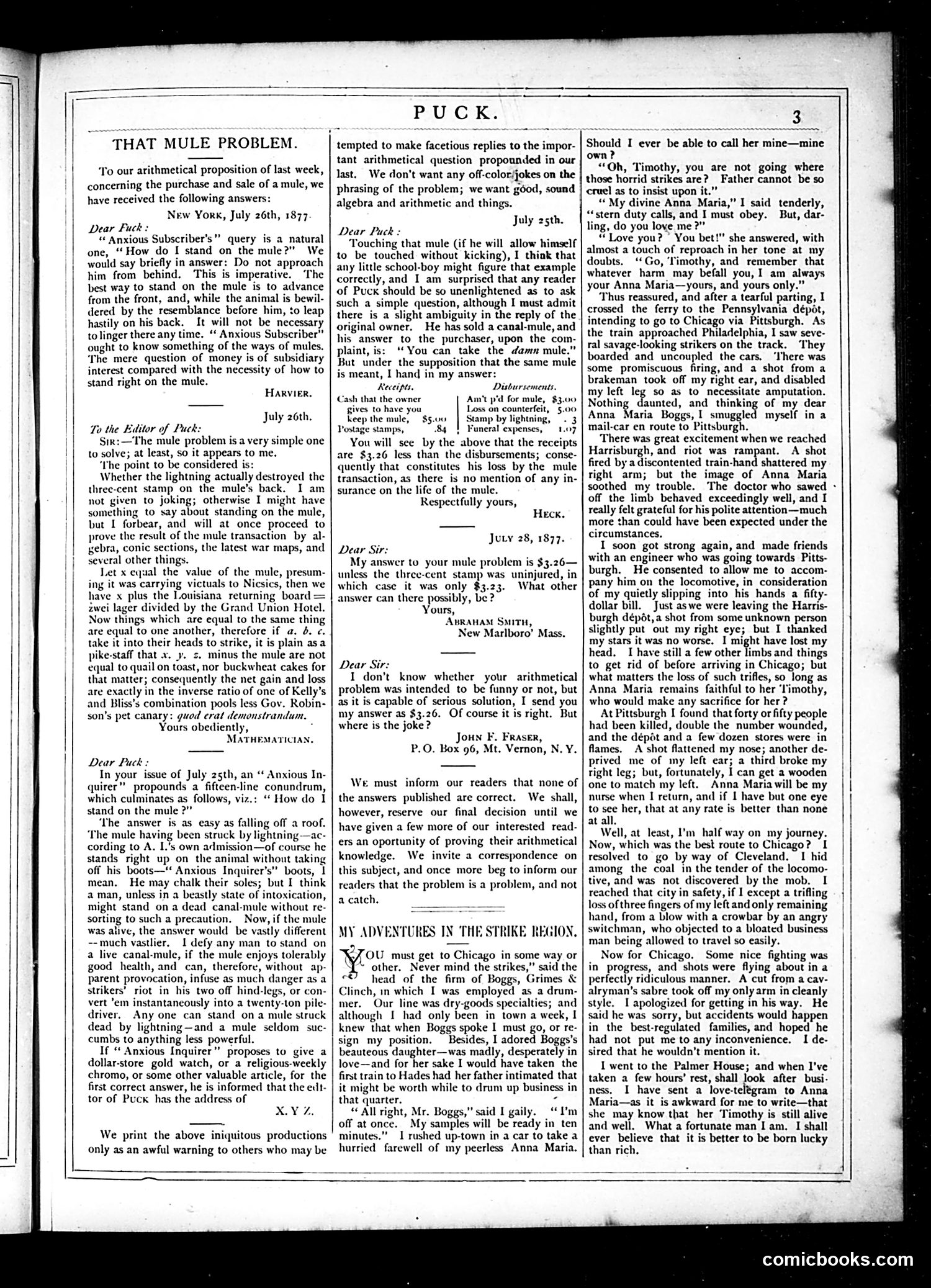
This page is primarily **advice column content**, not political cartoons. The main feature, "That Mule Problem," presents readers' solutions to an arithmetic puzzle from the previous week about purchasing a mule. The only substantive non-advice content is "My Adventures in the Strike Region," a first-person narrative about traveling to Chicago during labor unrest. The author describes visiting the Palmer House and encountering striking workers, noting sympathies with labor while remaining somewhat detached. The page reflects **1877 labor tensions**—likely referencing the Great Railroad Strike—through this personal account rather than editorial cartoon. The dominant content is humorous reader correspondence about mathematics, typical of Puck's mix of satire and audience participation.
📄 Transcribed text from this page (OCR, searchable)
Machine-transcribed from the original scan — historical spelling and the odd misread are preserved.
THAT MULE PROBLEM. ‘To our arithmetical proposition of last week, concerning the purchase and sale of a mule, we have received the following answers: New York, July 26th, 1877 Dear Fuck: « Anxious Subscriber's" query is a_natural one, “How do I stand on the mule?” We would say briefly in answer: Do not approach him from behind. This is imperative. ‘The best way to stand on the mule is to advance from the front, and, while the animal is bewil- dered by the resemblance before him, to leap hastily on his back. It will not be necessary tolinger there any time. “ Anxious Subscriber” ought to know something of the ways of mules. ‘The mere question of money is of subsidiary interest compared with the necessity of how to stand right on the mule. Harvier. July 26th. Ta the Editor of Puck: Six:—The mule problem is a very simple one to solve; at least, so it appears to me. ‘Ihe point to be considered is: Whether the lightning actually destroyed the three-cent stamp on the mule’s back. I am to joking; otherwise I might have something to say about standing on the mule, but I forbear, and will at once proceed to prove the result of the mule transaction by al- gebra, conic sections, the latest war maps, and several other things. Let x equal the value of the mule, presum- ing it was carrying victuals to Nicsics, then we have x plus the Louisiana returning board zwei lager divided by the Grand Union Hotel Now things which are equal to the same thing are equal to one another, therefore if a. 4. ¢. take it into their heads to strike, it is plain asa pike-staff that x. y. 5. minus the mule are not equal to quail on toast, nor buckwheat cakes for that matter; consequently the net gain and loss are exactly in the inverse ratio of one of Kelly’s and Bliss’s combination pools less Gov. Robin- son's pet canary: guod erat demonstrandum. Yours obediently, : MATHEMATICIAN, Dear Puck: In your issue of July 2gth, an “ Anxious In- quirer” propounds a fiftcen-line conundrum, which culminates as follows, viz.: ‘‘ How do 1 stand on the mule ?” ‘The answer is as easy as falling off a roof. ‘The mule having been struck by lightning—ac- cording to A. 1's own admission—of course he stands right up on the animal without taking off his boots—‘ Anxious Inquirer’s” boots, 1 mean. He may chalk their soles; but I think a man, unless in a beastly state of intoxication, might stand ona dead canal-mule without re- sorting to such a precaution. Now, if the mule was alive, the answer would be vastly different --much vastlier. 1 defy any man to stand on a live canal-mule, if the mule enjoys tolerably good health, and can, therefore, without ap- parent provocation, infuse as much danger as a strikers’ riot in his two off hind-legs, or con- vert ’em instantaneously into a twenty-ton pile- driver, Any one can stand ona mule struck dead by lightning—and a mule seldom suc- cumbs to anything less powerful. If “ Anxious Inquirer” proposes to give a dollar-store gold watch, or a religious-weekly chromo, or some other valuable article, for the first correct answer, he is informed that the edt- tor of Puck has the address of X.Y Z. We print the above iniquitous productions only as an awful warning to others who may be ‘PUCK. tempted to make facetious replies to the impor- tant arithmetical question propounded in our last. We don't want any off-color/jokes on the phrasing of the problem; we want good, sound algebra and arithmetic and things. July 25th. Dear Puck : Touching that mule (if he will allow himself to be touched without kicking), I think that any little school-boy might figure that example correctly, and I am surprised that any reader of Puck should be so unenlightened as to ask such a simple question, although I must admit there is a slight ambiguity in the reply of the original owner. He has sold a canal-mule, and his answer to the purchaser, upon the com- plaint, is: ‘ You can take the damn mule.” But under the supposition that the same mule is meant, I hand in my answer: Receipts. Disbursements, Cash that the owner Am't p'd for mule, $3.00 gives to have you Loss on counterfeit, 5.00 Keep the mule, $5.00 | Stamp by lightning, ~~ 3 Postage stamps, 84 | Funeral expenses, 1.07 You will see by the above that the receipts are $3.26 less than the disbursements; conse- quently that constitutes his loss by the mule transaction, as there is no mention of any in- surance on the life of the mule. Respectfully yours, Heck. Juty 28, 1877. Dear Sir: My answer to your mule problem is $3.26— unless the three-cent stamp was uninjured, in which case it was only $3.23. What other answer can there possibly, be? Yours, AbRAHAM SMITH, New Marlboro’ Mass. Dear Sir: I don’t know whether your arithmetical problem was intended to be funny or not, but as it is capable of serious solution, I send you my answer as $3.26. Of course it is right. But where is the joke? JOHN F. Fraser, P.O. Box 96, Mt. Vernon, N.Y. We must inform our readers that none of the answers published are correct. We shall, however, reserve our final decision until we have given a few more of our interested read- ers an oportunity of proving their arithmetical knowledge. We invite a correspondence on this subject, and once more beg to inform our readers that the problem is a problem, and not a catch, MY ADVENTURES IN THE STRIKE REGION, KJ OU must get to Chicago in some way or ™ other. Never mind the strikes,” said the <* head of the firm of Boggs, Grimes & Clinch, in which I was employed as a drum- mer. Our line was dry-goods specialties; and although I had only been in town a week, I knew that when Boggs spoke I must go, or re- sign my position. — Besides, I adored Boggs's beauteous daughter—was madly, desperately in love—and for her sake I would have taken the first train to Hades had her father intimated that it might be worth while to drum up business in that quarter. < “ All right, Mr. Boggs,” said I gaily. “I'm off at once. | My samples will be ready in ten minutes.” I rushed up-town in a car to take a hurried farewell of my peerless Anna Maria. Should I ever be able to call her mine—mine own ? “Qh, Timothy, you are not going where those horrid strikes are? Father cannot be so cruel as to insist upon it.” “My divine Anna Maria,” I said tenderly, “stern duty calls, and I must obey. But, dar- ling, do you love me ?” “Love you? You bet!” she answered, with almost a touch of reproach in her tone at my doubts. ‘Go, ‘Timothy, and remember that whatever harm may befall you, I am always your Anna Maria—yours, and yours only.” Thus reassured, and after a tearful parting, I crossed the ferry to the Pennsylvania dépot, intending to go to Chicago via Pittsburgh. As the train approached Philadelphia, I saw seve- ral savage-looking strikers on the track. They boarded and uncoupled the cars. ‘here was some promiscuous firing, and a shot from a brakeman took off my right ear, and disabled my left leg so as to necessilate amputation. Nothing launted, and thinking of my dear Anna Maria Boggs, 1 smuggled myself in a mail-car en route to Pittsburgh. There was great excitement when we reached Harrisburgh, and riot was rampant. A shot fired by a discontented train-hand shattered my right arm; but the image of Anna Maria soothed my trouble. The doctor who sawed off the limb behaved exceedingly well, and I really felt grateful for his polite attention—much more than could have been expected under the circumstances. I soon got strong again, and made friends with an engineer who was going towards Pitts- burgh. He consented to allow me to accom- pany him on the locomotive, in consideration of my quietly slipping into his hands a fifty- dollar bill. Just aswe were leaving the Harris- burgh dépét,a shot from some unknown person slightly put out my right eye; but I thanked my stars it was no worse. I might have lost my head. I have still a few other limbs and things to get rid of before arriving in Chicago; but what matters the loss of such trifles, so long as Anna Maria remains faithful to her ‘limothy, who would make any sacrifice for her ? At Pittsburgh I found that forty or fifty people had been killed, double the number wounded, and the dépét and a few dozen stores were in flames. A shot flattened my nose; another de- prived me of my left ear; a third broke my right leg; but, fortunately, I can get a wooden one to match my left. Anna Maria will be my nurse when I return, and if 1 have but one eye to see her, that at any rate is better than none at all. Well, at least, I’m half way on my journey. Now, which was the best route to Chicago? I resolved to go by way of Cleveland. I hid among the coal in the tender of the locomo- tive, and was not discovered by the mob. I reached that city in safety, if 1 except a trifling loss of three fingers of my left and only remaining hand, from a blow with a crowbar by an angry switchman, who objected to a bloated business man being allowed to travel so easily. Now for Chicago. Some nice fighting was in progress, and shots were flying about in a perfectly ridiculous manner. A cut from a cav- alryman’s sabre took off my only arm in cleanly style. I apologized for getting in his way. He said he was sorry, but accidents would happen in the best-regulated families, and hoped he had not put me to any inconvenience. I de- sired that he wouldn't mention it. I went to the Palmer House; and when I've taken a few hours’ rest, shall look after busi- ness. I have sent a love-telégram to Anna Maria—as it is awkward for me to write—that she may know that her Timothy is still alive and well, What a fortunate man I am, I shall ever believe that it is better to be born lucky than rich, comicbooks.com