
Puck, 1877-08-01 · page 7 of 16
Puck — August 1, 1877 — page 7: what you’re looking at
What you’re looking at
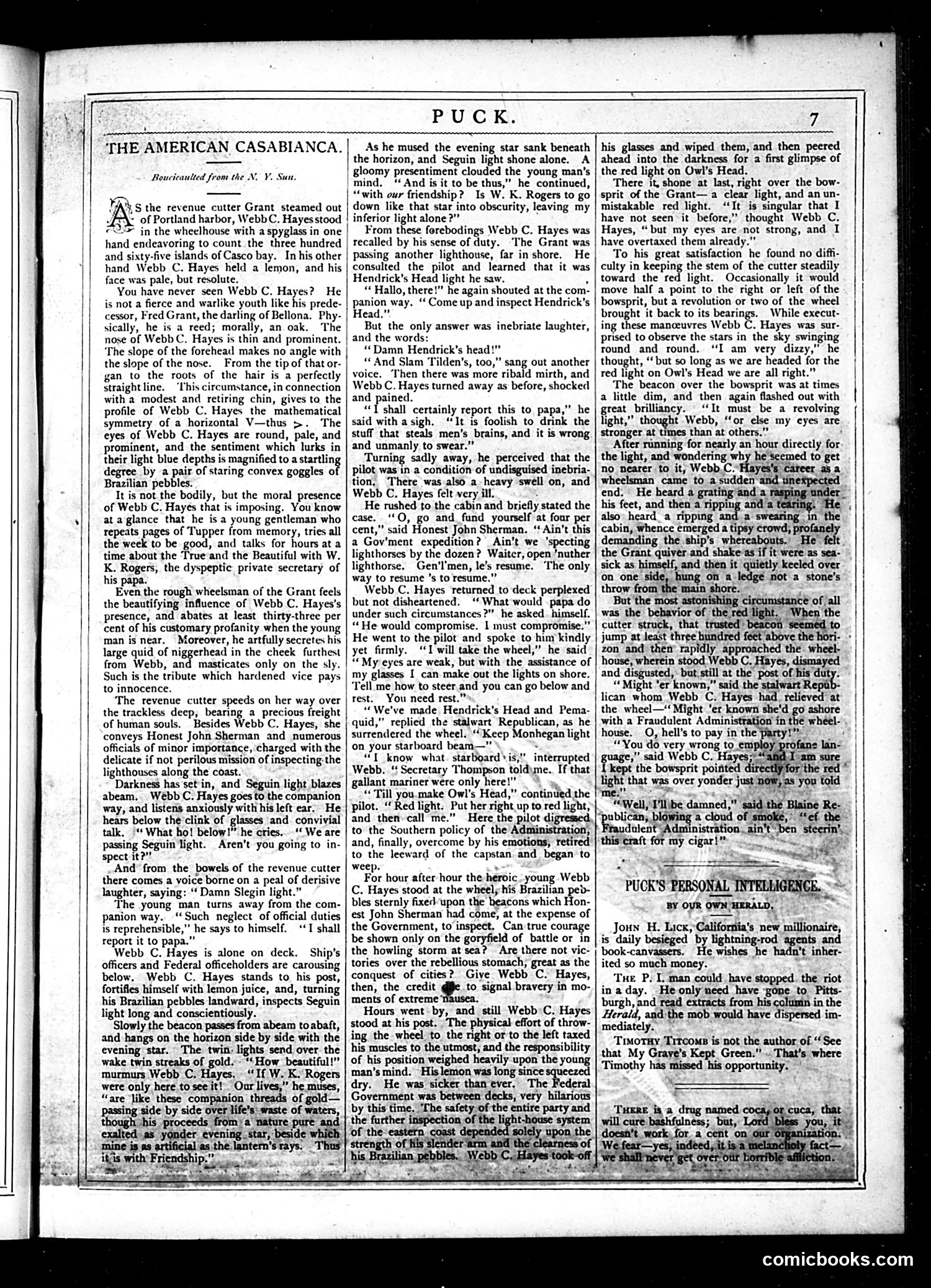
This page contains a short story titled "The American Casablanca" (credited to the N.Y. Sun) depicting drama aboard a revenue cutter named the Grant. The narrative focuses on Webb C. Hayes, a young officer, who must navigate conflict between the ship's captain and crew while managing navigational challenges near dangerous coastal lights. The text emphasizes Hayes's competence and emotional restraint under pressure—virtues Puck celebrates. The story appears designed to humorously illustrate administrative bureaucracy and inter-departmental tension aboard government vessels, using the maritime setting as satire for broader governmental inefficiency and competing interests. The bottom section includes "Puck's Personal Intelligence," brief gossip items about public figures including California millionaire John H. Lace.
📄 Transcribed text from this page (OCR, searchable)
Machine-transcribed from the original scan — historical spelling and the odd misread are preserved.
PUCK. 7 "THE AMERICAN CASABIANCA. Boucicaulted from the N.Y. Sun. AY $ the revenue cutter Grant steamed out of Portland harbor, Webb C. Hayes stood and sixty-five islands of Casco bay. In his other hand Webb C. Hayes held a lemon, and his face was pale, but resolute. You have never seen Webb C. Hayes? He is not a fierce and warlike youth like his prede- cessor, Fred Grant, the darling of Bellona. Phy- sically, he is a reed; morally, an oak. The nose of Webb C. Hayes is thin and prominent. ‘The slope of the forehead makes no angle with the slope of the nose. From the tip of that or- gan to the roots of the hair is a perfectly straight line. ‘This circumstance, in connection with a modest and retiring chin, gives to the profile of Webb C. Hayes the ‘mathematical symmetry of a horizontal V—thus >. The eyes of Webb C. Hayes are round, pale, and prominent, and the sentiment which lurks in their light blue depths is magnified to a startlin, degree by a pair of staring convex goggles o! Brazilian pebbles. It is not the bodily, but the moral presence of Webb C, Hayes that is imposing. You know at aglance that he is a young gentleman who repeats pages of Tupper from memory, tries all the week to be good, and talks for hours at a time about the ‘True and the Beautiful with W. K. Rogers, the dyspeptic private secretary of his papa. Even the rough wheelsman of the Grant feels the beautifying influence of Webb C. Hayes’s presence, and abates at least thirty-three per cent of his customary profanity when the young man is near. Moreover, he artfully secretes his large quid of nig; erhead in the cheek furthest from Webb, and masticates only on the sly. Such is the tribute which hardened vice pays to innocence. ‘The revenue cutter speeds on her way over the trackless deep, bearing a precious freight of human souls. Besides Webb C. Hayes, she conveys Honest John Sherman and numerous officials of minor importance, charged with the delicate if not perilous mission of inspecting the lighthouses along the coast. Darkness has set'in, and Seguin light blazes abeam. Webb C. Hayes goes to the companion way, and listens anxiously with his left ear. He hears below the'clink of glasses and. convivial talk. |‘ What ho! below!” he cries. ‘¢ We are passing Seguin light. Aren’t you going to in- spect Re And from the bowels of the revenue cutter there comes a voice borne on a peal of derisive laughter, saying: “Damn Slegin light.” The young man turns away from the com- panion way. “Such neglect of official duties Is reprehensible,” he says to himself. ‘I shall report it to papa.” Webb C. Hayes is alone on deck. Ship's officers and Federal officeholders are carousing below. Webb C. Hayes stands to his post, fortifles himself with lemon juice, and, turning his Brazilian pebbles landward, inspects Seguin light long and T conscientiously. Slowly the beacon passes from abeam toabaft, and hangs on the horizon side by side with the evening star. The twin: lights send over the wake twin streaks of gold. -‘*How beautiful!” murmurs Webb C, Hayes, “If W..K.'Rogers were only here to see it!’ Our lives,” he muses, “are ‘like these companion threads of gold— passing side’ by side over life's) waste of waters, though »his proceeds ‘a nature ‘pure evenidgstar oie ‘Thus | strength stein coast cape and edo his Bigailian Oe eeetons n ‘as the:lantern’s Tays. itis itis with hr Friendship 23> jn the wheelhouse with a spyglass in one | hand endeavoring to count the three hundred | As he mused the evening star sank beneath the horizon, and in light shone alone. A gloomy presentiment clouded the young man’s mind. ‘And is it to be thus,” he continued, | ‘with our friendship? Is W.K. Rogers to go down like that star into obscurity, leaving my inferior light alone?” From these forebodings Webb C. Hayes was recalled by his sense of duty. ‘The Grant was passing another lighthouse, far in shore. He consulted the pilot and learned that it was Hendrick’s Head light he saw. “ Hallo, thei he again shouted at the com: panion way. ‘Come up and inspect Hendrick’s Head.” But the only answer was inebriate laughter, | and the words: “Damn Hendrick’s head!” “ And Slam Tilden’s, too,” sang out another voice. Then there was more ribald mirth, and Webb C. Hayes turned away as before, shocked and pained. shall certainly report this to papa,” he said with a sigh. ‘‘It is foolish to drink the stuff that steals men’s brains, and it is wrong and unmanly to swear.” Turning sadly away, he perceived that the pilot was in.a condition of undisguised inebria- tion, There was also a heavy swell on, and Webb C. Hayes felt very ill. He rushed to the cabin and briefly stated the case. ‘*O, go and fund yourself at four per cent,” said Honest John Sherman. ‘Ain't this a Gov'ment expedition? Ain't we ’specting lighthorses by the dozen? Waiter, open ’nuther lighthorse. Gen'l'men, le’s resume. ‘The only way to resume 's to resume.” Webb C. Hayes returned to deck perplexed but not disheartened. ‘What would papa do under such circumstances?” he asked. himself. “He would compromise. 1 must compromise.”” He went to the pilot and spoke to hin kindly yet firmly. “I will take the wheel,” he said «My eyes are weak, but with the assistance of my glasses I can make out the lights on shore. ‘Tell me how to steer.and you can go below and rest. You need rest.” “We've made Hendrick’s Head and Pema- quid,” replied the stalwart Republican, as he surrendered the wheel. “Keep Monhegan light on your starboard beam—"” ‘ “T know what. starboard *is,” interrupted Webb. ‘Secretary Thompson told\me.. If that gallant mariner were only here!” “Till you.make Owl’s Head,” continued the pilot. “ Red light. Put her right up to red light, and then-call me.” Here the pilot digressed, to the Southern policy of the Administration, and, finally, overcome by his emotions, retired to the leeward of the capstan. and began to weep. For hour after hour the heroic young Webb C. Hayes stood at the wheel, his Brazilian peb- bles sternly fixed-upon the beacons which Hon. est John Sherman had come, at the expense of the Government, to inspect. Can true courage be shown only on the goryfield of battle or in the howling storm at sea? Are there not vic- tories over the rebellious stomach, great as the conquest of cities? Give Webb C. Hayes, then, the credit to signal bravery in mo- ments of extreme Hours went -by, and still Webb»C. Hayes stood at his post. . The physical effort of throw- ing the wheel to the ght or'to the left taxed his muscles to the utmost, and the responsibility of his position weighed heavily upon the you man’s mind. His lemon was long since dry. He was sicker than ever. The Federal Government was between decks, very hilarious by this time, ‘The safety. of the entire party and the further inspection of the light-house ea ‘of the lebb. | brought it back to its Dean publican, blowing his glasses and wiped them, and then peered ahead into the darkness for a first glimpse of the red light on Owl’s Head. There it, shone at last, right over the bow- sprit of the Grant— a clear light, and an un- mistakable red light. “It is singular that I have not seen it before,” thought Webb C. Hayes, “but my eyes are not strong, and I have overtaxed them already.” To his great satisfaction he found no diffi- culty in keeping the stem of the cutter steadily toward the red light. Occasionally it would move half a point to the right or left of the bowsprit, but a revolution or two of the wheel While execut- ing these manceuvres Webb C. Hayes was sur- prised to observe the stars in the sky swinging round and round. “I am very dizzy,” he thought, “but so long as we are headed for the red light on Owl’s Head we are all right.” The beacon over the bowsprit was at times a little dim, and then again flashed out with great brilliancy. ‘‘It must be a revolving light,” thought Webb, ‘‘or else my eyes are. stronger at times than at others.”” After running for nearly an hour directly = the light, and wondering why he’ ese’ to get no nearer to it, Webb.C. yess Cateer as a wheelsman came to a sudden and tinexpected end, He heard a grating“and'a ra punder | his feet, and then a ripping anda A He | also. heard a ripping a swearing in the cabin, whence terare a tipsy Crowd, profane ey demanding the ship’s whereabouts.. He’ the Grant quiver and shake’as if it were as sea- sick as himself, and then it quietly kecled over on one side, hung on a-ledge not a stone’s throw from the tain shore, But'the most astonishing circumstance ofall was the behavior of the red hE “When ae cutter struck, that trusted’ beacon jump at least ‘three bundred feet ‘above the hort 7 zon and then’ rapidly approached the. wheel- house, wherein stood Webb C. Hayes, dismayed and disgusted, but, still at the’ pa ty “ Might "er known,” said the stalwart Re| lican whom Webb C. Hayes had. ver at the wheel—“ Might ’er omit she'd go ashore with a Fraudulent Administration in the wheel- | house. O, hell’s to pay in the party!” ri “You do very wrong to mag rofans lan- wage,” said Webb C. Hayes) bo Ts am sure kept the bowsprit pointed di Ted light that was over yonder eames you told “Well, Tilibe damned,” said thé ues Re- lowing a cloud of a > ef the raudulent\ Administration. ain’ steerin’ this craft po cigar!" hy BY OUR OWN/HERALD, Joun H. Lick, California's new millionaire, is daily besieged by lightning-rod agents and book-canvassers. He wishes he hadn't inher- ited so much money. ‘ue P. I, man could have stopped. the riot in aday. Heonly need have ‘gone to Pitts- burgh, and read extracts from his colitmin in the Herald, andthe mob would have dispersed im- mediately. Timotny Titcome is not the author. of “See that My Graye’s Kept Green.” . That’s where Timothy has missed his opportunity. comicbooks.com