
Puck, 1877-08-01 · page 14 of 16
Puck — August 1, 1877 — page 14: what you’re looking at
What you’re looking at
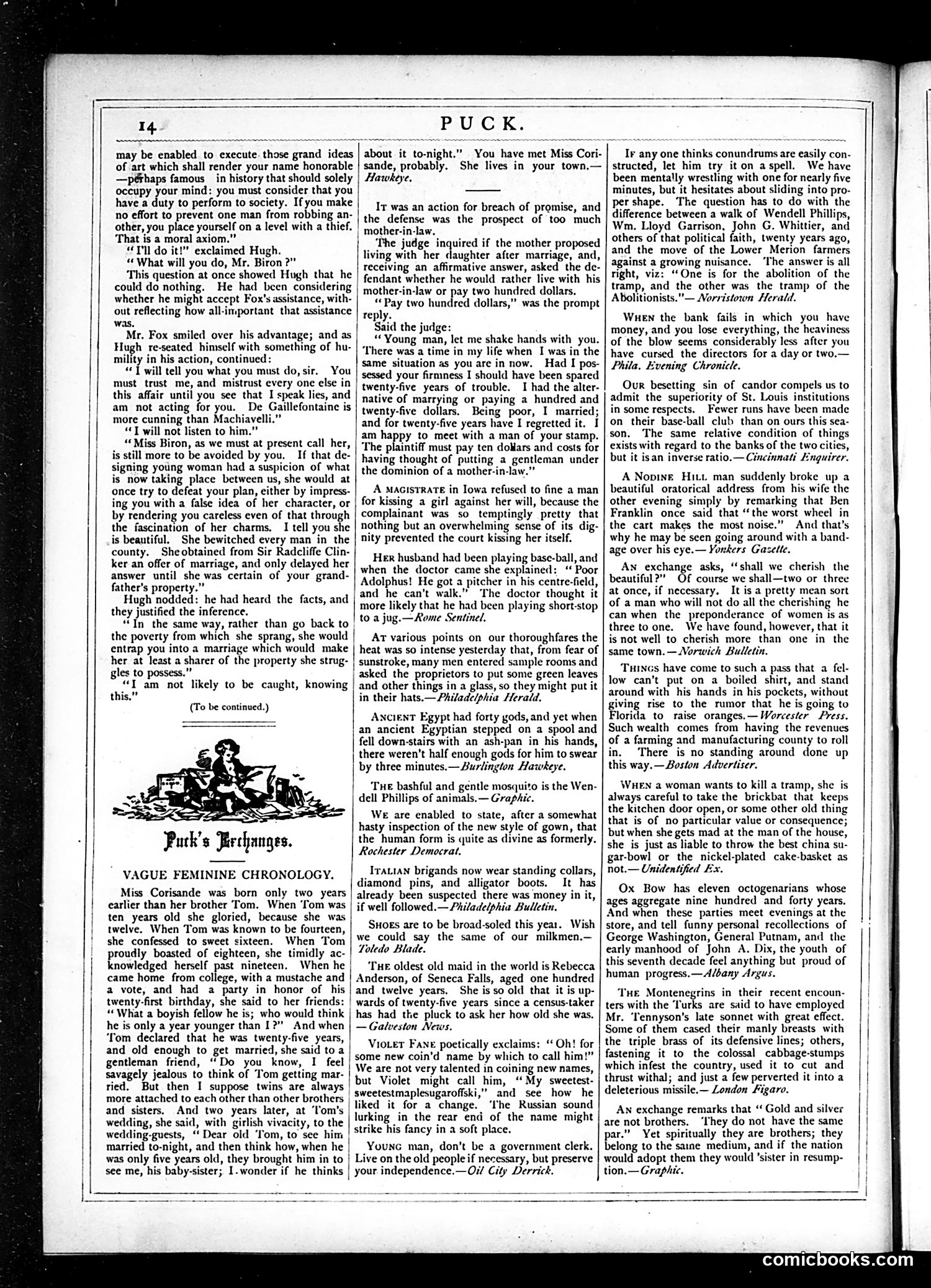
This page contains primarily text articles and satirical commentary rather than a major political cartoon. The visible illustration at bottom ("Puck's Archanizes") shows a small figure amid classical ruins or debris. The text includes several short satirical pieces mocking contemporary issues: a section on "Vague Feminine Chronology" jokes about women's uncertainty regarding their own ages, while other brief items satirize topics like Italian brigands wearing fashionable collars, old maids' claims to youth, and naming conventions ("sweetesplesugaroffia"). The main body text appears to be a humorous legal anecdote about breach of promise and marriage disputes. Overall, this page demonstrates Puck's characteristic approach: biting social commentary on gender, class, and contemporary manners through short witty observations rather than elaborate political cartooning.
📄 Transcribed text from this page (OCR, searchable)
Machine-transcribed from the original scan — historical spelling and the odd misread are preserved.
may be enabled to execute. those ead ideas of art which shall render your name honorable —pérhaps famous in history that should solely occupy Pht mind: you must consider that you have a duty to perform to society. If you make no effort to prevent one man from robbing an- other, you place yourself on a level with a thief. ‘That is a moral axiom.” “Tl do it!” exclaimed Hugh. “What will you do, Mr. Biron ?” ‘This question at once showed Hugh that he could do nothing. He had been considering | whether he might accept Fox's assistance, with- out reflecting how all-important that assistance was. Mr. Fox smiled over his advantage; and as | Hugh re-seated himself with something of hu- mility in his action, continued: “] will tell you what you must do, sir. You must trust me, and mistrust every one else in this affair until you see that I speak lies, and am not acting for you. De Gaillefontaine is more cunning than Machiavelli.” “T will not listen to him.” “Miss Biron, as we must at present call her, is still more to be avoided by you. If that de- signing young woman had a suspicion of what is now taking place between us, she would at once try to defeat your plan, either by impress- ing you with a false idea of her character, or by rendering you careless even of that through the fascination of her charms. I tell you she is beautiful. She bewitched every man in the county. Sheobtained from Sir Radcliffe Clin- ker an offer of marriage, and only delayed her answer until she was certain of your grand- father’s property.” Hugh nodded: he had heard the facts, and they justified the inference. “Tn the same way, rather than go back to the poverty from which she sprang, she would entrap you into a marriage which would make her at least a sharer of the property she strug- gles to possess.” “Tam not likely to be caught, knowing this,” (To be continued.) Puck 8 cng. VAGUE F! EMININE ( CHRONOLOGY. Miss Corisande was born only two years earlier than her brother Tom. When ‘Tom was ten years old she gloried, because she was twelve. When Tom was known to be fourteen, she confessed to sweet sixteen. When Tom proudly boasted of eighteen, she timidly ac- knowledged herself past nineteen. When he came home from college, with a mustache and a vote, and had a party in honor of his twenty-first birthday, she said to her friends: “What a boyish fellow he is; who would think | he is only a year younger than I?” And when ‘Tom declared that he was twenty-five years, and old enough to get married, she said to a | gentleman friend, “Do you know, I feel savagely jealous to think of Tom getting mar- ried. But then I suppose twins are always more attached to each other than other brothers _ and sisters. And two years later, at ‘lom’s | wedding, she said, with girlish vivacity, to the wedding-guests, ‘‘ Dear old ‘Tom, to see him i married to-night, and then think how, when he | was only five years old, they brought him in to | see me, his baby-sister; I-wonder if he thinks | PUCK. ener it to-night.” You “have met Miss Cor sande, probably. She lives in your town,— Hawkeye. It was an action for breach of promise, and the defense was the prospect of too much mother-in-law. The judge inquired if the mother proposed living with her daughter after marriage, and, receiving an affirmative answer, asked the de- fendant whether he would rather live with his mother-in-law or pay two hundred dollars. “Pay two hundred dollars,”” was the prompt reply. Said the judge: “Young man, let me shake hands with you. ‘There was a time in my life when I was in the same situation as you are in now. Had I pos- sessed your firmness I should have been spared twenty-five years of trouble. I had the alter- native of marrying or paying a hundred and twenty-five dollars, Being poor, I married; | and for twenty-five years have I regretted it. i | am hay py to meet with a man of your stamp. ‘The plaintiff must pay ten dollars and costs for having thought of putting a gentleman under the dominion of a mother-in-law.” A Macistrate in Iowa refused to fine a man | for kissing a girl against her will, because the complainant was so temptingly pretty that nothing but an overwhelming sense of its dig- nity prevented the court kissing her itself. Her husband had been playing base-ball, and when the doctor came she explained: ‘“ Poor Adolphus! He got a pitcher in his centre-field, and he can’t walk.” ‘The doctor thought it more likely that he had been playing short-stop to a jug.—Rome Sentinel. Ar various points on our thoroughfares the heat was so intense yesterday that, from fear of sunstroke, many men entered sample rooms and asked the proprietors to put some green leaves and other things in a glass, so they might put it in their hats.— Philadelphia Herald. Ancient Egypt had forty gods, and yet when an ancient Egyptian stepped on a spool and fell down-stairs with an ash-pan in his hands, there weren't half enough gods for him to swear by three minutes.— Burlington Hawkeye. Tue bashful and gentle mosquito is the Wen- dell Phillips of animals.— Graphic. We are enabled to state, after a somewhat hasty inspection of the new style of gown, that the human form is quite as divine as formerly. Rochester Democrat. Trattan brigands now wear standing collars, diamond pins, and alligator boots. It has already been suspected there was money in it, if well followed.— Philadelphia Bulletin, Snoes are to be broad-soled this year. Wish we could say the same of our milkmen.— Toledo Blade. ‘Tue oldest old maid in the world is Rebecca Anderson, of Seneca Falls, aged one hundred and twelve years, She is so old that it is up- wards of twenty-five years since a census-taker has had the pluck to ask her how old she was. —Galveston News. VioLet Fane poetically exclaims: ‘Oh! for some new coin’d name by which to call him!” We are not very talented in coining new names, but Violet might call him, ‘My sweetest- sweetestmaplesugarofiski,” and see how he liked it for a change, ‘I'he Russian sound lurking in the rear end of the name might strike his fancy in a soft place. Younc man, don’t be a government clerk. Live on the old ‘people if necessary, but preserve your independence.— Oi City Derrick. Ir any one thinks conundrums are easily con- structed, let him try it on a spell. We have been mentally wrestling with one for nearly five minutes, but it hesitates about sliding into pro- per shape. The question has to do with the difference between a walk of Wendell Phillips, Wm. Lloyd Garrison, John G. Whittier, and others of that political faith, twenty years ago, and the move of the Lower Merion farmers against a growing nuisance. ‘The answer is all right, viz: ‘One is for the abolition of the tramp, and the other was the tramp of the Abolitionists."— Norristown Herald. Wuen the bank fails in which you have money, and you lose everything, the heaviness of the blow seems considerably less after you have cursed the directors for a day or two.— Phila, Evening Chronicle. Our besetting sin of candor compels us to admit the superiority of St. Louis institutions in some respects. Fewer runs have been made on their base-ball club than on ours this sea- son. The same relative condition of things exists with regard to the banks of the two cities, but it isan inverse ratio.— Cincinnati Enquirer. A Nopine Hitt man suddenly broke up a beautiful oratorical address from his wife the other evening simply by remarking that Ben Franklin once said that ‘the worst wheel in the cart makes the most noise.” And that’s why he may be seen going around with a band- age over his eye.— Yonkers Gasette, An exchange asks, “shall we cherish the beautiful?” Of course we shall—two or three at once, if necessary. It is a pretty mean sort of a man who will not do all the cherishing he can when the preponderance of women is as three to one. We have found, however, that it is not well to cherish more than one in the same town.—Norwich Bulletin. ‘Tuincs have come to such a pass that a fel- low can’t put on a boiled shirt, and stand around with his hands in his pockets, without giving rise to the rumor that he is going to Florida to raise oranges.— Worcester Press. Such wealth comes from having the revenues of a farming and manufacturing county to roll in. There is no standing around done up this way.— Boston Advertiser. WHEN a woman wants to kill a tramp, she is always careful to take the brickbat that keeps the kitchen door open, or some other old thing that is of no particular value or consequence; but when she gets mad at the man of the house, she is just as liable to throw the best china su- gar-bowl or the nickel-plated cake-basket as not.— Unidentified Ex. ue Bow has eleven octogenarians whose aggregate nine hundred and forty years. ‘And w en these parties meet evenings at the store, and tell funny personal recollections of George Washington, General Putnam, and the early manhood of John A. Dix, the youth of this seventh decade feel anything but proud of human progress. —Avbany Argus. ‘THe Montenegrins in their recent encoun- ters with the ‘1 ‘Turks are said to have employed Mr. ‘Tennyson's late sonnet with great effect. Some of them cased their manly breasts with the triple brass of its defensive lines; others, fastening it to the colossal cabbage-stumps which infest the country, used it to cut and thrust withal; and just a few perverted it into a deleterious missile.— London Figaro. An exchange remarks that “Gold and silver are not brothers. ‘hey do not have the same par.” Yet spiritually they are brothers; they belong to the saine medium, and if the nation would adopt them they would sister in resump- tion.— Graphic. comicbooks.com