
Puck, 1877-08-01 · page 10 of 16
Puck — August 1, 1877 — page 10: what you’re looking at
What you’re looking at
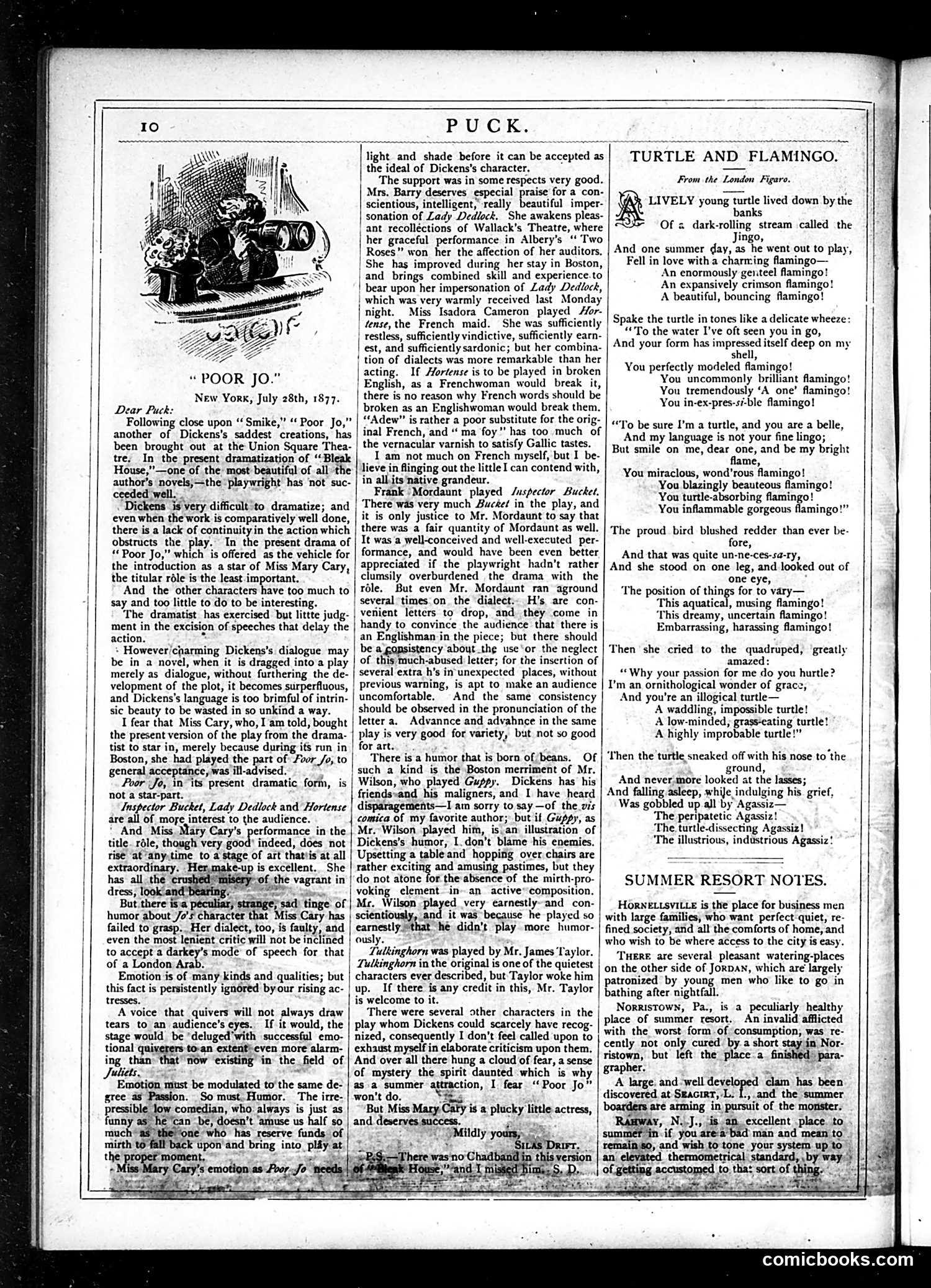
The cartoon labeled "Poor Jo" depicts a disheveled character, likely referencing Charles Dickens' character Jo from *Bleak House*—a homeless boy repeatedly told to "move on" by authorities. The accompanying article critiques the theatrical dramatization of Dickens' work, particularly *Bleak House*, noting that while the play captures certain elements, it struggles with adapting Dickens' complex social commentary into stage format. The satirical point appears to be commentary on how theatrical adaptations oversimplify or sentimentalize Dickens' critiques of social injustice and class inequality. "Poor Jo" becomes a symbol of tragic inevitability—a victim of society who cannot escape his circumstances—making this both a literary criticism and social commentary on Victorian poverty and institutional indifference.
📄 Transcribed text from this page (OCR, searchable)
Machine-transcribed from the original scan — historical spelling and the odd misread are preserved.
“POOR JO.” New York, July 28th, 1877. Dear Puck: Following close upon ‘‘ Smike,” ‘‘ Poor Jo,” another of Dickens’s saddest creations, has | been brought out at the Union Square Thea- | tre. In the present dramatization of ‘Bleak House,”—one of the: most beautifyl of all ‘the author's novels,—the ‘playwright has ‘not suc- ceeded well... Dickens is very difficult to dramatize; and even when the work is comparatively well done, there is a lack of continuity in the action which obstructs the play. In the present drama of “Poor Jo,” which is offered as the vehicle for the introduction as a star of Miss Mary Cary, the titular réle is the least important. And the other characters have too much to say and too little to do to be interesting. The dramatist has exercised but littte judg- | ment in the excision of speeches that delay the action. + However/cnarming Dickens's dialogue may be in a novel, when it is dragged into'a play merely as dialogue, without furthering the de- velopment of the plot, it becomes surperfluous, and Dickens's language is too brimful of intrin- sic beauty to be wasted in so unkind a way. I fear that Miss Cary, who, I am told, bought the present version of the play from the drama- tist to star in, merely because during its run in Boston, she had played the part of: vor Jo, to general acceptance, was ill-advised. Poor Jo, in its present dramatic form, is not a star-part. Inspector Bucket, Lady Dedlock and Hortense are all of moge. interest to the audience. * And Miss. Mary Cary’s performance in the title. role, though very g¢ indeed, does not rise ‘at’any,time to a stage of art thattis at all extraordi Her, ¢-up is excellent. She has all the eo of, the vagrant in dress, look-and’ But.there isa peculiar, strange, ; sad tinge of humor about /o’s character that Miss Cary has failed to grasp.. Her dialect, too, is faulty, and | even the most lenient critic will not be inclined to accept a darkey’s mode of speech for that | of a London Arab. Emotion is of many kinds and qualities; but this fact is persistently ignored by our rising ac- tresses. A voice that quivers will not always draw tears to an audience's eyes.. If it would, the stage would be 'deluged’with successful emo- tional quiverers to-an extent}even more alarm- ing than: that” now ‘existing’ in the. field of Suliets. Emotion must be modulated to’ the same de- gree as Passion. So must.Humor. The irre- pressible Jow comedian, who always is just as funny as he ‘can “be, doesn’t ‘amuse us half so much® ne who has reserve funds. of mirth to fall back upon’ and bring into play at the moment, . , ies es as Poor, Jo% PUCK. light and shade before it can be e accepted as the ideal of Dickens's character. The support was in some respects very good. Mrs. Barry deserves especial praise for a con- scientious, intelligent, ‘really Beautiful imper- sonation of Lady Dedlock, She awakens pleas- | ant recolléctions of Wallack’s Theatre, where | her graceful performance in Albery’s ‘“ Two | Roses” won her the affection of her auditors. | She has improved during her stay in Boston, | and brings combined skill and experience.to bear upon her impersonation of Lady Dedlock, | which was very warmly received last Monday | night. Miss Isadora Cameron played Hor- tense, the French maid. She was sufficiently restless, sufficiently vindictive, sufficiently earn- | est, and sufficiently sardonic; ‘but her combina- | tion of dialects was more remarkable than her acting. If Hortense is to be played in broken English, as a Frenchwoman would break it, there is no reason why French words should be broken as an Englishwoman would break them, “‘Adew” is rather a poor substitute for the orig- inal French, and “ ma foy”’ has too much of the vernacular varnish to satisfy Gallic tastes. I am not much on French myself, but I be- lieve in flinging out the littleI can contend with, in all.its native grandeur. Frank ‘Mordaunt played /uspector Bucket, ‘There was very much Bucéef in the play, and it is only justice to Mr. Mordaunt to say that there was a fair quantity of Mordaunt as well. It was a well-conceived and well-executed per- formance, and would have been even better appreciated if the playwright hadn’t rather clumsily overburdened the drama with the role. But even Mr. Mordaunt ran aground | several ‘times.on the dialect.. H’s. are con- venient letters to drop, and they come in | handy to convince the audience that there is an Englishman in the piece; but there should bea jistency about the use‘or the neglect | of this much-abused letter; for the indertion of several extra h’s in unexpected places, without | previous warning, is apt to make an audience uncomfortable. And the same consistency should be observed in the pronunciation of the letter a. Advannce and advahnce in the same play is very good for variety, but not so good for art. There is a humor that is born of/beans. Of | such a kind is the Boston merriment of Mr. Wilson, who played Guppy. Dickens has his friends»and his maligners, and I have heard dis ments—I am sorry to say—of the vis comica of my favorite author; but if Guppy, as Mr. Wilson played him, is.an: illustration of Dickens’s humor, I.don’t blame his enemies. Upsetting a table and hopping over chairs are rather exciting and amusing pastimes, but they do not atone for the absence of the mirth-pro- voking element in- an active’composition. Mr. Wilson Pla ed_very earnestly~and con- | scientiously, it was because he played so carneatlpat he didn’t play more humor- | ously. | _ Tulkinghorn was played by Mr. James Taylor. | Zudkinghorn in the original is one of the quietest characters ever described, but-Taylor woke him | up. If there is any credit in this, Mr. Taylor is welcome to it. play whom Dickens could scarcely have recog. nized, consequently I don’t feel called upon to exhaust myself in elaborate criticism upon them. And over all there hung a cloud of fear, a sense of mystery the spirit daunted which is why as a summer attraction, I. fear ‘Poor Jo” won't do. N¥ But Miss Mary Caty i isa bape? little actress, and. deserves success. Mildly There were several other characters in the | TURTLE AND_ FLAMINGO. From the London Pigara, ® Of a dark-rolling stream called the Jingo, And one summer day, as he went out to play, Fell in love with a charming flamingo— An enormously genteel flamingo! An expansively crimson flamingo! A beautiful, bouncing flamingo! LIVELY young turtle lived down by the banks Spake the turtle in tones like a delicate wheeze: “To the water I’ve oft seen you in go, And your form has impressed itself deep on my shell, You perfectly modeled flamingo! You uncommonly brilliant flamingo! You tremendously ‘A one’ flamingo! You in-ex-pres-si-ble flamingo! “To be sure I’m a turtle, and you are a belle, And my language is not your fine lingo; But smile on me, dear one, and be my bright flame, You miraclous, wond’rous flamingo! You blazingly beauteous flamingo! You turtle-absorbing flamingo! You inflammable gorgeous flamingo!” The proud bird blushed redder than ever be- fore, And that was quite un-ne-ces-sa-ry, And she stood on one leg, and looked out of one eye, The position of WOAH for to vary— ‘This aquatical, musing flamingo! ‘This dreamy, uncertain flamingo! Embarrassing, harassing flamingo! Then she cried to the quadruped, ‘greatly amazed: “Why your passion for me do you hurtle? I'm an ornithological wonder of grace, ‘And you're an illogical turtle— A waddling, impossible turtle! A low-minded, grass-eating turtle! A highly improbable turtle!” ‘Then the turtle sneaked off with his nose to ‘the ground, And never.more looked at the lasses; And falling asleep, while indulging his grief, Was gobbled up all by Agassiz— The peripatetic Agassiz! The. turtle-dissecting Agassiz! The illustrious, industrious Agassiz! SUMMER RESORT NOTES. HorNELtsvILte is the place for business men with large families, who want perfect-quiet, re- fined society, and all the comforts of home, an: who wish to be where access to the city is easy. ‘THERE are several pleasant watering-places ‘on the other side of Jorpan, which are’ largely patronized by young men who like to go in bathing after nightfall. Norristown, Pa., is a peculiarly healthy place of summer resort. An invalid afflicted with the worst form of consumption, was re- cently not only cured. by. a short stay.in Nor- ristown, but left the: place.a_finish€d® para- grapher. A large, and -well devel clam has been discovered. at Sgacirr, L. L,.and the summer boarders are arming in. pursuit of the monster. ‘RAHWAY, NuJ., jis excellent place. to. summerin if oe ‘bad man aid cae to we and wish to‘tone your system up to thermometrical ‘standard, aDY NAS comicbooks.com