
A complete issue · 16 pages · 1877
Puck — June 27, 1877
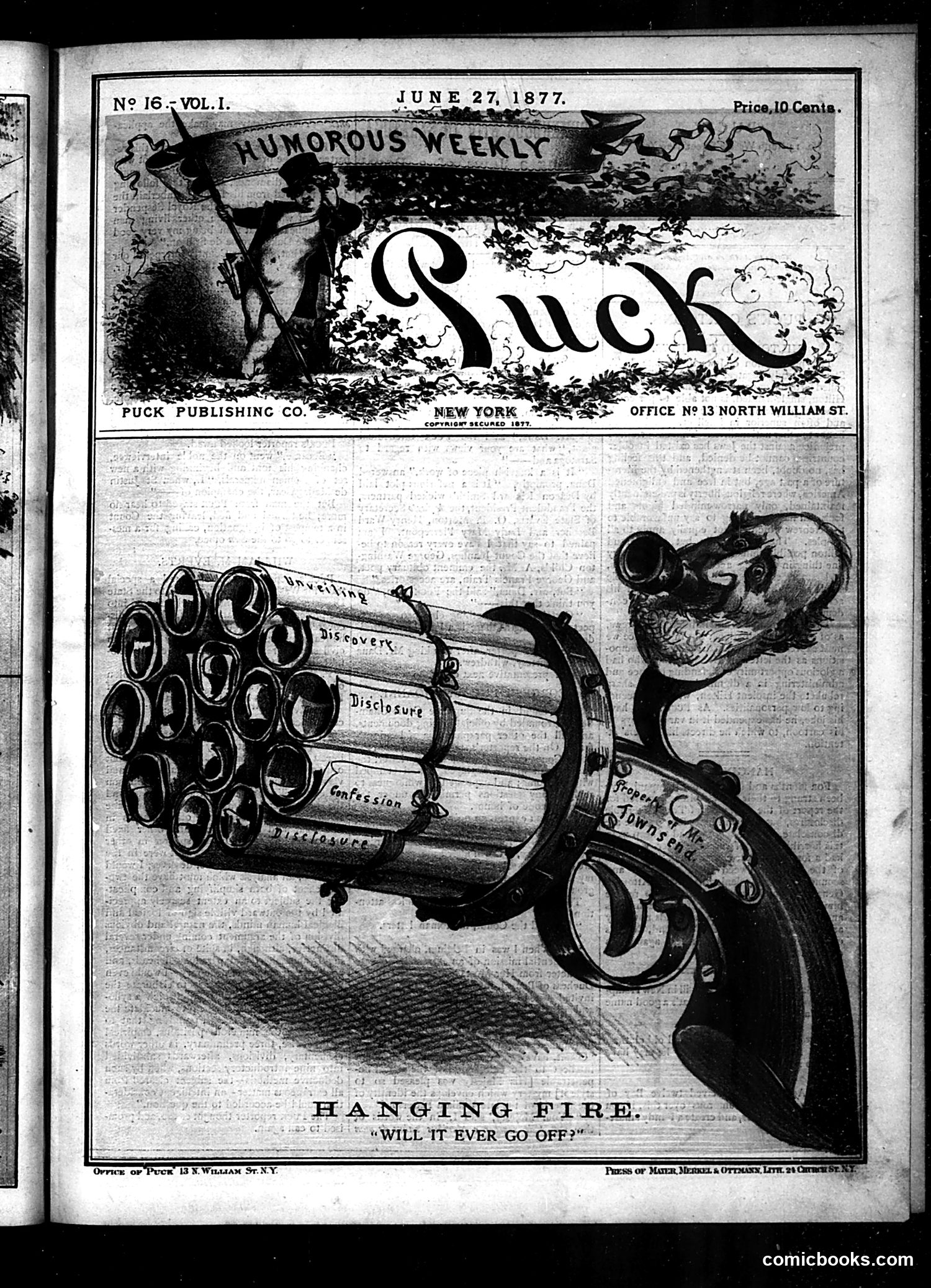
This Puck cartoon satirizes political scandals or revelations that fail to produce consequences. The revolver's chambers are labeled with damaging disclosures: "Wrestling," "Discovery," "Disclosure," "Confession," and "Superposure" (likely "Exposure"). The ape-like figure pointing the gun asks whether it will "ever go off"—meaning whether these revelations will finally result in action or punishment. The satire suggests that despite mounting evidence of wrongdoing, nothing happens; the political "gun" remains perpetually cocked but ineffective. Without additional context identifying the specific figure or scandals referenced, the cartoon appears to criticize political immunity or the failure of revelations to produce accountability during the 1877 period.
This page combines satirical articles and commentary rather than visual cartoons. The main content critiques **Judge Hilton's exclusion of Jews from the Grand Union Hotel in Saratoga** — a real historical incident involving discrimination. The satire targets Hilton's anti-Semitic actions through interviews with various figures ("Puck's Reporters Interviewing the Lights of the World"). Contributors mock Hilton's prejudice by comparing it to un-American values and questioning his authority to exclude citizens. Other brief items satirize contemporary figures: **Ex-Secretary Chandler's** "nervous prostration," and **Tweed's** firing, likely referencing the notorious Boss Tweed. The tone is indignant moral commentary wrapped in satirical questioning — Puck using humor and rhetoric to oppose discrimination rather than visual caricature.
This page contains interviews with notable figures rather than political cartoons. The visible interviews include: - **Miss Anna Dickinson**: A lecturer discussed for her eloquent speaking style and her romantic interests - **Dr. Mary Walker**: A physician noted for her unconventional dress and progressive views - **Geo. Francis Train**: An eccentric businessman whose controversial opinions on Jews and other topics are mocked through the reporter's deliberately naive questioning - **Benjamin Disraeli**: Referenced as head of the English Cabinet The satire works by having reporters pose innocent questions that expose these figures' peculiarities and contradictions. The piece particularly ridicules Train's inflammatory rhetoric about Jews and his general bombast, using his own words against him through deadpan interviewing technique. This reflects 19th-century Puck's approach: humoring public figures through careful questioning rather than direct caricature.
This page contains primarily **text content rather than cartoons**: "The Saratoga Lament" (a poem), a "Fashionable Intelligence" gossip column, and an "Answers for the Anxious" advice section. The poem "The Saratoga Lament" appears to satirize social pretension and the vanities of wealthy visitors to Saratoga Springs, a fashionable resort. It critiques shallow materialism and romantic posturing among the elite. The gossip column mocks various social figures and situations—including commentary on New York newspapers, the Pope's refusal regarding the Count de Chambord, and humorous anecdotes about aristocratic absurdities. The advice column humorously addresses readers' personal concerns. Overall, this page reflects **Puck's focus on satirizing upper-class American society and social hypocrisy** rather than featuring the visual political cartoons the magazine is better known for.
This page contains three distinct articles rather than political cartoons: 1. **"The Game They Played"** - A humorous anecdote about a chess match between "the Great American" and a dignified gentleman with a red beard, involving insults, a spilled drink, and escalating chaos at a hotel. The satire targets American cockiness and lack of decorum. 2. **"Sioux or Chinese?"** - Critiques a hotel's policy of excluding Native Americans while accepting Chinese guests. The piece sarcastically questions the logic of this discrimination, using Mr. Sitting Bull as an example to expose the hypocrisy of racial prejudice. 3. **"The Poetic Brotherhood"** - Discusses a corrected copy of Victor Hugo's sonnet circulating in the press. This is primarily text-based satirical commentary rather than visual cartoons.
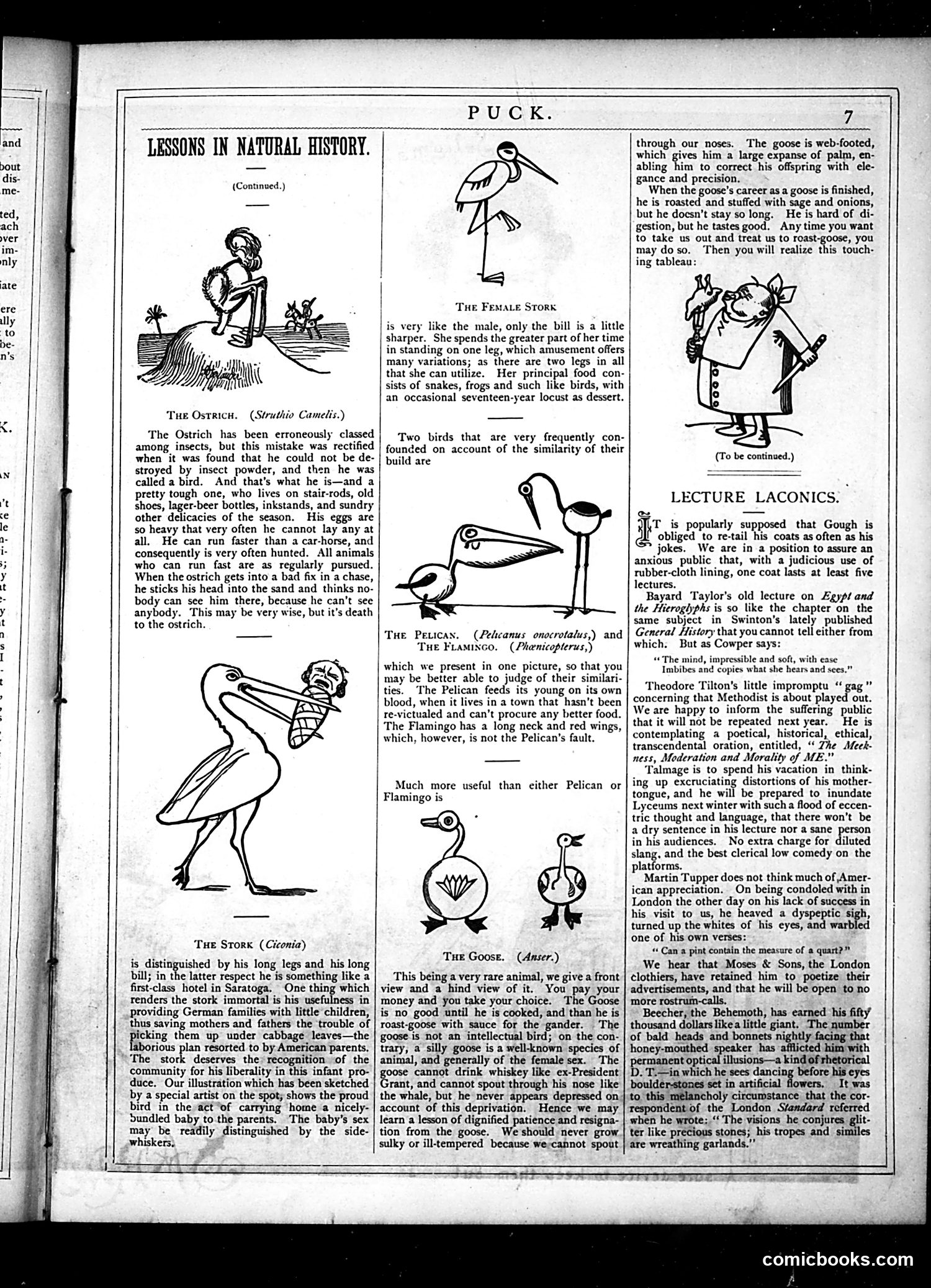
This page is primarily educational/humorous rather than political satire. It presents illustrated descriptions of various birds—the Ostrich, Female Stork, Pelican, Flamingo, and Goose—with accompanying text that blends genuine natural history with comedic observations. The humor derives from anthropomorphizing these birds, attributing human characteristics and behaviors. For example, the Ostrich is jokingly described as "a pretty tough one" who eats "old shoes, lager-beer bottles, inkstands." The Goose section includes satirical commentary about human foibles reflected through bird behavior. The final section, "Lecture Laconics," appears to mock various public figures and lecturers of the era through brief, witty jabs—though specific identities are unclear without additional context. Overall, this is Puck's characteristic blend of natural science with social comedy.
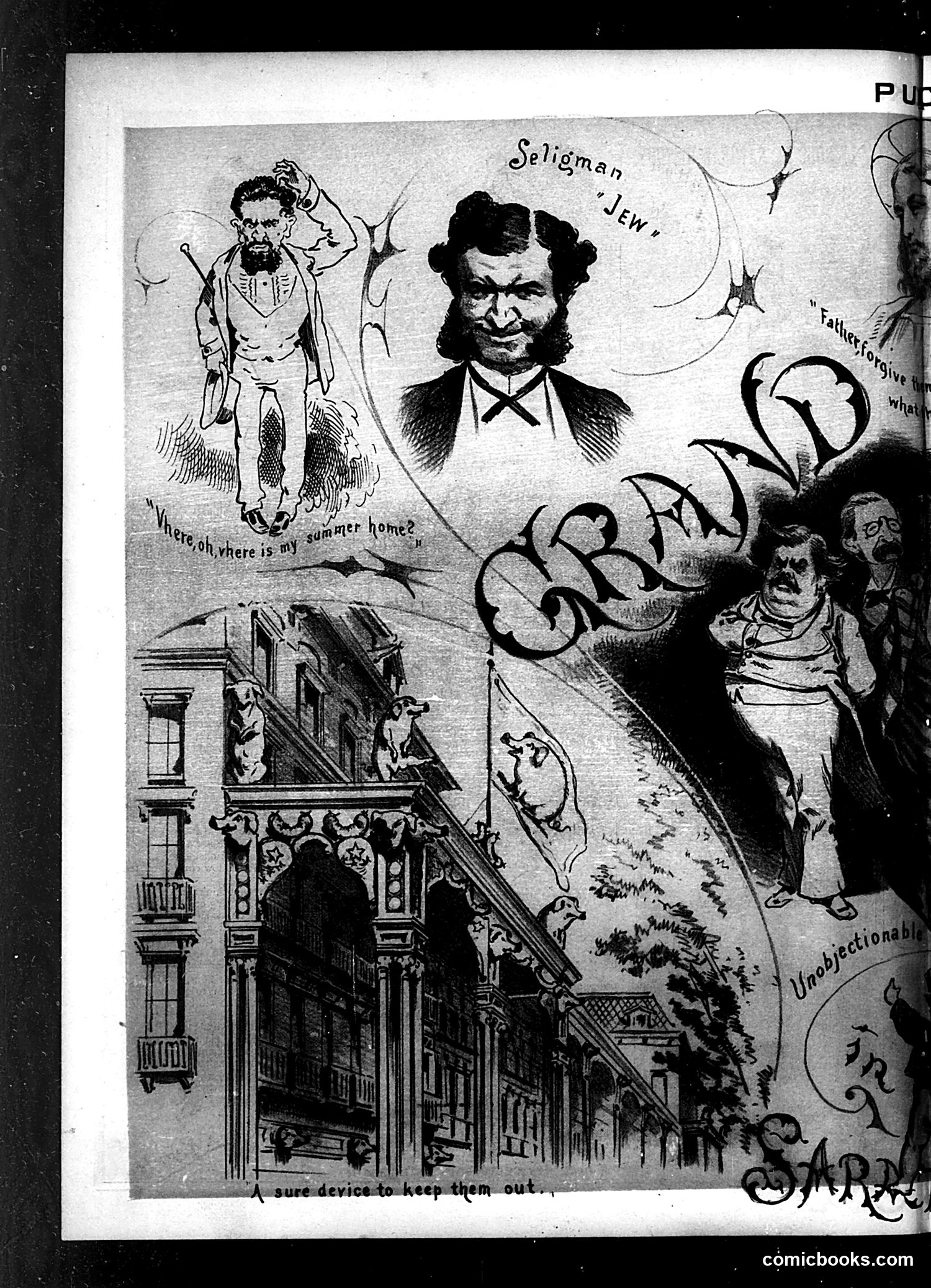
This appears to be an antisemitic political cartoon from 19th-century America. The central figure is labeled "Seligman 'Jew'" and depicts a Jewish person with exaggerated stereotypical features. The cartoon plays on conspiracy theories about Jewish people and wealth/power, showing the figure as a specter haunting a wealthy building. Text reads: "Where, oh where is my summer home?" and "sure device to keep them out," suggesting anxieties about Jewish people gaining access to exclusive neighborhoods and social spaces. The surrounding figures and architectural details appear meant to represent exclusionary practices or resistance to Jewish assimilation into elite American society. This reflects historical antisemitic attitudes prevalent during Puck's publication period.
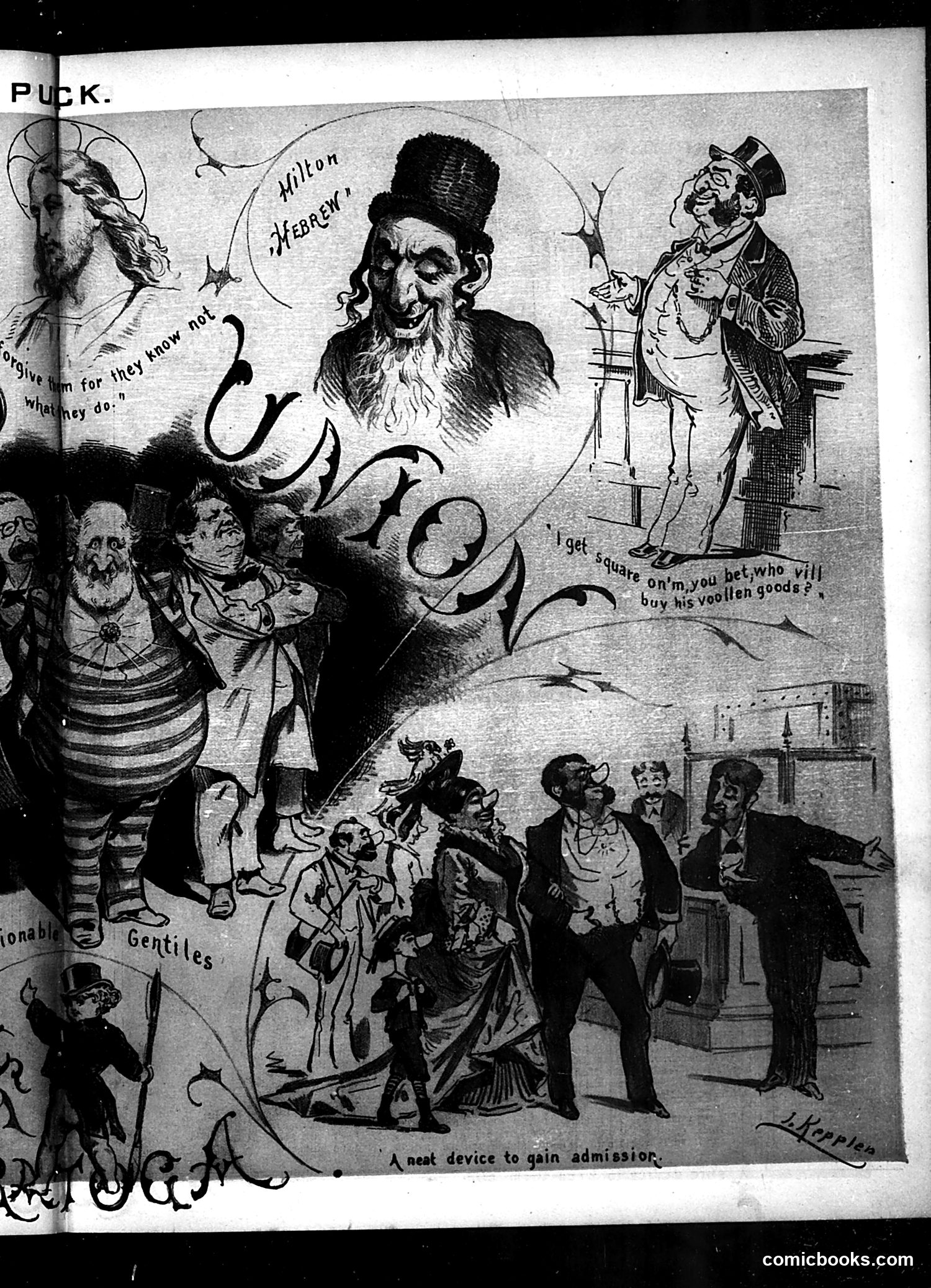
This satirical cartoon depicts what appears to be a Jewish stereotyped figure (labeled "Hebrew Milton") dominating a scene where people are trying to gain admission to something—likely a theater or entertainment venue. The caption "A neat device to gain admission" suggests commentary on methods of entry or access. The caricature employs offensive ethnic stereotypes common to 19th-century American satire. One figure asks another to "square on" them, betting on who will buy tickets, while the central bearded figure towers over smaller figures below, implying control or gatekeeping of access. The satire appears to mock Jewish involvement in entertainment or commerce, reflecting antisemitic attitudes prevalent in Gilded Age publications. Without additional context, the specific incident referenced remains unclear.
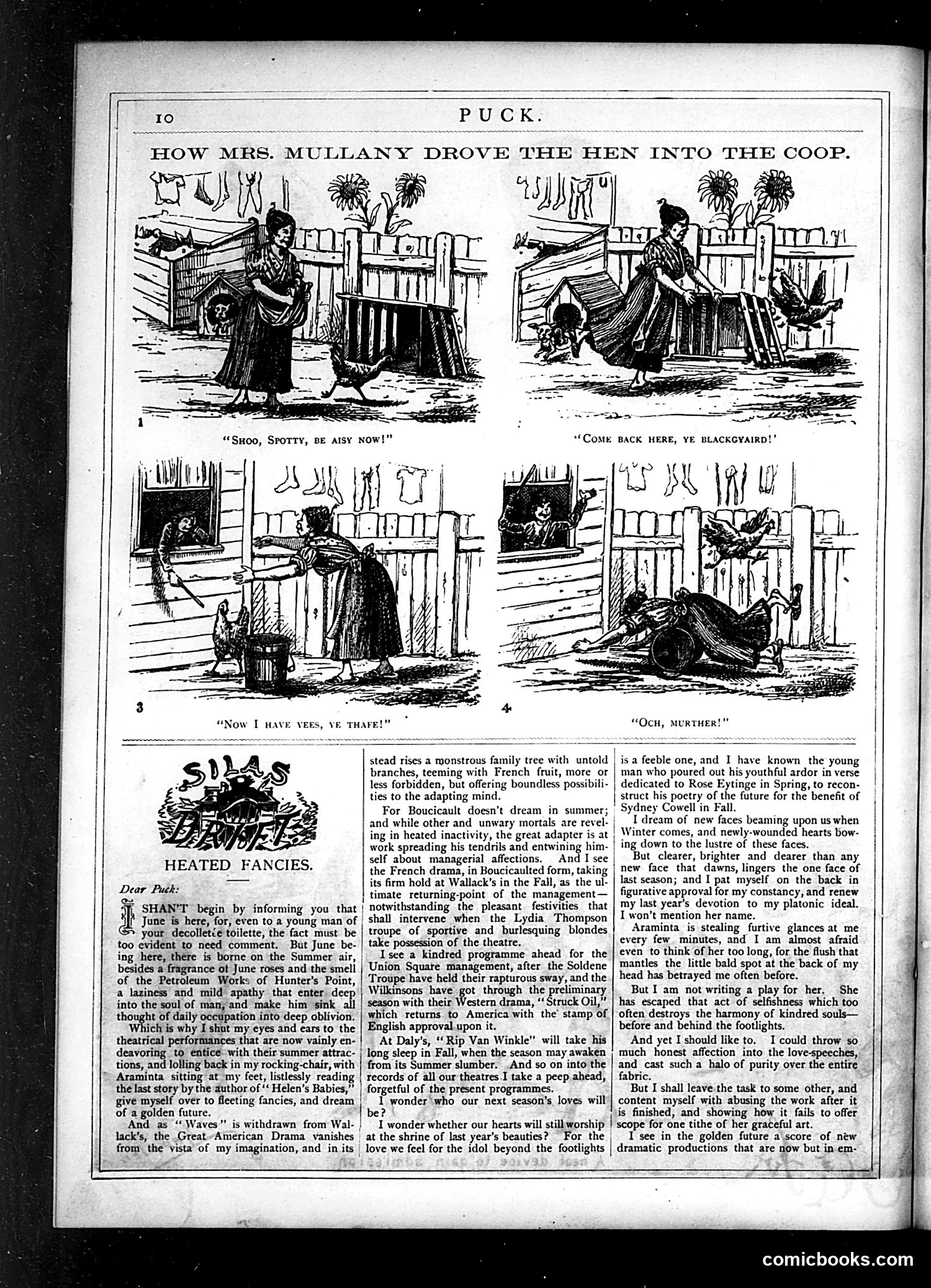
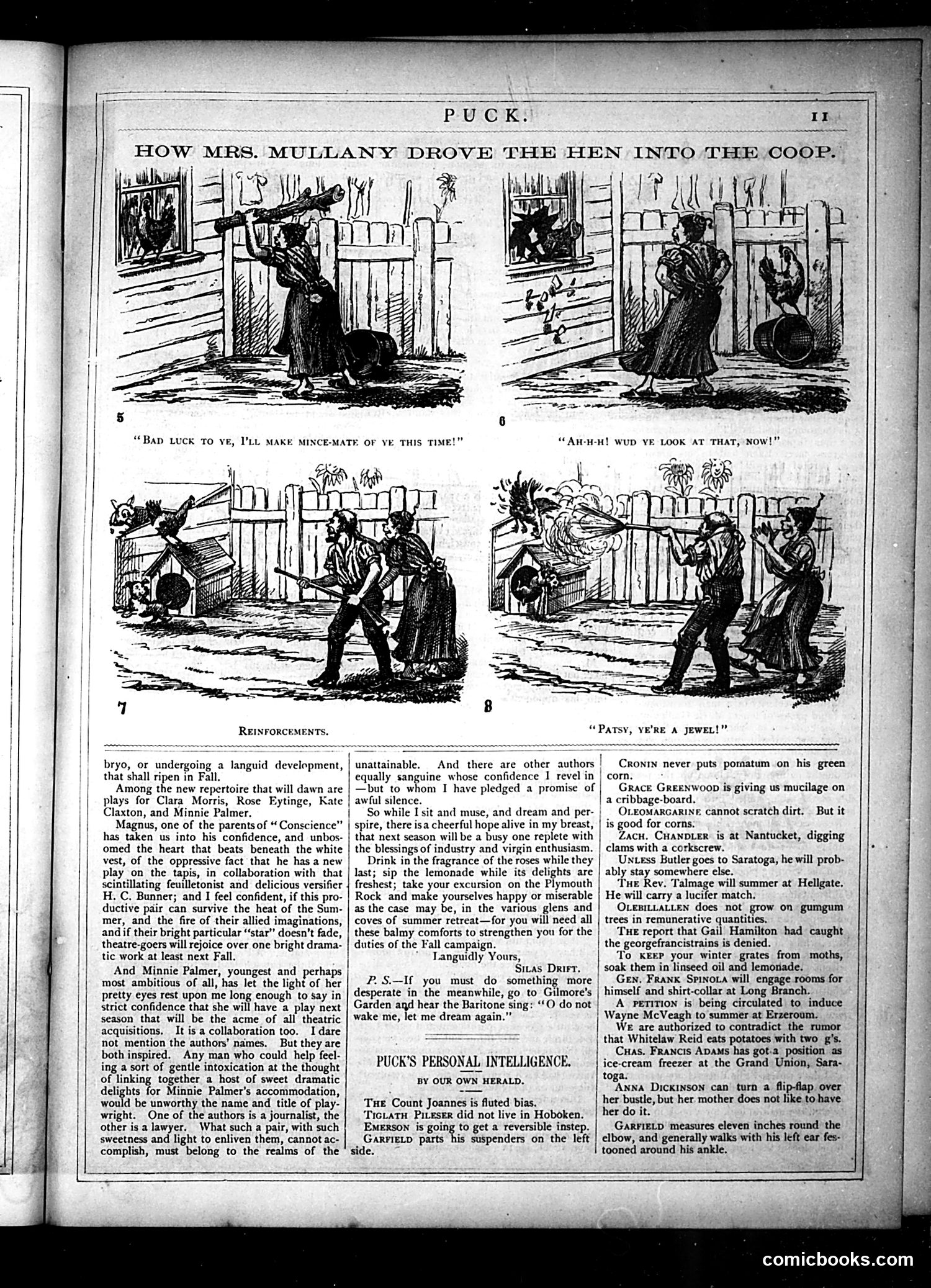
This is a four-panel comic strip showing a domestic mishap. Mrs. Mullany attempts to herd a hen into a chicken coop, but her efforts backfire comically. In panels 1-2, she chases with a stick. By panel 3, a man (possibly her husband) has become involved in the chaos. Panel 4 shows the situation spiraling—the hen is now wildly airborne while multiple people struggle to contain it. The humor derives from the slapstick escalation of a simple farm task gone wrong, a common theme in early-20th-century American comedy. The title's deadpan tone ("drove the hen into the coop") contrasts with the obvious disaster unfolding, creating ironic humor typical of Puck's style.
This page contains Chapter XIII of "Two Knaves and a Queen," an English serialized story featured in Puck magazine. The narrative involves characters scheming over inheritance and property disputes—specifically concerning Miss Hiron and questions of who will receive a fortune. Key figures include M. de Gaillefontaine, Mr. Fox, Mr. Silas, and Renè. The plot involves legal maneuvering, threats, and negotiation over financial terms and wills. Mr. de Gaillefontaine attempts to resolve disputes by proposing financial settlements. This is not a political cartoon but rather serialized fiction—Puck regularly published literary works alongside satirical content. The page reflects late 19th-century storytelling conventions, focusing on melodramatic social intrigue among wealthy characters rather than contemporary political satire.
This page contains two distinct sections: a theater review ("PUCK") and a separate satirical piece ("THE TAG"). **"PUCK" section:** A critic discusses a new play's climax, critiquing the artificiality of theatrical conventions. The review mocks both actors' excessive mannerisms and audiences' gullible acceptance of obvious dramatic tricks. It's a meta-commentary on Victorian theater's overwrought style. **"THE TAG" section:** This appears to be a satirical anecdote about a gentleman adjusting his overcoat and hat in public—apparently a commentary on propriety and masculine vanity. The piece ridicules social pretension, suggesting that concerns about appearance ("wearing one's hat") can become absurdly self-important. Both sections employ Puck's characteristic approach: mocking contemporary social and cultural affectations through witty, observational humor aimed at educated readers.
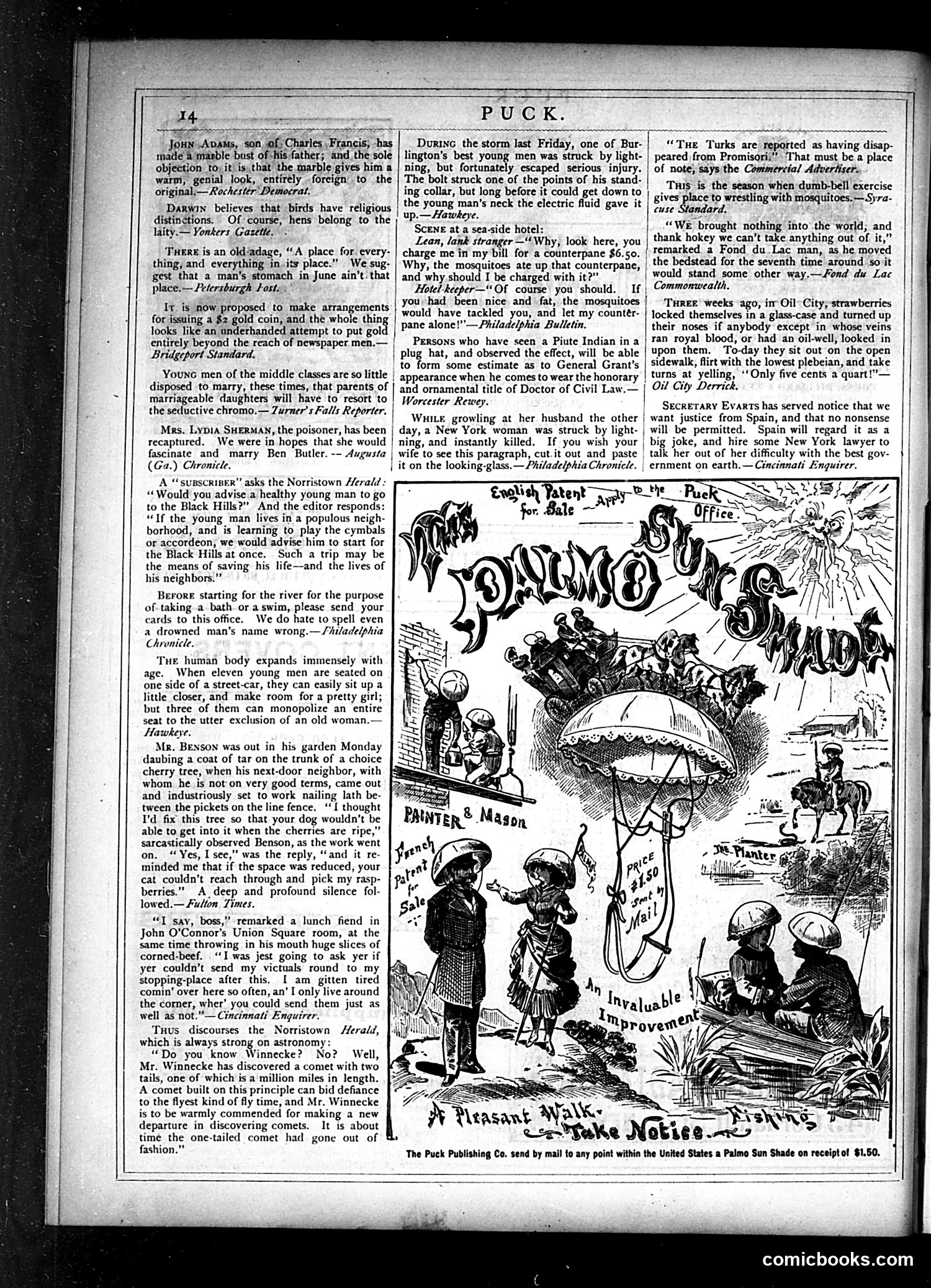
This page is primarily **advertising and miscellaneous items** rather than political satire. The right half features multiple patent advertisements for inventions like "Palma Shade," "Dalmous Shade," and "A Pleasant Walk" shoe insert—typical of Puck's commercial content. The left column contains brief humorous anecdotes and social commentary, including jokes about: - A man tarring his cherry tree to prevent his dog from climbing it - Observations about lightning strikes and mosquitoes - A dismissed domestic worker's misadventure These are light satirical vignettes mocking everyday situations and human behavior rather than addressing specific political figures or events. The overall tone is comedic rather than polemical.
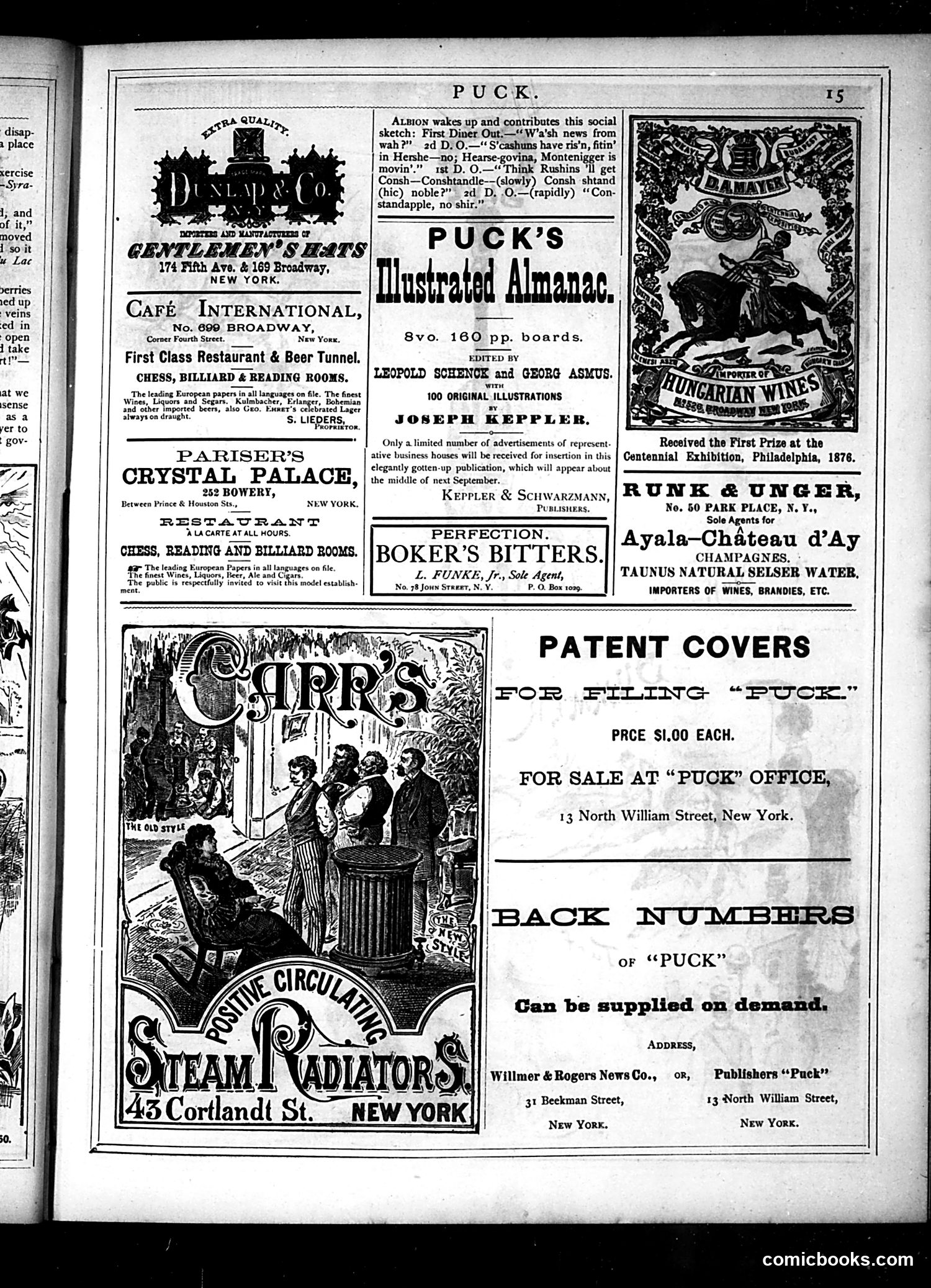
This page is primarily **advertising and promotional content** rather than political satire or editorial cartooning. It features various New York business advertisements including: - D. & Co. (gentlemen's hats) - Café International (restaurant and beer hall) - Pariser's Crystal Palace (entertainment venue) - Curr's Positive Circulating Steam Radiators (heating equipment) - Runk & Unger (wine importers) The only illustrated content is a large ad for Curr's radiators showing a Victorian-era scene of well-dressed men in what appears to be a social setting—likely meant to suggest comfort and modern heating technology. The page also promotes **Puck's own products**: patent covers ($1 each) and back issues available for sale. This is a typical magazine advertising page from the late 19th century.
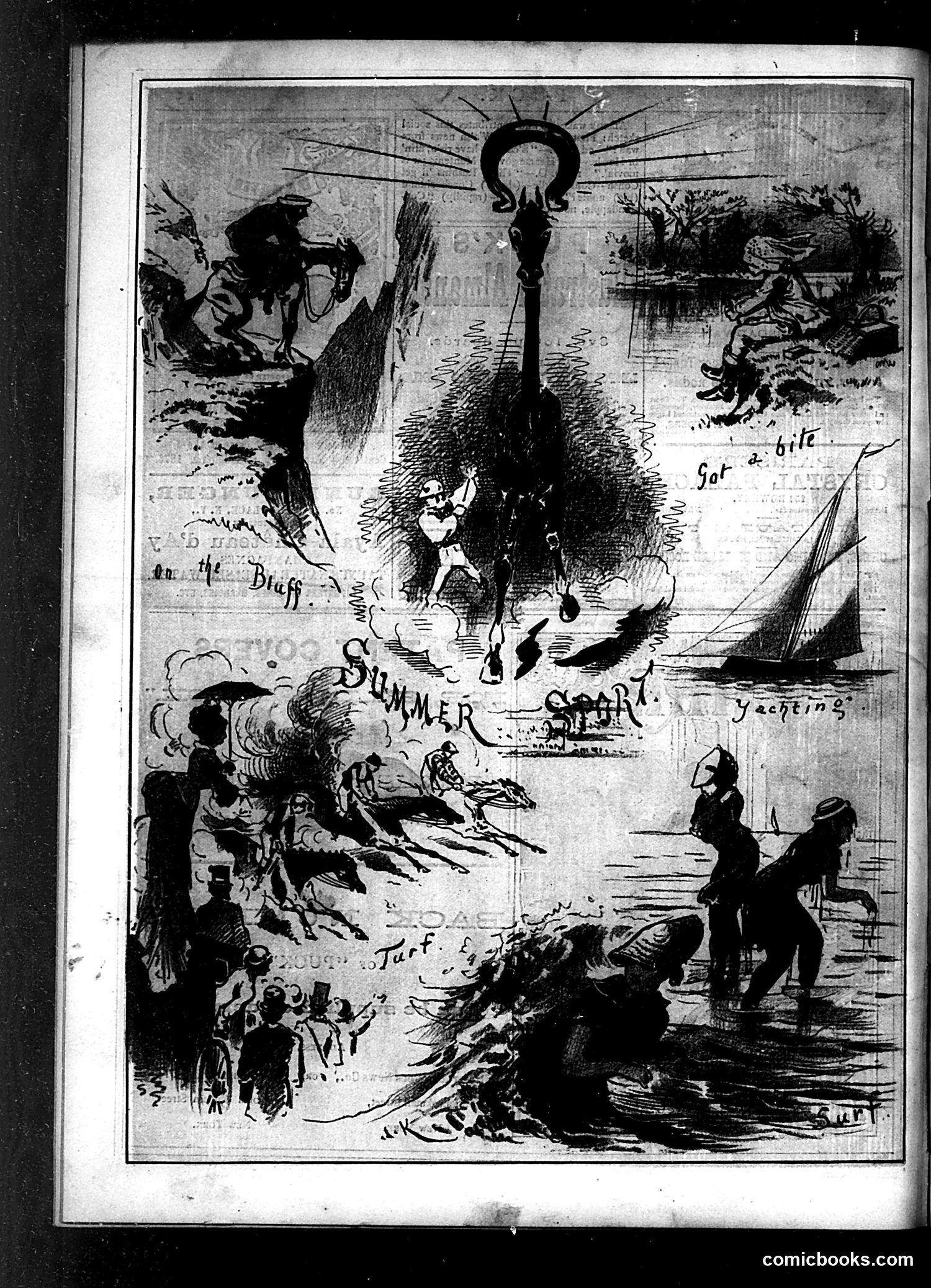
This appears to be a seasonal cartoon celebrating summer activities. The central image shows a large lantern or lamp radiating light, surrounded by vignettes labeled with summer pastimes: "Got a bite" (fishing), "Bluff" (card games), "Summer" (general season), "Scare" (possibly pranks), "Yachting" (sailing), and "Tart" (unclear reference, possibly food or social activity). The composition uses a common Puck format: a dominant central image surrounded by smaller illustrated scenes. The style suggests late 19th or early 20th-century publication. Rather than political satire, this appears to be lighthearted social commentary on leisure activities—showing how Victorian-era Americans spent their summer months across different social classes and activities. The various figures engaged in these pastimes suggest both wealthy (yachting) and working-class (fishing) summer pleasures.