
Puck, 1877-06-27 · page 12 of 16
Puck — June 27, 1877 — page 12: what you’re looking at
What you’re looking at
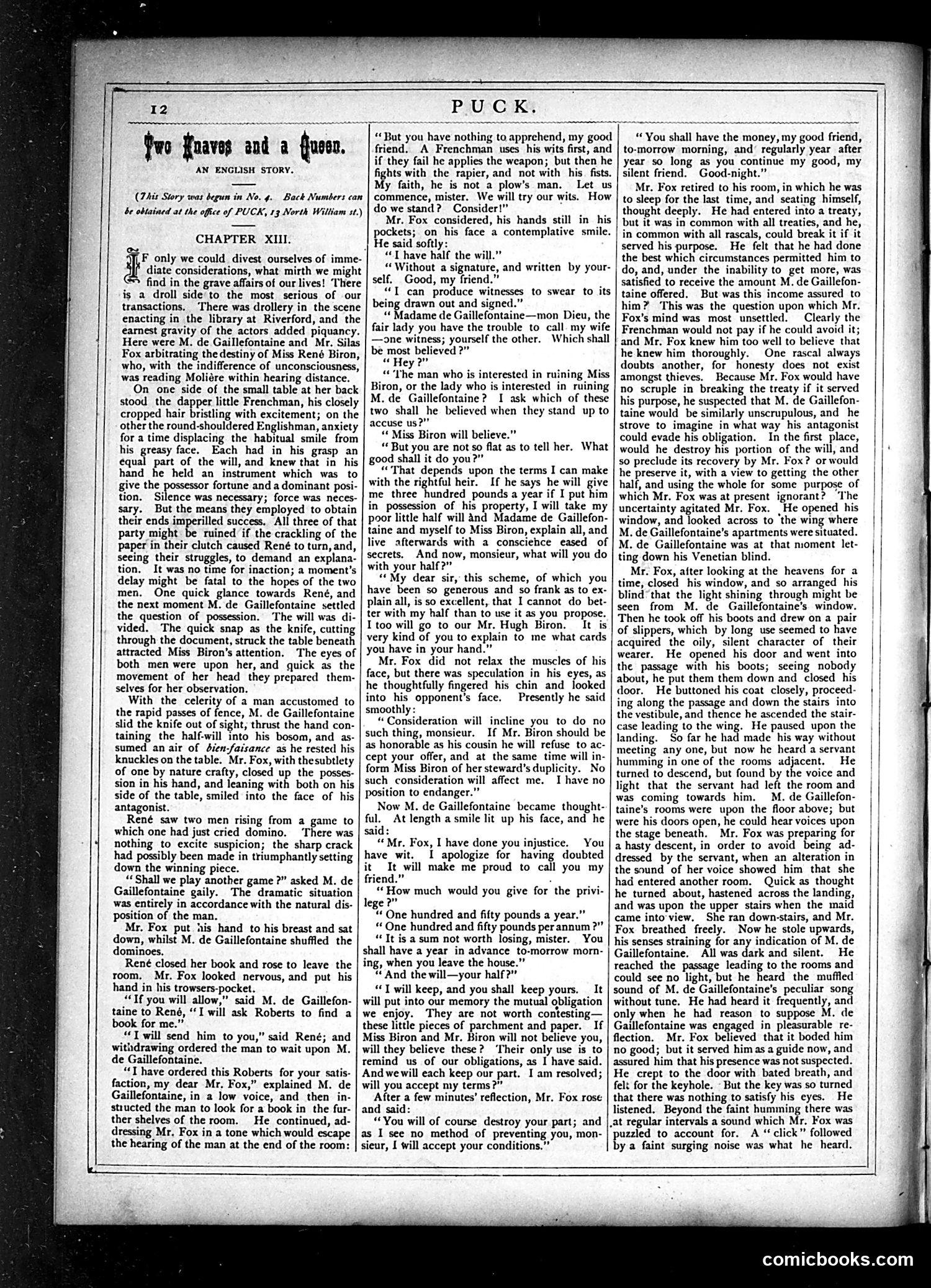
This page contains Chapter XIII of "Two Knaves and a Queen," an English serialized story featured in Puck magazine. The narrative involves characters scheming over inheritance and property disputes—specifically concerning Miss Hiron and questions of who will receive a fortune. Key figures include M. de Gaillefontaine, Mr. Fox, Mr. Silas, and Renè. The plot involves legal maneuvering, threats, and negotiation over financial terms and wills. Mr. de Gaillefontaine attempts to resolve disputes by proposing financial settlements. This is not a political cartoon but rather serialized fiction—Puck regularly published literary works alongside satirical content. The page reflects late 19th-century storytelling conventions, focusing on melodramatic social intrigue among wealthy characters rather than contemporary political satire.
📄 Transcribed text from this page (OCR, searchable)
Machine-transcribed from the original scan — historical spelling and the odd misread are preserved.
Fuo foaves and a ffueen. AN ENGLISH STORY. (This Story was begun in No. 4. Back Numbers can be obtained at the office of PUCK, 13 North William st.) CHAPTER XIII. F only we could divest ourselves of imme- diate considerations, what mirth we might find in the grave affairs of our lives! ‘There is a droll side’to the most serious of our transactions. ‘There was drollery in the scene enacting in the library at Riverford, and the earnest gravity of the actors added piquancy. Here were M. de Gaillefontaine and Mr. Silas Fox arbitrating the destiny of Miss René Biron, who, with the indifference of unconsciousness, was reading Moliére within hearing distance. On one side of the small table at her back stood the dapper little Frenchman, his closely cropped hair bristling with excitement; on the other the round-shouldered Englishman, anxiety for a time displacing the habitual smile from his greasy face. Each had in his grasp an equal part of the will, and knew that in his hand abe held an instrument which was to give the possestor fortune and a dominant posi- tion. Silence was necessary; force was sted sary. But the means they employed to obtain their ends imperilled success. All three of that party might be ruined if the crackling of the paper in their clutch caused René to turn, and, seeing their struggles, to demand an explana- tion. It was no time for inaction; a moment’s delay might be fatal to the hopes of the two men. One quick glance towards René, and the next moment M. de Gaillefontaine settled the question of pomesrion: The will was di- vided. The quick snap as the knife, cutting through the document, struck the table beneath attracted Miss Biron’s attention. The eyes of both men were upon her, and quick as the movement of her head they prepared them- selves for her observation. With the celerity of a man accustomed to the rapid passes of fence, M. de Gaillefontaine slid the knife out of sight, thrust the hand con- taining the half-will into his bosom, and as- sumed an air of dien-faisance as he rested his knuckles on the table. Mr. Fox, with thesubtlety of one by nature crafty, closed up the posses- sion in his hand, and leaning with both on his side of the table, smiled into the face of his antagonist. René saw two men rising from a game to which one had just cried domino. ‘There was nothing to excite suspicion; the sharp crack had possibly been made in triumphantly setting down the winning piece. “« Shall we play another game ?” asked M. de Gaillefontaine gaily. The dramatic situation was entirely in accordance with the natural dis- position of the man. Mr. Fox put his hand to his breast and sat down, whilst M. de Gaillefontaine shuffled the dominoes, René closed her book and rose to leave the room. Mr. Fox looked nervous, and put his hand in his trowsers-pocket. “If you will allow,” said M. de Gaillefon- taine to René, ‘I will ask Roberts to find a book for me.” “Twill send him to you,” said René; and withdrawing ordered the man to wait upon M. de Gaillefontaine. “T have ordered this Roberts for your satis- faction, my dear Mr. Fox,” explained M. de Gaillefontaine, in a low voice, and then in- structed the man to look for a book in the fur- ther shelves of the room. He continued, ad- dressing Mr. Fox in a tone which would escape the hearing of the man at the end of the room: PUCK. “But you have nothing to apprehend, my good friend. A Frenchman uses his wits first, and if they fail he applies the weapon; but then he fights with the rapier, and not with his. fists. My faith, he is not a plow’s man. Let. us commence, mister. We will try our wits. How do we stand? Consider!" Mr. Fox considered, his hands still in his pockets; on his face a contemplative smile. He said softly: “«T have half the will.” “ Without a signature, and written by your- self. Good, my friend.” “T can produce witnesses to swear to its being drawn out and signed.” “ Madame de Gaillefontaine—mon Dieu, the fair lady you have the trouble to call. my wife —one witness; yourself the other. Which shall be most believed ?” “Hey 2” “The man who is interested in ruining Miss Biron, or the lady who is interested in ruining M. de Gaillefontaine? I ask which of these two shall he believed when they stand up to accuse us?” “ Miss Biron will believe.” “ But you are not so flat as to tell her. What good shall it do you?” “That depends upon the terms I can make with the rightful heir. If he says he will give me three hundred pounds a year if I put him in possession of his property, I will take my poor little half will 4nd Madame de Gaillefon- taine and myself to Miss Biron, explain all, and live afterwards with a conscience eased of secrets. And now, monsieur, what will you do with your half?” “My dear sir, this scheme, of which you have been so generous and so frank as to ex- plain all, is so excellent, that I cannot do bet- ter with my half than to use it as you propose. I too will go to our Mr. Hugh Biron. It is very kind of you to explain to me what cards you have in your hand.” Mr. Fox did not relax the muscles of his face, but there was speculation in his eyes, as he thoughtfully fingered his chin and looked into his opponent's face. Presently he said smoothly : “ Consideration will incline you to do no such thing, monsieur. If Mr. Biron should be as honorable as his cousin he will refuse to ac- cept your offer, and at the same time will in- form Miss Biron of her steward’s duplicity. No such consideration will affect me. I have no position to endanger.” Now M. de Gaillefontaine became thought- ful. At length a smile lit up his face, and he said: “Mr. Fox, I have done you injustice. You have wit. 1 apologize for having doubted it It will make me proud to call you my friend.” : “How much would you give for the privi- lege 2” “ One hundred and fifty pounds a year.” “ One hundred and fifty pounds perannum ?” “Tt is a sum not worth losing, mister. You shall have a year in advance to-morrow morn- ing, when you leave the house.” “ And the will—your half?” “Twill keep, and you shall keep yours. It will put into our memory the mutual obligation we enjoy. They are not worth contesting— these little pieces of parchment and paper. If Miss Biron and Mr. Biron will not believe you, will they believe these? ‘Their only use is to remind us of our obligations, as I have saii And wewill each keep our part. I am resolved; will you accept my terms?” After a few minutes’ reflection, Mr. Fox rosé and said: “You will of course destroy your part; and as 1 see no method of preventing you, mon- sieur, I will accept your conditions.” “You shall have the money, my good friend, to-morrow morning, and’ regularly year after year so long as you continue my good, my silent friend. Good-night.” Mr. Fox retired to his room, in which he was to sleep for the last time, and seating himself, thought deeply. He had entered into a treaty, but it was in common with all treaties, and he, in common with all rascals, could break it if it served his purpose. He felt that he had done the best which circumstances permitted him to do, and, under the inability to get more, was satisfied to receive the amount M. de Gaillefon- taine offered. But was this income assured to him? This was the question upon which Mr. Fox’s mind was most unsettled. Clearly the Frenchman would not pay if he could avoid it; and Mr. Fox knew him too well to believe that he knew him thoroughly. One rascal always doubts another, for honesty does not exist amongst thieves. Because Mr. Fox would have no scruple in breaking the treaty if it served his purpose, he suspected that M. de Gaillefon- taine would be similarly unscrupulous, and he strove to imagine in what way his antagonist could evade his obligation. In the first place, would he destroy his portion of the will, and so preclude its recovery by Mr. Fox? or would he preserve it, with a view to getting the other half, and using the whole for some purpose of which Mr. Fox was at present ignorant? ‘The uncertainty agitated Mr. Fox. |He opened his window, and looked across to ‘the wing where M. de Gaillefontaine’s apartments were situated. M. de Gaillefontaine was at that moment let- ting down his Venetian blind. Mr. Fox, after looking at the heavens for a time, closed his window, and so arranged his blind *that the light shining through might be seen from M. de Gaillefontaine’s window. Then he took off his boots and drew on a pair of slippers, which by long use seemed to have acquired the oily, silent character of their wearer. He opened his door and went into the passage with his boots; seeing nobody about, he put them them down and closed his door. He buttoned his coat closely, proceed- ing along the passage and down the stairs into the vestibule, and thence he ascended the stair- case leading to the wing. He paused upon the landing. So far he had made his way without meeting any one, but now he heard a servant humming in one of the rooms adjacent. He turned to descend, but found by the voice and light that the servant had left the room and was coming towards him. M. de Gaillefon- taine’s rooms were upon the floor above; but were his doors open, he could hear voices upon the stage beneath. Mr. Fox was preparing for a hasty descent, in order to avoid being ad- dressed by the servant, when an alteration in the sound of her voice showed him that she had entered another room. Quick as thought he turned about, hastened across the landing, and was upon the upper stairs when the maid came into'view. She ran down-stairs, and Mr. Fox breathed freely. Now he stole upwards, his senses straining for any indication of M. de Gaillefontaine. All was dark and silent. He reached the ¢ leading to the rooms and could see no light, but he heard the muffled sound of M. de Gaillefontaine’s peculiar song without tune. He had heard it frequently, and only when he had reason to suppose M. de Gaillefontaine was engaged in pleasurable re- flection. Mr. Fox believed that it boded him no good; but it served him as a guide now, and assured him that his presence was not suspected. He crept to the door with bated breath, and felt for the keyhole. - But the key was so turned that there was nothing to satisfy his eyes. He listened. Beyond the faint humming there was .at regular intervals a sound which Mr. Fox was puzzled to account for. A “click” followed by a faint surging noise was what he heard. comicbooks.com