
Puck, 1877-06-27 · page 7 of 16
Puck — June 27, 1877 — page 7: what you’re looking at
What you’re looking at
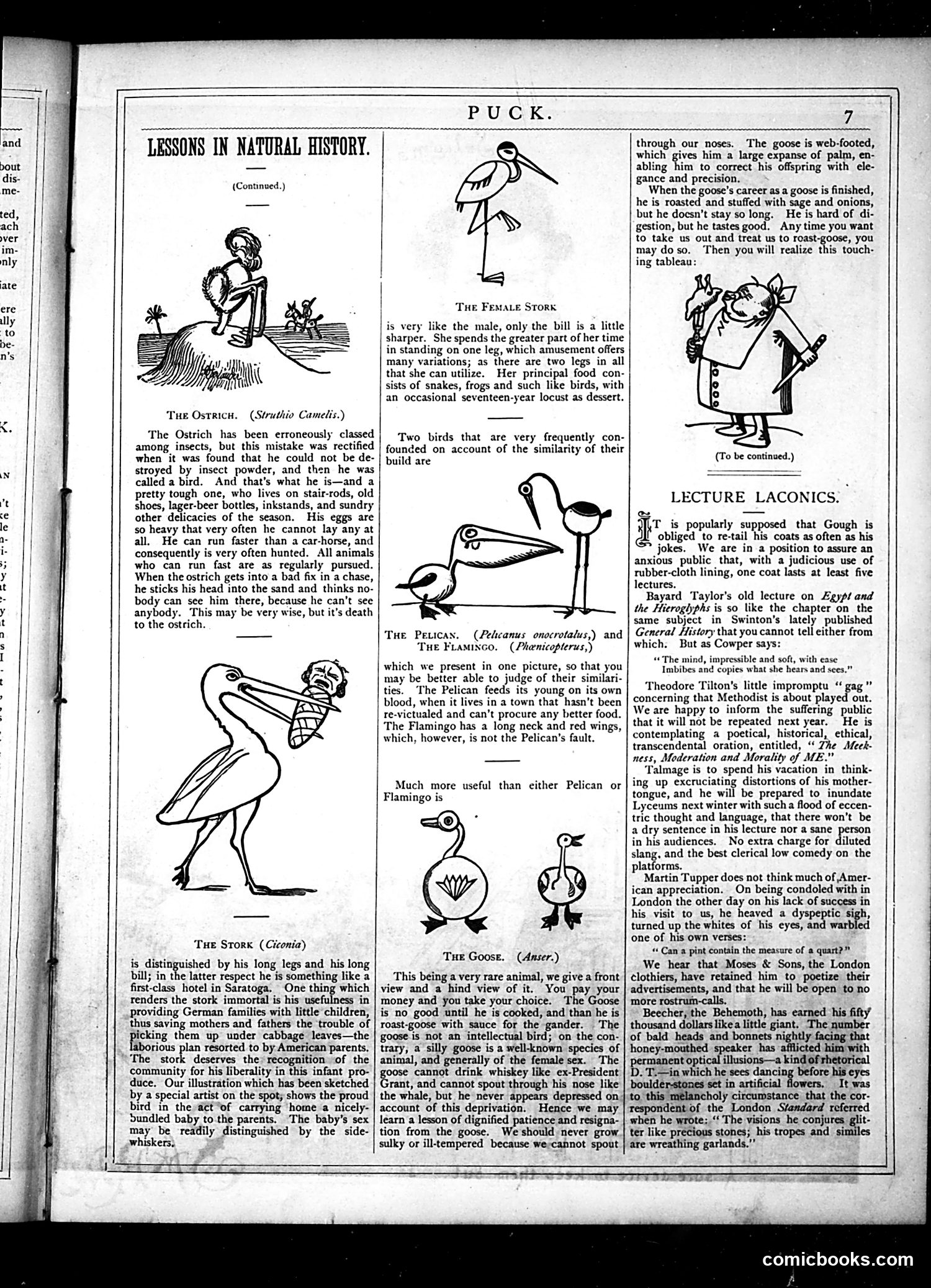
This page is primarily educational/humorous rather than political satire. It presents illustrated descriptions of various birds—the Ostrich, Female Stork, Pelican, Flamingo, and Goose—with accompanying text that blends genuine natural history with comedic observations. The humor derives from anthropomorphizing these birds, attributing human characteristics and behaviors. For example, the Ostrich is jokingly described as "a pretty tough one" who eats "old shoes, lager-beer bottles, inkstands." The Goose section includes satirical commentary about human foibles reflected through bird behavior. The final section, "Lecture Laconics," appears to mock various public figures and lecturers of the era through brief, witty jabs—though specific identities are unclear without additional context. Overall, this is Puck's characteristic blend of natural science with social comedy.
📄 Transcribed text from this page (OCR, searchable)
Machine-transcribed from the original scan — historical spelling and the odd misread are preserved.
"t 7 LESSONS IN NATURAL HISTORY. (Continued.) Tue Ostricu. (Struthio Camelis.) The Ostrich has been erroneously classed among insects, but this mistake was rectified when it was found that he could not be de- stroyed by insect powder, and then he was called a bird. And that’s what he is—and a pretty tough one, who lives on stair-rods, old shoes, lager-beer bottles, inkstands, and sundry other delicacies of the season. His eggs are so heavy that very often he cannot lay any at all. He can run faster than a car-horse, and consequently is very often hunted. All animals who can run fast are as regularly pursued. When the ostrich gets into a bad fix in a chase, he sticks his head into the sand and thinks no- body can sce him there, because he can’t see anybody. This may be very wise, but it's death to the ostrich. Tue Stork (Ciconia) is eeinpulshed by his long legs and his long bill; in the latter respect he is something like a first-class hotel in Saratoga. One thing which renders the stork immortal is his usefulness in providing German families with little ‘children, thus saving mothers and fathers the ‘trouble of picking them up under cabbage leaves—the rious pee resorted to by American parents, ‘The stork deserves the» recognition of the community for his liberality in this infant pro- duce. Our illustration which has been sketched by a special artist on the spot; shows the proud bird in the actof carrying ‘home a nicely- Dundled baby tothe parents. The baby’s sex may be readily distinguished by the side- Tue Femae Stork is very like the male, only the bill is a little sharper. She spends the greater part of her time in standing on one leg, which amusement offers many variations; as there are two legs in all that she can utilize. Her principal food con- sists of snakes, frogs and such like birds, with an occasional seventeen-year locust as dessert. Two birds that are very frequently con- founded on account of the similarity of their build are THe Pewican. (Fedcanus onocrotalus,) and Tue Framinco. (Phenicopterus,) which we present in one picture, so that you may be better able to judge of their similari- ties. The Pelican feeds its young on its own blood, when it lives in a town that hasn’t been re-victualed and can’t procure any better food. ‘The Flamingo has a long neck and red wings, which, however, is not the Pelican’s fault. Much more useful than either Pelican or Flamingo is Tue Goose. (Anser.) This being a very rare animal, we give a front view and a hind view of it. You pay your money and you take your choice. The Goose is no good until he is cooked, and than he is roast-goose with sauce for the gander. . The goose is not an intellectual bird; on the con- trary, a silly goose is a well-known species of animal, and generally of the female sex. The oose cannot drink whiskey like ex-President through our noses. The goose is web-footed, which gives him a large expanse of palm, en- abling him to correct his offspring with ele- gance and precision, When the goose’s career as a goose is finished, he is roasted and stuffed with sage and onions, but he docsn’t stay so long. He is hard of di- gestion, but he tastes good. Any time you want to take us out and treat us to roast-goose, you may do so. Then you will realize this touch- ing tableau: (To be continued.) LECTURE LACONICS. i is popularly supposed that Gough is obliged to re-tail his coats as often as his jokes. We are in a position to assure an anxious public that, with a judicious use of rubber-cloth lining, one coat lasts at least five lectures. Bayard Taylor’s old lecture on Egypt and the Hieroglyphs is so like the chapter on the same subject in Swinton’s lately published General History that you cannot tell either from which, But as Cowper says: “The mind, impressible and soft, with ease Imbibes and copies what she hears and sees.” Theodore Tilton’s little impromptu “ gag” concerning that Methodist is about played out. We are happy to inform the suffering public that it will not be repeated next year. He is contemplating a poetical, historical, ethical, transcendental oration, entitled, “‘ Zhe Meck- ness, Moderation and Morality of ME.” ‘Talmage is to spend his vacation in think- ing up excruciating distortions of his mother- tongue, and he will be prepared to inundate Lyceums next winter with such a flood of eccen- tric thought and language, that there won't be a dry sentence in his lecture nor a sane person in his audiences. No extra charge for diluted slang, and the best clerical low comedy on the platforms. Martin Tupper does not think much of Amer- ican appreciation. On being condoled with in London the other day on his lack of success in his visit to us, he heaved a dyspeptic sigh, turned up the whites of his eyes, and warbled one of his own verses: «Can a pint contain the measure of a quart?” We hear that Moses & Sons, the London clothiers, have retained him to poetize their advertisements, and that he will be open to no more rostrum-calls. Beecher, the Behemoth, has earned his fifty thousand dollars likea little giant. The number of bald heads and bonnets nightly: facing that honey-mouthed eee has affli him with fom ‘optical illusions—a kind of rhetorical ). T.—in which he sees dancing before his eyes rant, and cannot spout through his nose like account of this deprivation. Hence we may learn a lesson of dignified patience and resigna- tion from the goose. We should never grow. whiskers, sulky or ill-tempered because wescannot spout the whale, but he never appears depressed on | boulder-stones set in artificial Tt was to this mélancholy circumstance that the cor- respondent of the London Standard referred when he wrote: ‘‘ The visions he conjures glit- ter like precious stones; his tropes and similes are wreathing garlands. comicbooks.com