
Puck, 1877-06-27 · page 3 of 16
Puck — June 27, 1877 — page 3: what you’re looking at
What you’re looking at
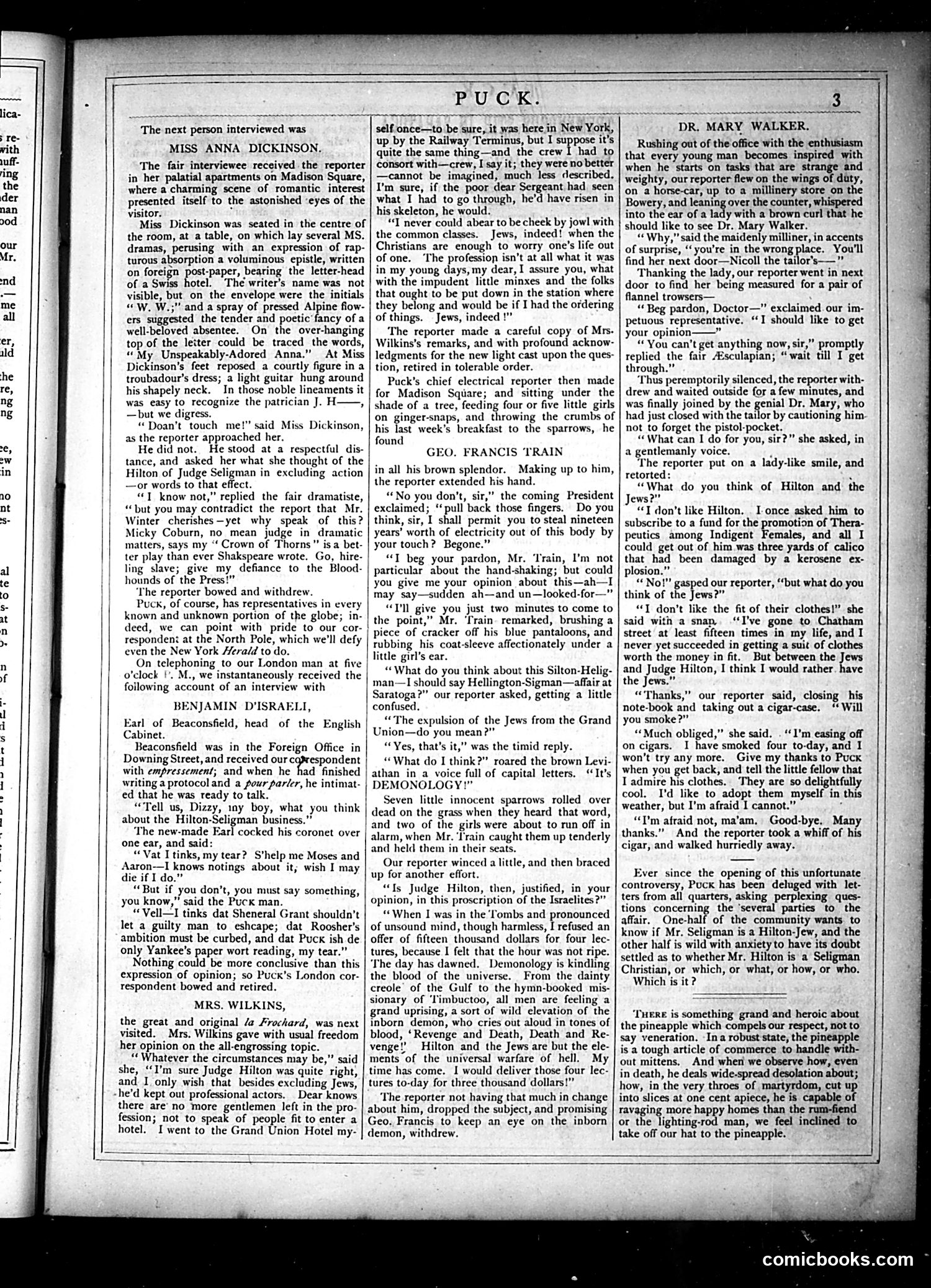
This page contains interviews with notable figures rather than political cartoons. The visible interviews include: - **Miss Anna Dickinson**: A lecturer discussed for her eloquent speaking style and her romantic interests - **Dr. Mary Walker**: A physician noted for her unconventional dress and progressive views - **Geo. Francis Train**: An eccentric businessman whose controversial opinions on Jews and other topics are mocked through the reporter's deliberately naive questioning - **Benjamin Disraeli**: Referenced as head of the English Cabinet The satire works by having reporters pose innocent questions that expose these figures' peculiarities and contradictions. The piece particularly ridicules Train's inflammatory rhetoric about Jews and his general bombast, using his own words against him through deadpan interviewing technique. This reflects 19th-century Puck's approach: humoring public figures through careful questioning rather than direct caricature.
📄 Transcribed text from this page (OCR, searchable)
Machine-transcribed from the original scan — historical spelling and the odd misread are preserved.
The next person interviewed was MISS ANNA DICKINSON. ‘The fair interviewee received the reporter in her palatial apartments on Madison Square, where a charming scene of romantic interest presented itself to the astonished ‘eyes of the visitor. . Miss Dickinson was seated in the centre of the room, at a table, on which lay several MS. dramas, perusing with an expression of rap- turous absorption a voluminous epistle, written on foreign pom nape bearing the letter-head of a Swiss hotel. The writer's name was not visible, but on the envelope were the initials «W. W.;”' and a spray of pressed Alpine fiow- ers suggested the tender and poetic’ fancy of a well-beloved absentee. On the over-hanging top of the letter could be traced the words, «My Unspeakably-Adored Anna.” At Miss Dickinson's feet reposed a courtly figure in a troubadour’s dress; a light guitar hung around his shapely neck. In those noble lineaments it was easy to recognize the patrician J. H—, —but we digress. “Doan’t touch me!” said Miss Dickinson, as the reporter approached her. He did not. He stood at a respectful dis- tance, and asked her what she thought of the Hilton of Judge Seligman in excluding action —or words to that effect. “T know not,” replied the fair dramatiste, “but you may contradict the report that Mr. Winter cherishes—yet why speak of this? Micky Coburn, no mean judge in dramatic matters, says my “‘ Crown of Thorns" isa bet- ter play than ever Shakspeare wrote. Go, hire- ling slave; give my defiance to the Blood- hounds of the Press!” ‘The reporter bowed and withdrew. Puck, of course, has representatives in every known and unknown portion of the globe; in- deed, we can point with pride to our cor- } respondeni at the North Pole, which we'll defy even the New York Heradd to do. On telephoning to our London man at five o'clock |’, M., we instantaneously received the following account of an interview with BENJAMIN D'ISRAELI, Earl of Beaconsfield, head of the English Cabinet. Beaconsfield was in the Foreign Office in Downing Street, and received our cqyrespondent with empressement; and when he had finished writing a protocol and a pour parler, he intimat- | ed that he was ready to talk. “Tell us, Dizzy, ny boy, what you think about the Hilton-Seligman business.”’ ‘The new-made Earl cocked his coronet over one ear, and said: “Vat I tinks, my tear? S'help me Moses and Aaron—I knows notings about it; wish I may die if I do.” “But if you don’t, you must say something, you know,” said the Puck man. “‘Vell—I tinks dat Sheneral Grant shouldn't let a guilty man to eshcape; dat Roosher’s ambition must be curbed, and dat Puck ish de only vankee’s pepe wort reading, my tear.”” Nothing could be more conclusive than this expression of opinion; so Puck’s London cor- respondent bowed and retired. MRS. WILKINS, the great and original /a Frochard, was next visited. Mrs. Wilkins gave with usual freedom her opinion on the all-engrossing topic. “Whatever the circumstances may be," said she, “I'm sure Judge Hilton was quite right, and I. only wish that besides excluding Jews, -he’d kept out professional acto: Dear knows there are’ no more gentlemen left in the pro- fession; not to speak of people fit to enter a hotel. I went to the Grand Union Hotel my- self. once—to be sure,.it was herein New York, up by the Railway Terminus, but I suppose it’s quite the same thing—and the crew I had to consort with—crew, I say it; they were no better —cannot be imagined, much less described. I'm sure, if the poor dear Sergeant had seen what I had to go through, he'd have risen in his skeleton, he would. “T never could abear to be cheek by jowl with the common classes. Jews, indeed! when the Christians are enough to worry one’s life out of one. ‘The profession isn’t at all what it was in my young days, my dear, I assure you, what with the impudent little minxes and the folks that ought to be put down in the station where they belong and would be if I had the ordering of things. Jews, indeed !"" ‘The reporter made a careful copy of Mrs. Wilkins’s remarks, and with profound acknow- ledgments for the new light cast upon the ques- tion, retired in tolerable order. Puck’s chief electrical reporter then made for Madison Square; and sitting under the shade of a tree, feeding four or five little girls on ginger-snaps, and throwing the crumbs of his last week's breakfast to the sparrows, he found GEO. FRANCIS TRAIN in all his brown splendor. Making up to him, the reporter extended his hand. “No you don't, sir,” the coming President exclaimed; ‘pull back those fingers. Do you think, sir, I shall permit you to steal nineteen years’ worth of electricity out of this body by your touch? Begone.” “1 beg your pardon, Mr. ‘Train, I'm not particular about the hand-shaking; but could you give me your opinion about this—ah- may say—sudden ah—and un—looked-for— “Tl give you just two minutes to come to the point,” Mr. ‘Train. remarked, brushing a piece of cracker off his blue pantaloons, and rubbing his coat-sleeve affectionately under a little girl’s ear. “What do you think about this Silton-Helig- man—I should say Hellington-Sigman—affair at Saratoga?” our reporter asked, getting a little confused. “The expulsion of the Jews from the Grand jon—do you mean?” “Yes, that’s it,” was the timid reply. “What do I think?” roared the brown Levi- athan in a voice full of capital letters, “It’s DEMONOLOGY!" Seven little innocent sparrows rolled over dead on the grass when they heard that word, and two of the girls were about to run off in alarm, when Mr. ‘Train caught them up tenderly and held them in their seats. Our reporter winced a little, and then braced up for another effort. “Is Judge Hilton, then, justified, in your opinion, in this proscription of the Israelites?” “When I was in the ‘Tombs and pronounced of unsound mind, though harmless, I refused an offer of fifteen thousand dollars for four lec- tures, because I felt that the hour was not ripe. ‘The day has dawned. Demonology is kindling the blood of the universe. From the dainty creole’ of the Gulf to the hymn-booked mis- sionary of ‘l'imbuctoo, all men are feeling a grand uprising, a sort of wild elevation of the inborn demon, who cries out aloud in tones of blood, ‘Revenge and Death, Death and Re- venge!’ Hilton and the Jews are but the ele- ments of the universal warfare of hell. My time has come. I would deliver those four lec- tures to-day for three thousand dollars!” ‘The reporter not having that much in change about him, dropped the subject, and promising Geo. Francis to keep an eye on the inborn demon, withdrew. DR. MARY WALKER. Rushing out of the office with the enthusiasm that every young man becomes inspired with when he starts on tasks that are strange and weighty, our reporter flew on the wings of daty, on a horse-car, up to a millinery store on the Bowery, and leaning over the counter, whispered into the ear of a lady with a brown curl that he should like to see Dr. Mary Walker. “Why,” said the maidenly milliner, in accents of surprise, ‘‘ you're in the wrong place. You'll find her next door—Nicoll the tailor's—” Thanking the lady, our reporter went in next door to find her being measured for a pair of flannel trowsers— . “Beg pardon, Doctor—” exclaimed. our im- petuous representative. ‘I should like to get your opinion" “You can’t get anything now, sir,” promptly replied the fair Asculapian; “wait till I get through.” ‘Thus peremptorily silenced, the reporter with- drew and waited outside for a few minutes, and was finally joined by the genial Dr. Mary, who had just closed with the tailor by cautioning him- not to forget the pistol-pocket. “What can I do for you, sir?” she asked, in a gentlemanly voice. j ‘The reporter put on a lady-like smile, and retorted: : “What do you think of Hilton and the jews?" “I don’t like Hilton. _ I-once asked him to subscribe to a fund for the promotion of Thera- peutics among Indigent ais, and all I could get out of him was three yards of calico that had been damaged by a kerosene ex- plosion.”” ‘ No!” gasped our reporter, “‘but what do you think of the Jews?” “1 don’t like the fit of their clothes!” she said with a snap, “I’ve gone to Chatham street at least fifteen times in my life, and I never yet succeeded in getting a suit of clothes worth the money in fit. But between the Jews and Judge Hilton, I think I would rather. have the Jews.” “Thanks,” our reporter said, closing his note-book and taking out a cigar-case. “Will you smoke?” “Much obliged,” she said. . I'm easing off on cigars. I have smoked four to-day, and I won't try any more. Give my thanks to Puck when you get back, and tell the little fellow that I admire his clothes. They are so delightfully cool. I'd like to adopt them myself in this weather, but I'm afraid I cannot.” . “I'm afraid not, ma'am, Good-bye. Many thanks.” And the reporter took a whiff of his cigar, and walked hurriedly away. Ever since the opening of this unfortunate controversy, Puck has been deluged with let- ters from all quarters, asking perplexing ques- tions concerning the ‘several parties to the affair. One-half of the community wants. to know if Mr. Seligman is a Hilton-Jew, and the other half is wild with anxiety to have its doubt settled as to whether Mr. Hilton is a Seligman Christian, or which, or what, or how, or who. Which is it ? ‘Tuere is something grand and heroic about the pineapple which compels our respect, not to say veneration. -In a robust state, the pineapple is a tough article of commerce to handle with- out mittens. And when we observe how, even in death, he deals wide-spread desolation about; how, in the very throes of martyrdom, cut uj into slices at one cent apiece, he is capable o' rum-fiend ravaging more happy homes than the or the ff ghting.rod man, we feel inclined to take off our hat to the pineapple. comicbooks.com