
Puck, 1877-06-27 · page 2 of 16
Puck — June 27, 1877 — page 2: what you’re looking at
What you’re looking at
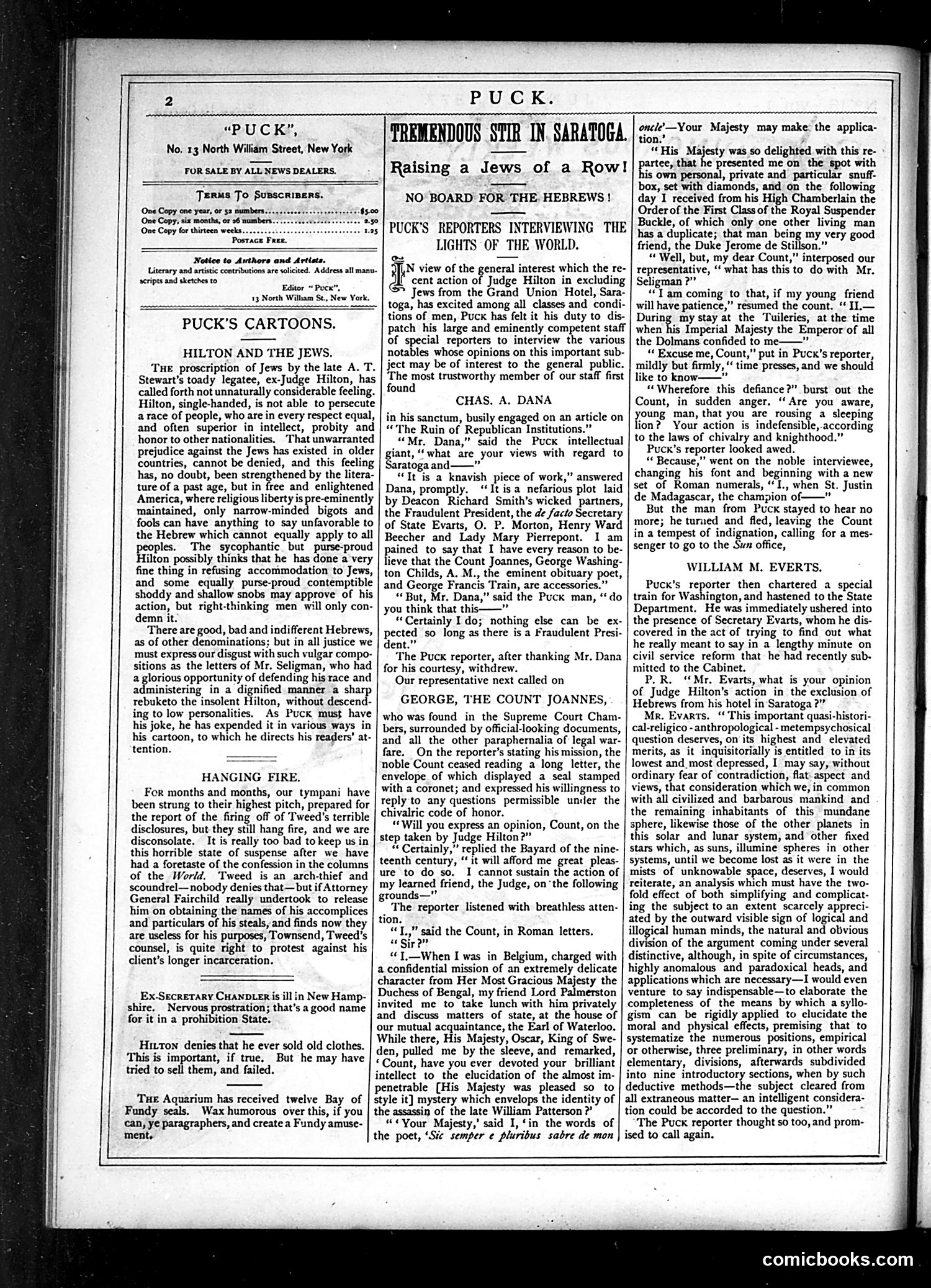
This page combines satirical articles and commentary rather than visual cartoons. The main content critiques **Judge Hilton's exclusion of Jews from the Grand Union Hotel in Saratoga** — a real historical incident involving discrimination. The satire targets Hilton's anti-Semitic actions through interviews with various figures ("Puck's Reporters Interviewing the Lights of the World"). Contributors mock Hilton's prejudice by comparing it to un-American values and questioning his authority to exclude citizens. Other brief items satirize contemporary figures: **Ex-Secretary Chandler's** "nervous prostration," and **Tweed's** firing, likely referencing the notorious Boss Tweed. The tone is indignant moral commentary wrapped in satirical questioning — Puck using humor and rhetoric to oppose discrimination rather than visual caricature.
📄 Transcribed text from this page (OCR, searchable)
Machine-transcribed from the original scan — historical spelling and the odd misread are preserved.
PUCK. “PUCK”, No, 13 North William Street, New York FOR SALE BY ALL NEWS DEALERS. Terus To Supscriners. Notice to Authors and Artiste. Literary and artistic contributions are solicited. Address all manu- scripts and sketches to Editor “ Puck”, 13 North William St, New York. PUCK’S CARTOONS. HILTON AND THE JEWS. Tue proscription of Jews by the late A. T. Stewart's toady legatee, ex-Judge Hilton, has called forth not unnaturally considerable feeling. Hilton, single-handed, is not able to persecute arace of people, who are in every respect equal, and often superior in intellect, probity and honor to other nationalities, ‘That unwarranted prejudice against the Jews has existed in older countries, cannot be denied, and this feeling has, no doubt, been strengthened by the litera- ture of a past age, but in free and enlightened America, where religious liberty is pre-eminently maintained, only harrow-minded, bigots and fools can have anything to say unfavorable to the Hebrew which cannot equally apply to all ples. The sycophantic but purse-proud Hilton possibly thinks that he has done a very fine thing in refusing accommodation to Jews, and some equally purse-proud contemptible shoddy and shallow snobs may approve of his action, but right-thinking men will only con- demn it. There are good, bad and indifferent Hebrews, as of other denominations; but in all justice we must express our disgust with such vulgar compo- sitions as the letters of Mr. Seligman, who had a glorious opportunity of defending his race and administering in a dignified manner a shai rebuketo the insolent Hilton, without descend. ing to low personalities. As Puck must have his joke, he has expended it in various ways in his cartoon, to which he directs his readers’ at- tention. HANGING FIRE. For months and months, our tympani have been strung to their highest pitch, prepared for the report of the firing off of Tweed’s terrible disclosures, but they still hang fire, and we are disconsolate. It is really too bad tokeep us in this horrible state of suspense after we have had a foretaste of the confession in the columns of the World. Tweed is an arch-thief and scoundrel—nobody denies that—but if Attorney General Fairchild really undertook to release him on obtaining the names of his accomplices and particulars of his steals, and finds now they are useless for his purposes, Townsend, Tweed’s counsel, is quite right to protest against his client's longer incarceration. Ex-SecreTary CHANDLER i New Hamp- shire. Nervous prostration; that’s a good name for it in a prohibition State. Hitton denies that he ever sold old clothes. This is important, if true. But he may have tried to sell them, and failed. ‘Tue Aquarium has received twelve Bay of Fundy seals. Wax humorous over this, if you can, ye paragraphers, and create a Fundy amuse- ment, TREMENDOUS STIR IN. SARATOGA. Raising a Jews of a Row! NO’ BOARD FOR: THE, HEBREWS ! PUCK'’S REPORTERS INTERVIEWING THE LIGHTS OF THE WORLD. (i view of the general interest which the re- cent action of Judge Hilton in excluding Jews from the Grand Union Hotel, Sara- toga, has excited among all classes and condi- tions of men, Puck has felt it his duty to dis- patch his large and eminently competent staff of special reporters to interview the various notables whose opinions on this important sub- ject may be of interest to the general public. The most trustworthy member of our staff first found oe CHAS. A. DANA in his sanctum, busily engaged on an article on “The Ruin of Republican Institutions.” “Mr. Dana,” said the Puck intellectual jiant, “what are your views with regard to Scratoga and——” “It is a knavish piece of work,” answered Dana, promptly. ‘It isa nefarious plot laid by Deacon Richard Smith's wicked partners, the Fraudulent President, the de facto Secretary of State Evarts, O. P. Morton, Henry Ward Beecher and Lady Mary Pierrepont. I am pane to say that I have every reason to be- lieve that the Count Joannes, George Washing- ton Childs, A. M., the eminent obituary poet, and George Francis Train, are accessories.” “But, Mr. Dana,” said the Puck man, ‘do you think that this——” “Certainly Ido; nothing else can be ex- pected so long as there is a Fraudulent Presi- dent.” ‘The Puck reporter, after thanking Mr, Dana for his courtesy, withdrew. Our representative next called on GEORGE, THE COUNT JOANNES, who was found in the Supreme Court Cham- bers, surrounded by official-looking documents, and’ all the other paraphernalia of legal war- fare. On the reporter’s stating his mission, the noble Count ceased reading a long letter, the envelope of which displayed a seal stamped with a coronet; and expressed his willingness to reply'to any questions permissible under the chivalric code of honor. “Will you express an opinion, Count, on the step taken by Judge Hilton?” “ Certainly,” replied the Bayard of the nine- teenth century, “‘ it will afford me great pleas- ure to do so. I cannot sustain the action of my learned friend, the Judge, on ‘the following grounds—"” The reporter listened with breathless atten- tion. “1,” said the Count, in Roman letters. “ Sir?” «J,—When I was in Belgium, charged with a.confidential mission of an extremely delicate character from Her Most Gracious Majesty the Duchess of Bengal, my friend Lord Palmerston invited me to take lunch with him privately and discuss matters of state, at the house of our mutual acquaintance, the Earl of Waterloo. While there, His Majesty, Oscar, King of Swe- den, pulled me by the sleeve, and remarked, «Count, have you ever devoted your brilliant intellect to the elucidation of the almost im- penetrable [His Majesty was pleased so to style it] mystery which envelops the identity of the assassin of the late William Patterson ?’ “Your Majesty,’ said I, ‘in the words of the poet, ‘Sic semper e pluribus sabre de mon ‘Your Majesty may make: the applica- tio: c ‘His Majesty was so delighted with this re- rtee, that he presented me on the spot with is own personal, private and particular snuff- box, set with diamonds, and on the following day I received from his High Chamberlain the Order of the First Class of the Royal Suspender Buckle, of which only one other living man hasa duplicates that man being my very good friend, the Duke Jerome de Stillson.” “ Well, but, my dear Count,” interposed our representative, ‘‘ what has this to do with Mr. Seligman ?” “Tam coming to that, if my young friend will have patience,” resumed the count. ‘“ II.— During my stay at the Tuileries, at the time when his Imperial Majesty the Emperor of all the Dolmans confided to me——”” « Excuse me, Count,” put in Puck’s reporter, mildly but firmly, “‘ time presses, and we should like to know——"" “Wherefore this defiance?” burst out the Count, in sudden anger. “Are you aware, oung man, that you are rousing a sleeping ion? Your action is indefensible,.according to the laws of chivalry and knighthood.” Puck's reporter looked awed. “ Because,” went on the noble interviewee, changing his font and beginning with a new set of Roman numerals, “I., when St. Justin de Madagascar, the champion of —” But the man from Puck stayed to hear no more; he turned and fled, leaving the Count in a tempest of indignation, calling for a mes- senger to go to the Swx office, WILLIAM M. EVERTS. Puck’s reporter then chartered a special train for Washington, and hastened to the State Department. He was immediately ushered into the presence of Secretary Evarts, whom he dis- covered in the act of trying to find out what he really meant to say in a lengthy minute on civil service reform that he had recently sub- mitted to the Cabinet. P.R. ‘Mr. Evarts, what is your opinion of Judge Hilton’s action in the exclusion of Hebrews from his hotel in ‘Saratoga ?”” Mr. Evarts. ‘This important quasi-histori- cal-religico anthropological - metempsychosical question deserves, on its highest and elevated merits, as it inquisitorially is entitled to in its lowest and_most depressed, I may say, without ordinary fear of contradiction, flat-aspect and views, that consideration which we, in common with all civilized and barbarous mankind and the remaining inhabitants of this mundane sphere, likewise those of the other planets in this solar and lunar system, and other fixed stars which, as suns, illumine spheres in other systems, until we become lost as it were in the mists of unknowable space, deserves, I would reiterate, an analysis which must have the two- fold effect of both simplifying and complicat- ing the subject to an extent scarcely appreci- ated by the outward visible sign of logical and illogical human minds, the natural and obvious division of the argument coming under several distinctive, although, in spite of circumstances, highly anomalous and paradoxical heads, and applications which are necessary—I would even venture to say indispensable—to elaborate the completeness of the means by which a syllo- gism can be rigidly applied to elucidate the moral and physical effects, premising that to systematize the numerous positions, empirical or otherwise, three preliminary, in other words elementary, divisions, afterwards subdivided into nine introductory sections, when by such deductive methods—the subject cleared from all extraneous matter— an intelligent considera- tion could be accorded to the question.”” The Puck reporter thought so too, and prom- ised to call again. comicbooks.com