
Puck, 1877-06-27 · page 13 of 16
Puck — June 27, 1877 — page 13: what you’re looking at
What you’re looking at
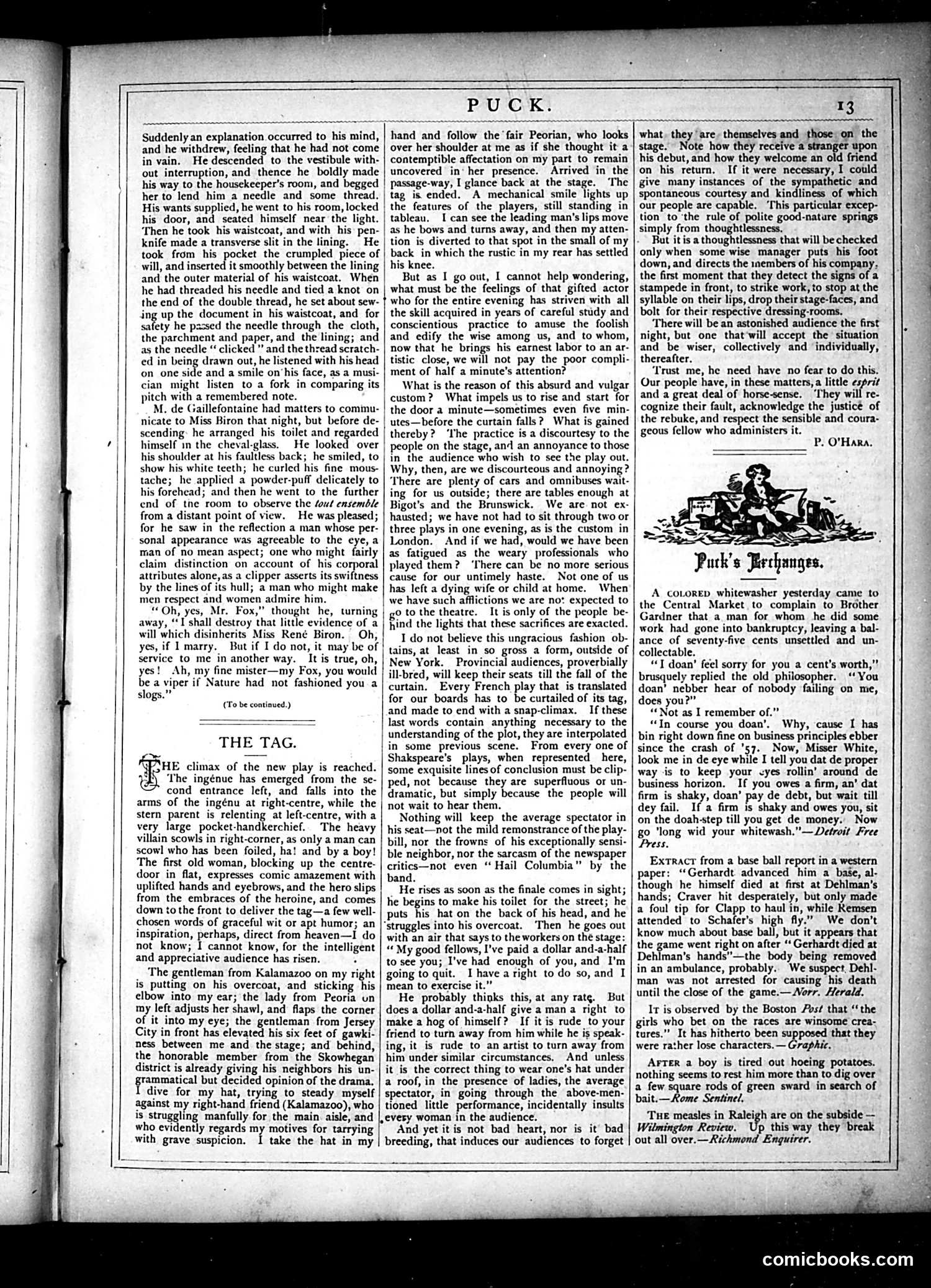
This page contains two distinct sections: a theater review ("PUCK") and a separate satirical piece ("THE TAG"). **"PUCK" section:** A critic discusses a new play's climax, critiquing the artificiality of theatrical conventions. The review mocks both actors' excessive mannerisms and audiences' gullible acceptance of obvious dramatic tricks. It's a meta-commentary on Victorian theater's overwrought style. **"THE TAG" section:** This appears to be a satirical anecdote about a gentleman adjusting his overcoat and hat in public—apparently a commentary on propriety and masculine vanity. The piece ridicules social pretension, suggesting that concerns about appearance ("wearing one's hat") can become absurdly self-important. Both sections employ Puck's characteristic approach: mocking contemporary social and cultural affectations through witty, observational humor aimed at educated readers.
📄 Transcribed text from this page (OCR, searchable)
Machine-transcribed from the original scan — historical spelling and the odd misread are preserved.
Suddenly an explanation occurred to his mind, and he withdrew, feeling that he had not come in vain. He descended to the vestibule with- out interruption, and thence he boldly made his way to the housekeeper’s room, and begged | her to lend him a needle and some thread. His wants supplied, he went to his room, locked | his door, and seated himself near the light. ‘Then he took his waistcoat, and with his: pen- knife made a transverse slit in the linin, He took from his pocket the crumpled piece of will, and inserted it smoothly between the lining and the outer material of his waistcoat. When he had threaded his needle and tied a knot on the end of the double thread, he set about sew- ing up the document in his waistcoat, and for satety he passed the needle through the cloth, the parchment and paper, and the lining; and as the needle “‘ clicked ” and the thread scratch- ed in being drawn out, he listened with his head on one side and a smile on‘his face, as a musi- cian might listen to a fork in comparing its pitch with a remembered note. M. de Gaillefontaine had matters to commu- nicate to Miss Biron that night, but before de- scending: he arranged his toilet and regarded himself in the cheval-glass. He looked over his shoulder at his faultless back; he smiled, to show his white teeth; he curled his fine mous- tache; he applied a powder-puff delicately to his forehead; and then he went to the further end of the room to observe the lout ensemble from a distant point of view. He was pleased; for he saw in the reflection a man whose per- sonal appearance was agreeable to the eye, a man of no mean aspect; one who might fairly claim distinction on account of his corporal attributes alone, as a clipper asserts its swiftness by the lines of its hull; a man who might make men respect and women admire him. “Oh, yes, Mr. Fox,” thought he, turning | away, ‘I shall destroy that little evidence of a will which disinherits Miss René Biron. Oh, yes, if I marry. But if I do not, it may be of service to me in another way. It is true, oh, yes! Ah, my fine mister—my Fox, you would be a viper if Nature had not fashioned you a slogs.”” (To be continued.) THE TAG. | —_ ——s \ESHE climax of the new play is reached. rey ‘The ingénue has emerged from the se- cond entrance left, and falls into the arms of the ingénu at right-centre, while the stern parent is relenting at left-centre, with a very large pocket-handkerchief. The heavy villain scowls in right-corner, as only a man can scowl who has been foiled, ha! and by a boy! The first old woman, blocking up the centre- door in flat, expresses comic amazement with uplifted hands and eyebrows, and the hero slips from the embraces of the heroine, and comes down to the front to deliver the tag—a few well- chosen words of graceful wit or apt humor; an inspiration, perhaps, direct from heaven—I do not know; I cannot know, for the intelligent and appreciative audience has risen. . __ The gentleman from Kalamazoo on my right is putting on his overcoat, and sticking his elbow into my ear; the lady from Peoria un my left adjusts her shawl, and flaps the corner of it into my eye; the gentleman from Jerse; City in front has elevated his six feet of gawki- ness between me and the stage; and behind, the honorable member from the Skowhegan district is already giving his neighbors his un- Fammatical but decided opinion of the drama. dive for my hat, trying to steady myself against my right-hand friend (Kalamazoo), who is struggling manfully for the main. aisle, and |, who evidently regards my motives for tarrying with grave suspicion. take the hat in my hand and follow the” Peorian, who looks over her shoulder at me as if she thought it a contemptible affectation on my part to remain uncovered in‘ her presence. Arrived in the passage-way, I glance back at the stage. The tag is ended. A mechanical smile lights up the features of the players, still standing in tableau. I can see the leading man’s lips move as he bows and turns away, and then my atten- tion is diverted to that spot in the small of my back in which the rustic in my rear has settled his knee. But as I go out, I cannot help wondering, what must be the feelings of that gifted actor who for the entire evening has striven with all the skill acquired in years of careful study and conscientious practice to amuse the foolish and edify the wise among us, and to whom, now that he brings his earnest labor to an ar- tistic close, we will not pay the poor compli- ment of half a minute's attention? What is the reason of this absurd and vulgar custom? What impels us to rise and start for the door a minute—sometimes even five min- utes—before the curtain falls? What is gained thereby? ‘I'he practice is a discourtesy to the people on the stage, and an annoyance to those in the audience who wish to see the play out. Why, then, are we discourteous and annoying? ‘There are plenty of cars and omnibuses wait- ing for us outside; there are tables enough at Bigot’s and the Brunswick. We are not ex- hausted; we have not had to sit through two or three plays in one evening, as is the custom in London. And if we had, would we have been as fatigued as the weary professionals who played them? ‘There can be no more serious cause for our untimely haste. Not one of us has left a dying wife or child at home. When we have such afflictions we are no: expected to 0 to the theatre. It is only of the people be- hind the lights that these sacrifices are exacted. I do not believe this ungracious fashion ob- tains, at least in so gross a form, outside of New York. Provincial audiences, proverbially ill-bred, will keep their seats till the fall of the curtain, Every French play that is translated for our boards has to be curtailed of its tag, and made to end with a snap-climax. If these last words contain anything necessary to the | understanding of the plot, they are interpolated in some previous scene. From every one of Shakspeare’s plays, when represented here, some exquisite lines of conclusion must be clip- ped, not because they are superfluous or un- dramatic, but simply because the people will not wait to hear them. Nothing will keep the average spectator in his seat—not the mild remonstrance of the play- bill, nor the frowns of his exceptionally sensi- ble neighbor, nor the sarcasm of the newspaper critics—not even ‘Hail Columbia” by the band. _ He rises as soon as the finale comes in sight; he begins to make his toilet for the street; he puts his hat on the back of his head, and he “struggles into his overcoat. Then he goes out with an air that says to the workers on thé stage: “ My good fellows, I've paid a dollar and-a-half to see you; I’ve had enough of you, and I'm going to quit. Ihave a right todo so, and I mean to exercise it.” He probably thinks this, at any rat. But does a dollar and-a-half give a man a right to make a hog of himself? If it is rude to your friend to turn away from him while he is speak- ing, it is rude to an artist to turn away from him under similar circumstances, And unless it is the correct thing to wear one’s hat under a roof, in the presence of ladies, the average spectator, in going through the above-men- tioned little performance, incidentally insults every woman in the audience. And yet it is not bad heart, nor is it’ bad breeding, that induces our audiences to forget 13 what, they “are. themselves and those on the stage. Note how they receive a stranger upon his debut, and how they welcome an old friend ‘on his return. If it were necessary, I could give many instances of the sympathetic and spontaneous courtesy and kindliness of which our people are capable. ‘This particular excep- tion to ‘the rule of polite good-nature springs simply from thoughtlessness. But it is a thoughtlessness that will be checked only when some wise manager puts his foot down, and directs the inembers of his company. the first moment that they detect the signs of a stampede in front, to strike work, to stop at the syllable on their lips, drop their stage-faces, and bolt for their respective dressing-rooms. ‘There will be an astonished audience the first night, but one that‘will accept the situation and be wiser, collectively and individually, thereafter. ‘Trust me, he need have no fear to do this. Our people have, in these matters, a little esprit and a great deal of horse-sense. ‘They will re- cognize their fault, acknowledge the justicé of the rebuke, and respect the sensible and coura- geous fellow who administers it. Puck's Fechanges. A CoLorep whitewasher yesterday came to the Central Market to complain to Brother Gardner that a_man for whom he did some work had gone into bankruptcy, leaving a bal- ance of seventy-five cents unsettled and un- collectable. “I doan’ feel sorry for you a cent’s worth,” brusquely replied the old philosopher. ‘You doan’ nebber hear of nobody ‘failing on me, does you?” “Not as I remember of.” “In course you doan’. Why, cause I has bin right down fine on business principles ebber since the crash of '57. Now, Misser White, look me in de eye while I tell you dat de proper way is to keep your cyes rollin’ around de business horizon. If you owes a firm, an’ dat firm is shaky, doan’ pay de debt, but wait till dey fail, If a firm is shaky and owes you, sit on the doah-step till you get de money. Now go ‘long wid your whitewash.” —Detroit Free Press. Extract from a base ball report in a western paper: ‘Gerhardt advanced him a base, al- though he himself died at first at Dehlman’s hands; Craver hit desperately, but only made a foul tip for Clapp to haul in, while Remsen attended to Schafer’s high fly.” We don’t know much about base ball, but it appears that the game went right on after ‘‘ Gerhardt died at Dehiman's hands”—the body being removed in an ambulance, probably.. We suspect, Dehl- man was not arrested for causing his death until the close of the game.—Worr. Herald. It is observed by the Boston /os¢ that ‘‘the girls who bet on the races are winsome crea- tures.” It has hitherto been supposed that they were rather lose characters.— Graphic, AFTER a boy is tired out hoeing potatoes. nothing seems to rest him more than to dig over a few square rods of green sward in search of bait.—Kome Sentinel, Tue measles in Raleigh are on the subside — Wilmington Review. Up this way they break out all over.—Richmond Engutrer, comicbooks.com