
A complete issue · 16 pages · 1877
Puck — May 1877
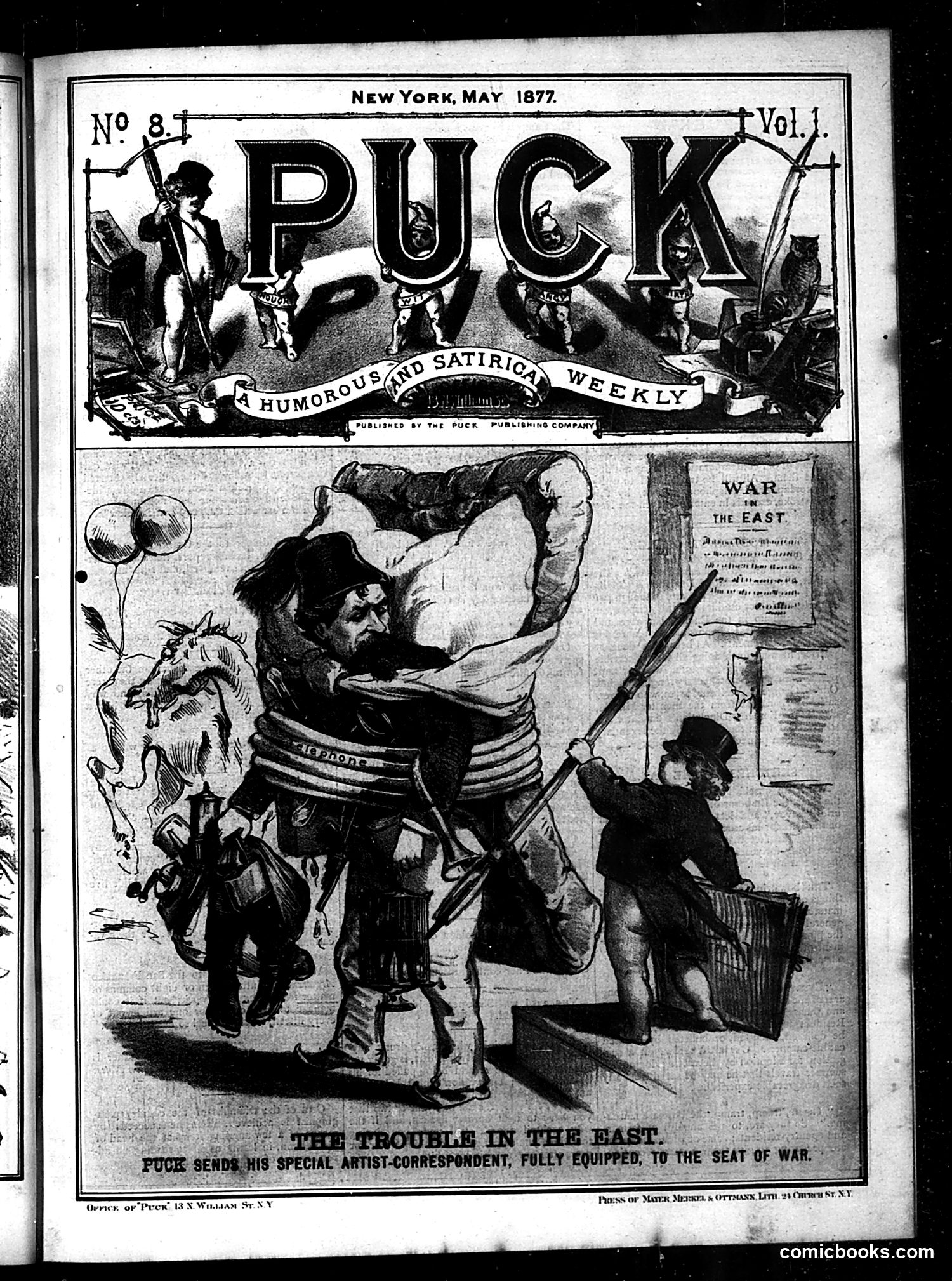
This May 1877 *Puck* cartoon satirizes America's military involvement in Eastern conflicts. The central figure appears to be a bloated military commander or politician (possibly representing the U.S. government or a specific official) who is "fully equipped" for war, as the caption states. He's depicted as grotesquely oversized, carrying weapons and supplies while smaller figures—possibly representing journalists or correspondents—scurry around him with cameras and documents. The sidebar labeled "War in the East" references contemporary conflicts, likely the Russo-Turkish War (1877-78) or similar Eastern European upheaval. The satire mocks American overpreparedness, military excess, or foreign interventionism—suggesting that the U.S. was sending correspondents and resources to cover distant conflicts with unnecessary grandeur. The joke critiques either warmongering impulses or absurd military posturing regarding far-away events.
This page contains editorial commentary and satirical sketches rather than a single cohesive political cartoon. **"The Trouble in the East"** criticizes American newspapers' obsession with distant conflicts while ignoring local issues—a recurring complaint about media priorities. **"The Modern St. George"** appears to satirize President Hayes, comparing him unfavorably to the legendary knight. The sketch suggests Hayes is ineffectual or cowardly in confronting major problems (represented as "the dragon"). **"Sketches of the Day"** includes brief satirical commentary on the Czar, anti-monopoly efforts, and various contemporary figures and social absurdities. The page is primarily opinion-based commentary typical of Puck's approach: political critique mixed with social observation and humor about current events, likely from the 1870s-1880s based on Hayes's presidency reference.
This page contains three separate articles rather than cartoons. The main piece, "Tweed's True Confession," is a satirical letter purporting to be a genuine confession from **William M. Tweed**, the notorious Tammany Hall political boss. The letter mocks Tweed's criminal activities—including bribery, embezzlement, and corruption—while sarcastically claiming he's being forced to confess against his will. The other articles satirize **Chicago politicians** and **religious hypocrisy**, attacking figures who exploit their positions for personal gain while presenting themselves as reformers. The satire targets political corruption endemic to 19th-century American urban politics, particularly the brazen theft and bribery by machine politicians who faced minimal consequences.
This page contains primarily **literary content** rather than political cartoons. The main sections are: 1. **"Moods of Love"** — A poem with romantic verses about courtship and relationships, illustrated with a small decorative figure 2. **"Sayings and Doings"** — Social commentary on current topics, including discussion of Carnival celebrations, temperance debates, and theatrical productions (references to Mark Twain and Bret Harte's play "Ah Sin") 3. **"An Apprentice Wanted"** — A humorous story about a young man responding to a job advertisement, which leads to romantic complications with the advertiser's daughter The cartoons are minimal; the page emphasizes Puck's satirical writing rather than visual political commentary. The humor targets Victorian social conventions and romantic entanglements of the era.
This page contains several literary and social commentary pieces rather than political cartoons. The main sections include: **"Heart's Logic"** and **"Woman's Train"** — poetry about romantic relationships and gender dynamics, reflecting late 19th/early 20th-century attitudes toward courtship and women's roles. **"A Strange Combination"** — a humorous narrative about a gentleman combining artistic pursuits with blacksmithing, and separately running a beer saloon and coffin business from the same storefront. The satire mocks incongruous professional combinations and the absurdity of selling both beer and coffins in one location—likely commentary on urban entrepreneurship or working-class business practicality. **"A Jew D'Esprit"** and **"The Effect of Exposure"** appear to be brief satirical pieces, though details are unclear from the OCR text alone. The page emphasizes literary humor over visual cartooning.
The main cartoon depicts a figure labeled "Mr. Woodin" presenting legislative arguments to what appears to be Albany political authorities. The accompanying Senate debate (April 25th) discusses Woodin's proposal regarding mayoral powers and police commissioners in what seems to be a New York City governance dispute. The satire centers on bureaucratic absurdity—specifically, a debate about whether kissing one's cousin on the cheek constitutes an improper display of affection requiring legal regulation. The cartoon ridicules the legislative tendency to micromanage trivial personal matters while ignoring substantive governance issues. The page also includes advertisements and theatrical announcements, including a notice about Henry the Fifth productions.
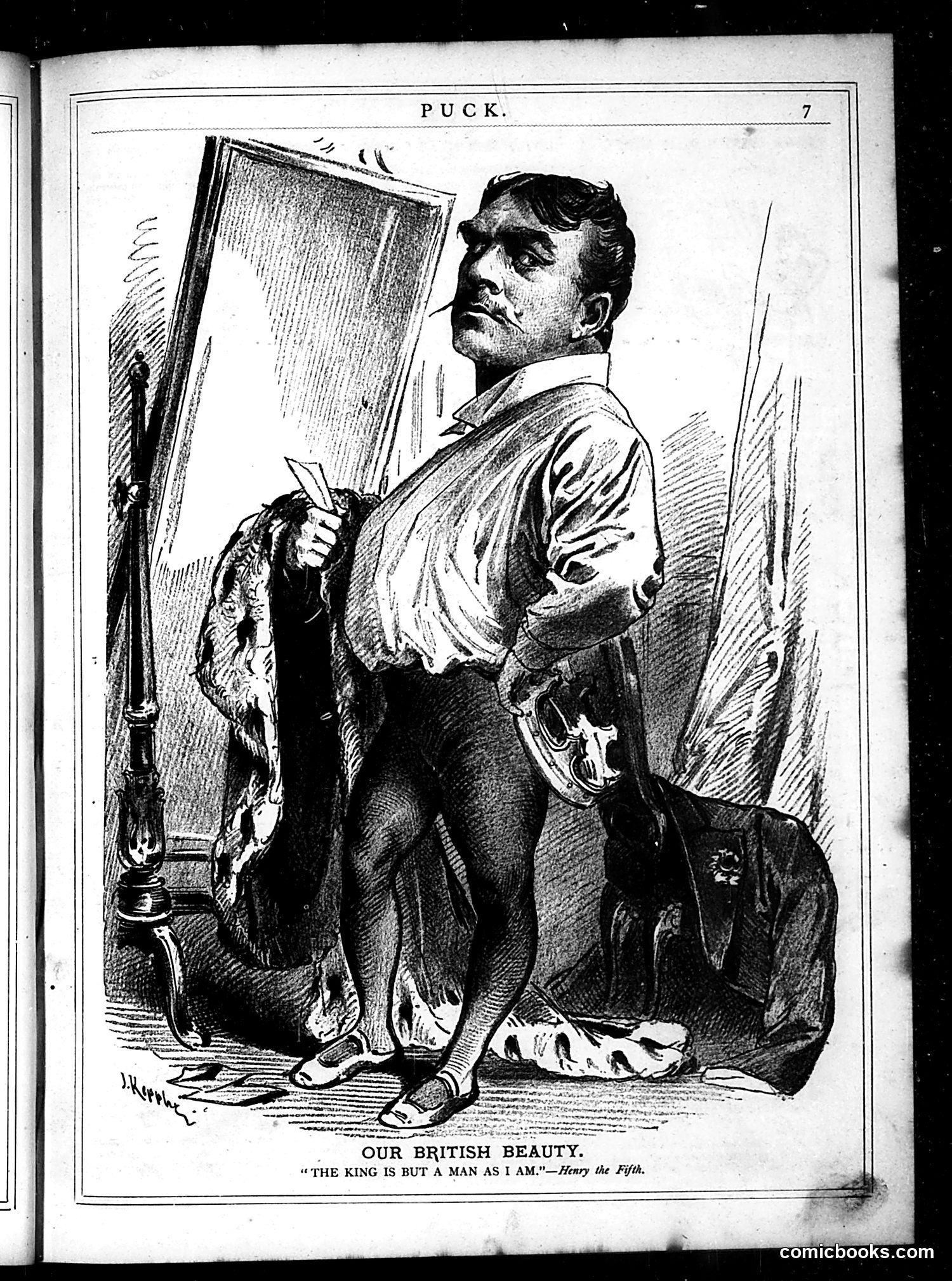
This Puck cartoon satirizes a well-dressed British man admiring himself in a mirror, holding what appears to be game or hunting trophies. The caption quotes Henry the Fifth: "The King is but a man as I am." The satire likely mocks British vanity or pretension—suggesting that despite claims of equality or democratic values ("the King is but a man"), this figure is preoccupied with displays of wealth, status, and sporting conquest. The "British Beauty" title appears ironic, possibly critiquing British imperial self-regard or upper-class affectation during the period. The specific historical reference or targeted individual remains unclear without additional context about Puck's publication date and contemporary British politics.
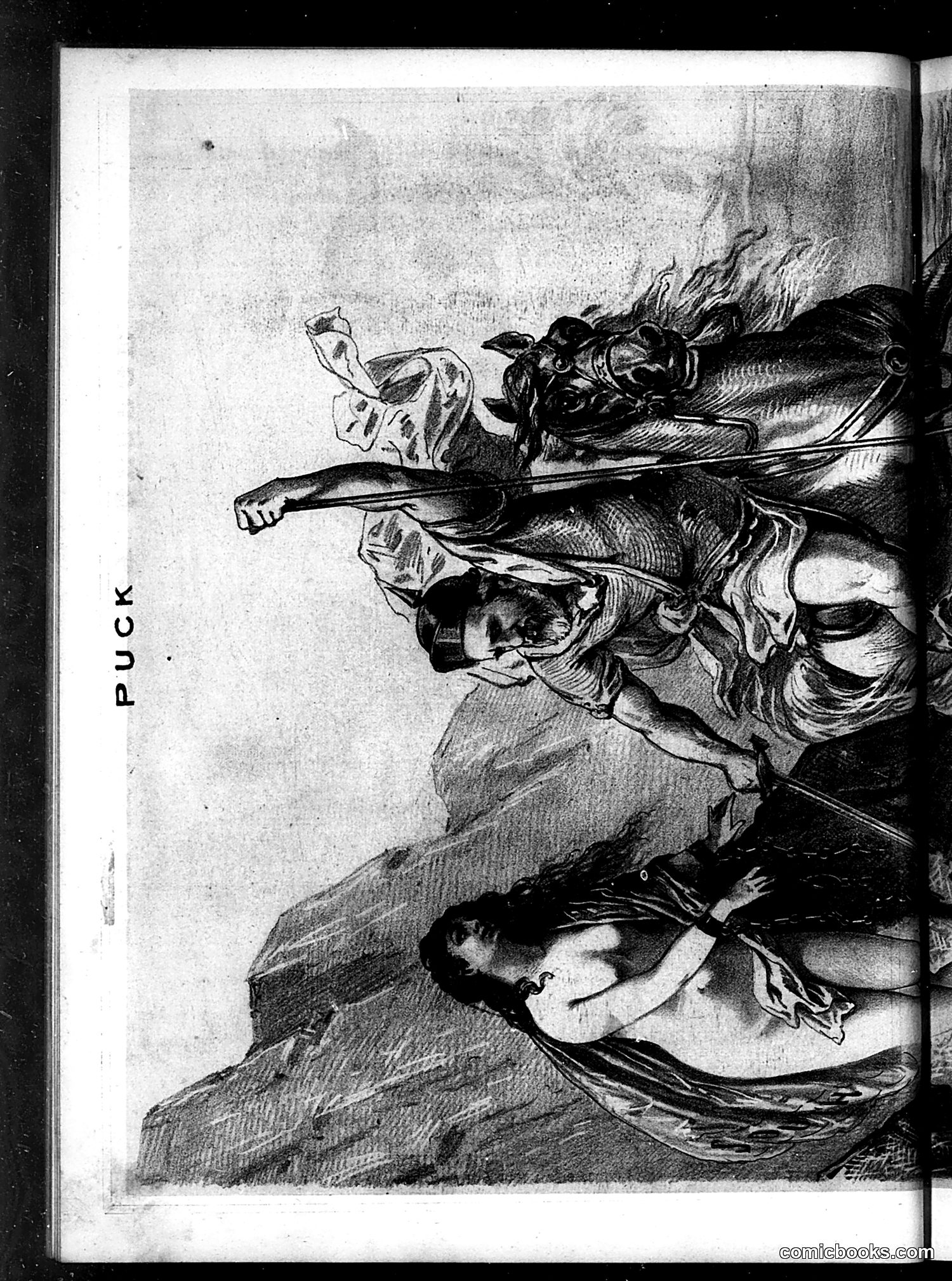
This page shows a single illustration labeled "PUCK" (visible on the left margin). The image depicts a figure in period clothing wielding what appears to be a long staff or pole weapon in an aggressive stance. The figure has curled hair typical of late 18th or 19th-century styling and wears draped clothing. However, without additional OCR text or caption information visible on this page, I cannot definitively identify the specific historical figure being caricatured, the political event being referenced, or the satirical point being made. The artistic style and clothing suggest this is political satire from Puck magazine's era (late 1800s), but determining the exact subject requires either clearer text or additional context I cannot reliably infer from the image alone.
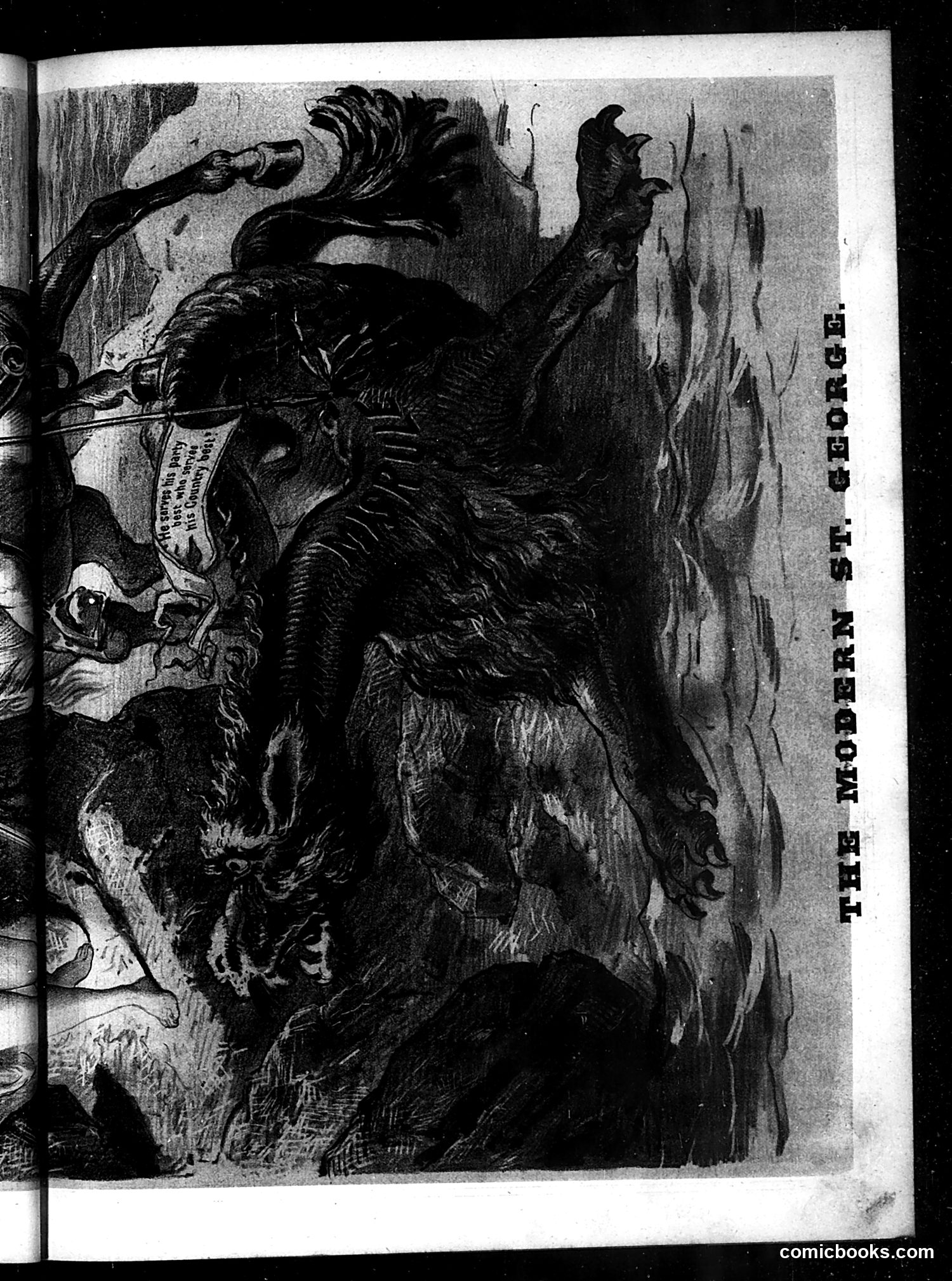
This political cartoon depicts a figure wielding a sword and lance against a dragon-like creature. The title "The Modern St. George" invokes the legendary saint who slew a dragon, suggesting the cartoon's subject is presented as a heroic fighter against evil. The composition shows dramatic action, with the figure in combat stance. Based on Puck magazine's satirical tradition, this likely comments on a contemporary political figure or movement portrayed as heroically battling corruption, tyranny, or another social evil represented by the dragon. Without clearer identification of the specific figure or historical date, the exact political target remains unclear, though the medieval allegory framework was common in Puck's social criticism during the late 19th/early 20th century.
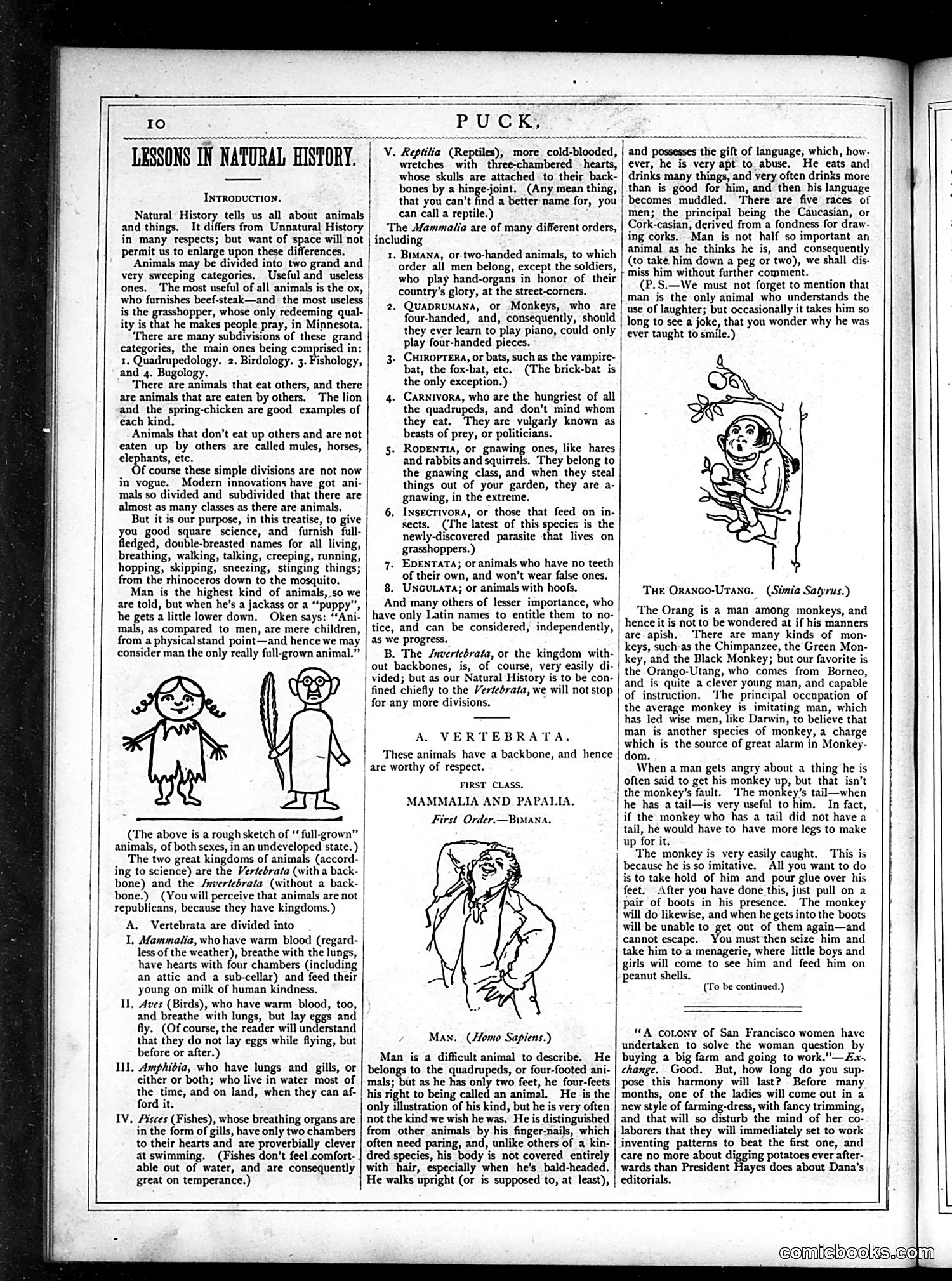
This page is primarily **educational content, not political satire**. It's a "Lessons in Natural History" article explaining animal classification to readers, particularly children. The two small illustrations show: - A sketch labeled as a "rough sketch of 'full-grown' animals, of both sexes, in an undeveloped state"—essentially generic human figures used to introduce biological taxonomy The article systematically categorizes animals from Vertebrata (backbone-bearing creatures) through increasingly specific classes like Mammalia, Aves, and Reptilia, with humorous asides (comparing carnivores to "beasts of prey, or politicians"). The text includes a sidebar about the **Orangutan**, noting its resemblance to humans and its intelligence. This appears to be straightforward science education dressed in Puck's characteristic light, witty tone—not political commentary.
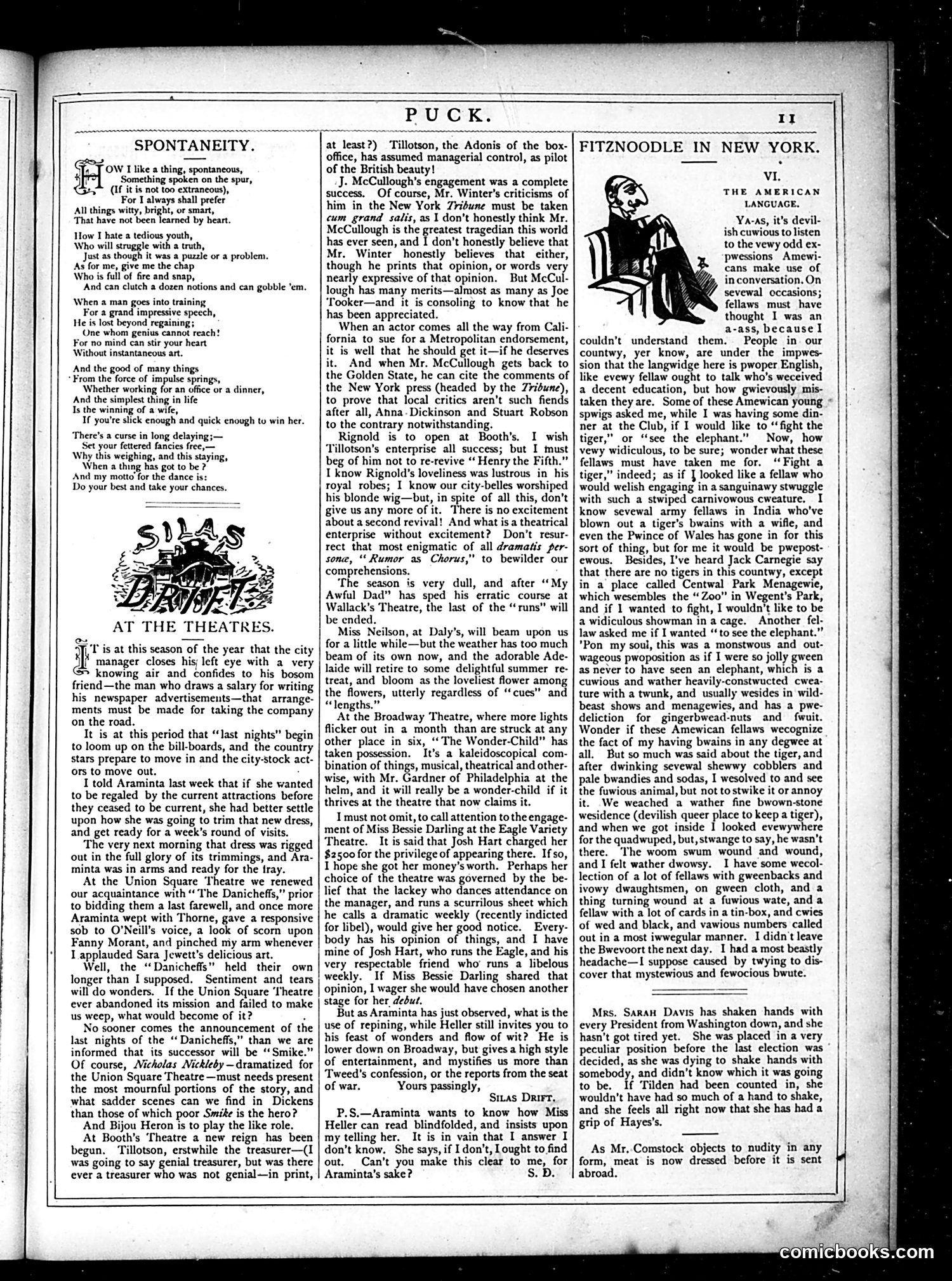
This page contains theater criticism and social commentary rather than political cartoons. The main content includes: **"Spontaneity"** - A poem criticizing affected, pretentious behavior in conversation and social interaction. **"At the Theatres"** - Theater reviews discussing current Broadway productions, including commentary on the "Danaides" (unclear which specific production), Union Square Theatre, and Booth's Theatre. The critic discusses various actors and the quality of performances, appearing to favor Sara Jewett's "Danaides." **"Fitznoodle in New York"** - A satirical essay mocking American pretensions about language, with an illustration of a snobbish character. The piece ridicules Americans who affect British pronunciation and mannerisms, while describing absurd entertainments they've witnessed. The page's satire targets contemporary American social affectation and cultural snobbery rather than specific political figures.
This page contains two distinct pieces: **"A Crisis in Cat-dom"** (left column) is a satirical report on a mass meeting of Metropolitan felines discussing widespread dog persecution. The "article" mocks real political meetings by using cats as stand-ins, with references to committee appointments, resolutions, and parliamentary procedure. It's absurdist humor satirizing the formality of civic organizations. **"Two Knaves and a Guess"** (right column) is the continuation of a serialized English story featuring characters Mr. Fox and M. de Gaillefortaine. This appears to be straightforward fiction rather than satire. The cat meeting satire likely ridicules contemporary political bodies or social movements through the transparent device of animal characters conducting human institutional activities—a common Puck technique for social commentary.
This page contains **prose fiction rather than political cartoons**. It appears to be Chapter VI and VII of a serialized story titled "Puck," featuring characters named M. de Gaillefontaine, Rene, and others in what seems to be a romantic or social narrative set in France. The text discusses relationships, personal duties, and social observations—discussing a character's philosophical views on loving one's fellow man and helping friends, contrasting with attitudes toward enemies. **No political satire or caricature is evident** on this particular page. This represents the magazine's literary fiction content rather than its signature satirical cartoon format. Without visible illustrations or explicitly political references, the satirical point (if any) remains unclear from the text alone.
This page contains **"Puck's Exchanges,"** a humor column collecting brief satirical items and jokes from various sources rather than a unified political cartoon. The content mocks social pretensions, romantic mishaps, and contemporary absurdities. One item satirizes a woman who moved in wearing jeans but now affects ignorance about her new neighbor's behavior. Another ridicules a man who lost love to Aimée and claims a "sure thing" in a dog-fight instead. The pieces target hypocrisy (people hiding their true backgrounds), failed romance, and the pretensions of the wealthy or fashionable. References to newspapers, fashion magazines, and street life reflect urban American concerns of the era. No major political figures are caricatured here—instead, the satire focuses on everyday social types and universal human follies presented as humorous observations.
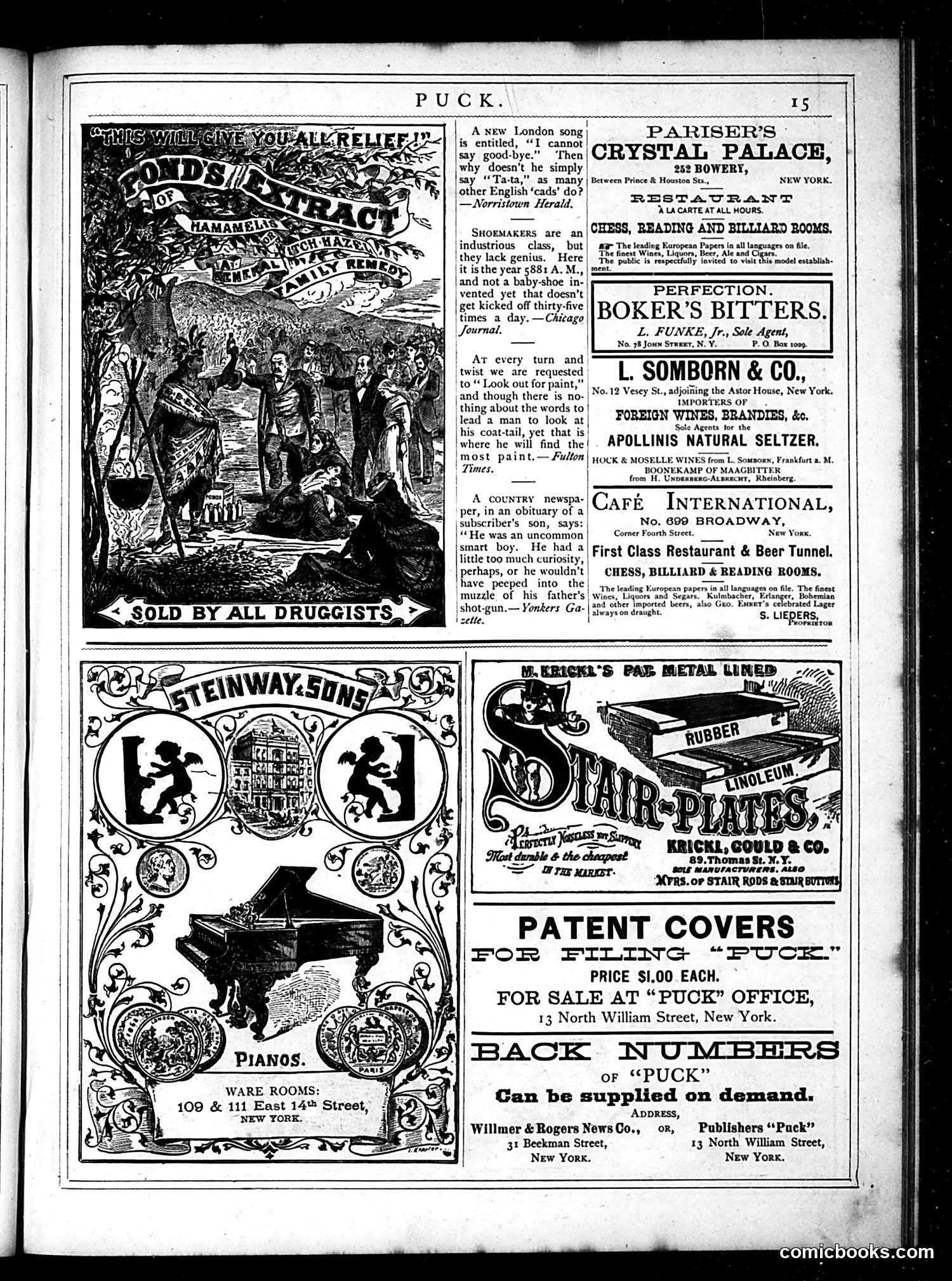
This is primarily an **advertising page** from Puck magazine (page 15), containing product advertisements rather than political cartoons or satirical content. The visible advertisements include: - **Bonds's Extract** (top left): A patent medicine with an engraving showing crowds, likely claiming to provide "relief" - **Steinway & Sons pianos** (bottom left): A decorative ad featuring the company's coat of arms and showroom address - **Krickl's stair plates** (right side): Metal linings for stairs - Various other commercial establishments: restaurants, importers, and services in New York City The page also advertises **back issues of Puck** and patent covers for "Filling Puck" available at the magazine's office. This reflects Puck's business model: satirical content subsidized by advertising revenue from luxury goods and services targeting affluent readers.
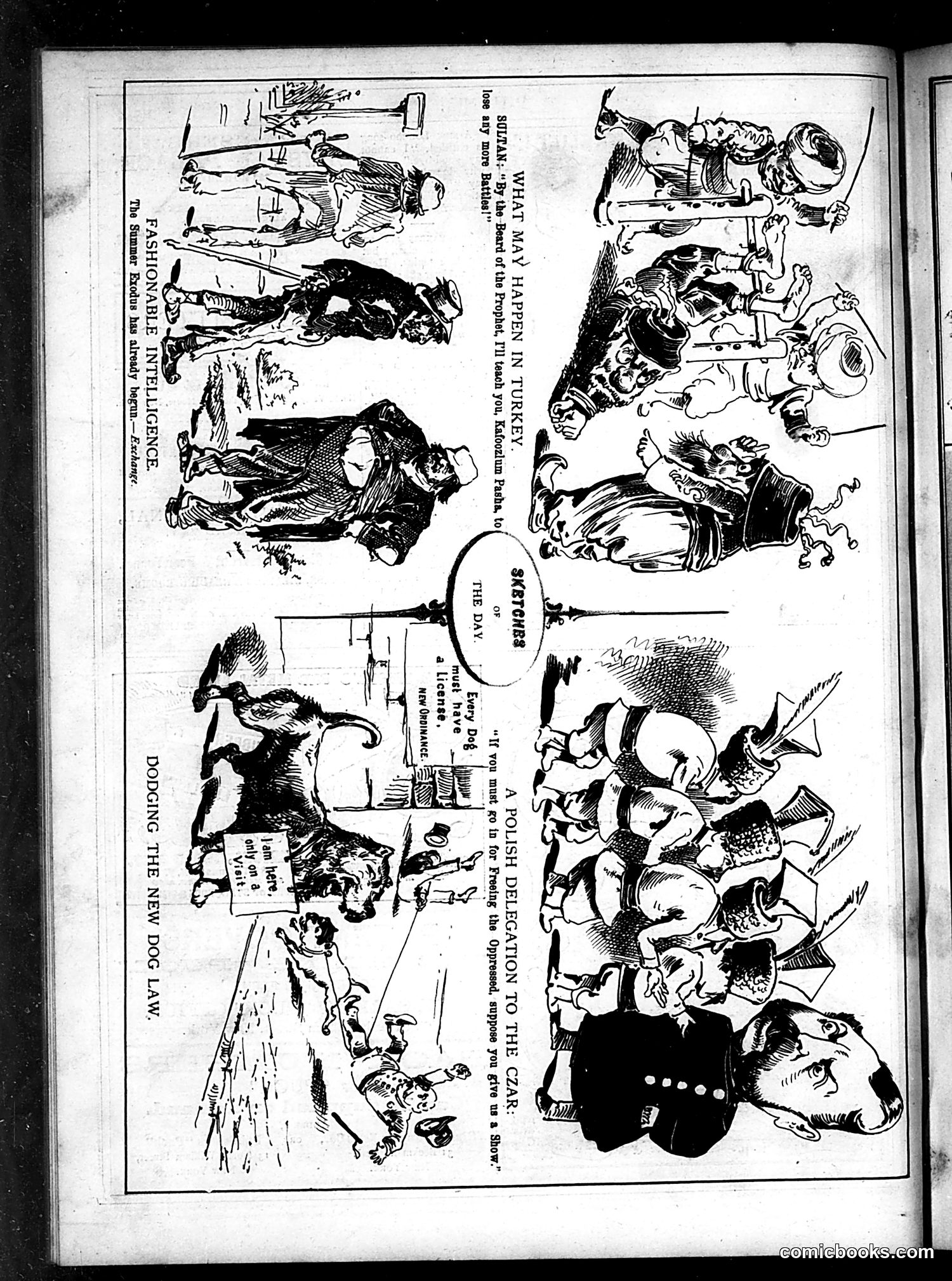
This Puck page contains satirical commentary on late 19th-century American politics and society. The left side shows "Dodging the New Dog Law"—depicting figures evading animal control regulations, likely satirizing how wealthy or politically connected individuals circumvent laws that apply to ordinary citizens. The right side, titled "What May Happen in Turkey," appears to be commentary on Ottoman Empire politics, showing various figures in apparent conflict or chaos—reflecting contemporary American concerns about instability in Turkey during this period of decline. The central image, "A Foolish Delegation to the Czar," likely references American diplomatic efforts toward Russia, presenting the mission as absurd or futile. Without clear date markers visible, the exact political events referenced remain unclear, but the overall theme involves critiquing government officials and international diplomacy.