
Puck, 1877-05 · page 14 of 16
Puck — May 1877 — page 14: what you’re looking at
What you’re looking at
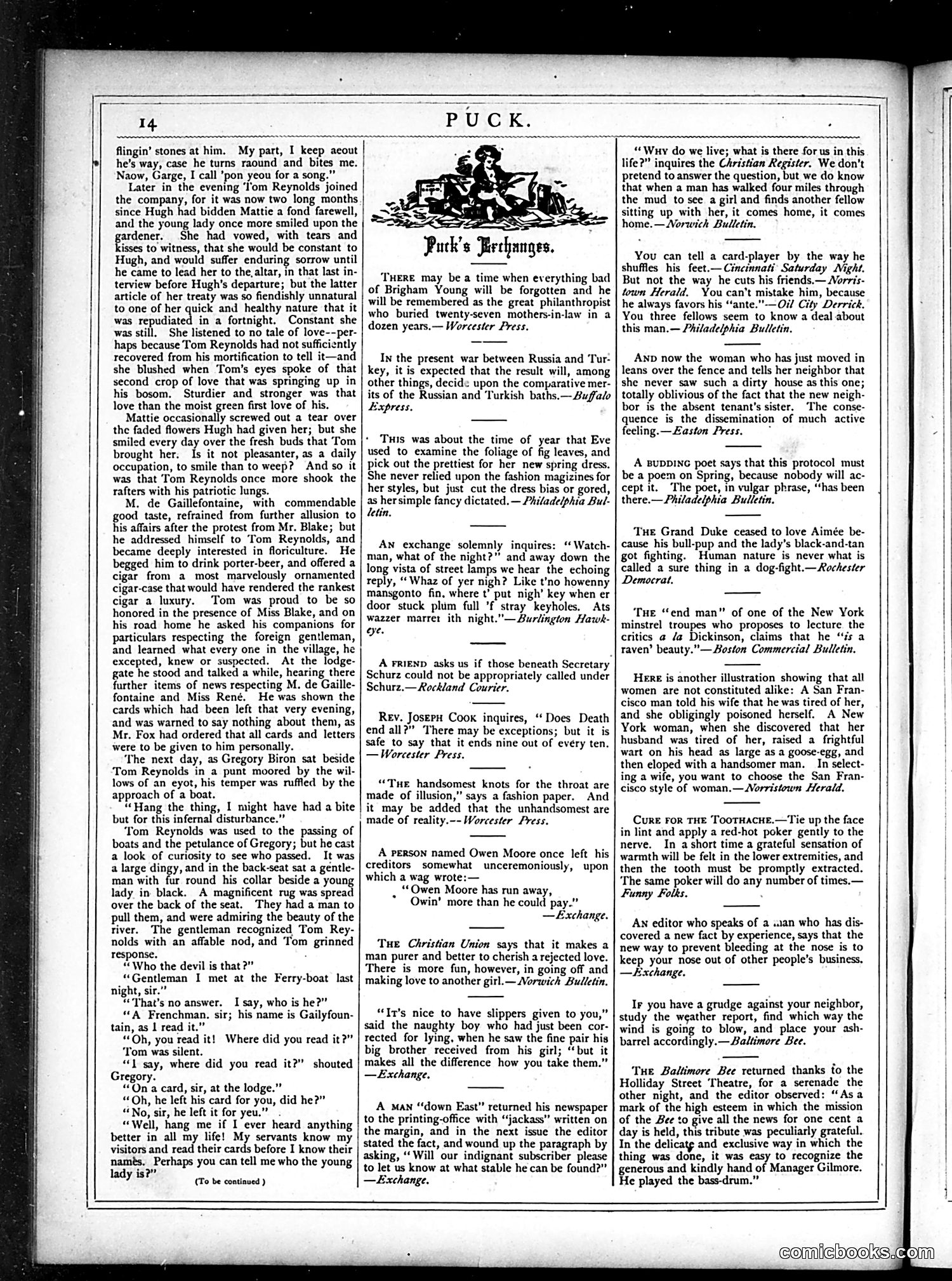
This page contains **"Puck's Exchanges,"** a humor column collecting brief satirical items and jokes from various sources rather than a unified political cartoon. The content mocks social pretensions, romantic mishaps, and contemporary absurdities. One item satirizes a woman who moved in wearing jeans but now affects ignorance about her new neighbor's behavior. Another ridicules a man who lost love to Aimée and claims a "sure thing" in a dog-fight instead. The pieces target hypocrisy (people hiding their true backgrounds), failed romance, and the pretensions of the wealthy or fashionable. References to newspapers, fashion magazines, and street life reflect urban American concerns of the era. No major political figures are caricatured here—instead, the satire focuses on everyday social types and universal human follies presented as humorous observations.
📄 Transcribed text from this page (OCR, searchable)
Machine-transcribed from the original scan — historical spelling and the odd misread are preserved.
14 flingin’ stones at him. My part, I keep acout Naow, Garge, I call ’pon yeou for a song.” Later in the evening ‘Il'om Reynolds joined the company, for it was now two long months since Hugh had bidden Mattie a fond farewell, and the young lady once more smiled upon the ardener. She had vowed, with tears and ‘isses to witness, that she would be constant to Hugh, and would suffer enduring sorrow until he came to lead her to the, altar, in that last in- terview before Hugh's departure; but the latter article of her treaty was so fiendishly unnatural to one of her quick and healthy nature that it was repudiated in a fortnight. Constant she was still. She listened to no tale of love--per- haps because Tom Reynolds had not sufficiently recovered from his mortification to tell it—and she blushed when Tom's eyes spoke of that second crop of love that was springing up in his bosom. Sturdier and stronger was that love than the moist green first love of his. Mattie occasionally screwed out a tear over the faded flowers Hugh had given her; but she brought her. Is it not pleasanter, as a daily occupation, to smile than to weep? And so it was that Tom Reynolds once more shook the rafters with his patriotic lungs. M. de Gaillefontaine, with commendable good taste, refrained from further allusion to his affairs after the protest from Mr. Blake; but he addressed himself to Tom Reynolds, and became deeply interested in floriculture. He begged him to drink porter-beer, and offered a cigar from a most marvelously ornamented cigar-case that would have rendered the rankest cigar a luxury. ‘Tom was proud to be so honored in the presence of Miss Blake, and on his road home he asked his companions for particulars respecting the foreign gentleman, and learned what every one in the village, he excepted, knew or suspected. At the lodge- gate he stood and talked a while, hearing there further items of news respecting M. de Gaille- fontaine and Miss René. He was shown the cards which had been left that very evening, and was warned to say nothing about them, as Mr. Fox had ordered that all cards and letters were to be given to him personally. ‘The next day, as Gregory Biron sat beside Tom Reynolds in a punt moored by the wil- lows of an eyot, his temper was ruffled by the approach of a boat. “Hang the thing, I might have had a bite but for this infernal disturbance.” ‘Tom Reynolds was used to the passing of boats and the petulance of Gregory; but he cast a look of curiosity to see who Tt was a large dingy, and in the back-seat sat a géntle- man with fur round his collar beside a young lady in black. A magnificent rug was sprea over the back of the seat. They had a man to pull them, and were admiring the beauty of the river. The gentleman recognized Tom Rey- nolds with an affable nod, and Tom grinned response, . “Who the devil is that?” “Gentleman I met at the Ferry-boat last night, sir.” “That's no answer. I say, who is he?” “A Frenchman. sir; his name is Gailyfoun- tain, as 1 read it.” “Oh, you read it! Where did you read it?” ‘Tom was silent. “1 say, where did you read it?” shouted Gregory. “On a card, sir, at the lodge.” “Oh, he left his card for you, did he?” “No, sir, he left it for yeu.” “Well, hang me if I ever heard anything better in all my life! My servants know my visitors and read their cards before I know their namés. Perhaps you can tell me who the young lady is?” (To be continued ) he’s way, case he turns raound and bites me. | smiled every day over the fresh buds that Tom |’ ‘THeRe may be a time when everything bad of Brigham Young will be forgotten and he will be remembered as the great philanthropist who buried twenty-seven mothers-in-law in a dozen years.— Worcester Press. In the present war between Russia and ‘Tur- key, it is expected that the result will, among other things, decide upon the comparative mer- its of the Russian and Turkish baths.— Buffalo Express. Tuts was about the time of year that Eve used to examine the foliage of fig leaves, and pick out the prettiest for her new spring dress. She never relied upon the fashion magizines for her styles, but just cut the dress bias or gored, as hersimple fancy dictated.— Philadelphia Bul- detin, AN exchange solemnly inquires: Watch- man, what of the night?” and away down the long vista of street lamps we hear the echoing reply, “ Whaz of yer nigh? Like t’no howenny mansgonto fin, where t’ put nigh’ key when er door stuck plum full ’f stray keyholes. Ats wazzer marrer ith night."—Burlington Hawk- ge. A FRIEND asks us if those beneath Secretary Schurz could not be appropriately called under Schurz.— Rockland Courier. Rev. Josep Cook inquires, “Does Death end all?” There may be exceptions; but it is safe to say that it ends nine out of every ten. —Worcester Press. “Tue handsomest knots for the throat are made of illusion,” says a fashion paper. And it may be added that the unhandsomest are made of reality.-- Worcester Press. A PERSON named Owen Moore once left his creditors somewhat unceremoniously, upon which a wag wrote:— _ Owen Moore has run away, Owin’ more than he could pay.” —Exchange. Tue Christian Union says that it makes a man purer and better to cherish a rejected love. There is more fun, however, in going off and making love to another girl.— Norwich Bulletin, “It’s nice to have slippers given to you,” said the naughty boy who had just been cor- rected for lying, when he saw the fine pair his big brother received from his girl; “but it makes all the difference how you take them.” —Exchange. A man “down East” returned his newspaper to the printing-office with “jackass” written on the margin, and in the next issue the editor stated the fact, and wound up the paragraph by asking, Will our indignant subscriber please to let us know at what stable he can be found?” —Exchange, “Way do we live; what is there for us in this life?” inquires the Christian Register. We don't pretend to answer the question, but we do know that when a man has walked four miles through the mud to sce a girl and finds another fellow sitting up with her, it comes home, it comes home.—Norwich Bulletin. You can tell a card-player by the way he shuffles his feet.— Cincinnati Saturday Night. But not the way he cuts his friends.— Norvis- town Herald. You can’t mistake him, because he always favors his “‘ante.""—Oil City Derrick. You three fellows seem to know a deal about this man.— Philadelphia Bulletin, AND now the woman who has just moved in leans over the fence and tells her neighbor that she never saw such a dirty house as this one; totally oblivious of the fact that the new neigh- bor is the absent tenant's sister, ‘The conse- quence is the dissemination of much active feeling. —Easton Press. 7 A BUDDING poet says that this protocol must be a poem on Spring, because nobody will ac- cept it. ‘The poet, in vulgar phrase, ‘thas been there.— Philadelphia Bulletin. Tue Grand Duke ceased to love Aimée be- cause his bull-pup and the lady’s black-and-tan got fighting. Human nature is never what is called a sure thing in a dog-fight.—Xochester Democrat. ‘Tue “end man" of one of the New York minstrel troupes who proposes to lecture the critics @ /a Dickinson, claims that he “7s a _| raven’ beauty.”— Boston Commercial Bulletin, Here is another illustration showing that all women are not constituted alike: A San Fran- cisco man told his wife that he was tired of her, and she obligingly poisoned herself. A New York woman, when she discovered that her husband was tired of her, raised a frightful wart on his head as large as a goose-egg, and then eloped with a handsomer man. _In select- ing a wife, you want to choose the San Fran- cisco style of woman.— Norristown Herald, Cure ror THE TooTHACHE.—Tie up the face in lint and apply a red-hot poker gently to the nerve. In a short time a grateful sensation of warmth will be felt in the lower extremities, and then the tooth must be promptly extracted. The same poker will do any number of times.— Funny Folks. . An editor who speaks of a .2an who has dis- covered a new fact by experience, says that the new way to prevent bleeding at the nose is to keep your nose out of other people’s business. —Exchange. Ir you have a grudge against your neighbor, study the weather report, find which way the wind is going to blow, and place your ash- barrel accordingly.— Baltimore Bee. Tue Baltimore Bee returned thanks to the Holliday Street ‘Theatre, for a serenade the other night, and the editor observed: “Asa mark of the high esteem in which the mission of the Bee to give all the news for one cent a day is held, this tribute was peculiarly grateful. In the delicatg and exclusive way in which the thing was done, it was easy to recognize the generous and kindly hand of Manager Gilmore. He played the bass-drum.” comichooks, (fon)