
Puck, 1877-05 · page 6 of 16
Puck — May 1877 — page 6: what you’re looking at
What you’re looking at
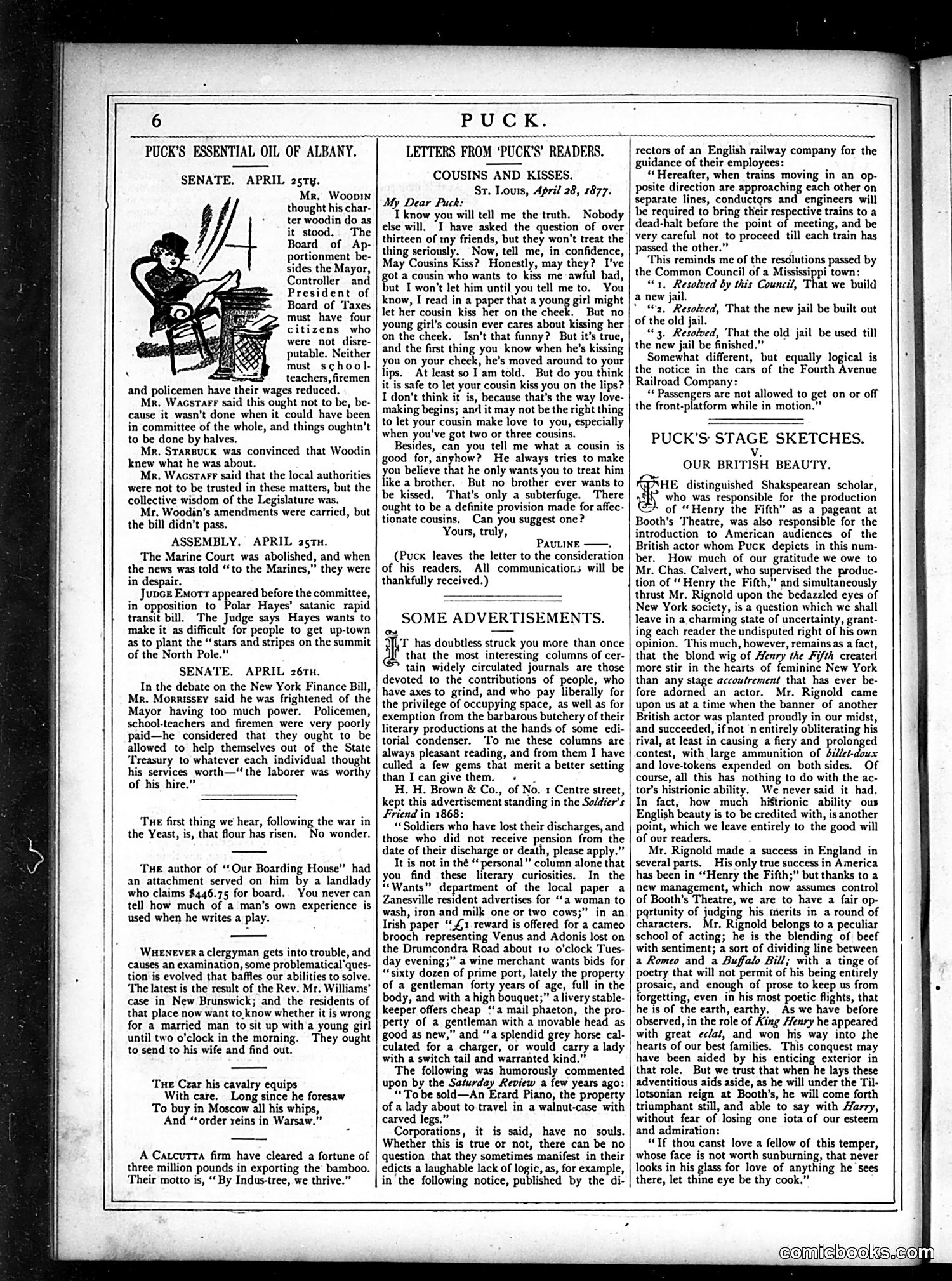
The main cartoon depicts a figure labeled "Mr. Woodin" presenting legislative arguments to what appears to be Albany political authorities. The accompanying Senate debate (April 25th) discusses Woodin's proposal regarding mayoral powers and police commissioners in what seems to be a New York City governance dispute. The satire centers on bureaucratic absurdity—specifically, a debate about whether kissing one's cousin on the cheek constitutes an improper display of affection requiring legal regulation. The cartoon ridicules the legislative tendency to micromanage trivial personal matters while ignoring substantive governance issues. The page also includes advertisements and theatrical announcements, including a notice about Henry the Fifth productions.
📄 Transcribed text from this page (OCR, searchable)
Machine-transcribed from the original scan — historical spelling and the odd misread are preserved.
6 PUCK. PUCK’S ESSENTIAL OIL OF ALBANY. SENATE. APRIL a5ty. Mr. Woopin thought his char- ter woodin do as it stood. The Board of Ap- portionment be- sides the Mayor, Controller and President of Board of ‘Taxes must have four citizens who were not disre- putable, Neither must s¢hool- teachers, firemen and policemen have their wages reduced. Mr. WacstarF said this ought not to be, be- cause it wasn’t done when it could have been in committee of the whole, and things oughtn’t to be done by halves. Mr. Starsuck was convinced that Woodin knew what he was about. Mr. WacstarrF said that the local authorities were not to be trusted in these matters, but the collective wisdom of the Legislature was. Mr. Woodin’s amendments were carried, but the bill didn’t pass. ASSEMBLY. APRIL astu. ‘The Marine Court was abolished, and when the news was told ‘‘to the Marines,” they were in despair. Jupce Emort appeared before the committee, in opposition to Polar Hayes’ satanic rapid transit bill. The Judge says Hayes wants to make it as difficult for people to get up-town as to plant the ‘‘stars and stripes on the summit of the North Pole.” SENATE. APRIL 26TH. In the debate on the New York Finance Bill, Mr. Morrissey said he was frightened of the Mayor having too much power. Policemen, school-teachers and firemen were very poorly paid—he considered that they ought to be allowed to help themselves out of the State ‘Treasury to whatever each individual thought his services worth—‘‘the laborer was worthy of his hire.” Tue first thing we hear, following the war in the Yeast, is, that flour has risen. No wonder. Tue author of ‘Our Boarding House” had an attachment served on him by a landlady who claims $446.75 for board. You never can tell how much of a man’s own experience is used when he writes a play. Wuenevera clergyman gets into trouble, and causes an examination, some problematical’ques- tion is evolved that baffles our abilities to solve. ‘The latest is the result of the Rev. Mr. Williams’ case in New Brunswick; and the residents of that place now want to know whether it is wrong for a married man to sit up with a young girl until two o'clock in the morning. They ought to send to his wife and find out. Tue Czar his cavalry equips With care. Long since he foresaw To buy in Moscow all his whips, And “order reins in Warsaw.” A Caxcutta firm have cleared a fortune of three million pounds in exporting the bamboo. Their motto is, ‘‘ By Indus-tree, we thrive.” LETTERS FROM ‘PUCK’S’ READERS. COUSINS AND KISSES. St. Louis, April 28, 1877. My Dear Puck: I know you will tell me the truth. Nobody else will. I have asked the question of over thirteen of my friends, but they won't treat the thing seriously, Now, tell me, in confidence, May Cousins Kiss? Honestly, may they? I've ot a cousin who wants to kiss me awful bad, ut I won't let him until you tell me to. You know, I read in a paper that a young girl might let her cousin kiss her on the cheek. But no young girl's cousin ever cares about kissing her on the cheek. Isn’t that funny? But it’s true, and the first thing you know when he's kissing you on your cheek, he’s moved around to your lips. At least so I am told. But do you think it is safe to let your cousin kiss you on the lips? I don’t think it is, because that's the way love- making begins; and it may not be the right thing to let your cousin make love to you, especially when you've got two or three cousins. Besides, can you tell me what a cousin is good for, anyhow? He always tries to make you believe that he only wants you to treat him like a brother. But no brother ever wants to be kissed. ‘That's only a subterfuge. There ought to be a definite provision made for affec- tionate cousins. Can you suggest one? Yours, truly, PAULINE —. (Puck leaves the letter to the consideration of his readers. All communication; will be thankfully received.) SOME ADVERTISEMENTS. ‘T has doubtless struck you more than once that the most interesting columns of cer- tain widely circulated journals are those devoted to the contributions of people, who have axes to grind, and who pay liberally for the privilege of occupying space, as well as for exemption from the barbarous butchery of their literary productions at the hands of some edi- torial condenser. To me these columns are always pleasant reading, and from them I have culled a few gems that merit a better setting thanI can give them. + _ H. H. Brown & Co., of No. 1 Centre street, kept this advertisement standing in the Soldier's Friend in 1868: “Soldiers who have lost their discharges, and those who did not receive pension from the date of their discharge or death, please apply.” It is not in thé “personal” column alone that you find these literary curiosities. In the “Wants” department of the local paper a Zanesville resident advertises for ‘‘a woman to wash, iron and milk one or two cows;” in an Irish paper ‘£1 reward is offered for a cameo brooch representing Venus and Adonis lost on the Drumcondra Road about 1 o'clock Tues- day evening;” a wine merchant wants bids for “sixty dozen of prime port, lately the property of a gentleman forty years of age, full in the body, and with a high bouquet;” a livery stable- keeper offers cheap ‘‘a mail phaeton, the pro- perty of a gentleman with a movable head as good as new,” and ‘‘a splendid grey horse cal- culated for a charger, or would carry a lady with a switch tail and warranted kind.” The following was humorously commented upon by the Saturday Review a few years ago: “To be sold—An Erard Piano, the propert of a lady about to travel in a walnut-case wit carved legs.” Corporations, it is said, have no souls. Whether this is true or not, there can be no question that they sometimes manifest in their edicts a laughable lack of logic, as, for example, in ‘the following notice, published by the di- rectors of an English railway company for the guidance of their employees: “Hereafter, when trains moving in an op- posite direction are approaching each other on separate lines, conductors and engineers will be required to bring their respective trains to a dead-halt before the point of meeting, and be very careful not to proceed till each train has passed the other."” ‘This reminds me of the resolutions passed by the Common Council of a atiesssippl town: “1, Resolved by this Council, That we build a new jail. “2, Resolved, That the new jail be built out of the old jail. “3. Resolved, ‘That the old jail be used till the new jail be finished.” Somewhat different, but equally logical is the notice in the cars of the Fourth Avenue Railroad Company: “Passengers are not allowed to get on or off the front-platform while in motion.” PUCK’S STAGE SKETCHES. Vv. OUR BRITISH BEAUTY. HE distinguished Shakspearean scholar, EY who, was responsible for the production of “Henry the Fifth” as a pageant at Booth’s Theatre, was also responsible for the introduction to American audiences of the British actor whom Puck depicts in this num- ber. How much of our gratitude we owe to Mr. Chas. Calvert, who supervised the produc- tion of ‘Henry the Fifth,” and simultaneously thrust Mr. Rignold upon the bedazzled eyes of New York society, is a question which we shall leave in a charming state of uncertainty, grant- ing each reader the undisputed right of his own opinion. ‘This much, however, remains as a fact, that the blond wig of Henry the Fifth created more stir in the hearts of feminine New York than any stage accoutrement that has ever be- fore adorned an actor. Mr. Rignold came upon us at a time when the banner of another British actor was planted proudly in our midst, and succeeded, if not ‘n entirely obliterating his rival, at least in causing a fiery and prolonged contest, with large ammunition of dil/et-doux and love-tokens expended on both sides. Of course, all this has nothing to do with the ac- tor’s histrionic ability. We never said it had. In fact, how much hiftrionic ability ous English beauty is to be credited with, is another point, which we leave entirely to the good will of our readers. Mr. Rignold made a success in England in several parts. His only true success in America has been in ‘Henry the Fifth;” but thanks to a new management, which now assumes control of Booth’s Theatre, we are to have a fair op- pqrtunity of judging his merits in a round of characters. Mr. Rignold belongs to a peculiar school of acting; he is the blending of beef with sentiment; a sort of dividing line between a Romeo and a Buffalo Bill; with a tinge of poetry that will not permit of his being entirely prosaic, and enough of prose to keep us from forgetting, even in his most poetic flights, that he is of the earth, earthy. As we have before observed, in the role of King Henry he appeared with great ec/at, and won his way into the hearts of our best families. This conquest may have been aided by his enticing exterior in that role. But we trust that when he lays these adventitious aids aside, as he will under the Til- lotsonian reign at Booth’s, he will come forth triumphant still, and able to say with Harry, without fear of losing one iota of our esteem and admiration: “Tf thou canst love a fellow of this temper, whose face is not worth sunburning, that never looks in his glass for love of anything he sees there, let thine eye be thy cook.” comichooks.coyn