
Puck, 1877-05 · page 10 of 16
Puck — May 1877 — page 10: what you’re looking at
What you’re looking at
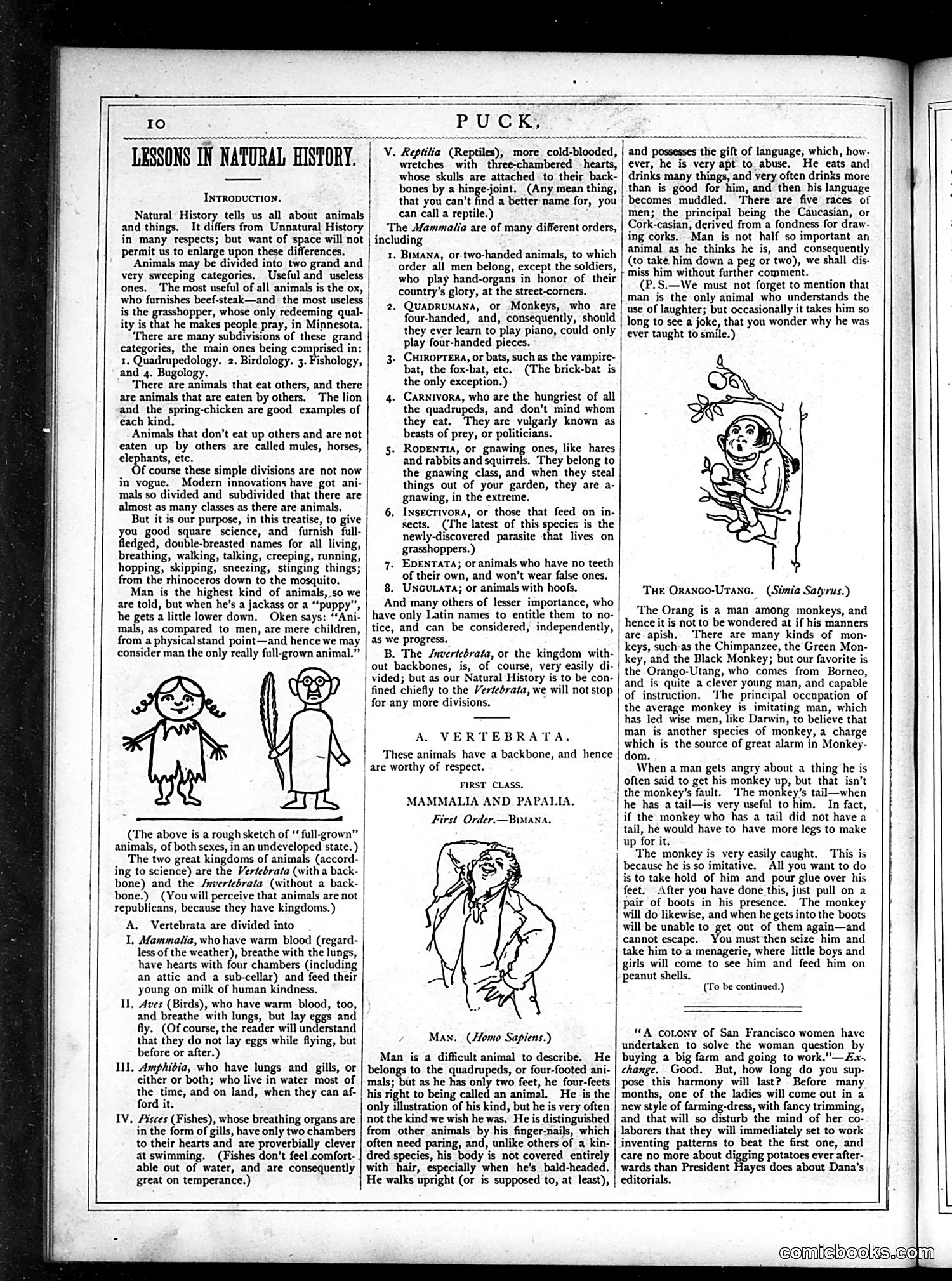
This page is primarily **educational content, not political satire**. It's a "Lessons in Natural History" article explaining animal classification to readers, particularly children. The two small illustrations show: - A sketch labeled as a "rough sketch of 'full-grown' animals, of both sexes, in an undeveloped state"—essentially generic human figures used to introduce biological taxonomy The article systematically categorizes animals from Vertebrata (backbone-bearing creatures) through increasingly specific classes like Mammalia, Aves, and Reptilia, with humorous asides (comparing carnivores to "beasts of prey, or politicians"). The text includes a sidebar about the **Orangutan**, noting its resemblance to humans and its intelligence. This appears to be straightforward science education dressed in Puck's characteristic light, witty tone—not political commentary.
📄 Transcribed text from this page (OCR, searchable)
Machine-transcribed from the original scan — historical spelling and the odd misread are preserved.
a 10 “PUCK, LESSONS IN NATURAL HISTORY. | INTRODUCTION. t Natural History tells us all about akimals | and things. It differs from Unnatural History in many respects; but want of space will not permit us to enlarge upon these differences. Animals may be divided into two grand and very sweeping categories. Useful and useless ones. The most useful of all animals is the ox, who furnishes beef-steak—and the most useless is the grasshopper, whose only redeeming qual- | ity is that he makes people pray, in Minnesota, | ‘There are many subdivisions of these grand categories, the main ones being comprised in: 1. Quadrupedology. 2. Birdology. 3. Fishology, and 4. Bugology. ‘There are animals that eat others, and there are animals that are eaten by others. The lion and the spring-chicken are good examples of each kind. Animals that don’t eat up others and are not eaten up by others are called mules, horses, | elephants, etc. | f course these simple divisions are not now in vogue. Modern innovations have got ani- mals so divided and subdivided that there are almost as many classes as there are animals. But it is our purpose, in this treatise, to give you good square science, and furnish full- fledged, double-breasted names for all living, breathing, walking, talking, creeping, running, hopping, skipping, sneezing, stinging things; from the rhinoceros down to the mosquito. Man is the highest kind of animals, so we are told, but when he’s a jackass or a “upp: he gets a little lower down. Oken says: ‘Ani. mals, as compared to men, are mere children, from a physical stand point—and hence we may | consider man the only really full-grown animal.” | (‘The above is a rough sketch of “full-grown” | animals, of both sexes, in an undeveloped state.) The two great kingdoms of animals (acco! ing to science) are the Vertebrata (witha back- bone) and the /nvertebrata (without a back- bone) (You will perceive that animals are not republicans, because they have kingdoms.) A, Vertebrata are divided into | 1. Mammatia, who have warm blood (regard- less of the weather), breathe with the lungs, have hearts with four chambers (including an attic and a sub-cellar) and feed their young on milk of human kindness. Il. Aves (Birds), who have warm blood, too, and breathe with lungs, but lay eggs and fly. (Of course, the reader will understand that they do not lay eggs while flying, but before or after.) III. Amphibia, who have lungs and gills, or either or both; who live in water most of the time, and’on land, when they can af- ford it. IV. Aisces (Fishes), whose breathing organs are in the form of gills, have only two chambers to their hearts and are proverbially clever at swimming. (Fishes don’t feel comfort- able out of water, and are consequently great on temperance.) V. Reptilia (Reptiles), more cold-blooded, wretches with three-chambered _ hearts, whose skulls are attached to their back- bones by a Hogedoing, (Any mean thing, that you can’t find a better name for, you can call a reptile.) ‘The Mammalia are of many different orders, including 1. Bimana, or.two-handed animals, to which order all men belong, except the soldiers, who play hand-organs in honor of their country’s glory, at the street-corners. » QUADRUMANA, or Monkeys, who are four-handed, and, consequently, should they ever learn to play piano, could only play four-handed pieces. . CHIROPTERA, or bats, such as the vampire- bat, the fox-bat, etc. (The brick-bat is the only exception.) Carnivora, who are the hungriest of all the quadrupeds, and don't mind whom they eat. They are vulgarly known as beasts of prey, or politicians. RopENTIA, or gnawing ones, like hares and rabbits and squirrels, They belong to the gnawing class, and when they steal things out of your garden, they are a- gnawing, in the extreme. Insectivora, or those that feed on in- sects, (‘The latest of this species is the newly-discovered parasite that lives on grasshoppers.) 7. EpENTATA; or animals who have no teeth of their own, and won't wear false ones. 8. UNGuLata; or animals with hoofs. And many others of lesser importance, who have only Latin names to entitle them to no- tice, and can be considered, independently, as we progress. B. The Jnvertebrata, or the kingdom with- out backbones, is, of course, very easily di- vided; but as our Natural History is to be con- fined chiefly to the Vertebrata, we will not stop for any more divisions. A. VERTEBRATA, ‘These animals have a backbone, and hence are worthy of respect. FIRST CLASS. MAMMALIA AND PAPALIA. First Order.—BiMana, Man. (Homo Sapiens.) Man is a difficult animal to describe. He belongs to the quadrupeds, or four-footed ani- mals; but as he has only two feet, he four-feets his right to being called an animal. He is the only illustration of his kind, but he is very often not the kind we wish he was. He is distinguished from other animals by his finger-nails, which often need paring, and, unlike others of a kin- dred species, his body is not covered entirel; with hair, especially when he’s bald-headed. He walks upright (or is supposed to, at least), and possesses the gift of language, which, how- ever, he is very apt to abuse. He eats and drinks many things, and very often drinks more than is good for him, and then his language | becomes muddled. ‘here are five races of | men; the principal being the Caucasian, or Cork-casian, derived from a fondness for draw- ing corks. Man is not half so important an animal as he thinks he is, and consequently | (to take him down a peg or two), we shall dis- } miss him without further comment. (P.S.—We must not forget to mention that man is the only animal who understands the | use of laughter; but occasionally it takes him so long to see a joke, that you wonder why he was ever taught to smile.) THe ORANGO-UTANG. (Simia Satyrus.) ‘The Orang is a man among monkeys, and hence it is not to be wondered at if his manners are apish. ‘There are many kinds of mon- keys, such-as the Chimpanzee, the Green Mon- key, and the Black Monkey; but our favorite is the Orango-Utang, who comes from Borneo, and is quite a clever young man, and capable of instruction. ‘Ihe principal occupation of the average monkey is imitating man, which has led wise men, like Darwin, to believe that man is another species of monkey, a charge which is the source of great alarm in Monkey- dom. When a man gets angry about a thing he is often said to get his monkey ups but that isn’t the monkey’s fault. ‘The monkey’s tail—when he has a tail—is very useful to him. In fact, if the monkey who has a tail did not have a tail, he would have to have more legs to make up for it. The monkey is very easily caught. This is because he is so imitative. All you want to do is to take hold of him and pour glue over his feet. After you have done this, just pull on a pair of boots in his presence. The monkey will do likewise, and when he gets into the boots | will be unable to get out of them again—and | cannot escape. You must then seize him and take him to a menagerie, where little boys and girls will come to see him and feed him on peanut shells. (To be continued.) “A cotony of San Francisco women have undertaken to solve the woman question by buying a big farm and going to work.”—Zx~ change. Good. But, how long do you sup- pose this harmony will last? Before many months, one of the ladies will come out in a new style of farming-dress, with fancy trimming, and that will so disturb the mind of her co- laborers that they will immediately set to work inventing patterns to beat the first one, and care no more about digging potatoes ever after- wards than President Hayes does about Dana’s editorials. comichooks.