
Puck, 1877-05 · page 3 of 16
Puck — May 1877 — page 3: what you’re looking at
What you’re looking at
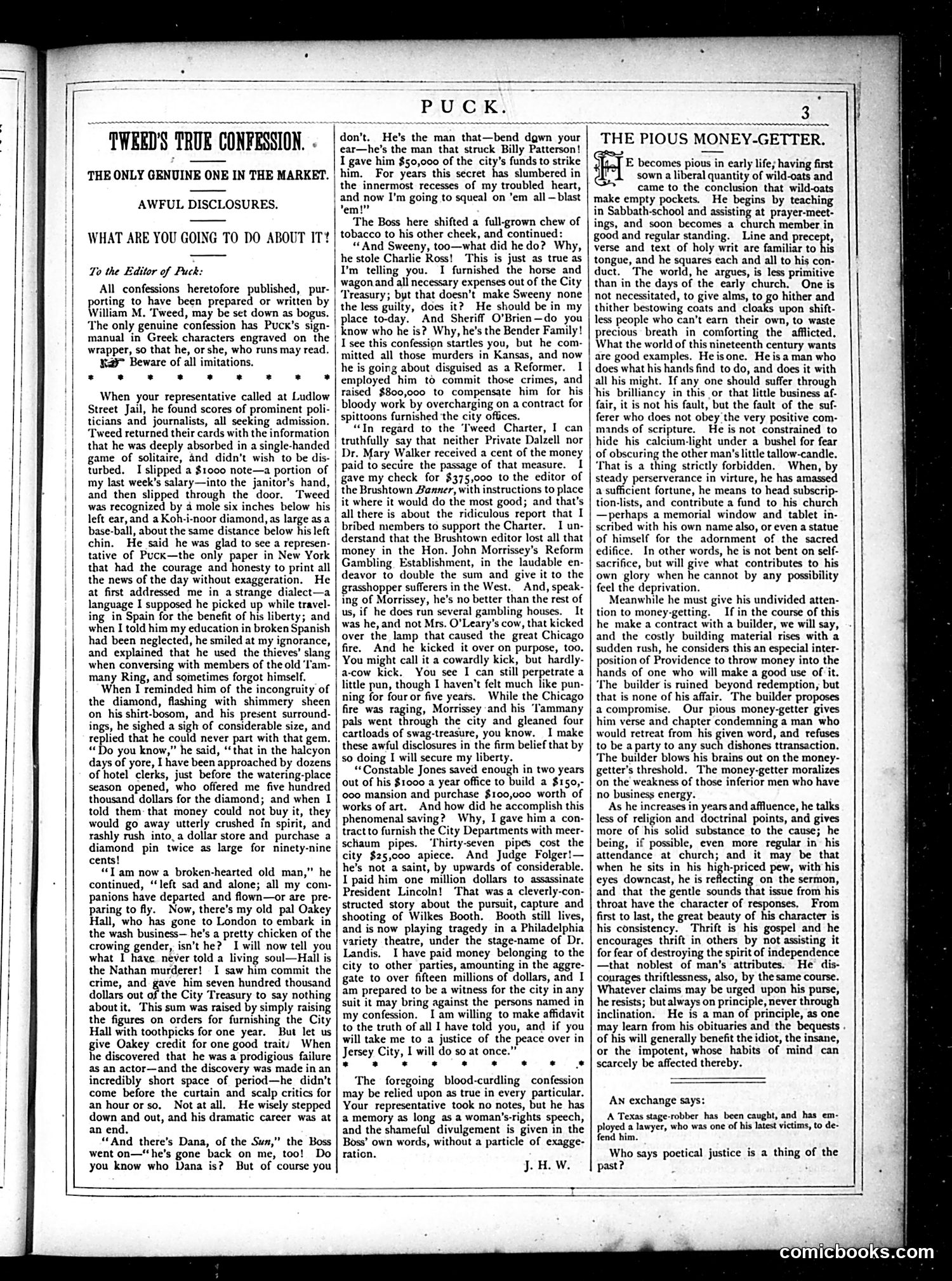
This page contains three separate articles rather than cartoons. The main piece, "Tweed's True Confession," is a satirical letter purporting to be a genuine confession from **William M. Tweed**, the notorious Tammany Hall political boss. The letter mocks Tweed's criminal activities—including bribery, embezzlement, and corruption—while sarcastically claiming he's being forced to confess against his will. The other articles satirize **Chicago politicians** and **religious hypocrisy**, attacking figures who exploit their positions for personal gain while presenting themselves as reformers. The satire targets political corruption endemic to 19th-century American urban politics, particularly the brazen theft and bribery by machine politicians who faced minimal consequences.
📄 Transcribed text from this page (OCR, searchable)
Machine-transcribed from the original scan — historical spelling and the odd misread are preserved.
— WEEDS TRUE CONFESSION. . THE ONLY GENUINE ONE IN THE MARKET. | AWFUL DISCLOSURES. WHAT ARE YOU GOING TO DO ABOUT IT? To the Editor of Puck: All confessions heretofore published, pur- rting to have been prepared or written by William M. ‘Tweed, may be set down as bogus. ‘The only genuine confession has Puck's sign- manual in Greek characters engraved on the wrapper, so that he, or she, who runs may read. Xa Beware of all imitations. = 8 © © 28 #& 28 es When your representative called at Ludlow Street Jail, he found scores of prominent poli- ticians and journalists, all seeking admission. Tweed returned their cards with the information that he was deeply absorbed in a single-handed game of solitaire, 4nd didn’t wish to be dis- turbed. I slipped a $1000 note—a portion of my last week's salary—into the janitor’s hand, and then slipped through the door, Tweed was recognized by a mole six inches below his left ear, and a Koh-i-noor diamond, as large as a | base-ball, about the same distance below his left | chin. He said he was glad to see a represen- tative of Puck—the only paper in New York that had the courage and honesty to print all the news of the day without exaggeration. He at first addressed me in a strange dialect—a language I supposed he picked up while travel- ing in Spain for the benefit of his liberty; and when I told him my education in broken Spanish had been neglected, he smiled at my ignorance, and explained that he used the thieves’ slang when conversing with members of the old ‘I'am- many Ring, and sometimes forgot himself. When I reminded him of the incongruity of the diamond, flashing with shimmery sheen on his shirt-bosom, and his present surround- ings, he sighed a sigh of considerable size, and replied that he could never part with that gem. “Do you know,” he said, ‘that in the halcyon days of yore, I have been approached by dozens of hotel’ clerks, just before the watering-place season opened, who offered me five hundred thousand dollars for the diamond; and when 1 told them: that money could not buy it, they would go away utterly crushed in spirit, and rashly rush into, a dollar store and purchase a diamond pin twice as large for ninety-nine cents! “Tam now a broken-hearted old man,” he continued, “left sad and alone; all my com- panions have departed and flown—or are pre- paring to fly. Now, there’s my old pal Oakey Hall, who has gone to London to embark in the wash business— he’s a pretty chicken of the crowing gender, isn’t he? I will now tell you what I have never told a living soul—Hall is the Nathan murderer! I saw him commit the crime, and gave him seven hundred thousand dollars out of the City Treasury to say nothing about it. This sum was raised by simply raising the figures on orders for furnishing the City Hall with toothpicks for one year. But let us give Oakey credit for one good trait). When he discovered that he was a prodigious failure as an actor—and the discovery was made in an incredibly short space of period—he didn’t come before the curtain and scalp critics for an hour or so. Not at all. He wisely stepped down and out, and his dramatic career was at an end. “And there’s Dana, of the Sun,” the Boss went on—he's gone back on me, too! Do you know who Dana is? But of course you PUCK. don't. He’s the man that—bend dgwn your ear—he’s the man that struck Billy Patterson! I gave him $50,000 of the city’s funds to strike him. For years this secret has slumbered in the innermost recesses of my troubled heart, | and now I'm going to squeal on ‘em all—blast ‘em! The Boss here shifted a full-grown chew of tobacco to his other cheek, and continued: “And Sweeny, too—what did he do? Why, he stole Charlie Ross! This is just as true as I'm telling you. I furnished the horse and wagonand all necessary expenses out of the City ‘Treasury; byt that doesn’t. make Sweeny none the less guilty, does it? He should be in my place to-day. And Sheriff O'Brien—do you know who he is? Why, he’s the Bender Family! I see this confession startles you, but he com- mitted all those murders in Kansas, and now he is going about disguised as a Reformer. I employed him to commit those crimes, and raised $800,000 to compensate him for his bloody work by overcharging on a contract for spittoons furnished ‘the city offices. “In regard to the ‘I'weed Charter, I can truthfully say that neither Private Dalzell nor Dr. Mary Walker received a cent of the money paid to sectire the passage of that measure. 1 gave my check for $375,000 to the editor of the Brushtown Banner, with instructions to place it where it would do the most good; and that’s all there is about the ridiculous report that I bribed members to support the Charter. I un- derstand that the Brushtown editor lost all that money in the Hon. John Morrissey’s Reform Gambling Establishment, in the laudable en- deavor to double the sum and give it to the grasshopper sufferers in the West. And, speak- ing of Morrissey, he’s no better than the rest of us, if he does run several gambling houses. It was he, and not Mrs. O'Leary's cow, that kicked over the lamp that caused the great Chicago fire. And he kicked it over on purpose, too. You might call it a cowardly kick, but hardly- a-cow kick. You see I can still perpetrate a | little pun, though I haven’t felt much like pun- ning for four or five years. While the Chicago fire was raging, Morrissey and his ‘Tammany pals went through the city and gleaned four cartloads of swag-treasure, you know. 1 make these awful disclosures in the firm belief that by so doing I will secure my liberty. “Constable Jones saved enough in two years out of his $1000 a year office to build a $150,- 000 mansion and purchase $100,000 worth of works of art. And how did he accomplish this phenomenal saving? Why, I gave him a con- tractto furnish the City Departments with meer- schaum pipes. irty-seven pipes cost the city $25,000 apiece. And Judge Folger!— he’s not a saint, by upwards of considerable. I paid him one million dollars to assassinate President Lincoln! That was a cleverly-con- structed story about the pursuit, capture and shooting of Wilkes Booth. Booth still lives, and is now playing tragedy in a Philadelphia variety theatre, under the stage-name of Dr. Landis. I have paid money belonging to the city to other parties, amounting in the aggre- gate to over fifteen millions of dollars, and I am prepared to be a witness for the city in any suit it may bring against the persons named in my confession. I am willing to make affidavit to the truth of all I have told you, and if you will take me to a justice of the peace over in Jersey City, 1 will do so at once.” . 2 © £ 8© #© © © # The foregoing blood-curdling confession may be relied upon as true in every particular. Your representative took no notes, but he has a memory as long as a woman’s-rights speech, and the shameful divulgement is given in the Boss’ own words, without a particle of exagge- ration. J.HW. THE PIOUS MONEY-GETTER. E becomes pious in early life; having first sown a liberal quantity of wild-oats and é came othe conclusion that wild-oats make empty pockets. He begins by teachi in Sabbath-school and assisting at neve ings, and soon becomes a church member in good and regular standing. Line and precept, verse and text of holy writ are familiar to his tongue, and he squares each and all to his con- duct. ‘The world, he argues, is less primitive than in the days of the early church. One is not necessitated, to give alms, to go hither and thither bestowing coats and cl upon shift- less people who can’t earn their own, to waste precious breath in comforting the afflicted, What the world of this nineteenth century wants are good examples. He isone. He is a man who does what his hands find to do, and does it with all his might. If any one should suffer through his brilliancy in this or that little business af- fair, it is not his fault, but the fault of the suf- ferer who does not obey'the very positive com- mands of scripture. He is not constrained to hide his calcium-light under a bushel for fear of obscuring the other man’s little tallow-candle. ‘That is a thing strictly forbidden, When, by steady perserverance in virture, he has amassed a sufficient fortune, he means to head subscrip- tion-lists, and contribute a fund to his church —perhaps a memorial window and tablet in- scribed with his own name also, or even a statue of himself for the adornment of the sacred edifice. In other words, he is not bent on self- sacrifice, but will give what contributes to his own glory when he cannot by any possibility feel the deprivation. Meanwhile he must give his undivided atten- tion to money-getting. _ If in the course of this he make a contract with a builder, we will say, and the costly building material rises with a sudden rush, he considers this an especial inter- position of Providence to throw money into the hands of one who will make a good use of it. ‘The builder is ruined beyond redemption, but that is none of his affair. The builder proposes acompromise. Our pious money-getter gives him verse and chapter condemning a man who would retreat from his given word, and refuses to be a party to any such dishones transaction, The builder blows his brains out on the money- getter’s threshold. The money-getter moralizes on the weakness of those inferior men who have no business energy. As he increases in years and affluence, he talks less of religion and doctrinal points, and gives more of his solid substance to the cause; he being, if possible, even more regular in. his attendance at church; and it may be that when he sits in his high-priced pew, with his eyes downcast, he is refeckin on the sermon, and that the gentle sounds that issue from his throat have the character of responses, From first to last, the great beauty of his character is his consistency. Thrift is his gospel and he encourages thrift in others by not assisting it for fear of destroying the spirit of independence —that noblest of man’s attributes. He’ dis- courages thriftlessness, also, by the same course. Whatever claims may be urged upon his purse, he resists; but always on principle, never through inclination, He is a man of principle, as one may learn from his obituaries and the bequests . of his will generally benefit the idiot, the insane, or the impotent, whose habits of mind can scarcely be affected thereby. AN exchange says: A Texas stage-robber has been caught, and has em- ployed a lawyer, who was one of his latest victims, to de- fend him. Who says poetical justice is a thing of the past? ‘