
Puck, 1877-05 · page 12 of 16
Puck — May 1877 — page 12: what you’re looking at
What you’re looking at
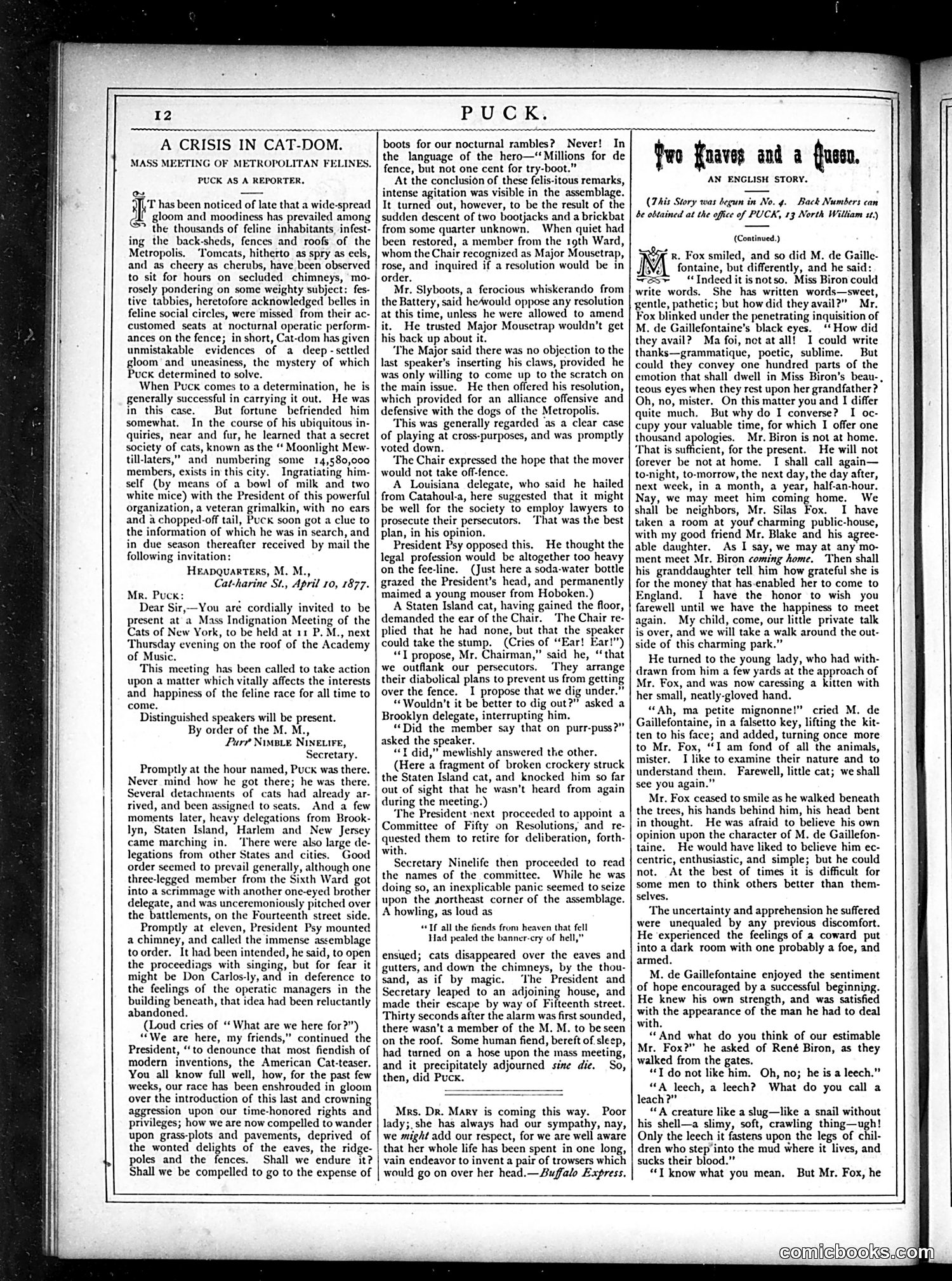
This page contains two distinct pieces: **"A Crisis in Cat-dom"** (left column) is a satirical report on a mass meeting of Metropolitan felines discussing widespread dog persecution. The "article" mocks real political meetings by using cats as stand-ins, with references to committee appointments, resolutions, and parliamentary procedure. It's absurdist humor satirizing the formality of civic organizations. **"Two Knaves and a Guess"** (right column) is the continuation of a serialized English story featuring characters Mr. Fox and M. de Gaillefortaine. This appears to be straightforward fiction rather than satire. The cat meeting satire likely ridicules contemporary political bodies or social movements through the transparent device of animal characters conducting human institutional activities—a common Puck technique for social commentary.
📄 Transcribed text from this page (OCR, searchable)
Machine-transcribed from the original scan — historical spelling and the odd misread are preserved.
12 PUCK. A CRISIS IN CAT-DOM. MASS MEETING OF METROPOLITAN PUCK AS A REPORTER. eo Ace ie has been noticed of late that a wide-spread EL gloom and moodiness has prevailed among =" the thousands of feline inhabitants infest- ing the back-sheds, fences and roofs of the Metropolis. ‘Tomcats, hitherto as spry as eels, and as cheery as cherubs, have been observed to sit for hours on secluded chimneys, mo- rosely pondering on some weighty subject: fes- tive tabbies, heretofore acknowledged belles in feline social circles, were missed from their ac- customed seats at nocturnal operatic perform- ances on the fence; in short, Cat-dom has given unmistakable evidences of a deep - settled gloom and uneasiness, the mystery of which Puck determined to solve. When Puck comes to a determination, he is generally successful in carrying it out. He was in this case. But fortune befriended him somewhat. In the course of his ubiquitous in- quiries, near and fur, he learned that a secret society of cats, known as the “ Moonlight Mew- til-aters,” and numbering some 14,580,000 members, exists in this city. Ingratiating him- self (by means of a bowl of milk and two white mice) with the President of this powerful organization, a veteran grimalkin, with no ears and a chopped-off tail, Puck soon got a clue to the information of which he was in search, and in due season thereafter received by mail the following invitation: Heapquarters, M. M., Cat-harine St., April 10, 1877. Mr. Pi i Dear Sir,—You are cordially invited to be present at a Mass Indignation Meeting of the Cats of New York, to be held at 11 P.M, next ‘Thursday evening on the roof of the Academy of Music, This meeting has been called to take action upon a matter which vitally affects the interests and happiness of the feline race for all time to come. Distinguished speakers will be present. By order of the M. M., Pur? NiMBce NINELIFE, Secretary. Promptly at the hour named, Puck was there. Never mind how he got there; he was there. Several detachments of cats had already ar- rived, and been assigned to seats. And a few moments later, heavy delegations from Brook- lyn, Staten Island, Harlem and New Jersey came marching in. ‘There were also large de- legations from other States and cities. Good order seemed to prevail generally, although one three-legged member from the Sixth Ward got into a scrimmage with another one-eyed brother delegate, and was unceremoniously pitched over the battlements, on the Fourteenth strect side. Promptly at eleven, President Psy mounted a chimney, and called the immense assemblage toorder. It had been intended, he said, to open the proceedings with singing, but for fear it might be Don Carlos-ly, and in deference to the feelings of the operatic managers in the building bencath, that idea had been reluctantly abandoned. (Loud cries of ‘‘ What are we here for?”) ‘We are here, my friends,” continued the President, ‘‘to denounce that most fiendish of modern inventions, the American Cat-teaser. You all know full well, how, for the past few weeks, our race has been enshrouded in gloom over the introduction of this last and crowning aggression upon our time-honored rights and privileges; how we are now compelled to wander upon grass-plots and pavements, deprived of the wonted delights of the eaves, the ridge- | poles and the fences. Shall we endure it? Shall we be compelled to go to the expense of boots for our nocturnal rambles? Never! In the language of the hero—‘ Millions for de fence, but not one cent for try-boot.” At the conclusion of these felis-itous remarks, intense agitation was visible in the assemblage. It turned out, however, to be the result of the sudden descent of two bootjacks and a brickbat from some quarter unknown. When quiet had been restored, a member from the 19th Ward, whom the Chair recognized as Major Mousetrap, rose, and inquired if a resolution would be in order. Mr. Slyboots, a ferocious whiskerando from the Battery, said heAvould oppose any resolution at this time, unless he were allowed to amend it. He trusted Major Mousetrap wouldn’t get his back up about it. ‘The Major said there was no objection to the last speaker’s inserting his claws, provided he was only willing to come up to the scratch on the main issue. He then offered his resolution, which provided for an alliance offensive and defensive with the dogs of the Metropolis. This was generally regarded ‘as a clear case of playing at cross-purposes, and was promptly voted down. The Chair expressed the hope that the mover would not take off-fence. A Louisiana delegate, who said he hailed from Catahoul-a, here suggested that it might be well for the society to employ lawyers to prosecute their persecutors. ‘That was the best plan, in his opinion. President Psy opposed this. He thought the legal profession would be altogether too heavy on the fee-line. (Just here a soda-water bottle grazed the President’s head, and permanently maimed a young mouser from Hoboken.) A Staten Island cat, having gained the floor, demanded the ear of the Chair. ‘The Chair re- plied that he had none, but that the speaker could take the stump. (Cries of ‘Ear! Ear!") “I propose, Mr. Chairman,” said he, “that we outflank our persecutors. ‘They arrange their diabolical plans to prevent us from getting over the fence. 1 propose that we dig under.” “Wouldn’t it be better to dig out?” asked a Brooklyn delegate, interrupting him. “Did the member say that on purr-puss?” asked the speaker. “¥ did,” mewlishly answered the other. (Here a fragment of broken crockery struck the Staten Island cat, and knocked him so far out of sight that he wasn’t heard from again during the meeting.) ‘The President next proceeded to appoint a Committee of Fifty on Resolutions, and re- quested them to retire for deliberation, forth- with. Secretary Ninelife then proceeded to read the names of the committee. While he was doing so, an inexplicable panic seemed to seize upon the northeast corner of the assemblage. A howling, as loud as “If all the fiends from heaven that fell Had pealed the banner-cry of hell,” ensued; cats disappeared over the eaves and gutters, and down the chimneys, by the thou- sand, as if by magic. ‘Ihe President and Secretary leaped to an adjoining house, and made their escape by way of Fifteenth street. Thirty seconds after the alarm was first sounded, there wasn’t a member of the M. M. to be seen on the roof. Some human fiend, bereft of. sleep, had turned on a hose upon the mass meeting, and it precipitately adjourned sine die. So, then, did Puck. Mrs. Dr. Mary is coming this way. Poor lady;,she has always had our sympathy, nay, we might add our respect, for we are well aware that her whole life has been spent in one long, vain endeavor to invent a pair of trowsers which would go on over her head.— Buffalo Express. fwo foaves and a ffueen, AN ENGLISH STORY. (This Story was begun in No. 4. Back Numbers can be obtained at the office of PUCK, 13 North William st.) (Continued.) Fe g R. Fox smiled, and so did M. de Gaille- DM fontaine, but differently, and he said: esy “Indeed it is notso, Miss Biron could write words. She has written words—sweet, gentle, pathetic; but how did they avail?” Mr, Fox blinked under the penetrating inquisition of M. de Gaillefontaine’s black eyes. ‘How did they avail? Ma foi, not at all! I could write thanks—grammatique, poetic, sublime. But could they convey one hundred parts of the emotion that shall dwell in Miss Biron’s beau-, teous eyes when they rest upon her grandfather? Oh, no, mister. On this matter you and I differ quite much. But why do I converse? I oc- cupy your valuable time, for which I offer one thousand apologies. Mr. Biron is not at home. ‘That is sufhcient, for the present. He will not forever be not at home. I shall call again— to-night, to-morrow, the next day, the day after, next week, in a month, a year, half-an-hour. Nay, we may meet him coming home. We shall be neighbors, Mr. Silas Fox. I have taken a room at youf charming public-house, with my good friend Mr. Blake and his agree- able daughter. As I say, we may at any mo- ment meet Mr. Biron coming home, Then shall his granddaughter tell him how grateful she is for the money that has-enabled her to come to England. 1 have the honor to wish you farewell until we have the happiness to meet again. My child, come, our little private talk is over, and we will take a walk around the out- side of this charming park.” He turned to the young lady, who had with- drawn from him a few yards at the approach of Mr. Fox, and was now caressing a kitten with her small, neatly-gloved hand. “Ah, ma petite mignonne!” cried M. de Gaillefontaine, in a falsetto key, lifting the kit- ten to his face; and added, turning once more to Mr. Fox, “1 am fond of all the animals, mister. I like to examine their nature and to understand them. Farewell, little cat; we shall see you again.” Mr. Fox ceased to smile as he walked beneath the trees, his hands behind him, his head bent in thought. He was afraid to believe his own opinion upon the character of M. de Gaillefon- taine. He would have liked to believe him ec- centric, enthusiastic, and simple; but he could not. At the best of times it is difficult for some men to think others better than them- selves. ‘The uncertainty and apprehension he suffered were unequaled by any previous discomfort. He ‘experienced the feelings of a coward put into a dark room with one probably a foe, and armed. M. de Gaillefontaine enjoyed the sentiment of hope encouraged by a successful beginning. He knew his own strength, and was satisfied with the appearance of the man he had to deal with, “And what do you think of our estimable Mr. Fox?” he asked of René Biron, as they walked from the gates. “T do not like him. Oh, no; he is a leech.” “(A leech, a leech? What do you call a leach?” “A creature like a slug—like a snail without his shell—a slimy, soft, crawling thing—ugh! Only the leech it fastens upon the legs of chil- dren who step’ into the mud where it lives, and sucks their blood.” “T know what you mean. But Mr. Fox, he comichooks.caan