
Puck, 1877-05 · page 5 of 16
Puck — May 1877 — page 5: what you’re looking at
What you’re looking at
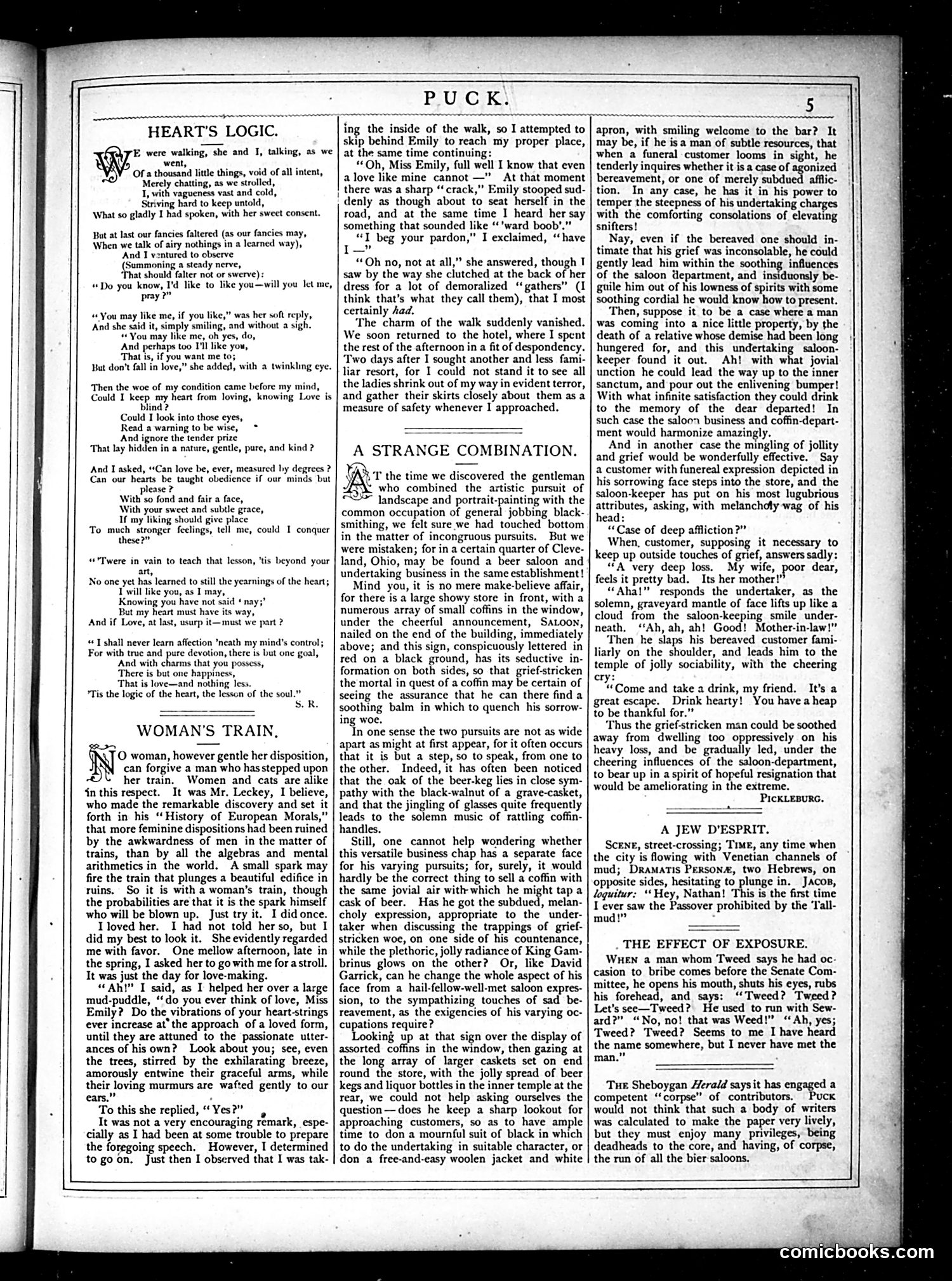
This page contains several literary and social commentary pieces rather than political cartoons. The main sections include: **"Heart's Logic"** and **"Woman's Train"** — poetry about romantic relationships and gender dynamics, reflecting late 19th/early 20th-century attitudes toward courtship and women's roles. **"A Strange Combination"** — a humorous narrative about a gentleman combining artistic pursuits with blacksmithing, and separately running a beer saloon and coffin business from the same storefront. The satire mocks incongruous professional combinations and the absurdity of selling both beer and coffins in one location—likely commentary on urban entrepreneurship or working-class business practicality. **"A Jew D'Esprit"** and **"The Effect of Exposure"** appear to be brief satirical pieces, though details are unclear from the OCR text alone. The page emphasizes literary humor over visual cartooning.
📄 Transcribed text from this page (OCR, searchable)
Machine-transcribed from the original scan — historical spelling and the odd misread are preserved.
HEART'S LOGIC. E were walking, she and I, talking, as we went, Of a thousand little things, void of all intent, Merely chatting, as we strolled, I, with vagueness vast and cold, Striving hard to keep untold, ‘What so gladly I had spoken, with her sweet consent, Bot at last our fancies faltered (as our fancies may, When we talk of airy nothings in a learned way), And I ventured to observe {Summoning a steady nerve, at should falter not or swerve): «Do you know, I'd like to like you—will you let me, pray?” “You may like me, if you like,” was her soft reply, And she said it, simply’ smiling, and without a sigh. “You may like me, oh yes, do, And perhaps too I'll like you, That is, if you want me to; But don't fall in love,” she addegl, with a twinkling eye. Then the woe of my condition came before my mind, Could I keep mry heart from loving, knowing Love is blind? Could I look into those eyes, Read a warning to be wise, * And ignore the tender prize ‘That lay hidden in a nature, gentle, pure, and kind ? And I asked, “Can love be, ever, measured hy degrees ? Can our hearts be taught obedience if our minds but please ? With so fond and fair a face, With your sweet and subtle grace, If my liking should give place To much stronger feelings, tell me, could I conquer these?” ««"Twere in vain to teach that lesson, ‘tis beyond your art, No one yet has learned to still the yearnings of the heart; T will like you, as I may, Knowing you have not said * nay;? But my heart must have its way, And if Love, at last, usurp it—must we part ? «I shall never learn affection ’neath my mind’s control; For with true and pure devotion, there is but one goal, ‘And with charms that you possess, There is but one happiness, That is love—and nothing less. "Tis the logic of the heart, the lesson of the soul." Ss WOMAN'S TRAIN, =o) O woman, however gentle her disposition, can forgive a man who has stepped upon her train. Women and cats are alike ‘in this respect. It was Mr. Leckey, I believe, who made the remarkable discovery and set it forth in his ‘History of European Morals,” that more feminine dispositions had been ruined by the awkwardness of men in the matter of trains, than by all the algebras and mental arithmetics in the world. A small spark may fire the train that plunges a beautiful edifice in ruins. So it is with a woman’s train, though the probabilities are that it is the spark himself who will be blown up. Just try it. I did once. I loved her. I had not told her so, but I did my best to look it. She evidently regarded me with favor. One mellow afternoon, late in the spring, I asked her to go with me for astroll. It was just the day for love-making. “Ah!” I said, as I helped her over a large mud-puddle, ‘do you ever think of love, Miss Emily? Do the vibrations of your heart-strings ever increase at*the approach of a loved form, until they are attuned to the passionate utter- ances of his own? Look about you; see, even the trees, stirred by the exhilarating breeze, amorously entwine their graceful arms, while their loving murmurs are wafted gently to our ears.” . To this she replied, ‘ Yes?” It was not a very encouraging remark, espe- cially as I had been at some trouble to prepare the foregoing speech. However, I determined to goon. Just then I observed that I was tak- | there was a sharp “crack, the inside of the walk, so I attempted to skip behind Emily to reach my proper place, at the same time continuing: “Oh, Miss Emily, full well I know that even a love like mine cannot At that moment mily stooped sud- denly as though about to seat herself in the road, and at the same time I heard her say something that sounded like ‘‘’ward boob’.”” “I beg your pardon,” I exclaimed, “have I— “Oh no, not at all,” she answered, though T saw by the way she clutched at the back of her dress for a lot of demoralized “gathers” (I think that’s what they call them), that I most certainly Aad. The charm of the walk suddenly vanished. We soon returned to the hotel, where I spent the rest of the afternoon in a fit of despondency. ‘Two days after I sought another and less fami- liar resort, for I could not stand it to see all the ladies shrink out of my way in evident terror, and gather their skirts closely about them as a measure of safety whenever I approached. A STRANGE COMBINATION. ’, T the time we discovered the gentleman Sit who combined the artistic pursuit of «*" landscape and portrait-painting with the common occupation of general jobbing black- smithing, we felt sure we had touched bottom in the matter of incongruous pursuits. But we were mistaken; for ina certain quarter of Cleve- land, Ohio, may be found a beer saloon and undertaking business in the same establishment! Mind you, it is no mere make-believe affair, for there is a large showy store in front, with a numerous array of small coffins in the window, under the cheerful announcement, SaLoon, nailed on the end of the building, immediately above; and this sign, conspicuously lettered in red on a black ground, has its seductive in- formation on both sides, so that grief-stricken the mortal in quest of a coffin may be certain of seeing the assurance that he can there find a soothing balm in which to quench his sorrow- ing woe. In one sense the two pursuits are not as wide apart as might at first appear, for it often occurs that it is but a step, so to speak, from one to the other. Indeed, it has often been noticed that the oak of the beer-keg lies in close sym- pathy with the black-walnut of a grave-casket, and that the jingling of glasses quite frequently leads to the solemn music of rattling coffin- handles. Still, one cannot help wondering whether this versatile business chap has a separate face for his varying pursuits; for, surely, it would hardly be the correct thing to sell a coffin with the same jovial air with which he might tapa cask of beer. Has he got the subdued, melan- choly expression, appropriate to the under- taker when discussing the trappings of grief- stricken woe, on one side of his countenance, while the plethoric, jolly radiance of King Gam- brinus glows on the other? Or, like David Garrick, can he change the whole aspect of his face from a hail-fellow-well-met saloon expres- sion, to the sympathizing touches of sad be- reavement, as the exigencies of his varying oc- cupations require? Looking up at that sign over the display of assorted coffins in the window, then gazing at the long array of larger caskets set on end round the store, with the jolly spread of beer kegs and liquor bottles in the inner temple at the rear, we could not help asking ourselves the question—does he keep a sharp lookout for approaching customers, so as to have ample time to don a mournful suit of black in which to do the undertaking in suitable character, or don a free-and-easy woolen jacket and white apron, with smiling welcome to the bar? It may be, if he is a man of subtle resources, that when a funeral customer looms in sight, he tenderly inquires whether it is a case of agonized bereavement, or one of merely subdued afflic- tion. In any case, he has it in his power to temper the steepness of his undertaking charges with the comforting consolations of elevating snifters! Nay, even if the bereaved one should in- timate that his grief was inconsolable, he could gently lead him within the soothing influences of the saloon department, and insiduonsly be- guile him out of his lowness of spirits with some soothing cordial he would know how to present. Then, suppose it to be a case where a man was coming into a nice little property, by the death of a relative whose demise had long hungered for, and this undertaking saloon- keeper found it out. Ah! with what jovial unction he could lead the way up to the inner sanctum, and pour out the enlivening bumper! With what infinite satisfaction they could drink to the memory of the dear departed! In such case the saloon business and coffin-depart- ment would harmonize amazingly. And in another case the mingling of jollity and grief would be wonderfully effective. Say a customer with funereal expression depicted in his sorrowing face steps into the store, and the saloon-keeper has put on his most lugubrious attributes, asking, with melancholy wag of his head: “Case of deep affliction?” When, customer, supposing it necessary to keep up outside touches of grief, answers sadly: “A ‘very deep loss. My wife, poor dear, feels it pretty bad. Its her mother!” “Aha!” ‘responds the undertaker, as the solemn, graveyard mantle of face lifts up like a cloud from the saloon-keeping smile under- neath, ‘Ah, ah, ah! Good! Mother-in-law!” Then he slaps his bereaved customer fami- liarly on the shoulder, and leads him to the temple of jolly sociability, with the cheering cry: “Come and take a drink, my friend. It's a great escape. Drink hearty! You have a heap to be thankful for.” ‘Thus the grief-stricken man could be soothed away from dwelling too oppressively on his heavy loss, and be gradually led, under the cheering influences of the saloon-department, to bear up in a spirit of hopeful resignation that would be ameliorating in the extreme. PIcKLEBURG. A JEW D'ESPRIT. ScENE, street-crossing; Time, any time when the city is flowing with Venetian channels of Dramatis Person®, two Hebrews, on opposite sides, hesitating to plunge in. Jacos, loquitur: ‘Hey, Nathan! This is the first time I ever saw the Passover prohibited by the ‘Tall- mud!” . THE EFFECT OF EXPOSURE. Wuen a man whom Tweed says he had oc- casion to bribe comes before the Senate Com- mittee, he opens his mouth, shuts his eyes, rubs his forehead, and says: ‘Tweed? Tweed? Let’s see—Tweed? He used to run with Sew- ard?” “No, no! that was Weed!” “Ah, yes; Tweed? Tweed? Seems to me I have heard the name somewhere, but I never have met the man.” ‘Tue Sheboygan Herald saysit has engaged a competent “corpse” of contributors. Puck would not think that such a body of writers was calculated to make the paper very lively, but they must enjoy many privileges, being deadheads to the core, and having, of corpse, the run of all the bier saloons. comicbooks.com