
A complete issue · 16 pages · 1877
Puck — May 1877
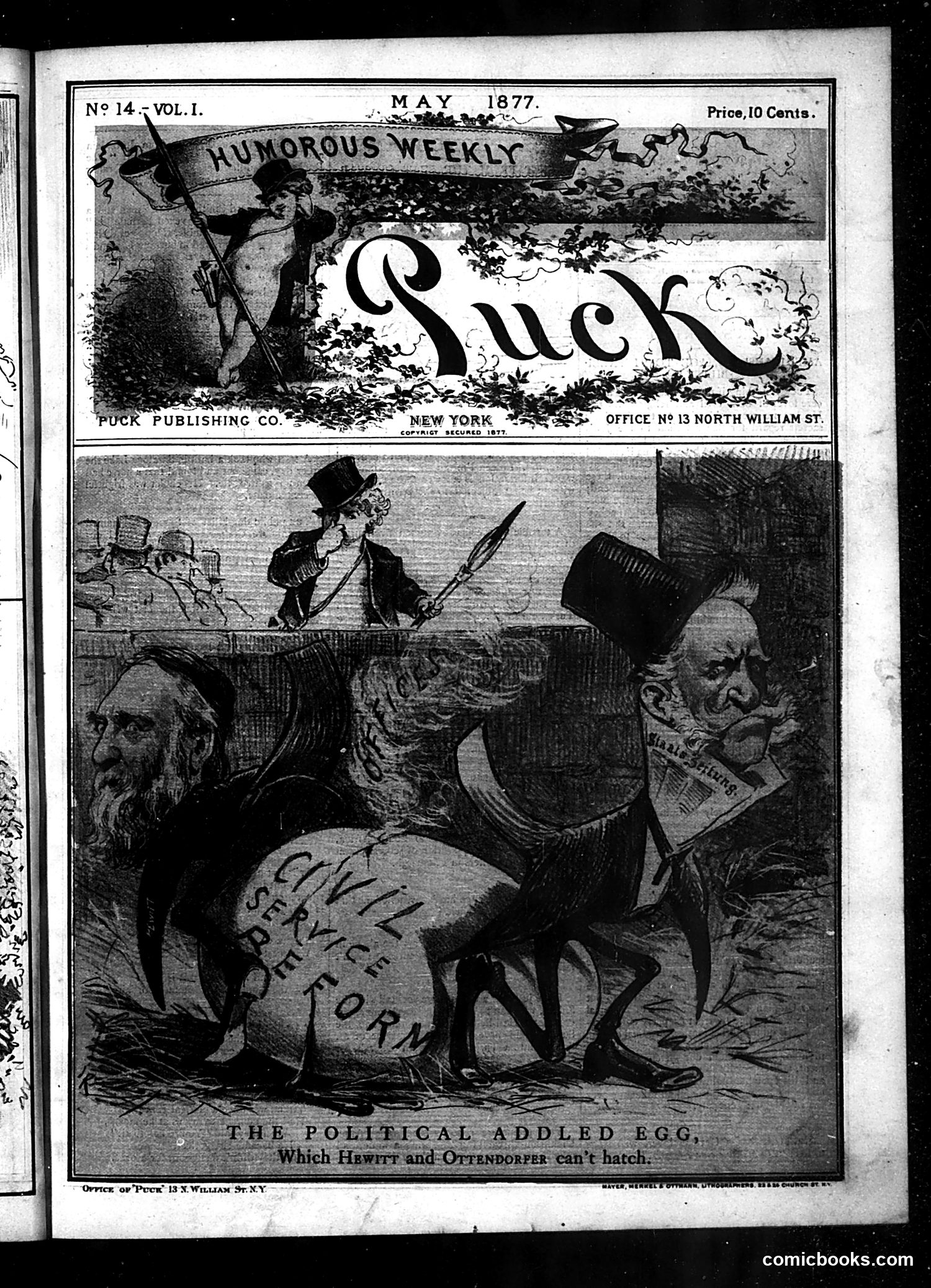
This May 1877 Puck cartoon satirizes two political figures—**Hewitt** and **Ottendorfer**—attempting unsuccessfully to hatch a cracked egg labeled "CIVIL SERVICE REFORM." The egg, depicted as broken and unviable, represents the failure of civil service reform efforts. Two bearded men (likely politicians or political operators) struggle futilely with this impossible task, while observers watch from above. The "addled" egg metaphor suggests their reform plans are fundamentally broken or corrupt—beyond repair. The cartoon reflects late-19th-century debates over government patronage versus merit-based hiring. It criticizes these particular figures' inability or unwillingness to genuinely implement civil service reforms, despite public pressure for cleaner government. The image mocks their political posturing as mere theater.
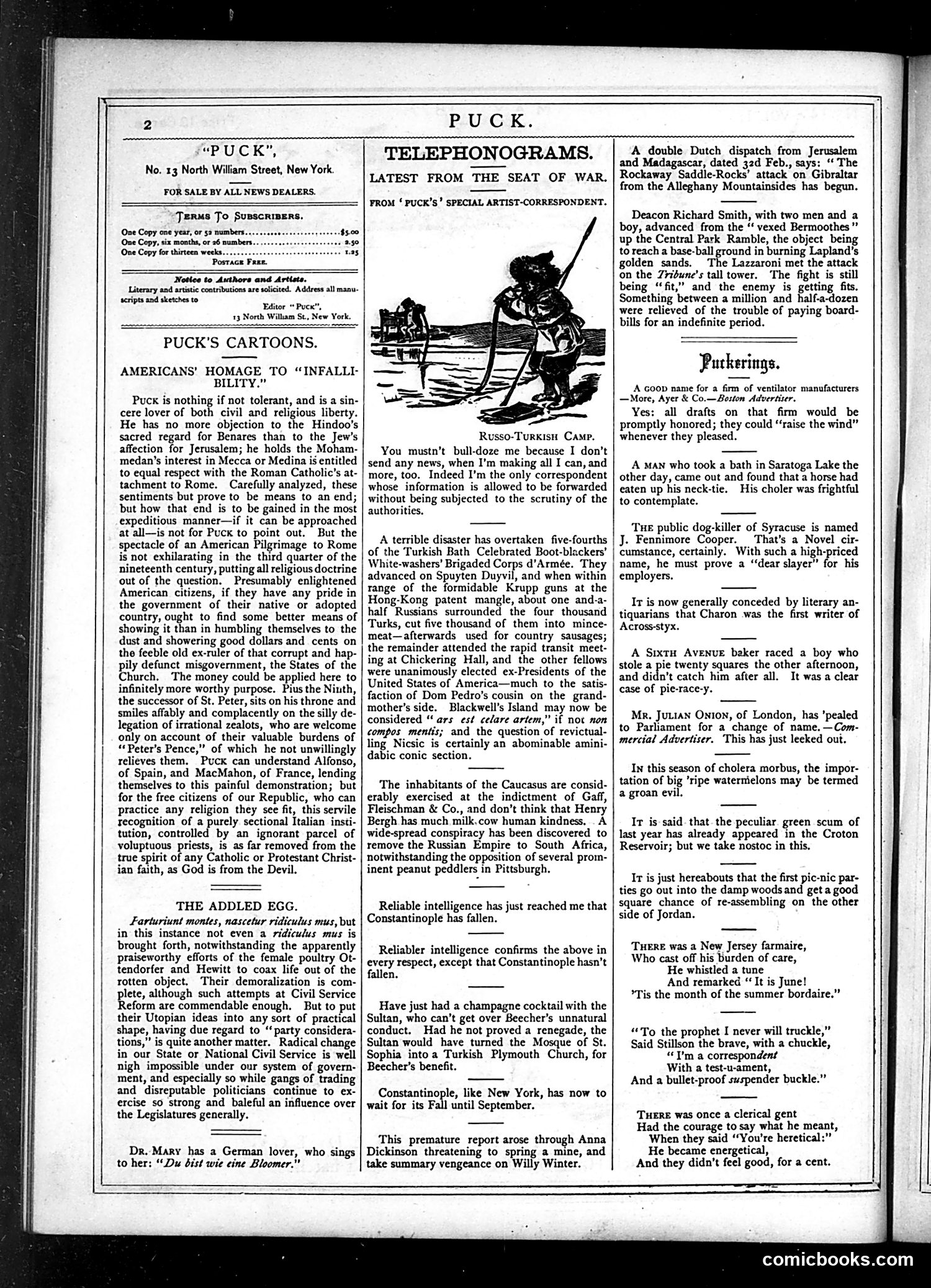
This page contains several satirical pieces and commentary rather than a single cartoon. The main illustrated item is titled "RUSSO-TURKISH CAMP," showing a figure using a telephone in military circumstances. The text pieces mock various targets: "AMERICANS' HOMAGE TO 'INFALLIBILITY'" critiques American attitudes toward religious authority; "THE ADDLED EGG" satirizes female suffrage advocates; and "PUCK'S CARTOONS" discusses American attitudes toward religious relics and Italian nationalism. Multiple brief satirical items follow, including jabs at Constantinople's political situation and references to contemporary figures like Anna Dickinson. The overall tone is typical Puck: irreverent commentary on contemporary politics, social movements, and international affairs, with particular focus on American religious attitudes and women's rights debates.
This page contains several separate articles and sections rather than a single unified cartoon. **"The Meerschaum"** is a poem about a pipe, with illustrations showing a woman smoking. The text celebrates the pipe as a symbol of leisure and pleasure. **"A Question of Personal Identity"** appears to be a humorous love poem or riddle playing on romantic confusion. **"Answers for the Anxious"** is an advice column addressing reader questions about social etiquette and personal matters. **"Summer Resort Jottings"** discusses Boston society's vacation plans, mentioning Nahant and Lake Mohawk as fashionable destinations. **"Foreign Fun"** comments on English and continental humor magazines, comparing their comedic styles. The page functions primarily as entertainment and advice content rather than political satire, reflecting Puck's varied editorial approach.
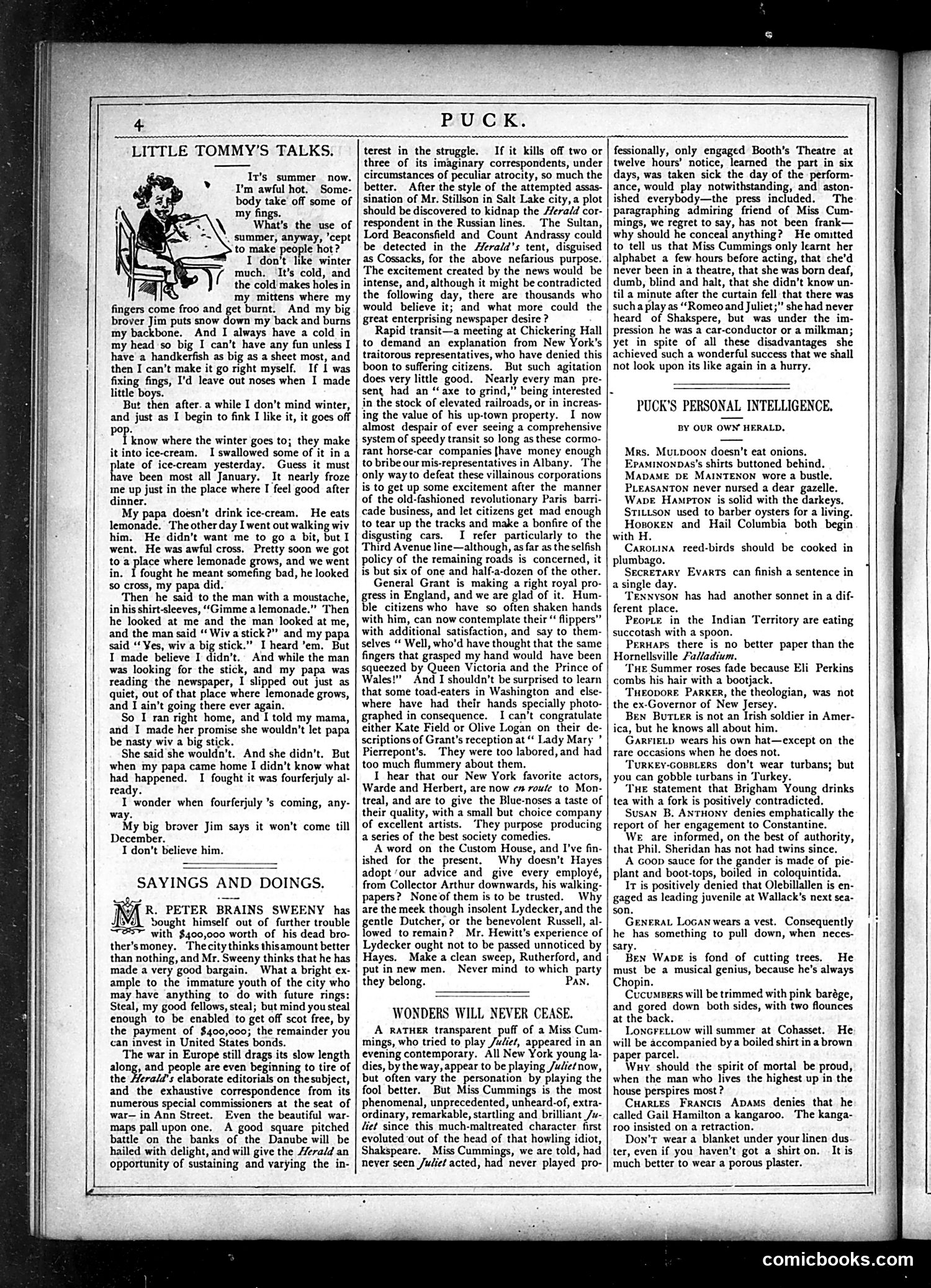
This page features "Little Tommy's Talks," a recurring humor column using a child character's innocent observations to satirize adult society. The cartoon shows a young boy with exaggerated features, a common format in Puck for social commentary. The text presents Tommy's naive childhood musings—about summer, winter discomforts, and parental behaviors—that subtly mock contemporary social issues. The column uses the child's perspective to critique adult hypocrisy and absurdity without explicit political attack. The surrounding sections ("Puck's Personal Intelligence," "Sayings and Doings," "Wonders Will Never Cease") contain brief gossip items and anecdotes about New York society figures and theatrical personalities, typical of Puck's satirical content targeting the era's cultural establishment.
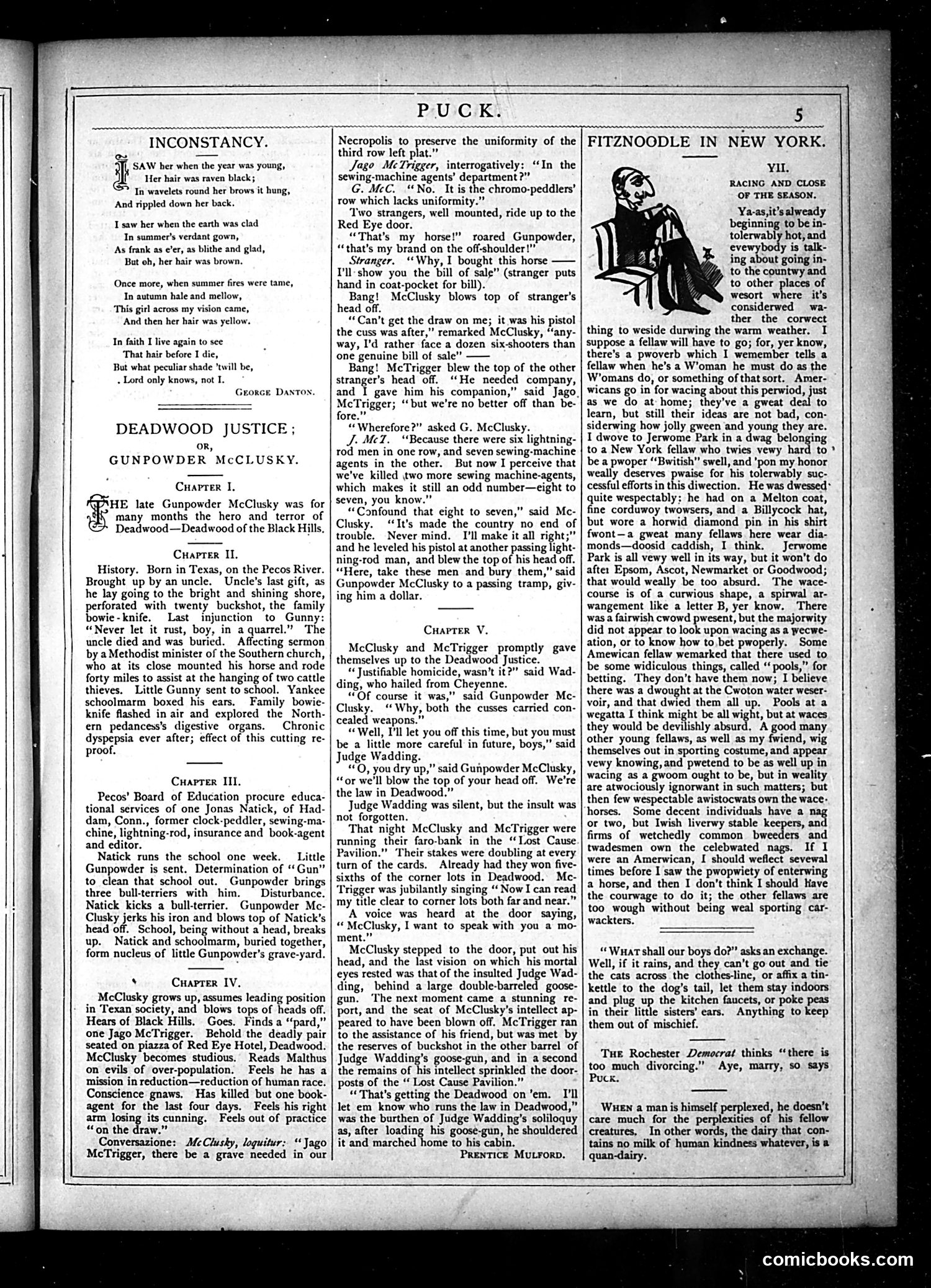
This page contains serialized fiction rather than political satire. The main content is "Deadwood Justice; or Gunpowder McClusky," a Western adventure story set in Texas featuring characters named Gunpowder McClusky and McTrigger. The page includes a poem titled "Inconsistency" by George Dayton and a separate humor piece "Fitznoodle in New York" discussing racing season and New York social life. The illustration shows a seated figure in period dress, though the OCR and image quality make it difficult to identify specific satirical targets or contemporary political references. This appears to be entertainment content rather than editorial commentary on current events, which was typical of Puck's varied offerings.
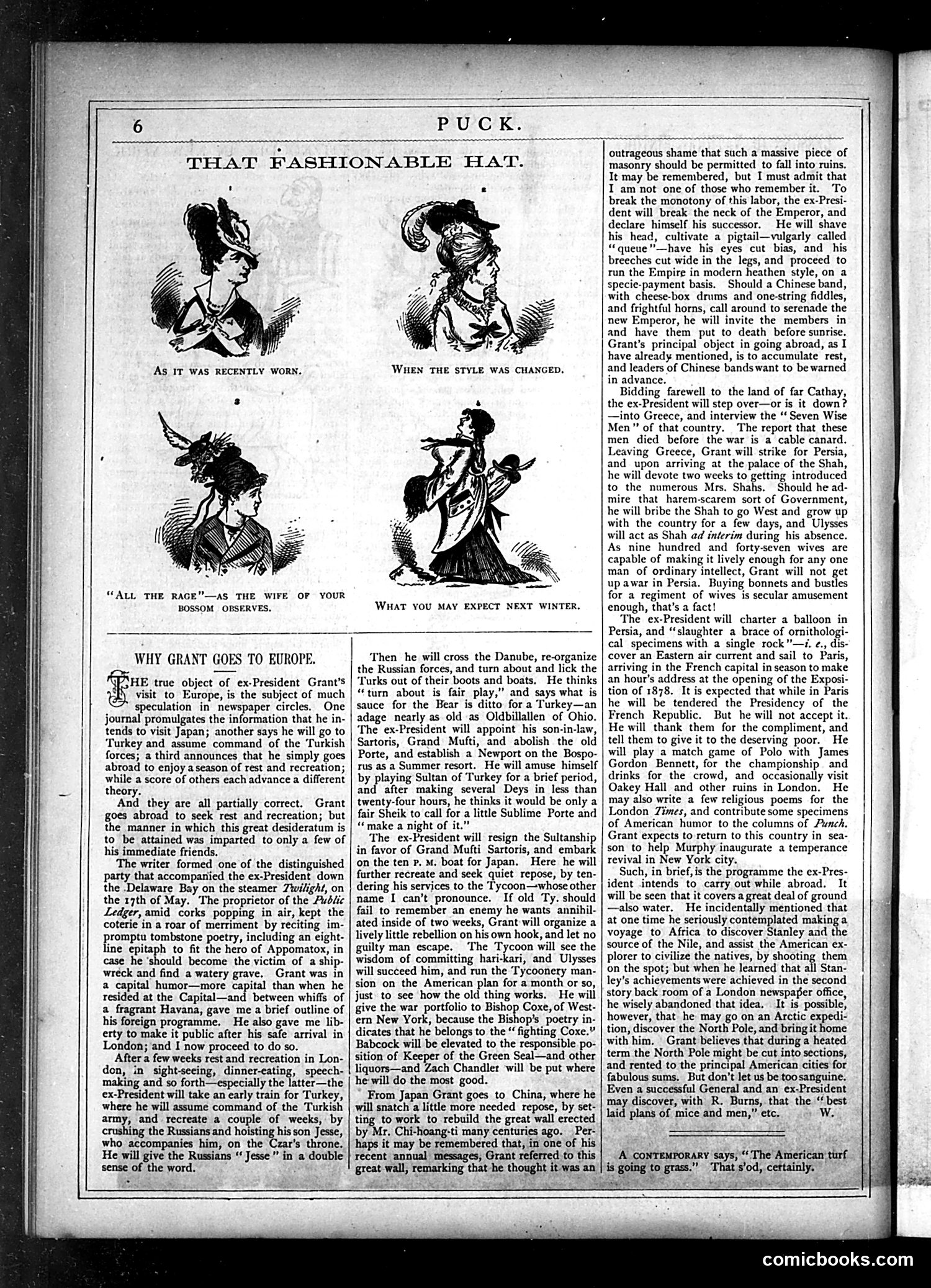
This page satirizes ex-President Ulysses S. Grant's planned foreign travels. The four sketches show a woman's hat in changing styles, captioned to reference Grant's journey: "As It Was Recently Worn," "When the Style Was Changed," "All the Rage," and "What You May Expect Next Winter." The accompanying article mocks Grant's stated purpose (rest and recreation) while detailing his actual plans: visiting Japan, China, and Persia, where he'll allegedly involve himself in local politics—reorganizing Russian forces, manipulating the Turkish Sultan, and briefing the Shah of Persia. The "fashionable hat" metaphor suggests Grant's pretenses keep shifting. The satire ridicules his claim of seeking quiet repose while predicting he'll engage in grandiose international meddling, making him a figure of ridicule across multiple continents.
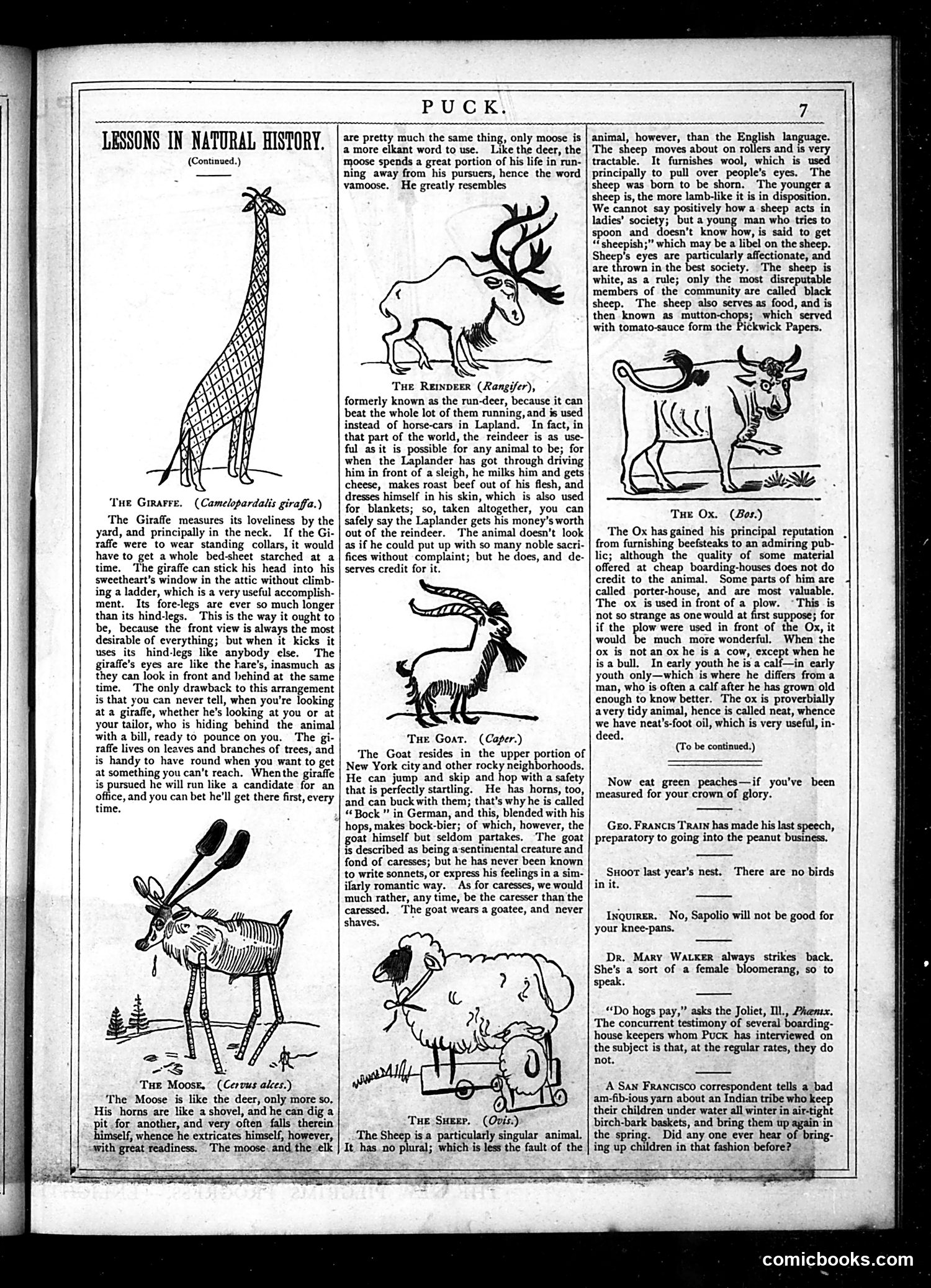
This page is primarily **educational content, not political satire**. It's a "Lessons in Natural History" feature with illustrated descriptions of animals: the Giraffe, Reindeer, Moose, Goat, Ox, and Sheep. Each animal receives a detailed, somewhat humorous natural history description. The writing style is characteristic of 19th-century educational humor—anthropomorphizing animals and making dry observations about their characteristics and uses. The page includes brief satirical items at bottom (references to "Dr. Mary Walker," "geo-political peanut business"), but these appear to be standard Puck filler jokes rather than the page's primary content. This represents Puck's educational entertainment function alongside its political commentary.
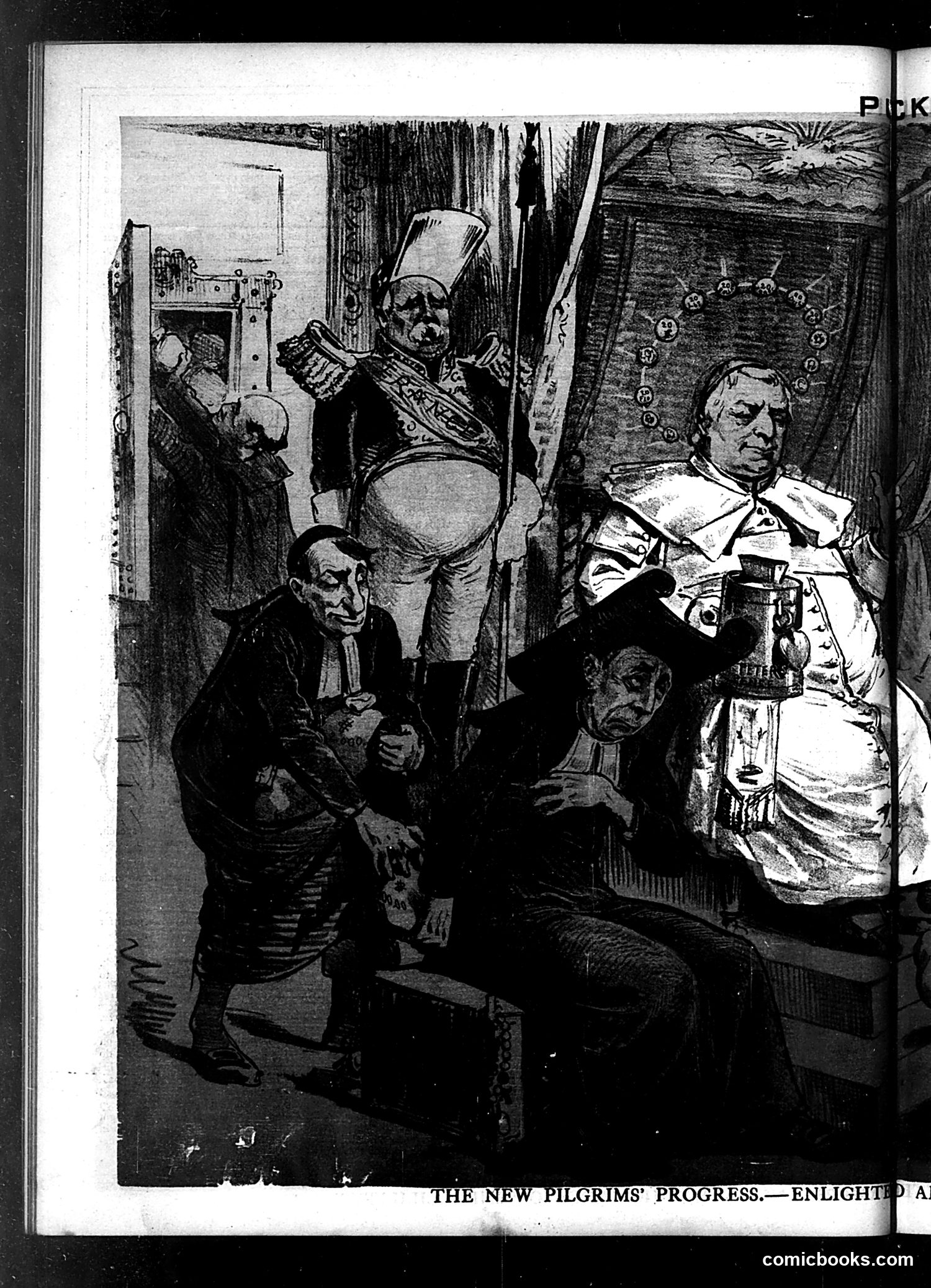
This political cartoon satirizes a journey through corrupt or morally questionable institutions. The title references John Bunyan's *Pilgrim's Progress*, a religious allegory about spiritual journey. The image shows several figures in what appears to be an official or institutional setting. A portly military or government official dominates the center, while civilians in dark coats—appearing distressed or subservient—occupy the lower portion. The contrast between the well-dressed, decorated authority figure and the ordinary citizens suggests commentary on power imbalance or exploitation. Without seeing the full caption or date, the exact target is unclear, but the "pilgrims" appear to be common people navigating a corrupt system rather than achieving spiritual enlightenment. The satire likely critiques institutional hypocrisy or abuse of authority during the Gilded Age.
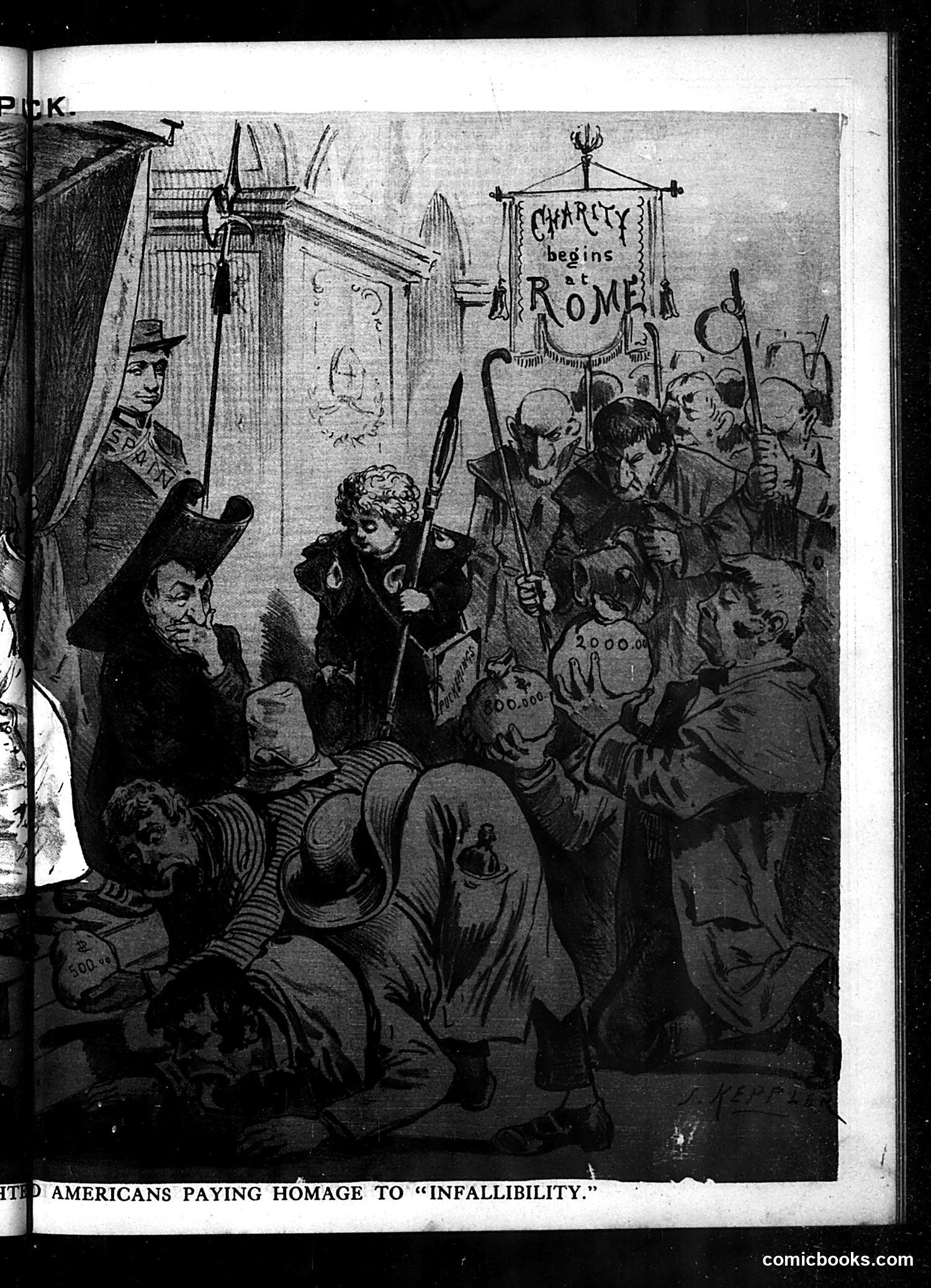
This Puck cartoon satirizes American reverence for the Roman Catholic Church, depicted as "Infallibility" — referencing the Catholic doctrine of papal infallibility (proclaimed officially in 1870). The image shows Americans of various classes paying homage to a Roman altar labeled "CHARITY begins at ROME." Armed soldiers or guards surround the scene, suggesting religious institutional power. The satire criticizes how American donations and deference flow toward Rome/the Vatican rather than benefiting domestic American causes. The "infallibility" reference suggests Puck viewed Catholic authority claims as arrogant and problematic. The cartoon reflects 19th-century American anti-Catholic sentiment, when many Protestants viewed the Vatican's influence over American Catholics with suspicion and resentment.
This page contains two articles rather than political cartoons. **"Classic Journalism"** is a nostalgic essay praising the Athens *Courier* and other historical newspapers, celebrating journalism's golden age when figures like Themistocles and Aristides founded publications. **"Summer Theatricals"** reviews contemporary theater, particularly criticizing burlesque shows. The writer argues that while "Evangeline" offers some clever humor, most summer theatrical productions are poorly constructed—merely stringing together weak jokes, rhymes, and puns rather than building coherent plots. The satire targets American audiences' low standards and the theater industry's cynical approach to summer entertainment, suggesting critics should demand better quality during the off-season.
This page contains two distinct pieces: "Pettengill's Photograph" (a short story about portrait photography) and "Two Knaves and a Queen" (a serialized English story). The text appears to be purely fictional narrative content rather than political satire. "Pettengill's Photograph" concerns a photographer managing a difficult customer's vanity and appearance concerns. "Two Knaves and a Queen" involves romantic entanglements and letters between characters named Gregory, René, Mr. Fox, and others. Without visible political cartoons on this page, I cannot identify specific satirical targets or contemporary references. The content is entertainment-focused rather than topical commentary typical of Puck's satirical mission.
This page contains three distinct sections: 1. **Top cartoon**: Shows a figure (likely a politician or public official) in a compromising situation, with text suggesting blackmail or coercion regarding personal letters or documents. The satirical point appears to target corruption or abuse of power. 2. **"Market Reports in Easton"**: A humorous piece mocking small-town gossip and local scandal, written as if reporting agricultural prices but actually detailing romantic entanglements and social drama. 3. **"Love's Young Dream"**: A longer satirical narrative about a love affair involving multiple characters—including references to a dog and various romantic complications—poking fun at sentimental romance and small-town social conventions. The overall theme ridicules political corruption, small-town hypocrisy, and romantic melodrama common to the era.
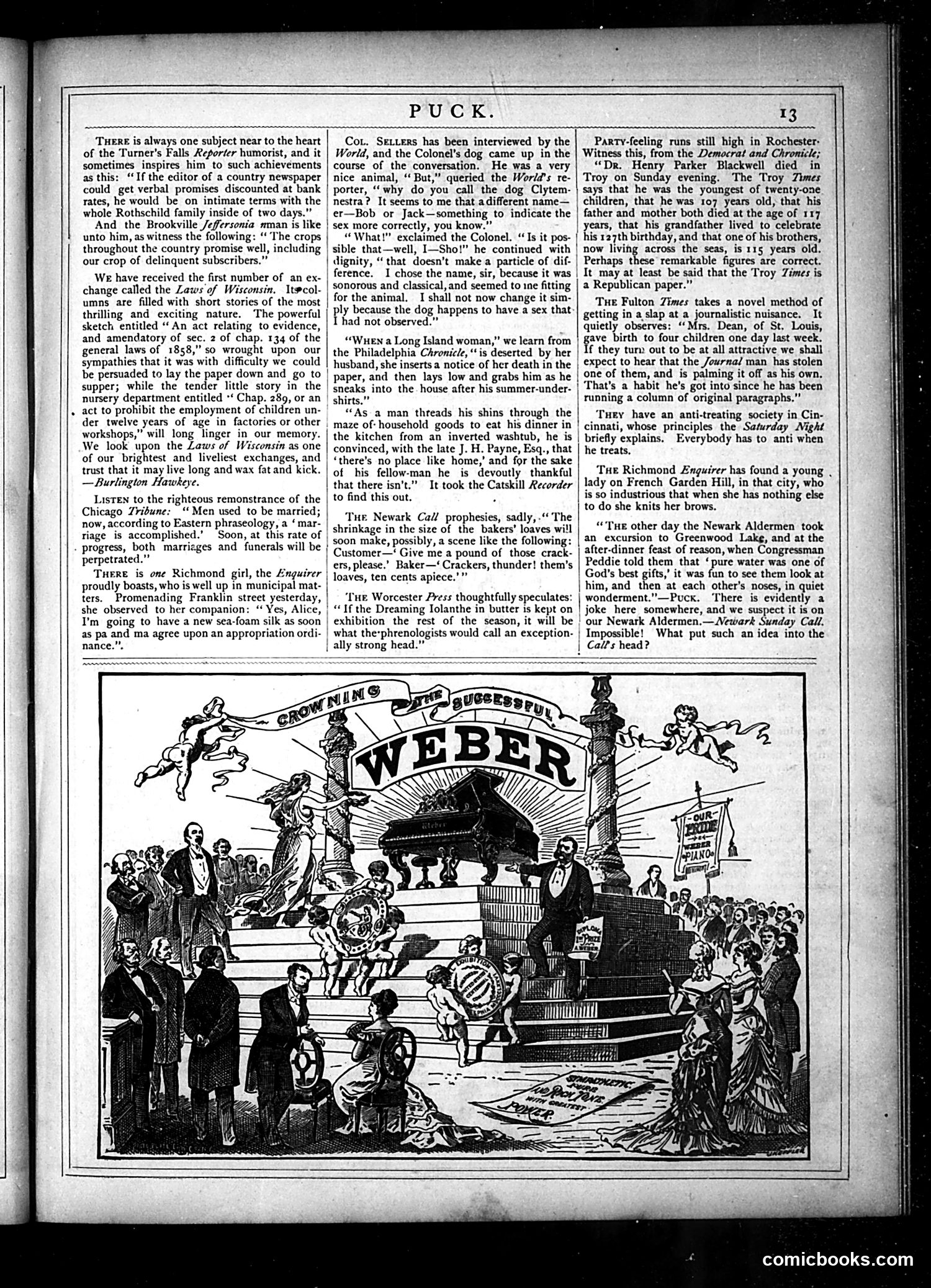
This page contains mostly **text commentary** rather than a primary political cartoon. The visible illustration is a **Weber piano advertisement**—not satirical content—showing an elaborate concert hall stage with crowds and performers, promoting "Weber" pianos as a "successful" instrument. The surrounding text discusses various topics: Colonel Sellers and his dog's unusual name ("Clytemnestra"), a Long Island woman's notice in a newspaper, comments on household management, and observations about butter being kept on exhibition. The commentary appears characteristic of Puck's **satirical social observations**—poking fun at everyday absurdities, naming conventions, and domestic life among the middle and upper classes. However, without clearer political references visible in this particular page, the specific satirical targets remain somewhat unclear.
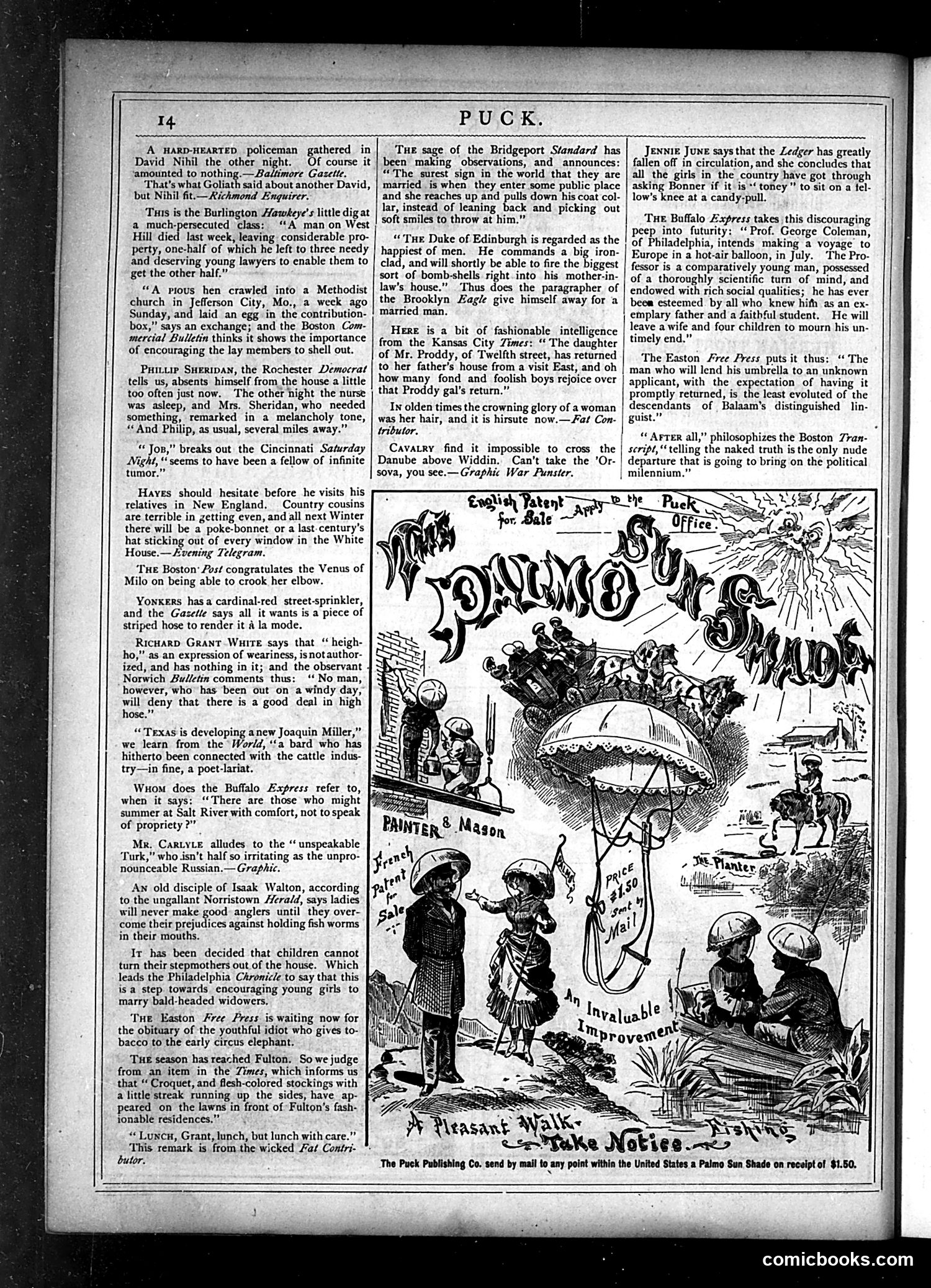
This page contains miscellaneous satirical commentary and advertisements rather than a unified political cartoon. The visible illustration appears to be titled something like "Donning a Sad" and depicts various figures in what looks like a chaotic or absurd scene, though the specific satirical target is unclear from the image quality. The text includes brief satirical notes on contemporary figures and issues—references to newspapers like the *Ledger* and *Standard*, commentary on various public figures, and social observations. Several items mock specific individuals' foibles or current events, though without clearer context or dates, the precise references are difficult to identify with certainty. The page ends with an advertisement for Puck's mail subscription service.
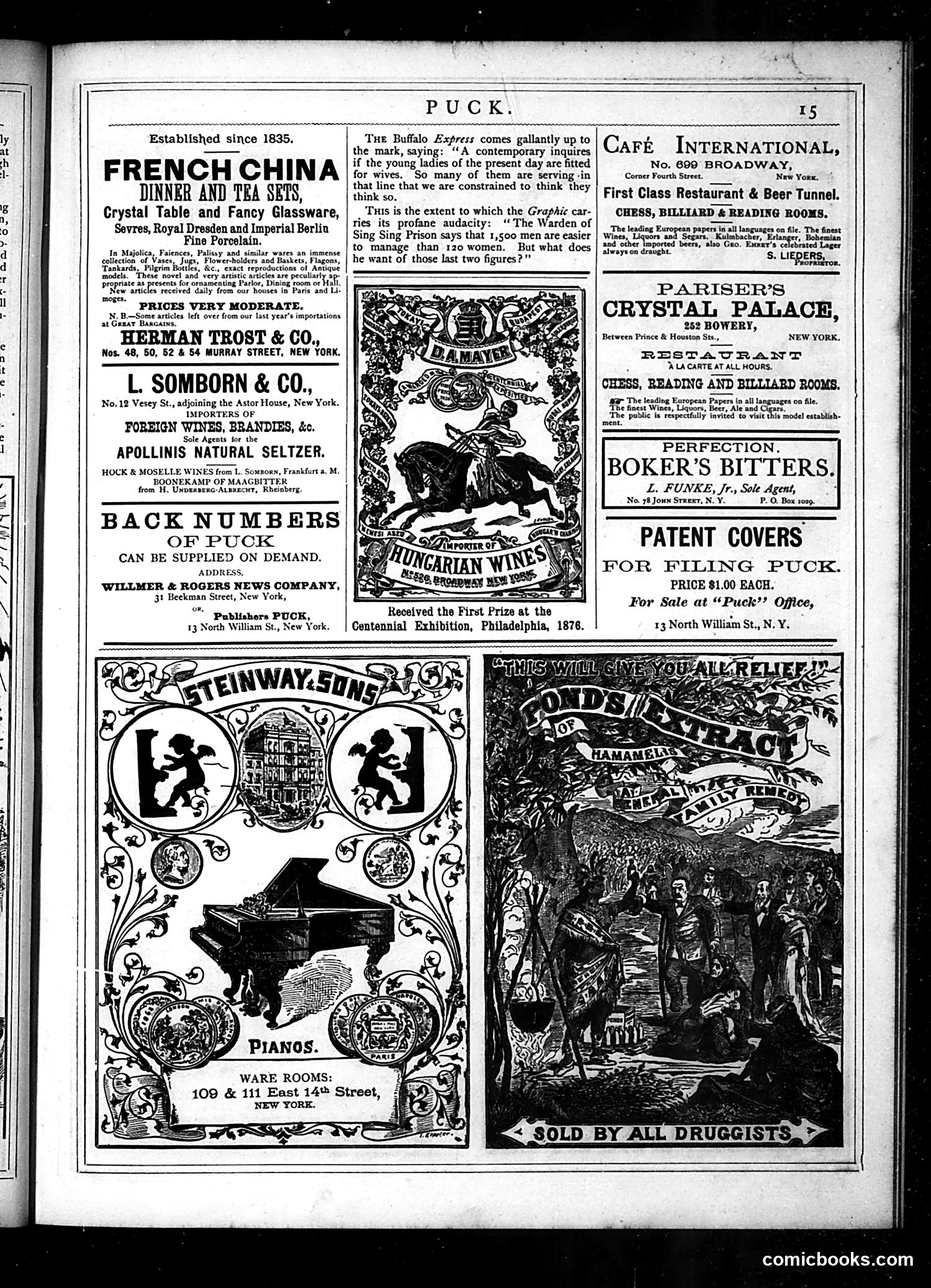
This page is primarily **advertising**, not political satire. The ads showcase late 19th-century luxury goods and services: French china dinnerware, imported wines, a piano manufacturer (Steinway & Sons), restaurants, and a patent medicine ("Gould's Extract," sold by druggists). The only illustrated content is a decorative Hungarian wine advertisement featuring a rearing horse—a heraldic symbol likely referencing Hungary's national imagery. There is no political cartoon or satirical commentary visible on this page. This represents typical Puck magazine revenue: advertisements subsidized the publication's satirical content that appeared elsewhere in the issue. The page documents consumer culture and commercial messaging from the 1870s-1880s era.
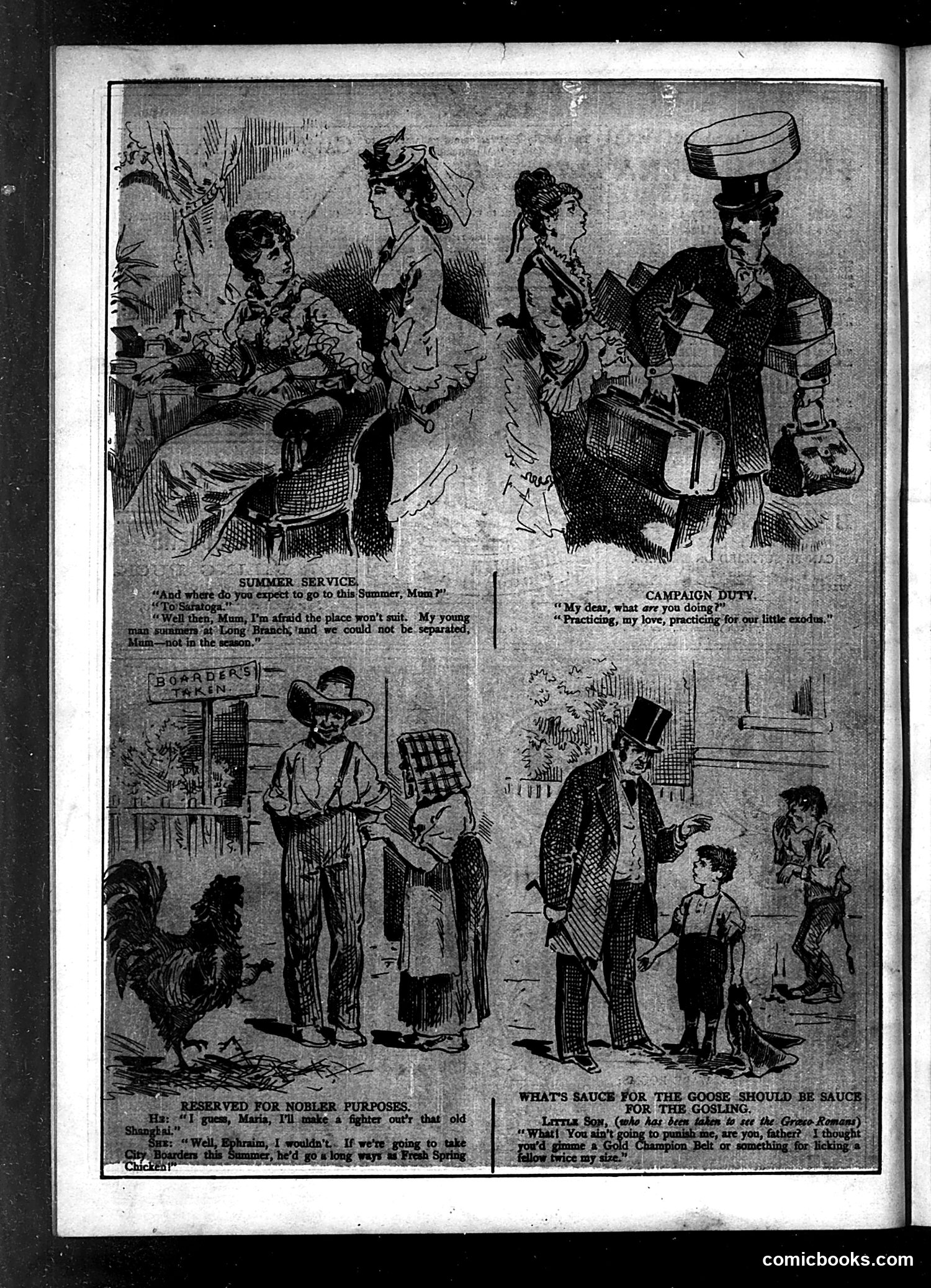
This page contains four separate satirical comics with domestic and social themes: 1. **"Summer Service"**: A woman worries about her young man's separation during summer—likely referencing the social custom of wealthy families' seasonal migrations. 2. **"Campaign Duty"**: A woman practices military drills, suggesting satire about women's involvement in military preparedness or suffrage activism. 3. **"Reserved for Nobler Purposes"**: A cowboy-dressed man at a boarding house discusses avoiding service—appears to mock draft evasion or claims of exemption. 4. **"What's Sauce for the Goose Should Be Sauce for the Gosling"**: A well-dressed gentleman with children—the title suggests commentary on applying rules inconsistently or hypocritically to different social classes. The overall tone mixes domestic humor with class commentary typical of Puck's satirical approach.