
Puck, 1877-05 · page 11 of 16
Puck — May 1877 — page 11: what you’re looking at
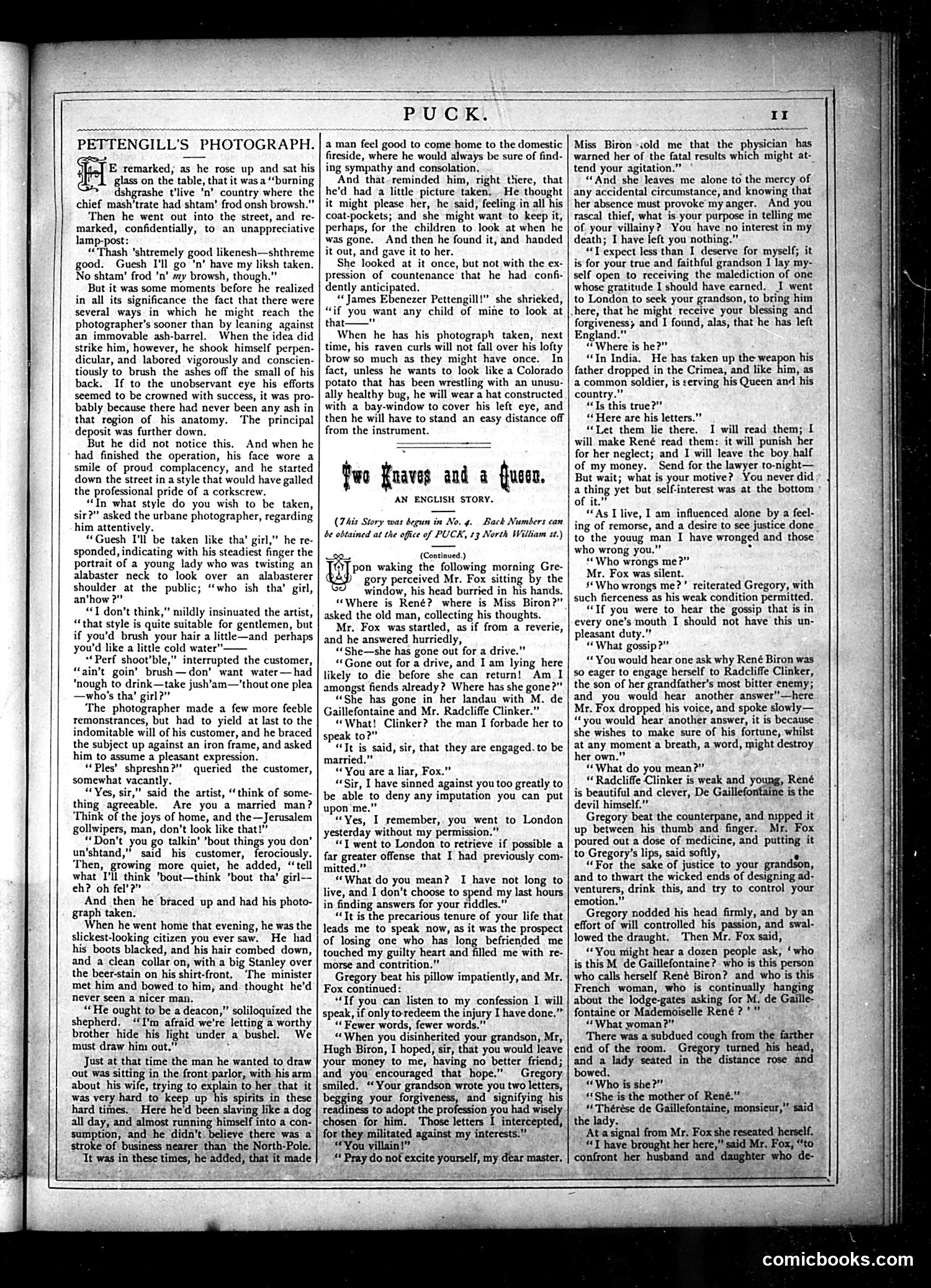
What you’re looking at
This page contains two distinct pieces: "Pettengill's Photograph" (a short story about portrait photography) and "Two Knaves and a Queen" (a serialized English story). The text appears to be purely fictional narrative content rather than political satire. "Pettengill's Photograph" concerns a photographer managing a difficult customer's vanity and appearance concerns. "Two Knaves and a Queen" involves romantic entanglements and letters between characters named Gregory, René, Mr. Fox, and others. Without visible political cartoons on this page, I cannot identify specific satirical targets or contemporary references. The content is entertainment-focused rather than topical commentary typical of Puck's satirical mission.
📄 Transcribed text from this page (OCR, searchable)
Machine-transcribed from the original scan — historical spelling and the odd misread are preserved.
PETTENGILL’S PHOTOGRAPH. E remarked, as he rose up and sat his glass on the table, that it was a ‘(burning dshgrashe t’live 'n’ country where the chief mash’trate had shtam’ frod onsh browsh.”” Then he went out into the street, and re- marked, confidentially, to an unappreciative lamp-post: “Thash 'shtremely good likenesh—shthreme good. Guesh I'll go 'n’ have my liksh taken. No shtam’ frod 'n’ my browsh, though.” But it was some moments before he realized in all its significance the fact that there were several ways in which he might reach the photographer's sooner than by leaning against an immovable ash-barrel. When the idea did strike him, however, he shook himself perpen- dicular, and labored vigorously and conscien- tiously to brush the ashes off the small of his back. If to the unobservant eye his efforts seemed to be crowned with success, it was pro- bably because there had never been any ash in that region of his anatomy. ‘The principal deposit was further down. But he did not notice this. And when he had finished the operation, his face wore a smile of proud complacency, and he started down the street in a style that would have galled the professional pride of a corkscrew. “In what style do you wish to be taken, sir?” asked the urbane photographer, regarding him attentively. “Guesh I'll be taken like tha’ girl,” he re- sponded, indicating with his steadiest finger the portrait of a young lady who was twisting an alabaster neck to look over an_alabasterer shoulder at the public; “who ish tha’ girl, an’how ?”” “I don’t think,” mildly insinuated the artist, “that style is quite suitable for gentlemen, but if you'd brush your hair a little—and perhaps you'd like a little cold water”—— “Perf shoot’ble,” interrupted the customer, “ain't goin’ brush—don’ want water—had *nough to drink—take jush’am—'thout one plea —who's tha’ girl?” The photographer made a few more feeble remonstrances, but had to yield at last to the indomitable will of his customer, and he braced the subject up against an iron frame, and asked him to assume a pleasant expression. “Ples' shpreshn?” queried the customer, somewhat vacantly. “Yes, sir,” said the artist, “think of some- thing agreeable. Are you a married man? Think of the joys of home, and the—Jerusalem gollwipers, man, don't look like that!” “Don't you go talkin’ ’bout things you don’ un’shtand,” said his customer, ferociously. Then, growing more quiet, he added, “tell what I’ll think 'bout—think ‘bout tha’ girl ch? oh fel’?” And then he braced up and had his photo- graph taken. When he went home that evening, he was the slickest-looking citizen you ever saw. He had his boots blacked, and his hair combed down, and a clean collar on, with a big Stanley over the beer-stain on his shirt-front. ‘The minister met him and bowed to him, and. thought he'd never seen a nicer man. “‘He ought to be a deacon,” soliloquized the shepherd. ‘I'm afraid we're letting a worthy brother hide his light under a bushel. We must draw him out.” t Just at that time the man he wanted to draw out was sitting in the front parlor, with his arm about his wife, trying to explain to her that it was very hard to keep up his spirits in these hard times. Here he'd been slaving like a dog all day, and almost running himself into a con- sumption, and he didn’t: believe there was a stroke of business nearer than the North-Pole. ‘Tt was in these times, he added, that it made PUCK. a man feel good to come home to the domestic fireside, where he would always be sure of find- ing sympathy and consolation, And that reminded him, right there, that he'd had a little picture taken, He thought it might please her, he said, feeling in all his coat-pockets; and she might want to keep it, perhaps, for the children to look at when he was gone. And then he found it, and handed it out, and gave it to her. She looked at it once, but not with the ex- pression of countenance that he had confi- dently anticipated. «James Ebenezer Pettengill!” she shrieked, “if you want any child of mine to look at that——"" When he has his photograph taken, next time, his raven curls will not fall over his lofty brow so much as they might have once. In fact, unless he wants to look like a Colorado potato that has been wrestling with an unusu- ally healthy bug, he will wear a hat constructed with a bay-window to cover his left eye, and then he will have to stand an easy distance off from the instrument. Fue raves and a {ueen. AN ENGLISH STORY. (This Story was begun in No. 4. Back Numbers can be obtained at the office of PUCK, 13 North William st.) (Continued.) r] pon waking the following morning Gre- gory perceived Mr. Fox sitting by the window, his head burried in his hands. “Where is René? where is Miss Biron?” asked the old man, collecting his thoughts. Mr. Fox was startled, as if from a reverie, and he answered hurriedly, “She—she has gone out for a drive.” “Gone out for a drive, and I am lying here likely to die before she can return! Am I amongst fiends already? Where has she gone?” “She has gone in her landau with M. de Gaillefontaine and Mr. Radcliffe Clinker.” “What! Clinker? the man I forbade her to speak to?” “Tt is said, sir, that they are engaged. to be married.” “You are a liar, Fox.” “Sir, I have sinned against you too greatly to be able to deny any imputation you can put upon me.” “Yes, I remember, you went to London yesterday without my permission.” “TI went to London to retrieve if possible a far greater offense that I had previously com- mitted.” “What do you mean? I have not long to live, and I don’t choose to spend my last hours in finding answers for your riddles.” “Tt is the precarious tenure of your life that leads me to speak now, as it was the prospect of losing one who has long befriended me touched my guilty heart and filled me with re- morse and contrition.” Gregory beat his pillow impatiently, and Mr. Fox continued: “If you can listen to my confession I will speak, if only toredeem the injury I have done.” “Fewer words, fewer words.” “When you disinherited your grandson, Mr, Hugh Biron, I hoped, sir, that you would leave your money to me, having no better friend; and you encouraged that hope.” Gregory. smiled. ‘Your grandson wrote you two letters, begging your forgiveness, and signifying his iness to adopt the profession you had wisel chosen for him. Those letters I intercepted, for'they militated against my interests.” €You villain!” “ Pray donot excite yourself, my dear master, Miss Biron -iold me that the physician has warned her of the fatal results which might at-_ tend your agitation.” * “And she leaves me alone to the mercy of any accidental circumstance, and knowing that her absence must provoke’ my anger. And you rascal thief, what is.your purpose in telling me of your villainy? You have no interest in my death; I have left you nothing.” “T expect less than I deserve for myself; it is for your true and faithful grandson I lay my- self open to receiving the malediction of one whose gratitude I should have earned. I went to London to seek your grandson, to bring him here, that he might receive your blessing and forgiveness} and I found, alas, that he has left England.” “Where is he?” “In India. He has taken up the weapon his father dropped in the Crimea, and like him, as a common soldier, is serving his Queen and his country.”” “Ts this true?” “Here are his letters.” “Let them lie there. I will read them; I will make René read them: it will punish her for her neglect; and I will leave the boy half of my money. Send for the lawyer to-night— But wait; what is your motive? You never did a thing yet but self-interest was at the bottom of it.” ‘As I live, 1 am influenced alone by a feel- ing of remorse, and a desire to see justice done to the youug man I have wronged and those who wrong you.” 6 “Who wrongs me?” Mr. Fox was silent. s* Who wrongs me?’ reiterated Gregory, with such fierceness as his weak condition permitted. “If you were to hear the gossip that is in every one’s mouth I should not have this un- pleasant duty.” “What gossip?” “You would hear one ask why René Biron was so eager to engage herself to Radcliffe Clinker, the son of her grandfather’s most bitter enemy; and you would hear another answer”’—here Mr. Fox dropped his voice, and spoke slowly— ‘you would hear another answer, it is because she wishes to make sure of his fortune, whilst at any moment a breath, a word, might destroy her own.” “What do you mean?” “ Radcliffe Clinker is weak and young, René is beautiful and clever, De Gaillefontaine is the devil himself.” ‘ Gregory beat the counterpane, and nipped it up between his thumb and finger. Mr. Fox poured out a dose of medicine, and putting it to Gregory's lips, said softly, x “For the sake of justice to your grandson, and to thwart the wicked ends of designing ad- venturers, drink this, and try to control your emotion.” Gregory nodded his head firmly, and by an effort of will controlled his passion, and swal- lowed the draught. ‘Then Mr. Fox said, “You might hear a dozen people ask, ‘ who is this M de Gaillefontaine?. who is this person who calls herself René Biron? and who is this French woman, who is continually hanging about the lodge-gates asking for M. de Gaille- fontaine or Mademoiselle René ?’” «What woman?” ‘There was a subdued cough from the farther end of the room. Gi turned his head, and a lady seated in the distance rose and bowed. “ “Who is she?” 7 ‘She is the mother of René.” sy “Thérése de Gaillefontaine, monsieur,’’ said» the lady. ‘At asignal from Mr. Fox she reseated herself, «T have brought her here,” said Mr. Fox, “to confront her husband and daughter who de- comicbooks.com