
Puck, 1877-05 · page 10 of 16
Puck — May 1877 — page 10: what you’re looking at
What you’re looking at
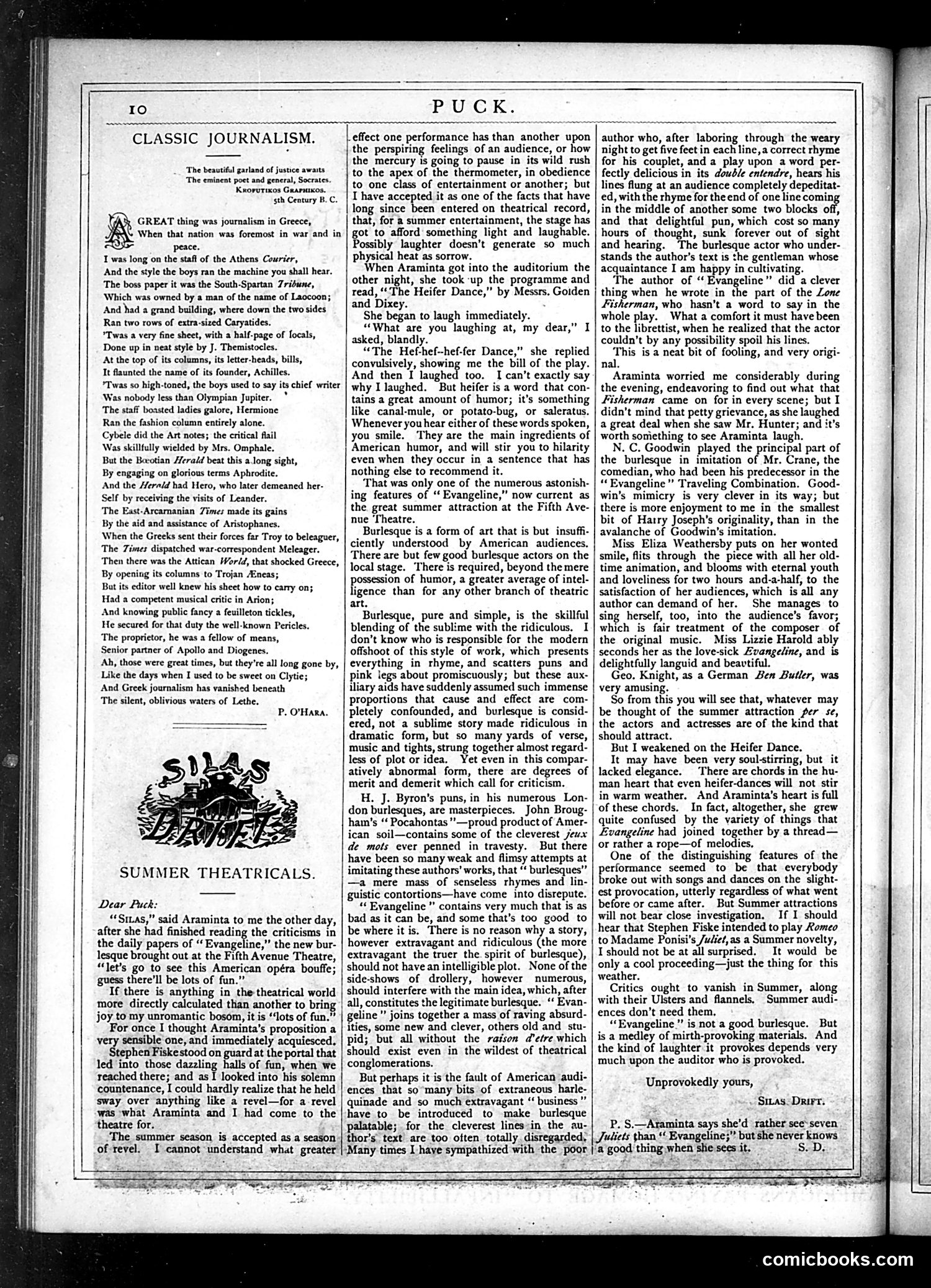
This page contains two articles rather than political cartoons. **"Classic Journalism"** is a nostalgic essay praising the Athens *Courier* and other historical newspapers, celebrating journalism's golden age when figures like Themistocles and Aristides founded publications. **"Summer Theatricals"** reviews contemporary theater, particularly criticizing burlesque shows. The writer argues that while "Evangeline" offers some clever humor, most summer theatrical productions are poorly constructed—merely stringing together weak jokes, rhymes, and puns rather than building coherent plots. The satire targets American audiences' low standards and the theater industry's cynical approach to summer entertainment, suggesting critics should demand better quality during the off-season.
📄 Transcribed text from this page (OCR, searchable)
Machine-transcribed from the original scan — historical spelling and the odd misread are preserved.
5 fo} PUCK. CLASSIC JOURNALISM. ‘The beautiful garland of justice awaits The eminent poet and general, Socrates. Kxorurixos Gnarixos. sth Century B.C. GREAT thing was journalism in Greece, ‘When that nation was foremost in war and in peace. I was long on the stafl of the Athens Courier, And the style the boys ran the machine you shall hear. The boss paper it was the South-Spartan 7ridune, ‘Which was owned by a man of the name of Laocoon; And had a grand building, where down the two sides Ran two rows of extra-sized Caryatides. "Twas a very fine sheet, with a half-page of focals, Done up in neat style by J. Themistocles. At the top of its columns, its letter-heads, bills, It flaunted the name of its founder, Achilles. *Twas so high-toned, the boys used to say its chief writer Was nobody less than Olympian Jupiter. The staff boasted ladies galore, Hermione Ran the fashion column entirely alone. Cybele did the Art notes; the critical flail ‘Was skillfully wielded by Mrs. Omphale. But the Bevotian Herald beat this a.long sight, By engaging on glorious terms Aphrodite. And the Hera/d had Hero, who later demeaned her- Self by receiving the visits of Leander. ‘The East-Arcarnanian Zimes made its gains By the aid and assistance of Aristophanes. When the Greeks sent their forces far Troy to beleaguer, The Times dispatched war-correspondent Meleager. Then there was the Attican World, that shocked Greece, By opening its columns to Trojan AEneas; But its editor well knew his sheet how to carry on; Had a competent musical critic in Arion; And knowing public fancy a feuilleton tickles, He secured for that duty the well-known Pericles. ‘The proprietor, he was a fellow of means, Senior partner of Apollo and Diogenes. Ah, those were great times, but they're all long gone by, Like the days when I used to be sweet on Clytie; And Greek journalism has vanished beneath ‘The silent, oblivious waters of Lethe. SUMMER THEATRICALS. Dear Puck: “Stas,” said Araminta to me the other day, after she had finished reading the criticisms in the daily papers of ‘‘ Evangeline,” the new bur- lesque brought out at the Fifth Avenue Theatre, “let’s go to see this American opéra bouffe; guess there'll be lots of fun.”” If there is anything in the theatrical world | more directly calculated than another to bring joy to my unromantic bosom, it is “lots of fun.” For once I thought Araminta’s proposition a very sensible'one, and immediately acquiesced. Stephen Fiske stood on dat the portal that led into those dazzling of fun, when we reached there; and as I looked into his solemn countenance, I could hardly realize that he held sway over anything like a revel—for a-revel was what Araminta and I had come to the theatre for. ‘The summer season is accepted as a season of-revel. I cannot understand what greater . effect one performance has than another upon the perspiring feelings of an audience, or how the mercury is going to pause in its wild rush to the apex of the thermometer, in obedience to one class of entertainment or another; but I have accepted it as one of the facts that have long since been entered on theatrical record, that, for a summer entertainment, the stage has got to afford: something light and laughable. Possibly laughter doesn’t generate so much physical heat as sorrow. When Araminta got into the auditorium the other night, she took ‘up the programme and read, “The Heifer Dance,” by Messrs. Goiden and Dixey. She began to laugh immediately. “What are you laughing at, my dear,” I asked, blandly. “The Hef-hef—hef-fer Dance,” she replied convulsively, showing me the bill of the play. And then I laughed too. I can’t exactly say why I laughed. But heifer is a word that con- tains a great amount of humor; it’s something like canal-mule, or potato-bug, or saleratus. Whenever you hear either of these words spoken, you smile. They are the main ingredients of American humor, and will stir you to hilarity even when they occur in a sentence that has nothing else to recommend it. ‘That was only one of the numerous astonish- ing features of “Evangeline,” now current as the. great summer attraction at the Fifth Ave- nue Theatre. Burlesque is a form of art that is but insuffi- ciently understood by American audiences. There are but few good burlesque actors on the local stage. ‘There is required, beyond the mere possession of humor, a greater average of intel- ligence than for any other branch of theatric art. Burlesque, pure and simple, is the skillful blending of the sublime with the ridiculous. I don’t know who is responsible for the modern offshoot of this style of work, which presents everything in rhyme, and scatters puns and pink legs about promiscuously; but these aux- iliary aids have suddenly assumed such immense proportions that cause and effect are com- pletely confounded, and burlesque is consid- ered, not a sublime story made ridiculous in dramatic form, but so many yards of verse, music and tights, strung together almost regard- less of plot or idea. Yet even in this compar- atively abnormal form, there are degrees of merit and demerit which call for criticism. H. J. Byron’s puns, in his numerous Lon- don burlesques, are masterpieces. John Broug- ham's “ Pocahontas ""—proud product of Amer- ican soil—contains some of the cleverest jeux de mots ever penned in travesty. But there have been so many weak and flimsy attempts at imitating these authors’ works, that “‘ burlesques”” —a mere mass of senseless rhymes and lin- guistic contortions—have come into disrepute. “ Evangeline ” contains very much that is as bad as it can be, and some that’s too good to be where it is. There is no reason why a story, however extravagant and ridiculous (the more extravagant the truer the. spirit of burlesque), should not have an intelligible plot. None of the side-shows of drollery, however numerous, should interfere with the main idea, which, after all, constitutes the legitimate burlesque. “ Evan- geline ” joins together a mass of raving absurd- ities, some new and clever, others old and stu- pid; but all without the ratson d'etre which should exist even in the wildest of theatrical conglomerations. But perhaps it is the fault of American audi- ences that so many bits of extraneous harle- quinade and so much extravagant “ business” have to be introduced to make burlesque palatable; for the cleverest lines:in the au- thor’s text) are too often totally disregarded, ‘Many times I haye sympathized with the poor author who, after laboring through the weary night to get five feet in each line,a correct rhyme for his couplet, and a play upon a word per- fectly delicious in its double entendre, hears his lines flung at an audience completely depeditat- ed, with the rhyme for the end of one line comin in the middle of another some two blocks off, and that delightful pun, which cost so many hours of thought, sunk forever out of sight and hearing. The burlesque actor who under- stands the author's text is the gentleman whose acquaintance I am happy in cultivating. The author of “Evangeline” did a clever thing when he wrote in the part of the Lone Fisherman, who hasn’t a word to say in the whole play. What a comfort it must have been to the librettist, when he realized that the actor couldn’t by any possibility spoil his lines. This is a neat bit of fooling, and very origi- nal. Araminta worried me considerably during the evening, endeavoring to find out what that Fisherman came on for in every scene; but I didn’t mind that petty grievance, as she laughed a great deal when she saw Mr. Hunter; and it’s worth soniething to see Araminta laugh. N. C. Goodwin played the principal part of the burlesque in imitation of Mr. Crane, the comedian, who had been his predecessor in the “Evangeline” Traveling Combination. Good- win’s mimicry is very clever in its way; but there is more enjoyment to me in the smallest bit of Harry Joseph's originality, than in the avalanche of Goodwin's imitation. Miss Eliza Weathersby puts on her wonted smile, flits through the piece with all her old- time animation, and blooms with eternal youth and loveliness for two hours and-a-half, to the satisfaction of her audiences, which is all any author can demand of her. She manages to sing herself, too, into the audience's favor; which is fair treatment of the composer of the original music. Miss Lizzie Harold ably seconds her as the love-sick Evangedine, and is delightfully languid and beavtiful. Geo. Knight, as a German Ben Butler, was very amusing. $o from this you will see that, whatever may be thought of the summer attraction per se, the actors and actresses are of the kind that should attract. But I weakened on the Heifer Dance. It may have been very soul-stirring, but it lacked elegance. There are chords in the hu- man heart that even heifer-dances will not stir in warm weather. And Araminta’s heart is full of these chords, In fact, altogether, she grew quite confused by the variety of things that Evangeline had joined together by a thread— or rather a rope—of melodies, One of the distinguishing features of the performance seemed to be that everybody broke out with songs and dances on the slight- est provocation, utterly regardless of what went before or came after. But Summer attractions will not bear close investigation. If I should hear that Stephen Fiske intended to play Xomeo to Madame Ponisi’s /u/iet,as a Summer novelty, I should not be at all surprised. It would be only a cool proceeding—just the thing for this weather. Critics ought to vanish in Summer, along with their Ulsters and flannels, Summer audi- ences don’t need them, “Evangeline.” is not a good burlesque. But is a medley of mirth-provoking materials. And the kind of laughter it provokes depends very much upon the auditor who is provoked. Unprovokedly yours, Siras-Drirr. P. S.—Araminta says she'd rather see-seven Juliets than “ Evangeline;” but she néver knows a good thing when she sees S. ——-—- ~~ Ts SRA comicbooks.com