
Puck, 1877-05 · page 7 of 16
Puck — May 1877 — page 7: what you’re looking at
What you’re looking at
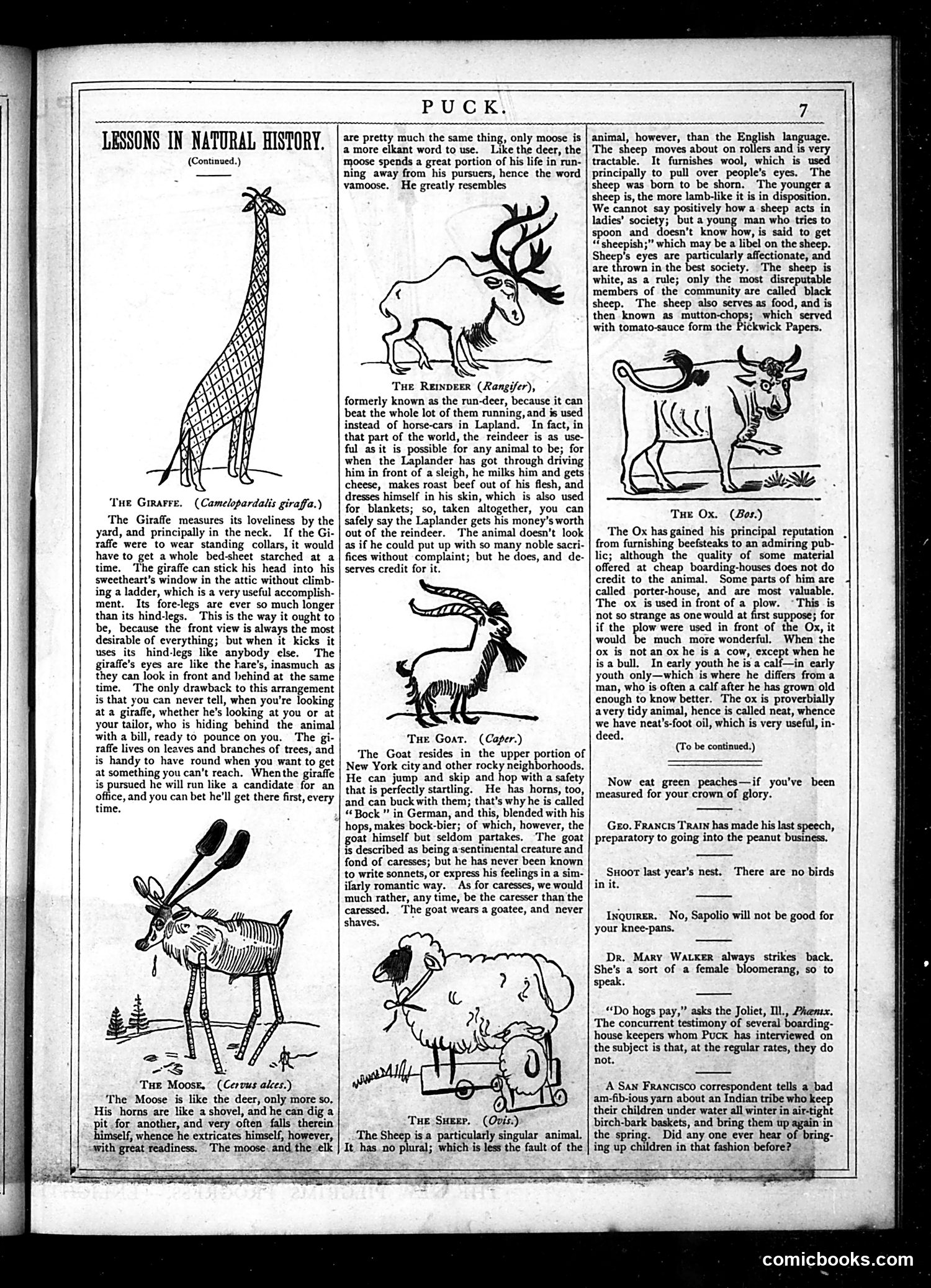
This page is primarily **educational content, not political satire**. It's a "Lessons in Natural History" feature with illustrated descriptions of animals: the Giraffe, Reindeer, Moose, Goat, Ox, and Sheep. Each animal receives a detailed, somewhat humorous natural history description. The writing style is characteristic of 19th-century educational humor—anthropomorphizing animals and making dry observations about their characteristics and uses. The page includes brief satirical items at bottom (references to "Dr. Mary Walker," "geo-political peanut business"), but these appear to be standard Puck filler jokes rather than the page's primary content. This represents Puck's educational entertainment function alongside its political commentary.
📄 Transcribed text from this page (OCR, searchable)
Machine-transcribed from the original scan — historical spelling and the odd misread are preserved.
PUCK. 7 LESSONS IN NATURAL HISTORY. (Continued.) ‘THe Grrarre. (Camelopardalis giraffa.) The Giraffe measures its loveliness by the yard, and principally in the neck. If the Gi- raffe were to wear standing collars, it would have to get a whole bed-sheet starched at a time. The giraffe can stick his head into his sweetheart’s window in the attic without climb- ing a ladder, which is a very useful accomplish- ment. Its fore-legs are ever so much longer than its hind-legs. This is the way it ought to be, because the front view is always the most desirable of everything; but when it kicks it uses its hind-legs like anybody else. ‘The giraffe’s eyes are like the hare’s, inasmuch as they can look in front and behind at the same time. The only drawback to this arrangement is that you can never tell, when you're looking at a giraffe, whether he’s looking at you or at your tailor, who is hiding behind the animal with a bill, ready to pounce on you. The gi- raffe lives on leaves and branches of trees, and is handy to have round when you want to get at something you can't reach. Whenthe giraffe is pursued he will run like a candidate for an office, and you can bet he'll get there first, every time. THE Moose, (Cervus ales.) ‘The Moose is like the deer, only more so, His horns are like a shovel, and he can dig a pit for another, and very often falls therein himself, whence he extricates himself, however, swith great readiness. “ The moose. and the: elk are pretty much the same thing, only moose is a more elkant word to use. Like the deer, the moose spends a great portion of his life in run- ning away from his pursuers, hence the word vamoose. He greatly resembles Tue Reinveer (Rangifer), formerly known as the run-deer, because it can beat the whole lot of them running, and is used instead of horse-cars in Lapland. In fact, in that part of the world, the reindeer is as use- ful as it is possible for any animal to be; for when the Laplander has got through driving him in front of a sleigh, he milks him and gets cheese, makes roast Beet out of his flesh, and dresses himself in his skin, which is also used for blankets; so, taken altogether, you can safely say the Laplander gets his money’s worth out of the reindeer. The animal doesn’t look as if he could put up with so many noble sacri- fices without complaint; but he does, and de- serves credit for it. Tue Goat. ( Caper.) The Goat resides in the upper portion of New York city and other rocky neighborhoods. He can jump and skip and hop with a safety that is perfectly startling. He has horns, too, and can buck with them; that’s why he is called ,| Bock ” in German, and this, blended with his hops, makes bock-bier; of which, however, the oat himself but seldom partakes. The goat is described as being a-sentimental creature and fond of caresses; but he has never been known to write sonnets, or express his feelings in a sim- ilarly romantic way. As for caresses, we would much rather, any time, be the caresser than the caressed, ‘The goat wears a goatee, and never shaves, . THE SHEep. The Sheep isa particularly singular animal. It has.no plural; which is less the fault of the animal, however, than the English language. The sheep moves about on rollers and is very tractable. It furnishes wool, which is used principally to pull over people’s eyes. The sheep was born to be shorn, The younger a sheep is, the more lamb-like it is in disposition. We cannot say positively how a sheep acts in ladies’ society; but a young man who tries to spoon and doesn’t know how, is said to get “sheepish;” which may be a libel on the sheep. Sheep's eyes are particularly affectionate, and are thrown in the best society. The sheep is white, as a rule; only the most disreputable members of the community are called black sheep. The sheep also serves as food, and is then known as mutton-chops; which served with tomato-sauce form the Pickwick Papers. Tue Ox. (Bos.) The Ox has gained his principal reputation from furnishing beefsteaks to an admiring pub- lic; although the quality of some material offered at cheap boarding-houses does not do credit to the animal. Some parts of him are called porter-house, and are most valuable. The ox is used in front of a plow. °This is Not so strange as one would at first suppose; for if the plow were used in front of the Ox, it would be much more wonderful. When the ox is not an ox he is a cow, except when he isa bull. In early youth he is a calf—in early youth only—which is where he differs from a man, who is often a calf after he has grown old enough to know better. The ox is proverbially avery tidy animal, hence is called neat, whence we have neat’s-foot oil, which is very useful, in- deed. (To be continued.) Now eat green peaches—if you've been measured for your crown of glory. Geo. Francis TRatn has made his last speech, preparatory to going into the peanut business. Suoor last year’s nest. There are no birds in it. Inqurrer. No, Sapolio will not be good for your knee-pans. Dr. Mary WALKER says strikes back. She's a sort of a female bloomerang, so to speak. “Do hogs pay,” asks the Joliet, Ill., Pientx. The concurrent testimony of several boarding- house keepers whom Puck has interviewed on the subject is that, at the regular rates, they do not. ‘A San Francisco correspondent tells a bad am-fib-ious yarn about an Indian tribe who keep their children under water all winter in air-tight birch-bark baskets, and bring them up again:in the spring. Did any one ever hear of bring- ing up children in that fashion before? > ” re comicbooks.com