
A complete issue · 16 pages · 1877
Puck — May 1877
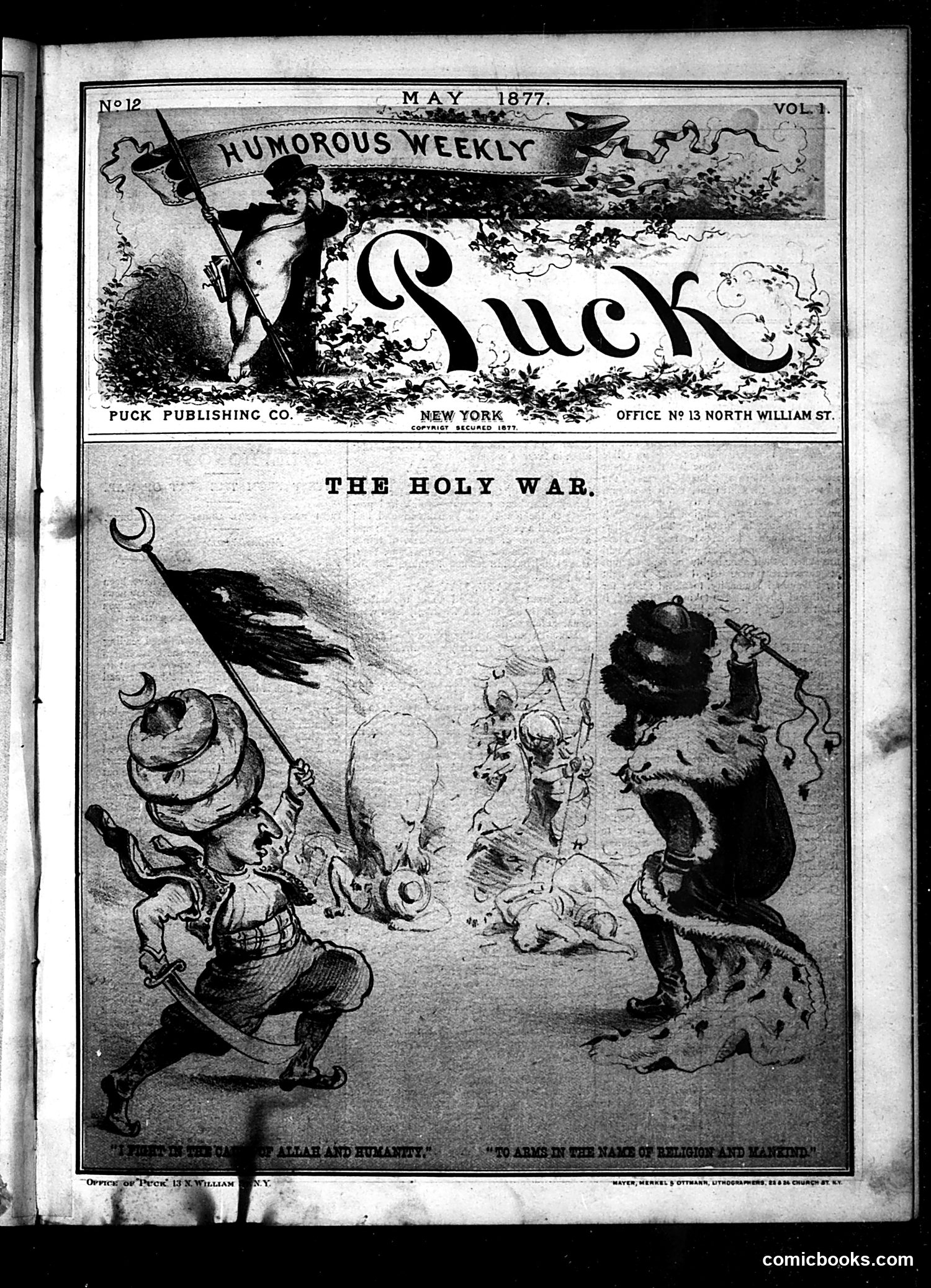
This satirical cartoon depicts a violent conflict between two figures wielding crescent-moon-topped flags and scimitars, surrounded by chaos and fallen bodies. The title "The Holy War" references religious conflict, likely the Russo-Turkish War (1877-78), which was framed in contemporary discourse as a clash between Christian Russia and the Ottoman Muslim Empire. The cartoon satirizes how both sides justified military aggression through religious rhetoric. The exaggerated violence and absurdity of the combatants' poses mock the notion that religion legitimizes warfare. The fallen figures and destruction emphasize the human cost of conflicts dressed up in theological language. This reflects Puck's typical satirical stance: exposing how leaders cynically weaponize faith to mobilize populations for political/territorial aims.
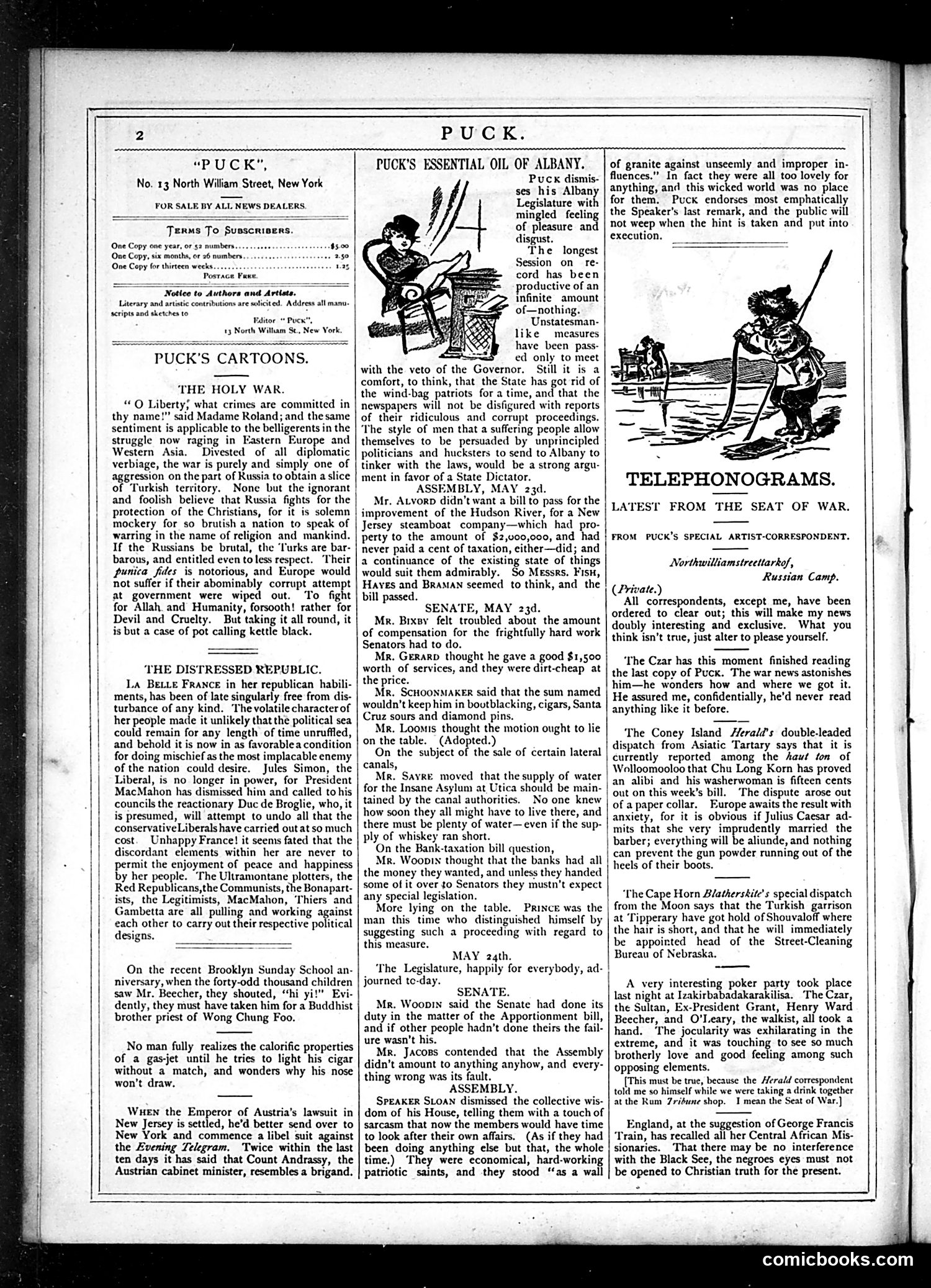
This page contains **political commentary and satire** rather than traditional cartoons. The main "Puck's Cartoons" section titled "THE HOLY WAR" critiques diplomatic bungling regarding **Russian-Turkish conflicts** and Christian persecution. Key targets include: - **La Belle France** (France) for republican instability and internal disorder - Politicians and "hucksters" sending incompetent diplomats to Albany - State politicians as corrupt "wind-bag patriots" The text mocks how wealthy interests manipulate legislation while ignoring genuine human suffering. The "Telephonograms" section provides war correspondence from the front, reporting on the **Coney Island Herald's** coverage and Turkish-British tensions. Overall, the page satirizes governmental incompetence, political corruption, and press sensationalism regarding international crises—themes relevant to late-19th-century American politics.
This page contains **no political cartoon**, but rather **satirical prose and humor columns** typical of Puck's content. "Indigestion" appears to be a humorous poem about digestive complaints. "Puckerings" contains brief satirical anecdotes mocking contemporary figures and situations—including references to the Smith Corresponding Society's debates on printing, and jabs at General Hood and Phil Sheridan (Civil War figures). "The Blue Ribbon" is a longer humorous essay about a woman wearing a blue ribbon as a sign of virtue or reform. The content satirizes social pretension, moral hypocrisy, and recent historical events (likely Reconstruction-era politics given Sheridan references), but **lacks identifying imagery** needed to pinpoint specific targets beyond general social commentary.
This page features a humorous poem titled "My Cigarette" that personifies smoking as a romantic, poetic experience. The verse celebrates cigarettes with dramatic flair—comparing them to various pleasures ("Like a harem window's boss," "As a maiden's first coy kiss"). The satire appears directed at *Victorian sentimentality* about smoking and masculine indulgence. By treating a cigarette with overwrought romantic language typically reserved for love poetry, Puck mocks both excessive aestheticism and the era's conflicted attitudes toward tobacco. The accompanying prose sections ("Jones Junction Journalism," "Summer Resort Jottings," "Puck's Personal Intelligence") contain miscellaneous gossip and social commentary typical of the magazine's format—no specific political figures are clearly identifiable in these sections.
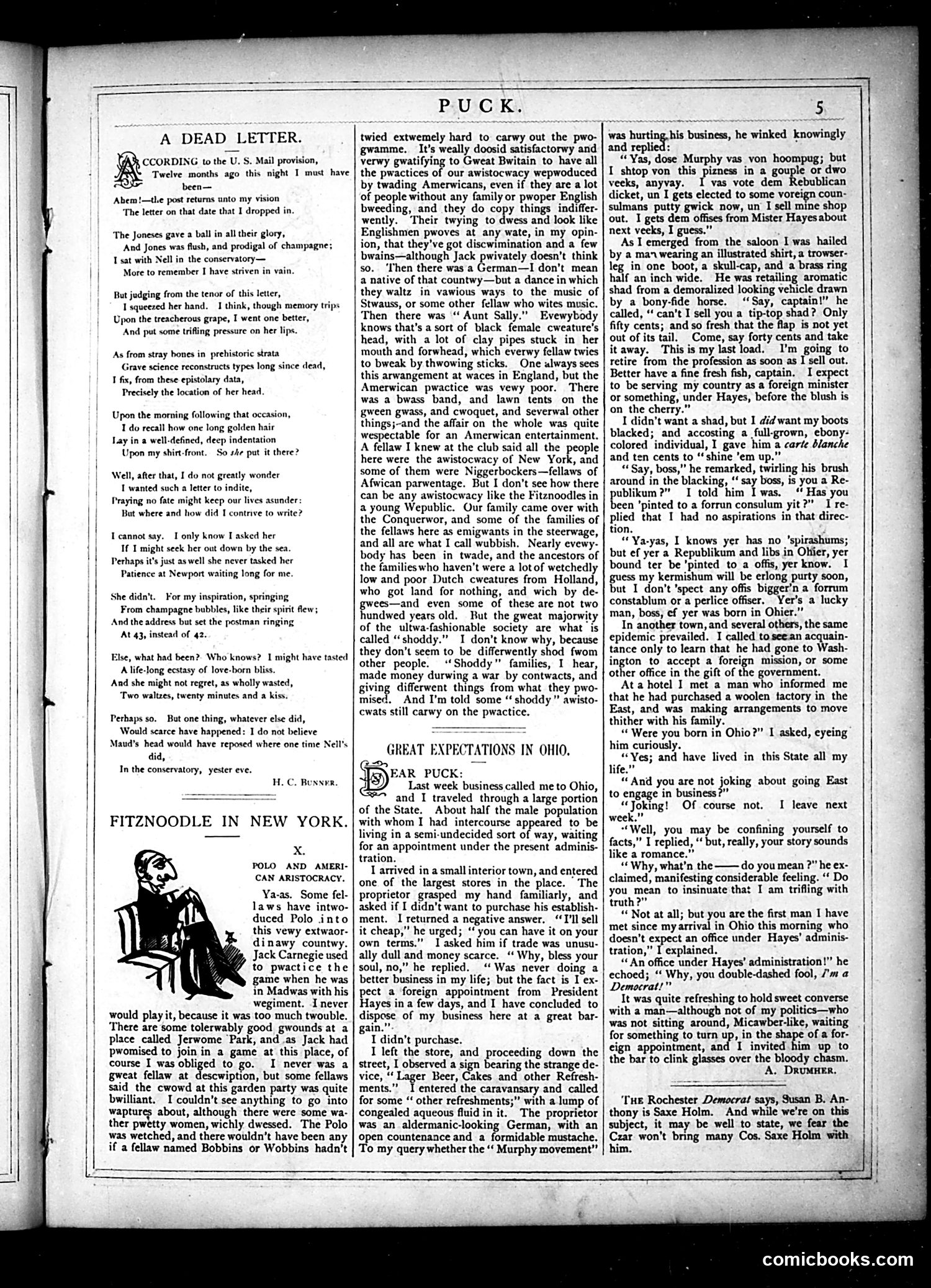
This page contains three distinct sections: 1. **"A Dead Letter"** — A poem by H.C. Bunner about an unanswered letter, expressing longing and regret over lost correspondence. 2. **"Fitznoodle in New York"** — A satirical illustrated column featuring a caricatured figure labeled "HOW CAN ARISTOCRACY" (appears to be mocking pretentious foreign aristocrats in America). The accompanying text describes Jack Carnegie using deception and social climbing to gain access to elite spaces like Tuxedo Park, critiquing American class aspirations and false gentility. 3. **"Great Expectations in Ohio"** — A letter describing business observations in Ohio, featuring commentary on American commerce and political appointments under what appears to be the Hayes administration. The page satirizes American social pretension, class mobility, and political patronage of the Gilded Age period.
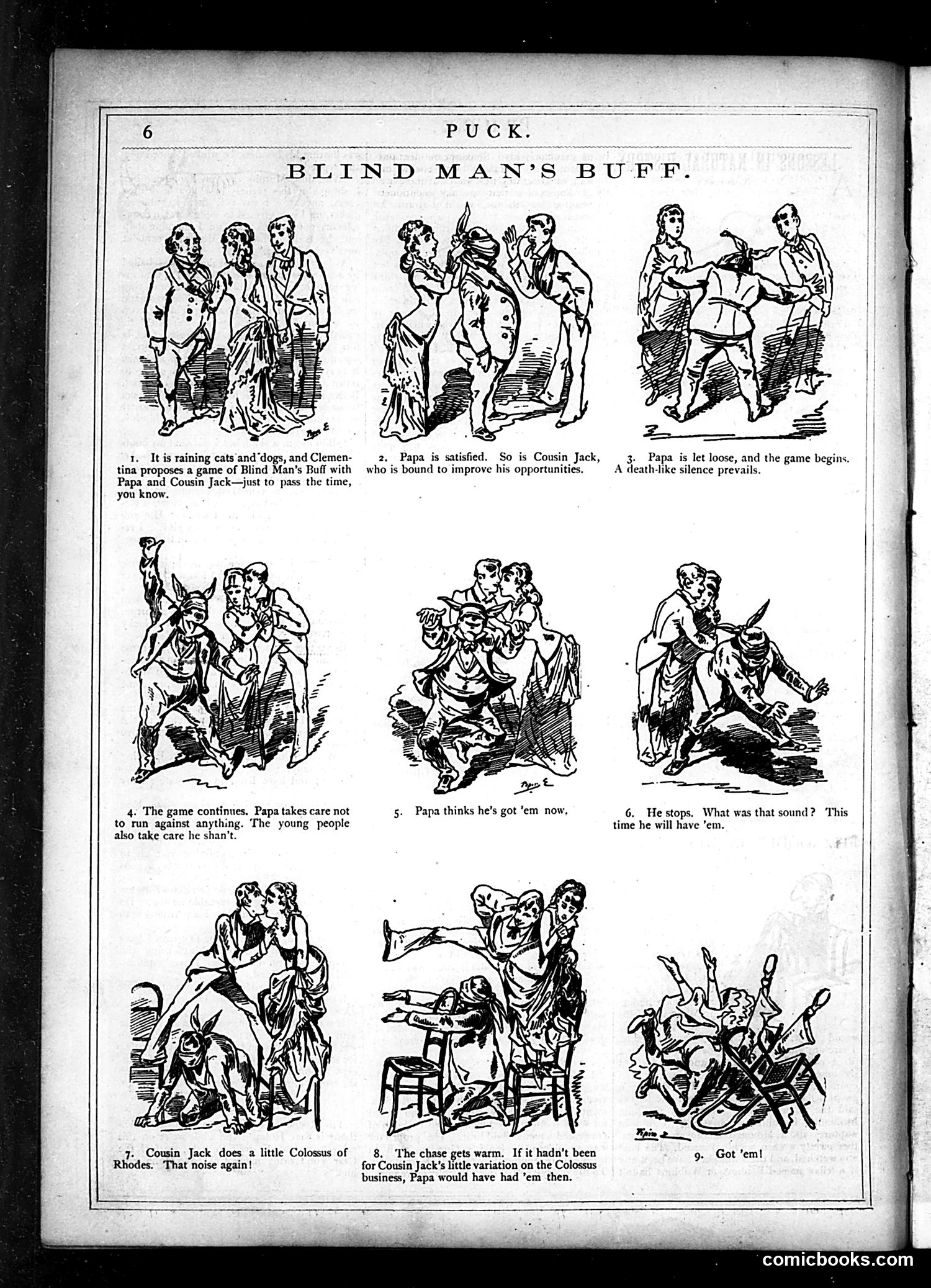
This is a humorous domestic scene rather than political satire. The comic strip depicts a parlor game of Blind Man's Buff—a Victorian-era children's game where one blindfolded player attempts to catch others. The narrative shows Papa reluctantly joining the game during rainy weather, then becoming increasingly chaotic as participants collide with furniture and each other. The humor escalates through physical comedy: Papa thinks he's caught someone but hasn't, furniture gets knocked over, and the scene ends with complete mayhem ("Got 'em!"). The social satire is gentle—poking fun at stuffy Victorian fathers forced into undignified play with younger family members. The exaggerated illustrations emphasize the disorder and loss of composure, suggesting upper-class discomfort with unstructured recreation.
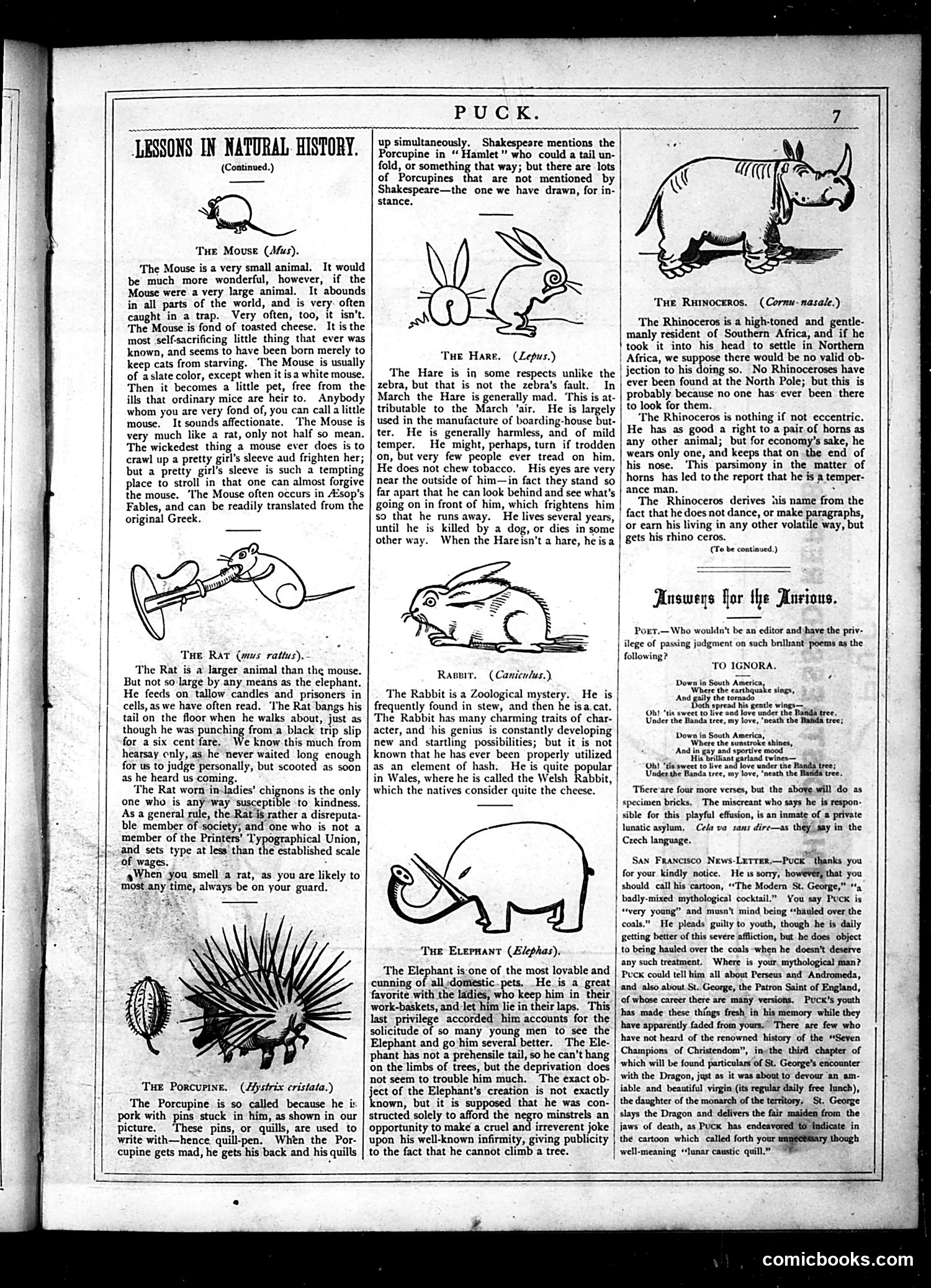
This page is primarily **educational natural history content**, not political satire. It's part of "Lessons in Natural History (Continued)" featuring illustrated descriptions of animals: the Mouse, Rat, Hare, Rabbit, Porcupine, Rhinoceros, and Elephant. The text provides detailed, often humorous observations about each creature's habits and characteristics. For example, it notes the Mouse's self-sacrificing nature and the Rat's membership in the "Printers' Typographical Union," suggesting labor-union humor relevant to the era. The bottom section, "Answers for the Curious," addresses reader questions about poetry and mythology—unrelated to politics. **This appears to be filler content** rather than satirical commentary. Puck frequently mixed humor, education, and lighter pieces between political cartoons. The animal illustrations are simple educational drawings rather than political caricatures.
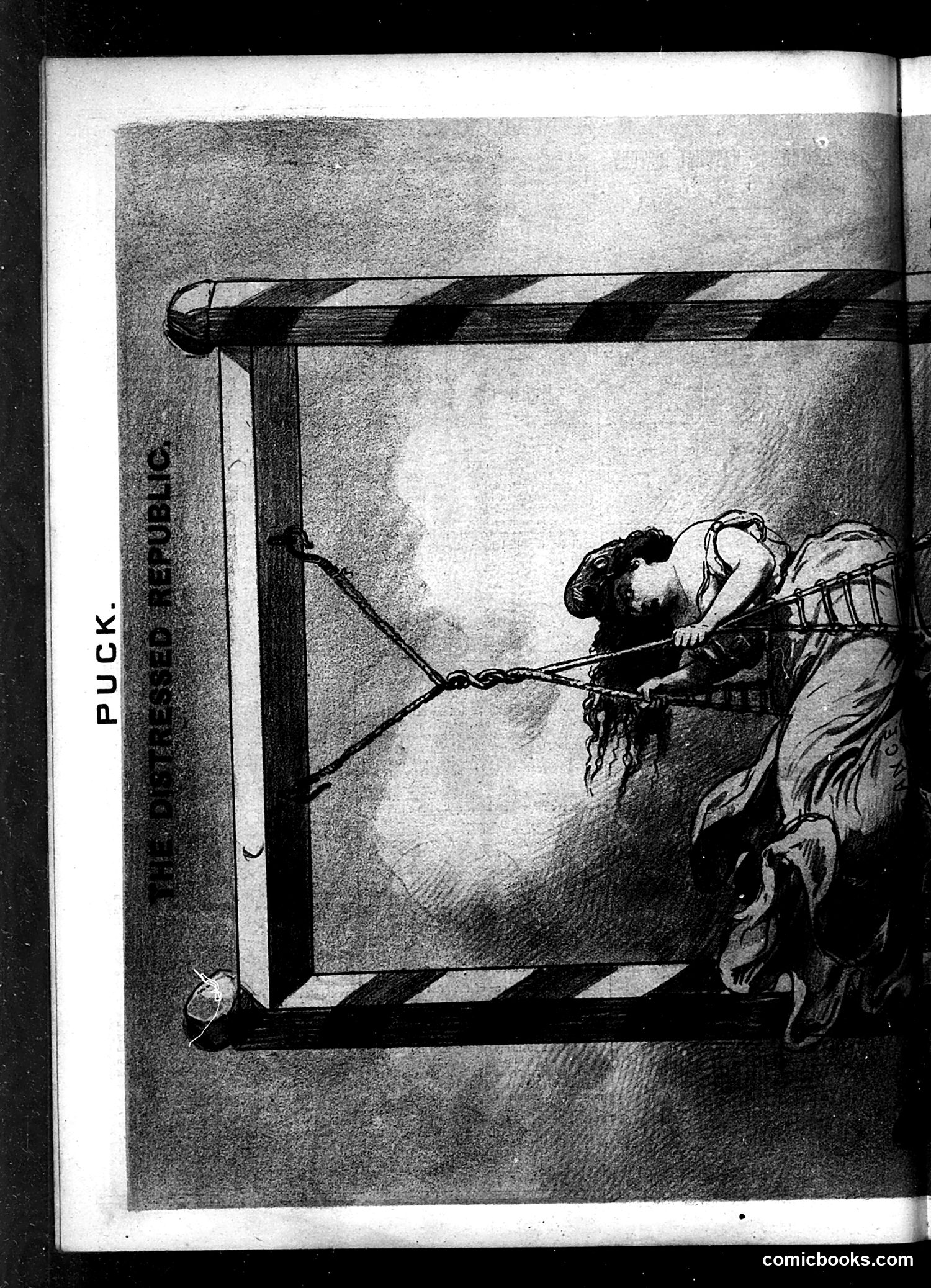
This page shows a single political cartoon labeled "PUCK" on the left margin. The image depicts a figure being hanged from a gallows, with another figure pulling on the rope. The cartoon uses the extreme visual metaphor of execution to express sharp political criticism. However, **without being able to identify the specific figures' faces clearly or having additional OCR text that names them**, I cannot definitively state who is being caricatured or what particular political event or scandal is being referenced. The gallows imagery suggests criticism of someone's political fate or removal from power, but determining the exact historical context and intended targets would require additional documentation beyond what's legible here. The style and format are consistent with Puck's confrontational satirical approach.
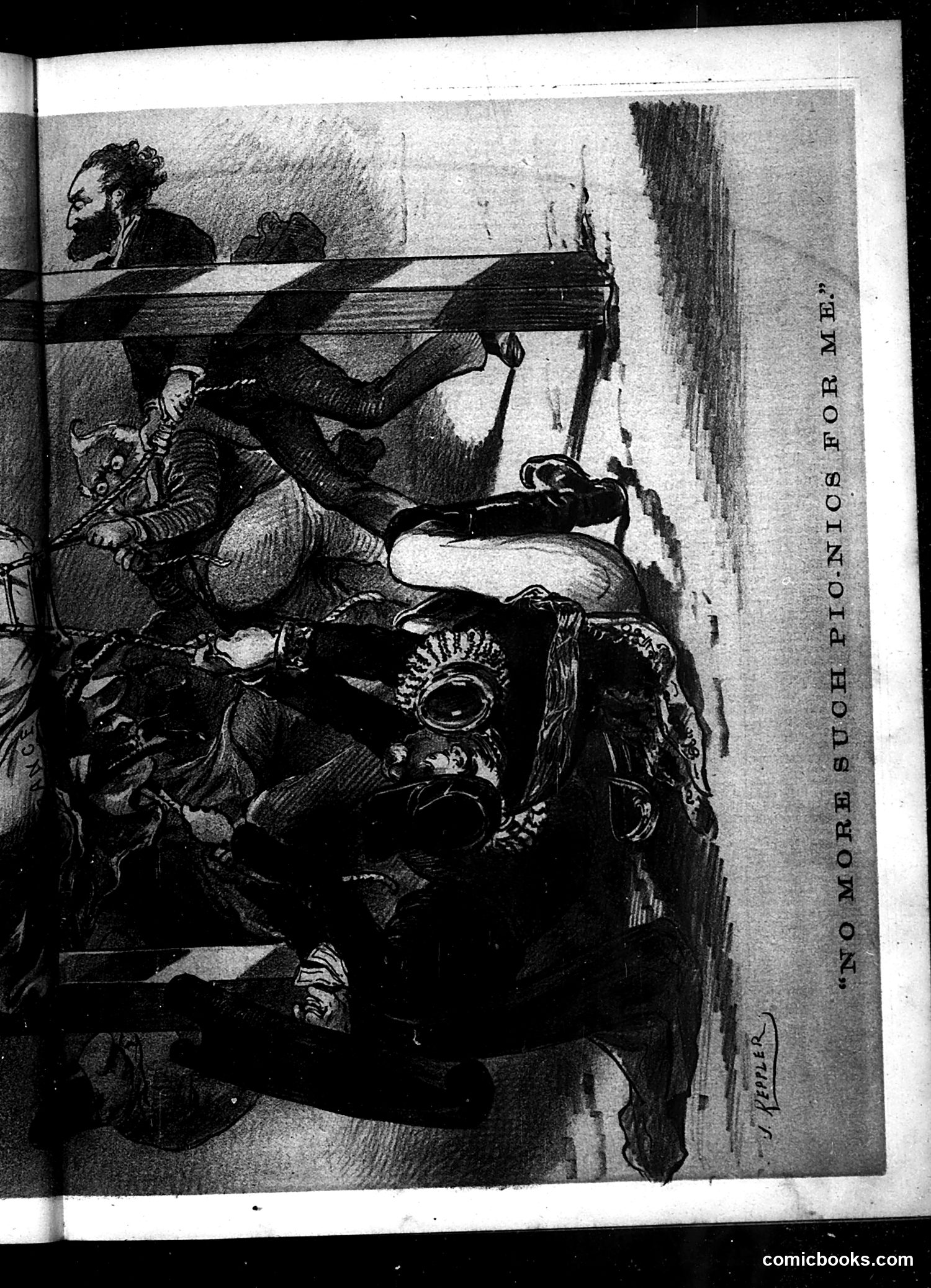
The caption reads "NO MORE BRUTOB POINTS FOR ME," which appears to be satirical text (OCR may have errors). The cartoon depicts a bearded man in formal attire operating what appears to be a mechanical device or contraption, with another figure visible above on a beam. The imagery suggests industrial or mechanical exploitation—possibly commentary on labor practices or working conditions of the era. Without clearer text identification or additional context about the specific Puck issue date, I cannot definitively identify the named figures or the precise political event being referenced. The style suggests late 19th or early 20th century American satire, likely targeting labor issues, industrial capitalism, or a specific political figure's policies. The mechanical apparatus implies commentary on dehumanizing industrial practices common to Puck's satirical concerns of that period.
This page contains three distinct sections: a poem titled "A Serenade in Three Flights," a section called "The Garden" (arts criticism), and "Sayings and Doings" (social commentary). The content focuses on cultural and entertainment criticism rather than political satire. "The Garden" critiques summer theater performances and a soprano named Elisa Galimberti. "Sayings and Doings" discusses New York legislation affecting churches, Russian military pay rates, and social observations about New York City's development. The page lacks prominent political cartoons—it's primarily text-based commentary typical of Puck's satirical journalism, mocking contemporary cultural figures, entertainment mediocrity, and urban social issues through witty prose rather than visual caricature.
This page contains primarily **text content** rather than prominent political cartoons. The main features are: 1. **"The Wily Nephew and the Dilatory Uncle"** - A satirical tale with moral lessons, featuring characters like Christopher Scroggs and Thomas in what appears to be a class-commentary narrative about inheritance and virtue. 2. **"Side Lights"** - A humor section with letters addressing theatrical and amateur performance critiques, including discussion of actress Miss Cassely's dramatic abilities and commentary on amateur theatrical societies. 3. **"His Book"** - A brief note about journalism and fiction writing. The page demonstrates Puck's format of mixing literary satire, theatrical criticism, and social commentary. The humor targets amateur performers and pretentious theatrical aspirations rather than specific political figures or events visible here.
This page appears to be primarily **literary fiction rather than political satire**. It contains "A Sleeping-Car Lyric" (a humorous poem about train travel discomforts) and "Two Knaves and a Queen," a serialized story (Chapter X). The narrative focuses on romantic misunderstandings between characters named Hugh, Miss Blake, and M. de Gaillefontaine. The dialogue satirizes **social pretension and vanity**—characters debate artistic merit, patronage relationships, and romantic pride rather than political issues. There's gentle mockery of artistic pretension (one character paints portraits) and class dynamics, but **no identifiable political figures or contemporary events** are referenced. This appears to be entertainment content rather than the magazine's trademark political commentary.
This page contains two main satirical pieces: **"Puck's Intrigues: How Mr. Parker Caught a Thief"** is a humorous anecdote about a man who purchases a stolen overcoat, then uses deception to recover it by posing as the original thief's accomplice. The story satirizes urban crime and the practicality of recovering stolen goods through clever social manipulation rather than law enforcement. **"The Bland Assessor"** appears to be a short political commentary featuring an editor character discussing property assessment. The cartoon likely satirizes local government bureaucracy and tax assessment procedures, mocking both the assessor's bland personality and the arbitrary nature of property valuations. Both pieces employ humor to critique everyday urban American experiences—petty theft and governmental inefficiency—typical of Puck's satirical approach to contemporary social issues.
This page contains no visible cartoons or illustrations—only text columns of miscellaneous jokes and brief satirical items. The content includes: - A anecdote about a Texas editor sued for libel - Jokes about shoelace manufacturing and postal cards - Commentary on refrigerators, dog shooting, and church attendance - Satirical notes about various newspapers' observations (Rochester Democrat, Cincinnati Enquirer, Chicago Tribune, Hartford Times, etc.) The items mock contemporary social issues: incompetent journalism, domestic life absurdities, fashion trends, and religious hypocrisy. Without identifying illustrations, the humor appears to target early-1900s American society's minor annoyances and contradictions. The page functions as filler content between major cartoons typical of Puck's format.
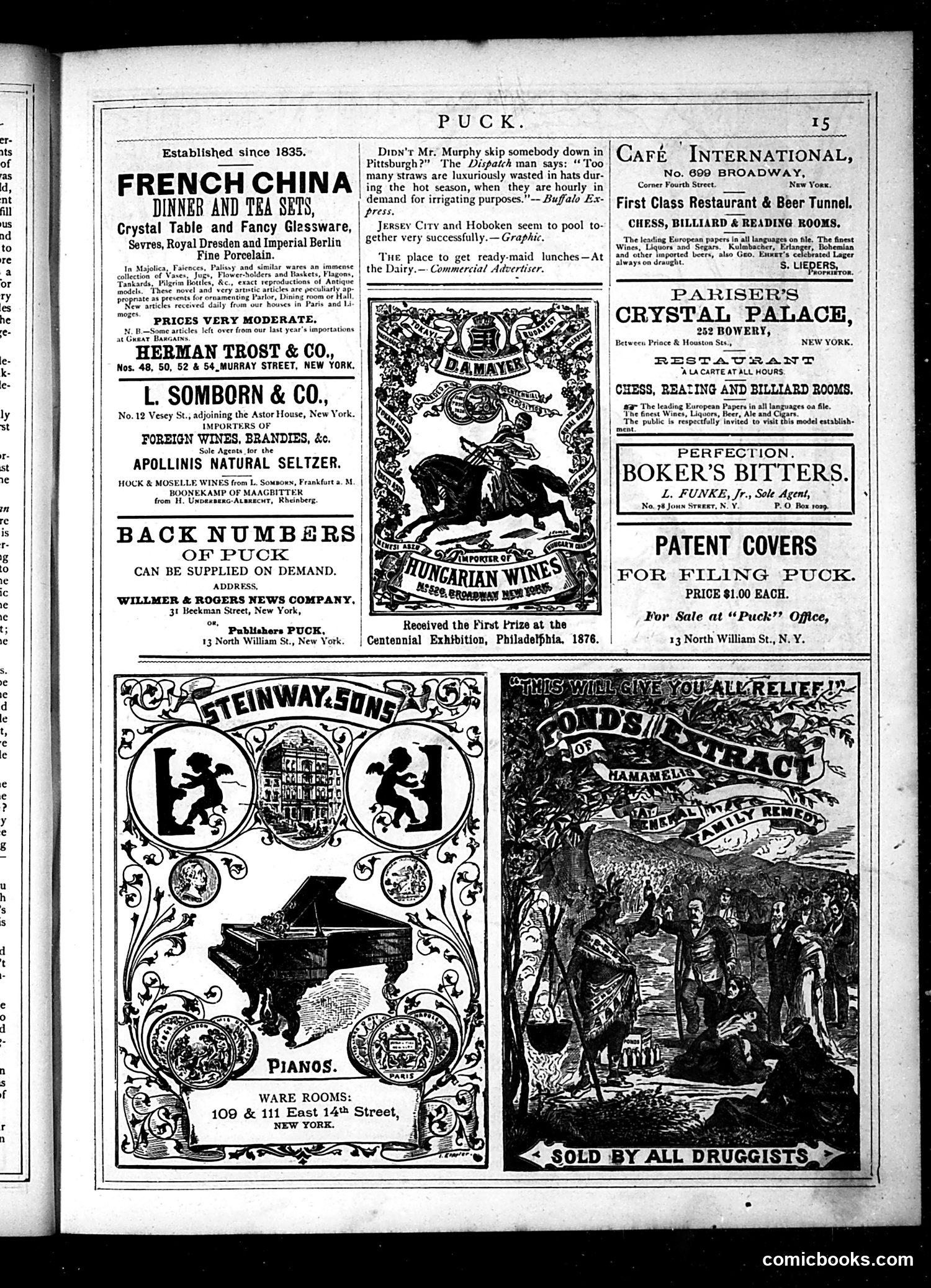
This page is primarily **advertising**, not political satire. It contains commercial advertisements for: - French China dinner sets and glassware (Lebrun Trost & Co.) - Wine and spirits imports (L. Somborn & Co., Apollinnis Natural Seltzer) - Back issues of Puck magazine - Café International restaurant and Pariser's Crystal Palace (entertainment venues) - Boker's Bitters (patent medicine/alcohol) - Steinway pianos - Pond's Extract (patent medicine, advertised as relief for "family remedies") The central image shows a **Hungarian wine label** noting it won first prize at the 1876 Centennial Exhibition in Philadelphia. No political figures or satire are visible. This is a typical page of late 19th-century magazine advertising reflecting contemporary consumer goods, entertainment venues, and patent medicines common to the period.
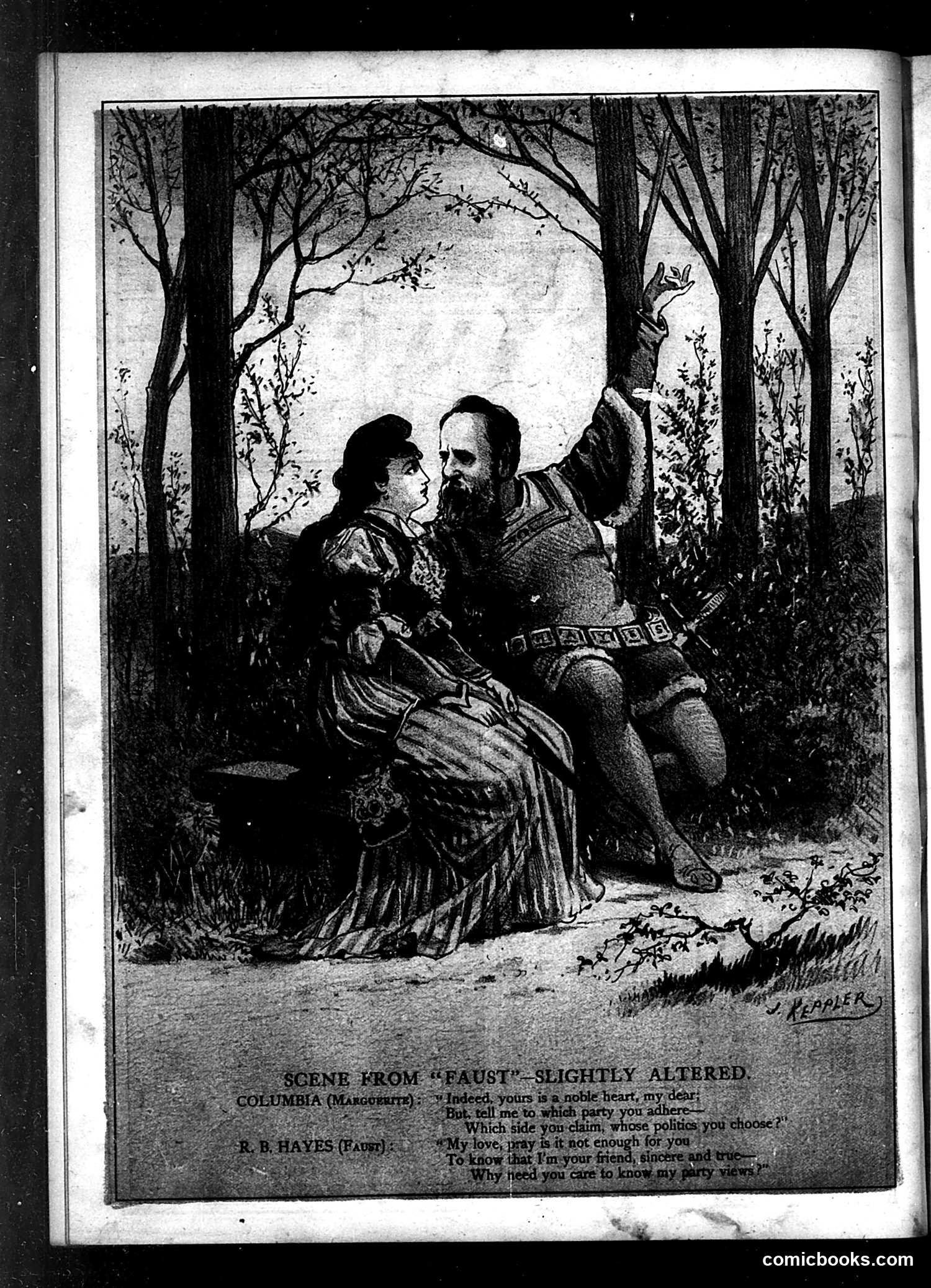
This illustration depicts a scene between two figures labeled Columbia (representing the United States) and R. B. Hayes (Faust). The satire references Goethe's *Faust*, where the protagonist makes a deal with the devil. The dialogue reveals the cartoon's political critique: Columbia questions Hayes about his party allegiance and political principles, suggesting he has compromised his integrity. The "Faust" reference implies Hayes has made a morally questionable bargain—likely alluding to the contested 1876 presidential election where Hayes became president through disputed circumstances. The satire suggests Hayes sacrificed his principles or made corrupt deals to gain power, making him analogous to Faust selling his soul. The artist (Keppler, visible in signature) criticizes Hayes's political compromises and questionable path to the presidency.