
Puck, 1877-05 · page 11 of 16
Puck — May 1877 — page 11: what you’re looking at
What you’re looking at
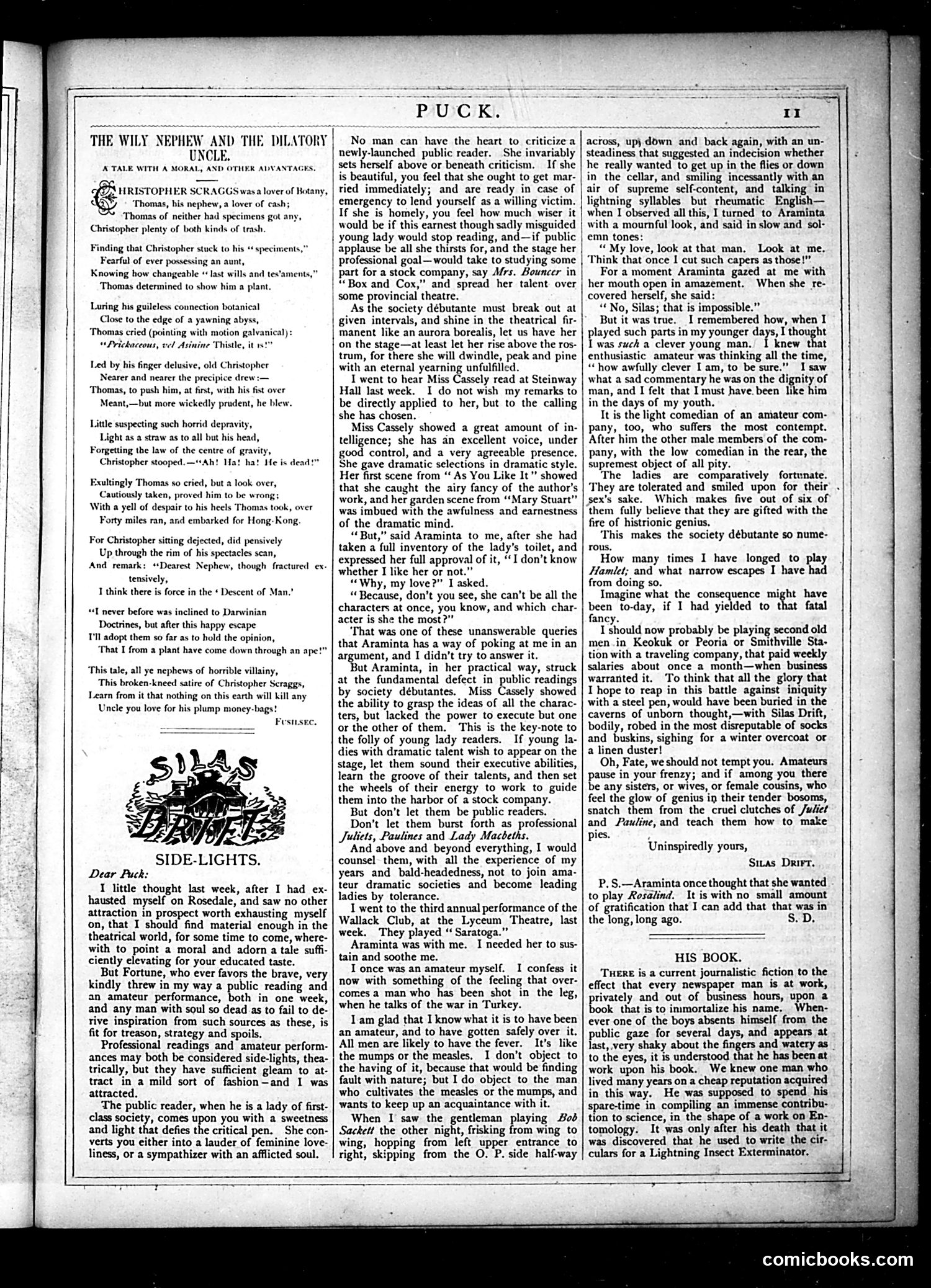
This page contains primarily **text content** rather than prominent political cartoons. The main features are: 1. **"The Wily Nephew and the Dilatory Uncle"** - A satirical tale with moral lessons, featuring characters like Christopher Scroggs and Thomas in what appears to be a class-commentary narrative about inheritance and virtue. 2. **"Side Lights"** - A humor section with letters addressing theatrical and amateur performance critiques, including discussion of actress Miss Cassely's dramatic abilities and commentary on amateur theatrical societies. 3. **"His Book"** - A brief note about journalism and fiction writing. The page demonstrates Puck's format of mixing literary satire, theatrical criticism, and social commentary. The humor targets amateur performers and pretentious theatrical aspirations rather than specific political figures or events visible here.
📄 Transcribed text from this page (OCR, searchable)
Machine-transcribed from the original scan — historical spelling and the odd misread are preserved.
) EPHEN AND THE DILATORY UNCLE. A TALE WITH A MORAL, AND OTHER ADVANTAGES. HRISTOPHER SCRAGGS wasa lover of Botany, ‘Thomas, his nephew, lover of ca ‘Thomas of neither had specimens got any, Christopher plenty of both kinds of trash. Finding that Christopher stuck to his + speciments,” Fearful of ever possessing an aunt, Knowing how changeable * last wills and tevaments,” ‘Thomas determined to show him a plant. Luring his guileless connection botanical Close to the edge of a yawning abyss, ‘Thomas cried (pointing with m “Prickaceous, vel Asinine T galvanical): istle, it rs!” Led by his finger delusive, old Christopher Nearer and nearer the precipice drew :— Thomas, to push him, at first, with his fist over Meant,—but more wickedly prudent, he blew. Little suspecting such horrid depravity, Light as a straw as to all but his head, Forgetting the law of the centre of gravity, Christopher stooped. —“Ah! Ha! fe is dead!” Exultingly Thomas so cried, but a look over, Cautiously taken, proved him to be wrong: With a yell of despair to his heels Thomas took, over Forty miles ran, and embarked for Hong-Kong For Christopher sitting dejected, did pensively Up through the rim of his spectacles scan, And remark: “Dearest Nephew, though fractured ex- tensively, I think there is force in the * Descent of Man.* “T never before was inclined to Darwinian Doctrines, but after this happy escape T'll adopt them so far as to hold the opinion, ‘That I from a plant have come down through an ape!” ‘This tale, all ye nephews of horrible villainy, This broken-kneed satire of Christopher Scraggs, Learn from it that nothing on this earth will kill any Uncle you love for his plump money-bags! Festusec. SIDE-LIGHTS. Dear Puck: I little thought last week, after I had ex- hausted myself on Rosedale, and saw no other attraction in prospect worth exhausting myself on, that I should find material enough in the theatrical world, for some time to come, where- with to point a moral and adorn a tale suffi- ciently elevating for your educated taste. But Fortune, who ever favors the brave, very kindly threw in my way a public reading and an amateur performance, both in one week, and any man with soul so dead as to fail to de- tive inspiration from such sources as these, is fit for treason, strategy and spoils. Professional readings and amateur perform- ances may both be considered side-lights, thea- trically, but they have sufficient gleam to at- tract in a mild sort of fashion—and I was attracted. The public reader, when he is a lady of first- class society, comes upon you with a sweetness and light that defies the critical pen. She con- verts you either into a lauder of feminine love- No man can have the heart to criticize a newly-launched public reader. She invariably sets herself above or beneath criticism. If she is beautiful, you feel that she ought to get mar- ried immediately; and are ready in case of emergency to lend yourself as a willing victim. If she is homely, you feel how much wiser it young lady would stop reading, and—if public applause be all she thirsts for, and the stage her professional goal—would take to studying some part for a stock company, say Mrs. Bouncer in “Box and Cox,” and spread her talent over some provincial theatre. As the society débutante must break out at given intervals, and shine in the theatrical fir- manent like an aurora borealis, let us have her on the stage—at least let her rise above the ros. trum, for there she will dwindle, peak and pine with an eternal yearning unfulfilled. I went to hear Miss Cassely read at Steinway Hall last week. I do not wish my remarks to be directly applied to her, but to the calling she has chosen. Miss Cassely showed a great amount of in- telligence; she has an excellent voice, under good control, and a very agreeable presence. She gave dramatic selections in dramatic style. Her first scene from “ As You Like It” showed that she caught the airy fancy of the author's work, and her garden scene from “Mary Stuart” was imbued with the awfulness and earnestness of the dramatic mind. “But,” said Araminta to me, after she had taken a full inventory of the lady’s toilet, and expressed her full approval of it, “I don’t know whether I like her or not.” “Why, my love?” I asked. “Because, don’t you see, she can’t be all the characters at once, you know, and which char- acter is she the most?” ‘That was one of these unanswerable queries that Araminta has a way of poking at me in an ment, and I didn’t try to answer it. jut Araminta, in her practical way, struck at the fundamental defect in public readings by society débutantes. Miss Cassely showed the ability to grasp the ideas of all the charac- ters, but lacked the power to execute but one or the other of them. This is the key-note to the folly of young lady readers. If young la- dies with dramatic talent wish to appear on the stage, let them sound their executive abilities, learn the groove of their talents, and then set the wheels of their energy to work to guide them into the harbor of a stock company. But don't let them be public readers. Don’t let them burst forth as professional Juliets, Paulines and Lady Macbeths. And above and beyond everything, I would counsel them, with all the experience of my years and bald-headedness, not to join ama- teur dramatic societies and become leading ladies by tolerance. I went to the third annual performance of the Wallack Club, at the Lyceum Theatre, last week. They played “ Saratoga.” Araminta was with me. I needed her to sus- tain and soothe me. I once was an amateur myself. I confess it now with something of the feeling that over- comes a man who has been shot in the leg, when he talks of the war in Turkey. lam glad that I know what it is to have been an amateur, and to have gotten safely over it. All men are likely to have the fever. It’s like the mumps or the measles. I don’t object to the having of it, because that would be finding fault with nature; but I do object to the man who cultivates the measles or the mumps, and wants to keep up an acquaintance with it. When I saw the gentleman playing 20d Sackett the other night, frisking from wing to wing, hopping from left upper entrance to liness, or a sympathizer with an afflicted soul. right, skipping from the O. P. side half-way would be if this earnest though sadly misguided | across, up) down and back again, with an un- steadiness that suggested an indecision whether he really wanted to get up in the flies or down in the cellar, and smiling incessantly with an air of supreme self-content, and talking in lightning syllables but rheumatic English— when I observed all this, I turned to Araminta with a mournful look, and said in slow and sol- emn tones: “« My love, look at that man. Look at me. Think that once | cut such capers as those!"" For a moment Araminta gazed at me with her mouth open in amazement. When she re- covered herself, she said: ‘No, Silas; that is impossible.” But it was true. I remembered how, when I played such parts in my younger days, I thought I was such a clever young man. | knew that enthusiastic amateur was thinking all the time, “how awfully clever Iam, to be sure.” I saw what a sad commentary he was on the dignity of man, and I felt that I must have. been like him in the days of my youth, It is the light comedian of an amiateur com- pany, too, who suffers the most contempt. After him the other male members of the com- pany, with the low comedian in the rear, the supremest object of all pity. ‘The ladies are comparatively fortunate. They are tolerated and smiled upon for their’ . sex’s sake. Which makes five out of six of them fully believe that they are gifted with the fire of histrionic genius. This makes the society débutante so nume- rous. How many times I have longed to play Hamlet; and what narrow escapes I have had from doing so. Imagine what the consequence might have been to-day, if I had yielded to ¢ fatal fancy. I should now probably be playing second old men.in Keokuk or Peoria or Smithville Sta- tion with a traveling company, that paid weekly salaries about once a month—when business warranted it. To think that all the glory that Thope to reap in this battle against iniquity with a steel pen, would have been buried in the caverns of unborn thought,—with Silas Drift, bodily, robed in the most disreputable of socks and buskins, sighing for a winter overcoat or a linen duster! Oh, Fate, we should not tempt you. Amateurs pause in your frenzy; and if among you there be any sisters, or wives, or female cousins, who feel the glow of genius in their tender bosoms, snatch them from the cruel clutches of Juliet and Pauline, and teach them how to make pies. Uninspiredly yours, Stras Drirt, P. S.—Araminta once thought that she wanted to play Rosalind, It is with no small amount of gratification that I can add that that was in the long, long ago. S.D. HIS BOOK. Tuere is a current journalistic fiction to the effect that every newspaper man is at work, rivately and out of business hours, upon a k that is to immortalize his name. When- ever one of the boys absents himself from the public gaze for several days, and appears at last, very shaky about the fingers and watery as to the eyes, it is understood that he has been at work upon his book. We knew one man who lived many years on a cheap reputation acquired in this way. He was supposed to spend his spare-time in compiling an immense contribu- tion to science, in the shape of a work on En- tomology. It was only after his death that it was discovered that he used to write the cir- culars for a Lightning Insect Exterminator. comicbooks.com