
Puck, 1877-05 · page 12 of 16
Puck — May 1877 — page 12: what you’re looking at
What you’re looking at
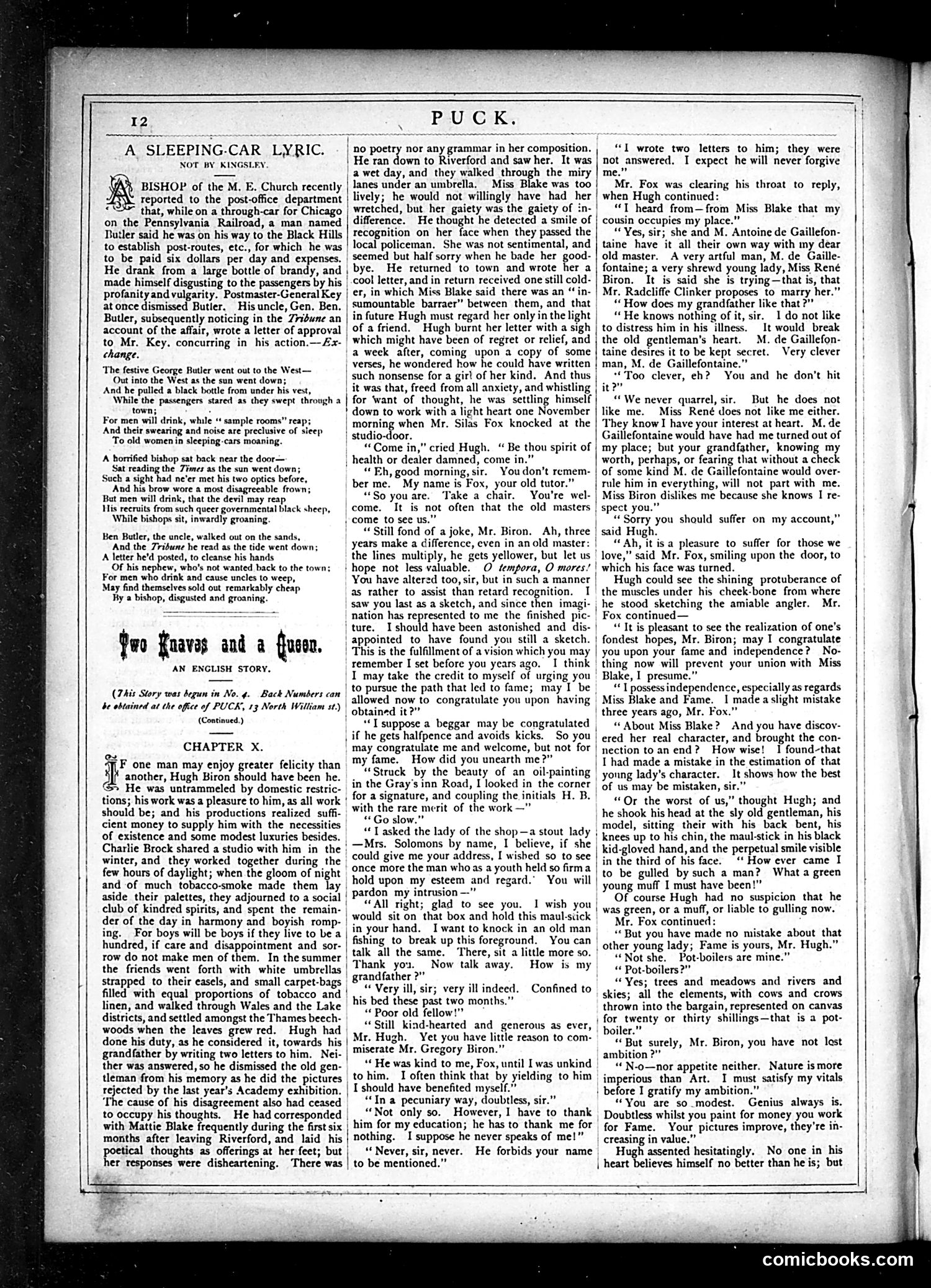
This page appears to be primarily **literary fiction rather than political satire**. It contains "A Sleeping-Car Lyric" (a humorous poem about train travel discomforts) and "Two Knaves and a Queen," a serialized story (Chapter X). The narrative focuses on romantic misunderstandings between characters named Hugh, Miss Blake, and M. de Gaillefontaine. The dialogue satirizes **social pretension and vanity**—characters debate artistic merit, patronage relationships, and romantic pride rather than political issues. There's gentle mockery of artistic pretension (one character paints portraits) and class dynamics, but **no identifiable political figures or contemporary events** are referenced. This appears to be entertainment content rather than the magazine's trademark political commentary.
📄 Transcribed text from this page (OCR, searchable)
Machine-transcribed from the original scan — historical spelling and the odd misread are preserved.
A SLEEPING.CAR LYRIC. BISHOP of the M. E. Church recently | reported to the post-office department | NOT BY KINGSLEY. a N that, while on a through-car for Chicago | on the Pennsylvania Railroad, a man named Dutler said he was on his way to the Black Hills to establish post-routes, etc., for which he was to be paid six dollars per day and expenses. He drank from a large bottle of brandy, and made himself disgusting to the passengers by his profanity and vulgarity. Postmaster-General Key at once dismissed Butler. His uncle, Gen. Ben. Butler, subsequently noticing in the Zridune an account of the affair, wrote a letter of approval to Mr. Key. concurring in his action.—£x- change. The festive George Butler went out to the West— Out into the West as the sun went down; And he pulled a black bottle from under his vest, While the passengers stared as they swept through a town; . For men will drink, while “+ sample rooms” reap; And their swearing and noise are preclusive of sleep To old womenin sleeping-cars moaning. A horrified bishop sat back near the door— Sat reading the Times as the sun went down; Such a sight had ne'er met his two optics before, And his brow wore a most disagreeable frown; But men will drink, that the devil may reap His recruits from such queer governmental black sheep, While bishops sit, inwardly groaning. i Ben Butler, the uncle, walked out on the sands, ‘And the Zribune he read as the tide went down; A letter he'd posted, to cleanse his hands Of his nephew, who's not wanted back to the town; For men who drink and cause uncles to weep, May find themselves sold out remarkably cheap By a bishop, disgusted and groaning. Juo fnavas and a ffuseo. AN ENGLISH STORY. (This Story was begun in No. 4. Back Numbers can be obtained at the office of PUCK, 13 North William st.) (Continued.) CHAPTER X. F one man may enjoy greater felicity than another, Hugh Biron should have been he. He was untrammeled by domestic restric- tions; his work was a pleasure to him, as all work should be; and his productions realized suffi- cient money to supply him with the necessities of existence and some modest luxuries besides. Charlie Brock shared a studio with him in the winter, and they worked together during the few hours of daylight; when the gloom of night and of much tobacco-smoke made them lay aside their palettes, they adjourned to a social | club of kindred spirits, and spent the remain- | der of the day in harmony and boyish romp- ing. For boys will be boys if they live to be a hundred, if care and disappointment and sor- row do not make men of them. In the summer | the friends went forth with white umbrellas | strapped to their easels, and small carpet-bags filled with equal proportions of tobacco and linen, and walked through Wales and the Lake districts, and settled amongst the Thames beech- woods when the leaves grew red. Hugh had done his duty, as he considered it, towards his grandfather by writing two letters to him. Nei- ther was answered, so he dismissed the old gen- tleman from his memory as he did the pictures rejected by the last year’s Academy exhibition. | ‘The cause of his disagreement also had ceased to occupy his thoughts. He had corresponded with Mattie Blake frequently during the first six | months after leaving Riverford, and laid his | poetical thoughts as offerings at her feet; but | her responses were disheartening. ‘There was | os it | no poetry nor any grammar in her composition. | er, in which Miss Blake said there was an “ in- | studio-door. | health or dealer damned, come in.” | if he gets halfpence and avoids kicks. He ran down to Riverford and saw her. It was a wet day, and they walked through the miry lanes under an umbrella. Miss Blake was too lively; he would not willingly have had her wretched, but her gaiety was the gaiety of in- difference. He thought he detected a smile of recognition on her face when they passed the local policeman, She was not sentimental, and seemed but half sorry when he bade her good- bye. He returned to town and wrote her a cool letter, and in return received one still cold- | sumountable barraer” between them, and that in future Hugh must regard her only in the light | of a friend. Hugh burnt her letter with a sigh which might have been of regret or relief, and a week after, coming upon a copy of some verses, he wondered how he could have written such nonsense for a girl of her kind. And thus it was that, freed from all anxiety, and whistling for want of thought, he was settling himself down to work with a light heart one November morning when Mr. Silas Fox knocked at the “Come in,” cried Hugh. “Be thou spirit of “Eh, good morning, sir. Youdon’t remem- ber me. My name is Fox, your old tutor.” “So you are. Take a chair. You're wel- come. It is not often that the old masters | + come to see us.” “Still fond of a joke, Mr. Biron. Ah, three years make a difference, even in anold master: | the lines multiply, he gets yellower, but let u: hope not less valuable. O tempora, O mores. You have altered too, sir, but in such a manner | as rather to assist than retard recognition. I saw you last as a sketch, and since then imagi- | nation has represented to me the finished pic- ture. I should have been astonished and dis- | appointed to have found you still a sketch. | This is the fulfillment of a vision which you may | remember I set before you years ago, I think | I may take the credit to myself of urging you | to pursue the path that led to fame; may I be allowed now to congratulate you upon having | obtained it?” “I suppose a beggar may be congratulated | So you | may congratulate me and welcome, but not for | my fame. How did you unearth me?” | “Struck by the beauty of an oil-painting in the Gray's inn Road, I looked in the corner for a signature, and coupling the initials H. B. with the rare merit of the work —” “Go slow.” “T asked the lady of the shop—a stout lady | —Mrs. Solomons by name, I believe, if she could give me your address, I wished so to see | once more the man who as a youth held so firma | hold upon my esteem and regard.’ You will | pardon my intrusion—” “All right; glad to see you. 1 wish you | | would sit on that box and hold this maul-siick in your hand. I want to knock in an old man fishing to break up this foreground. You can talk all the same. ‘There, sit a little more so. | Thank you. Now talk away. How is my grandfather ?” “ Very ill, sir; very ill indeed. his bed these past two months.” “Poor old fellow!” “Still kind-hearted and_ generous as ever, Mr. Hugh. Yet you have little reason to com- miserate Mr. Gregory Biron.” ‘« He was kind to me, Fox, until I was unkind tohim. I often think that by yielding to him I should have benefited myself.” “In a pecuniary way, doubtless, sir.” “Not only so. However, I have to thank him for my education; he has to thank me for nothing. I suppose he never speaks of me!” “Never, sir, never. He forbids your name to be mentioned.” Confined to “I wrote two letters to him; they were not answered. I expect he will never forgive me.” Mr. Fox was clearing his throat to reply, when Hugh continued: “T heard from—from Miss Blake that my cousin occupies my place.” “Yes, sir; she and M. Antoine de Gaillefon- taine have it all their own way with ny dear old master. A very artful man, M. de Gaille- fontaine; a very shrewd young lady, Miss René Biron. It is said she is trying—that is, that Mr. Radcliffe Clinker proposes to marry her.” “ How does my grandfather like that ?” “ He knows nothing of it, sir. 1 do not like to distress him in his illness. It would break the old gentleman's heart. M. de Gaillefon- taine desires it to be kept secret. Very clever man, M. de Gaillefontaine.” **Too clever, eh? You and he don’t hit it?” “We never quarrel, sir. But he does not like me. Miss René does not like me either. They know I have your interest at heart. M. de Gaillefontaine would have had me turned out of my place; but your grandfather, knowing my worth, perhaps, or fearing that without a chec! of some kind M. de Gaillefontaine would over- rule him in everything, will not part with me. Miss Biron dislikes me because she knows I re- spect you.” “Sorry you should suffer on my account,” said Hugh. “Ah, it isa pleasure to suffer for those we love,” said Mr. Fox, smiling upon the door, to hich his face was turned. Hugh could see the shining protuberance of the muscles under his cheek-bone from where he stood sketching the amiable angler. Mr. Fox continued— “Tt is pleasant to see the realization of one’s fondest hopes, Mr. Biron; may I congratulate you upon your fame and independence? No- thing now will prevent your union with Miss Blake, I presume.” “I possess independence, especially as regards Miss Blake and Fame. I made a slight mistake three years ago, Mr. Fox.” * About Miss Blake? And you have discov- ered her real character, and brought the con- nection toan end? How wise! 1 found-that I had made a mistake in the estimation of that young lady’s character. It shows how the best of us may be mistaken, sir.” “Or the worst of us,” thought Hugh; and he shook his head at the sly old gentleman, his model, sitting their with his back bent, his knees up to his chin, the maul-stick in his black kid-gloved hand, and the perpetual smile visible in the third of his face. ‘ How ever came I to be gulled by such a man? What a green young muff I must have been!” Of course Hugh had no suspicion that he was green, or a muff, or liable to gulling now. Mr. Fox continued: “But you have made no mistake about that other young lady; Fame is yours, Mr. Hugh.” “Not she. Pot-boilers are mine.” “ Pot-boilers?” “Yes; trees and meadows and rivers and skies; all the elements, with cows and crows thrown into the bargain, represented on canvas for twenty or thirty shillings—that is a pot- boiler.” “But surely, Mr. Biron, you have not last ambition ?” ‘«N-o—nor appetite neither. Nature ismore imperious than Art. I must satisfy my vitals | before I gratify my ambition.” “You are so modest. Genius always is. Doubtless whilst you paint for money you work for Fame. Your pictures improve, they're in- creasing in value.” Hugh assented hesitatingly. No one in his | heart believes himself no better than he is; but comicbooks.com