
Puck, 1877-05 · page 13 of 16
Puck — May 1877 — page 13: what you’re looking at
What you’re looking at
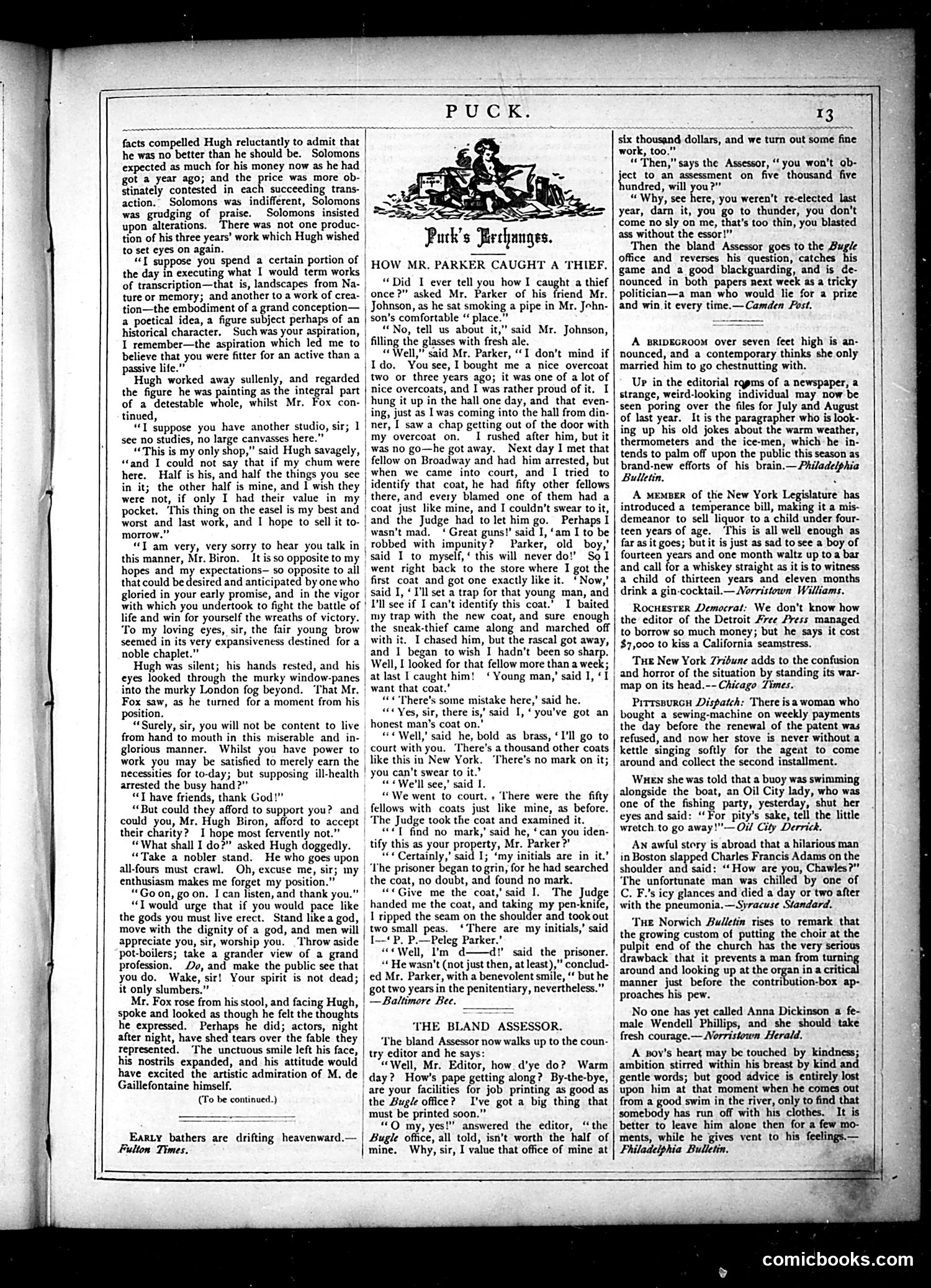
This page contains two main satirical pieces: **"Puck's Intrigues: How Mr. Parker Caught a Thief"** is a humorous anecdote about a man who purchases a stolen overcoat, then uses deception to recover it by posing as the original thief's accomplice. The story satirizes urban crime and the practicality of recovering stolen goods through clever social manipulation rather than law enforcement. **"The Bland Assessor"** appears to be a short political commentary featuring an editor character discussing property assessment. The cartoon likely satirizes local government bureaucracy and tax assessment procedures, mocking both the assessor's bland personality and the arbitrary nature of property valuations. Both pieces employ humor to critique everyday urban American experiences—petty theft and governmental inefficiency—typical of Puck's satirical approach to contemporary social issues.
📄 Transcribed text from this page (OCR, searchable)
Machine-transcribed from the original scan — historical spelling and the odd misread are preserved.
facts compelled Hugh reluctantly to admit that he was no better than he should be. Solomons expected as much for his money now as he had | got a year ago; and the price was more ob- stinately contested in each succeeding trans- action. Solomons was indifferent, Solomons was grudging of praise. Solomons insisted upon alterations. There was not one produc- tion of his three years’ work which Hugh wished to set eyes on again. “I suppose you spend a certain portion of | the day in executing what I would term works of transcription—that is, landscapes from Na- ture or memory; and another to a work of crea- tion—the embodiment of a grand conception— a poetical idea, a figure subject perhaps of an historical character. Such was your aspiration, I remember—the aspiration which led me to believe that you were fitter for an active than a passive life.”” Hugh worked away sullenly, and regarded the figure he was painting as the integral part of a detestable whole, whilst Mr. Fox con- tinued, ; “T suppose you have another studio, sir; 1 see no studies, no large canvasses here.” “This is my only shop,” said Hugh savagely, “and I could not say that if my chum were here. Half is his, and half the things you see in it; the other half is mine, and I wish they were not, if only I had their value in my pocket. ‘This thing on the easel is my best and worst and last work, and I hope to sell it to- | morrow.” “T am very, very sorry to hear you talk in this manner, Mr. Biron. It is so opposite to my hopes and my expectations— so opposite to all that could be desired and anticipated by one who gloried in your early promise, and in the vigor with which you undertook to fight the battle of | life and win for yourself the wreaths of victory. To my loving eyes, sir, the fair young brow seemed in its very expansiveness destined for a noble chaplet.”” Hugh was silent; his hands rested, and his eyes looked through the murky window-panes into the murky London fog beyond. ‘That Mr. Fox saw, as he turned for a moment from his ition. “Surely, sir, you will not be content to live from hand to mouth in this miserable and in- glorious manner. Whilst you have power to work you may be satisfied to merely earn the necessities for to-day; but supposing ill-health | arrested the busy hand?” “T have friends, thank God!” “But could they afford to support you? and could you, Mr. Hugh Biron, afford ‘to accept their charity? I hope most fervently not.” “What shall I do?” asked Hugh doggedly. “Take a nobler stand. He who goes upon all-fours must crawl. enthusiasm makes me forget my position.” “Go on, go on. I can listen, and thank you.” “I would urge that if you would pace like the gods you must live erect. Stand like a god, move with the dignity of a god, and men will appreciate you, sir, worship you. ‘Throw aside pot-boilers; take a grander view of a grand profession. Do, and make the public see that you do. Wake, sir! Your spirit is not dead; it only slumbers.” Mr. Fox rose from his stool, and facing Hugh, spoke and looked as though he felt the thoughts he expressed. Perhaps he did; actors, night after night, have shed tears over the fable they represented. ‘The unctuous smile left his face, his nostrils expanded, and his attitude would have excited the artistic admiration of M. de Gaillefontaine himself. (To be continued.) Earty bathers are drifting heavenward.— Fulton Times. Oh, excuse me, sir; my | HOW MR. PARKER CAUGHT A ‘THIEF. “Did I ever tell you how I caught a thief once ?” asked Mr. Parker of his friend Mr. | Johnson, as he sat smoking a pipe in Mr. John- son’s comfortable “ place.” “No, tell us about it,” said Mr. Johnson, filling the glasses with fresh ale. “Well,” said Mr. Parker, ‘(I don’t mind if | Ido. You see, I bought me a nice overcoat two or three years ago; it was one of a lot of nice overcoats, and I was rather proud of it. I hung it up in the hall one day, and that even- ing, just as I was coming into the hall from din- | ner, I saw a chap getting out of the door with my overcoat on. I rushed after him, but it | was no go—he got away. Next day I met that | fellow on Broadway and had him arrested, but | when we came into court, and I tried to identify that coat, he had fifty other fellows there, and every blamed one of them had a ‘coat just like mine, and I couldn’t swear to it, and the Judge had to let him go. Perhaps I wasn’t mad.‘ Great guns!’ said I, ‘am I to be robbed with impunity? Parker, old boy,’ ‘said I to myself,‘ this will never do!’ So 1 went right back to the store where I got the first coat and got one exactly like it. ‘ Now,’ said I, ‘I'll set a trap for that young man, and I'll see if I can’t identify this coat.’ I baited my trap with the new coat, and sure enough the sneak-thief came along and marched off with it. I chased him, but the rascal got away, and I began to wish I hadn't been so sharp. Well, I looked for that fellow more than a week; | at last I caught him! ‘ Young man,’ said I, ‘I want that coat.’ «««-There’s some mistake here,’ said he. “*Yes, sir, there is,’ said I, ‘you've got an honest man’s coat on.’ € Well,’ said he, bold as brass, ‘I'll go to court with you. There's a thousand other coats like this in New York. ‘There's no mark on it; you can’t swear to it.’ “ «We'll see,’ said I. “We went to court. , here were the fifty fellows with coats just like mine, as before. The Judge took the coat and examined it. “<T find no mark,’ said he, ‘can you iden- tify this as your property, Mr. Parker?" “<« Certainly,’ said 1; ‘my initials are in it.” ‘The prisoner began to grin, for he had searched | the coat, no doubt, and found no mark, “Give me the coat,’ said I. The Judge handed me the coat, and taking my pen-knife, 1 ripped the seam on the shoulder and took out two small peas. ‘There are my initials,’ said | I—'P. P.—Peleg Parker.’ | “Well, I'm d——d!’ said the prisoner. | “He wasn’t (not just then, at least),” conclud- | ed Mr. Parker, with a benevolent smile, “ but he | got two years in the penitentiary, nevertheless.” | | — Baltimore Bee. | ‘THE BLAND ASSESSOR. | ‘The bland Assessor now walks up to the coun- | try editor and he says: “Well, Mr. Editor, how. d'ye do? Warm | | day? How’s pape getting along? By-the-bye, | are your facilities for job printing as good as | the Bugle office? I’ve got a big thing that must be printed soon.” “O my, yes!” answered the editor, “the Bugle office, all told, isn’t worth the half of mine. Why, sir, I value that office of mine at work, too. “ Then,” says the Assessor, ‘‘ you won't ob- ject to an assessment on five thousand five undred, will you?” “Why, see here, you weren't re-elected last year, darn it, you go to thunder, you don't come no sly on me, that’s too thin, you blasted ass without the essor!”” Then the bland Assessor goes to the Bugle office and reverses his question, catches his game and a good blackguarding, and is de- nounced in both papers next week as a tricky politician—a man who would lie for a prize and win it every time.—Camden Fost. A BRIDEGROOM over seven feet high is an- nounced, and a contemporary thinks she only married him to go chestnutting with. Up in the editorial ragms of a newspaper, a strange, weird-looking individual may now be seen poring over the files for July and August of last year. It is the paragrapher who is look- ing up his old jokes about the warm weather, thermometers and the ice-men, which he in- tends to palm off upon the public this season as brand-new efforts of his brain.— Philadelphia Bulletin. A memper of the New York Legislature has introduced a temperance bill, making it a mis- demeanor to sell liquor to a child under four- teen years of age. ‘This is all well enough as far as it goes; but it is just as sad to see a boy of fourteen years and one month waltz up toa bar and call for a whiskey straight as it is to witness a child of thirteen years and eleven months drink a gin-cocktail.— Norristown Williams. Rocuester Democrat: We don't know how the editor of the Detroit Free Press managed to borrow so much money; but he says it cost $7,000 to kiss a California seamstress. Tue New York Zribune adds to the confusion and horror of the situation by standing its war- map on its head.--Chicago Times. PitrssurGcH Dispatch: There isa woman who bought a sewing-machine on weekly payments the day before the renewal of the patent was refused, and now her stove is never without a kettle singing softly for the agent to come | around and collect the second installment. Wuen she was told that a buoy was swimming alongside the boat, an Oil City lady, who was one of the fishing party, yesterday, shut her eyes and said: “For pity’s sake, tell the little wretch. to go away!"— Oil City Derrick. An awful story is abroad that a hilarious man in Boston slapped Charles Francis Adams on the shoulder aid said “How are you, Chawles?” ‘The unfortunate man was chilled by one of C. F.’s icy glances and died a day or two after with the pneumonia.—Syracuse Standard. ‘Tue Norwich Bulletin rises to remark that the growing custom of putting the choir at the pulpit end of the church has the very serious drawback that it prevents a man from turni: around and looking up at the organ in a criti | manner just before the contribution-box ap- proaches his pew. No one has yet called Anna Dickinson a fe- | male Wendell Phillips, and she should take fresh courage.— Norristown Herald. A noy’s heart may be touched by kindness; ambition stirred within his breast by kind and gentle words; but good advice is entirely lost upon him at that moment when he comes out from a good swim in the river, only to find that somebody has run off with his clothes. It is better to leave him alone then for a few mo- ments, while he gives vent to his feelings.— Philadelphia Bulletin. . comicbooks.com