
Puck, 1877-05 · page 10 of 16
Puck — May 1877 — page 10: what you’re looking at
What you’re looking at
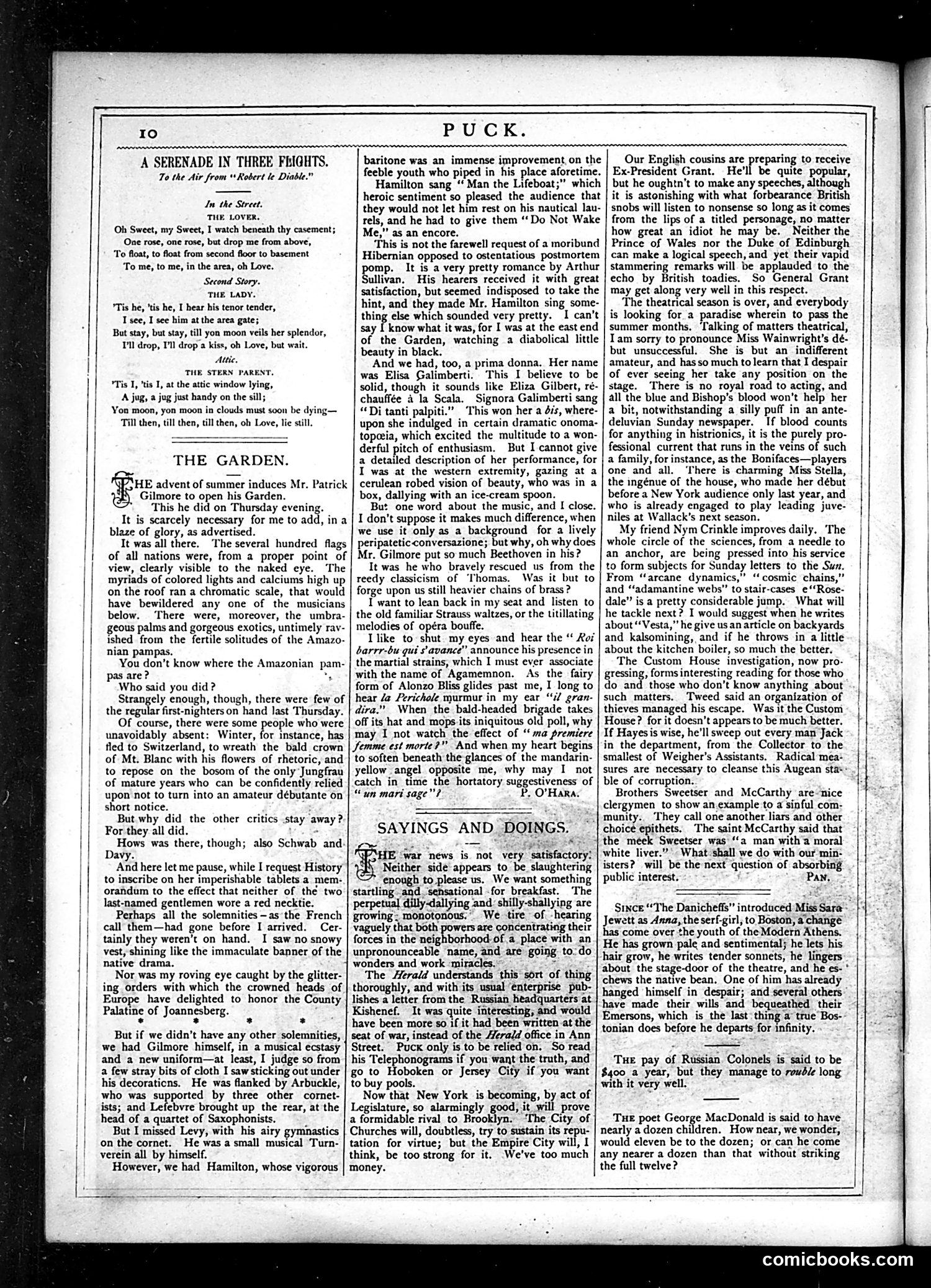
This page contains three distinct sections: a poem titled "A Serenade in Three Flights," a section called "The Garden" (arts criticism), and "Sayings and Doings" (social commentary). The content focuses on cultural and entertainment criticism rather than political satire. "The Garden" critiques summer theater performances and a soprano named Elisa Galimberti. "Sayings and Doings" discusses New York legislation affecting churches, Russian military pay rates, and social observations about New York City's development. The page lacks prominent political cartoons—it's primarily text-based commentary typical of Puck's satirical journalism, mocking contemporary cultural figures, entertainment mediocrity, and urban social issues through witty prose rather than visual caricature.
📄 Transcribed text from this page (OCR, searchable)
Machine-transcribed from the original scan — historical spelling and the odd misread are preserved.
———— Io PUCK. A SERENADE IN THREE FLIGHTS. To the Air from ** Robert le Diable.” In the Street. THE LOVER. Oh Sweet, my Sweet, I watch beneath thy casement; One rose, one rose, but drop me from above, To float, to float from second floor to basement To me, to me, in the area, oh Love. Second Story. THE LADY. ‘Tis he, ‘tis he, I hear his tenor tender, I see, I see him at the area gate; But stay, but stay, till yon moon veils her splendor, Tl drop, I'l! drop a kiss, oh Love, but wait. Attic, THE STERN PARENT. "Tis I, 'tis I, at the attic window lying, ‘A jug, a jug just handy on the sill; Yon moon, yon moon in clouds must soon be dying— Till then, till then, till then, oh Love, lie still. THE GARDEN. Fe advent of summer induces Mr. Patrick Gilmore to open his Garden. This he did on Thursday evening. It is scarcely necessary for me to add, ina blaze of glory, as advertised. It was all there. ‘The several hundred flags of all nations were, from a proper point of view, clearly visible to the naked eye. The myriads of colored lights and calciums high up on the roof ran a chromatic scale, that would have bewildered any one of the musicians below. There were, moreover, the umbra- geous palms and gorgeous exotics, untimely rav- ished from the fertile solitudes of the Amazo- nian pampas. You don’t know where the Amazonian pam- pas are? *, Who said you did? Strangely enough, though, there were few of the regular first-nighters on hand last Thursday. Of course, there were some people who were unavoidably absent: Winter, for instance, has fled to Switzerland, to wreath the bald crown of Mt. Blanc with his flowers of rhetoric, and to repose on the bosom of the only Jungfrau of mature years who can be confidently relied upon not to turn into an amateur débutante on short notice. : But why did the other critics .stay away ? For they all did. - Hows was there, though; also Schwab and. Davy. And here let me pause, while I request History to inscribe on her imperishable tablets a mem-. orandum to the effect that neither of thé two last-named gentlemen wore a red necktie. Perhaps all the solemnities—as‘the French call them—had gone before I arrived. Cer- tainly they weren't on hand. I saw no snowy vest, shining like the immaculate banner of the native drama. Nor was my roving eye caught by the glitter- ing orders with which the crowned heads of Europe have delighted to honor the County Palatine of Joannesberg. . * * But if we didn’t have any other solemnities, we had Gilmore himself, in a musical ecstasy and a new uniform—at least, I judge so from a few stray bits of cloth I saw sticking out under his decorations. He was flanked by Arbuckle, who was supported by three other cornet- ists; and Lefebvre brought up the rear, at the head of a quartet of Saxophonists. But I missed Levy, with his airy gymnastics ‘on the cornet. He was a small musical ‘Turn- verein all by himself. However, we had Hamilton, whose vigorous baritone was an immense improvement, on the feeble youth who piped in his place aforetime. Hamilton sang ‘‘ Man the Lifeboat;” which heroic sentiment so pleased the audience that they would not let him rest on his nautical lau- rels, and he had to give them ‘Do Not Wake Me,” as an encore. This is not the farewell request of a moribund Hibernian opposed to ostentatious postmortem It is a very pretty romance by Arthur ullivan. His hearers received it with great satisfaction, but seemed indisposed to take the hint, and they made Mr. Hamilton sing some- thing else which sounded very pretty. I can’t say [ know what it was, for I was at the east end of the Garden, watching a diabolical little beauty in black. ‘And we had, too, a prima donna. Her name was Elisa Galimberti. This I believe to be solid, though it sounds like Eliza Gilbert, ré- chauffée a la Scala. Signora Galimberti sang “Di tanti palpiti.” ‘This won her a dis, where- upon she indulged in certain dramatic onoma- topozia, which excited the multitude to a won- derful pitch of enthusiasm. But I cannot give a detailed description of her performance, for I was at the western extremity, gazing at a cerulean robed vision of beauty, who was in a box, dallying with an ice-cream spoon. But one word about the music, and I close. I don’t suppose it makes much difference, when we use it only as a backgrouad for a lively peripatetic conversazione; but why, oh why does Mr. Gilmore put so much Beethoven in his? It was he who bravely rescued us from the reedy classicism of ‘Thomas. Was it but to forge upon us still heavier chains of brass? I want to lean back in my seat and listen to the old familiar Strauss waltzes, or the titillating melodies of opéra bouffe. I like to shut my eyes and hear the “ Roi barrr-bu qui s'avance” announce his presence in the martial strains, which I must ever associate with the name of Agamemnon. As the fairy form of Alonzo Bliss glides past me, I long to hear Ze Perichole murmur in my ear “if gran- dira.” When the bald-headed brigade takes off its hat and mops.its iniquitous old poll, why may I not watch the effect of “ma premiere femme est morte?” And when my heart begins to soften beneath the glances of the mandarin- yellow angel opposite me, why may I not catch in time the hortatory suggestiveness of “un mari sage”? P. O’HaRa: SAYINGS AND DOINGS. HE ‘war news is not very satisfactory? Neither side appears to be slaughtering enough to please us. We want something startling. and. ‘sensational -for breakfast. The perpetual -dallying and: shilly-shallying are growing: monotonous.” We tire of -hearing vaguely that both. eed are concentrating their forces in the neighborhood of a place with an unpronounceable ‘name, and are going to:do wonders and work -miracl * The Hera/d understands this sort of thing thoroughly, and with its usual ‘enterprise pub- lishes a letter from the Russian headquarters at Kishenef. It was quite interesting, and would have been more so if it had been written at the seat of war, instead of the Heradd office in Ann Street. Puck only is to be relied on. So read his Telephonograms if you want the truth, and go to Hoboken or Jersey City if you want to buy pools. Now that New York is becoming, by act of Legislature, so alarmingly good, it will prove a formidable rival to Brooklyn. ‘The City of Churches will, doubtless, try to sustain its repu- tation for virtue; but the Empire City will, 1 think, be too strong for it. We've too much money. Our English cousins are preparing to receive Ex-President Grant. He'll be quite popular, but he oughtn’t to make any speeches, although it is astonishing with what forbearance British snobs will listen to nonsense so long as it comes from the lips of a titled personage, no matter how great an idiot he may be. Neither the Prince of Wales nor the Duke of Edinburgh can make a logical speech, and yet their vapid stammering remarks will be applauded to the echo by British toadies. So General Grant may get along very well in this respect. The theatrical season is over, and everybody is looking for a paradise wherein to pass the summer months. ‘Talking of matters theatrical, Iam sorry to pronounce Miss Wainwright’s dé- but unsuccessful. She is but an indifferent amateur, and hasso much to learn that I despair of ever seeing her take any position on the stage. There is no royal road to acting, and all the blue and Bishop’s blood won't help her a bit, notwithstanding a silly puff in an ante- deluvian Sunday newspaper. If blood counts for anything in histrionics, it is the purely pro- fessional current that runs in the veins of such a family, for instance, as the Bonifaces—players one and all. ‘There is charming Miss Stella, the ingénue of the house, who made her début before a New York audience only last year, and who is already engaged to play leading juve- niles at Wallack’s next season. My friend Nym Crinkle improves daily. The whole circle of the sciences, from a needle to an anchor, are being pressed into his service to form subjects for Sunday letters to the Sun. From “arcane dynamics,” ‘cosmic chains,” and “‘adamantine webs” to stair-cases_e‘‘Rose- dale” is a pretty considerable jump. What will he tackle next? I would suggest when he writes about “Vesta,” he give us an article on backyards and kalsomining, and if he throws in a little about the kitchen boiler, so much the better. The Custom House investigation, now pro- gressing, forms interesting reading for those who do and those who don’t know anything about such matters. Tweed said an organization of thieves managed his escape. Was it the Custom. House? for it doesn’t appears to be much better. If Hayesis wise, he'll sweep out every man Jack in the department, from the Collector to the smallest of Weigher’s Assistants. Radical mea- sures are necessary to cleanse this Augean sta=: ble of corruption. Brothers Sweetser and McCarthy are“nice clergymen to show an.example to a sinful com- munity.. ‘They call one another liars and other choicé epithets. The saint McCarthy said that the méek Sweetser was ‘‘a man witha moral white liver.”’ What: shall we do with our min: isters? will be the next question of absorbing public interest. Pan, Since “The Danicheffs” introduced Miss Sara Jewett as Anna, the serf-girl, to Boston, a’changé has come over the youth of the Modern Athens. He has grown pale and sentimental; he lets his hair grow, he writes tender sonnets, he lingers about the stage-door of the theatre, and he es- chews the native bean. One of him has already hanged himself in despair; and several others have made their wills and bequeathed their Emersons, which is the last thing a true Bos-- tonian does before he departs for infinity. Tue pay of Russian Colonels is. said to be $400 a year, but they manage to roud/e long with it very well. Tue poet George MacDonald is said to have nearly a dozen children. How near, we wonder, would eleven be to the dozen; or can he come any nearer a dozen than that without striking the full twelve? comicbooks.com