
Puck, 1877-05 · page 7 of 16
Puck — May 1877 — page 7: what you’re looking at
What you’re looking at
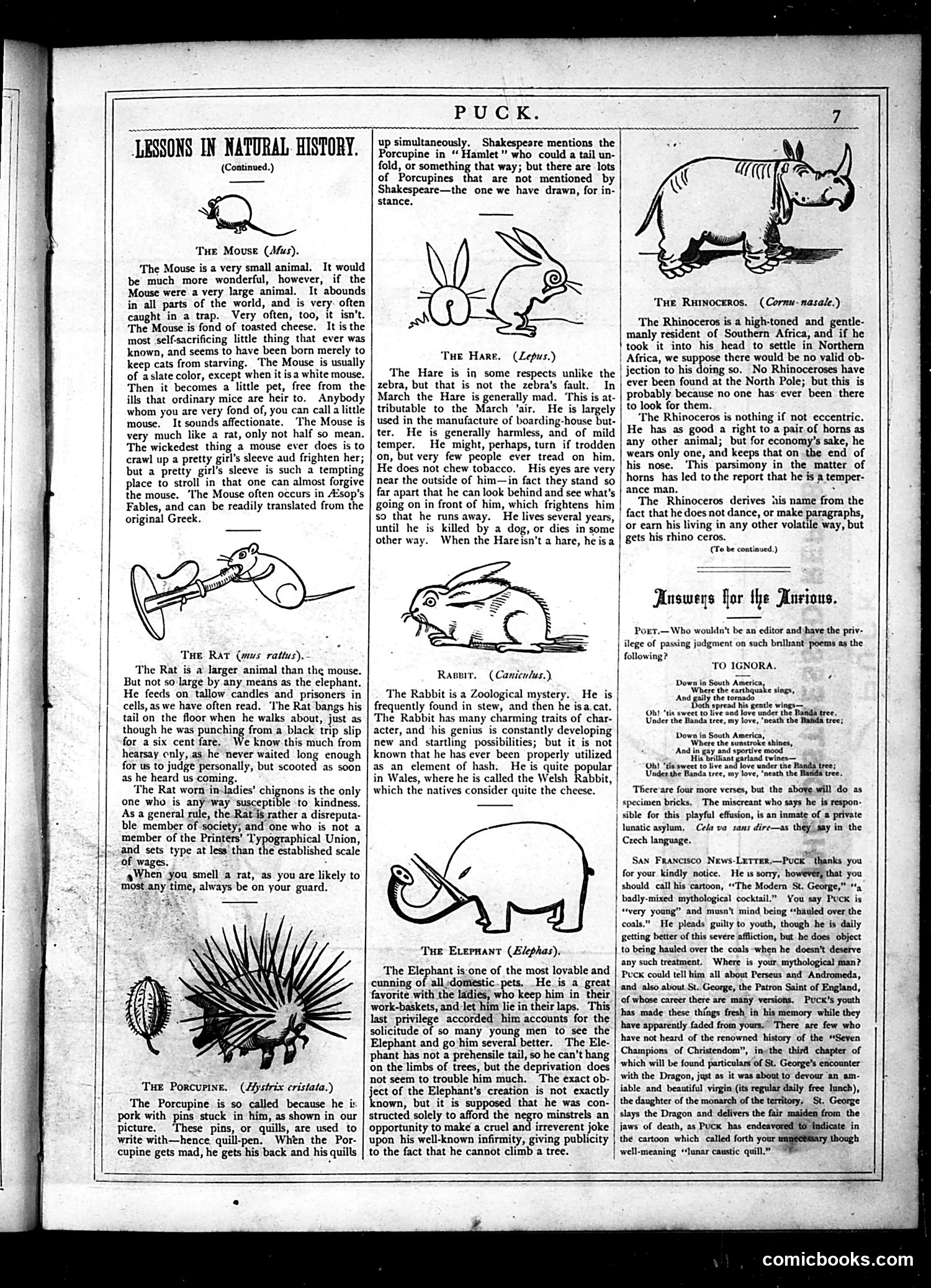
This page is primarily **educational natural history content**, not political satire. It's part of "Lessons in Natural History (Continued)" featuring illustrated descriptions of animals: the Mouse, Rat, Hare, Rabbit, Porcupine, Rhinoceros, and Elephant. The text provides detailed, often humorous observations about each creature's habits and characteristics. For example, it notes the Mouse's self-sacrificing nature and the Rat's membership in the "Printers' Typographical Union," suggesting labor-union humor relevant to the era. The bottom section, "Answers for the Curious," addresses reader questions about poetry and mythology—unrelated to politics. **This appears to be filler content** rather than satirical commentary. Puck frequently mixed humor, education, and lighter pieces between political cartoons. The animal illustrations are simple educational drawings rather than political caricatures.
📄 Transcribed text from this page (OCR, searchable)
Machine-transcribed from the original scan — historical spelling and the odd misread are preserved.
PUCK. “LESSONS IN NATURAL HISTORY. (Continued.) Low ‘THe Mouse (Aus). ‘The Mouse is a very small animal. It would be much more wonderful, however, if the Mouse were a very large animal. It abounds in all parts of the world, and is very often caught in a trap. Very often, too, it isn’t. ‘The Mouse is fond of toasted cheese. It is the most .self-sacrificing little thing that ever was known, and seems to have been born merely to keep cats from starving. The Mouse is usually of aslate color, except when it isa white mouse, Then it becomes a little pet, free from the ills that ordinary mice are heir to. Anybody whom you are very fond of, you can call a little mouse. It sounds affectionate. The Mouse is very much like a rat, only not half so mean. The wickedest thing a mouse ever does is to crawl up a pretty girl's sleeve aud frighten her; but a pretty girl's sleeve is such a tempting place to stroll in that one can almost forgive the mouse. ‘The Mouse often occurs in Aisop’s Fables, and can be readily translated from the original Greek. THe Rat (mus rattus).- The Rat is a larger animal than the mouse. But not so large by any means as the elephant. He feeds on tallow candles and prisoners in cells, as we have often read. ‘The Rat bangs his tail on the floor when he walks about, just as though he was punching from a black trip slip for a six cent fare. We know this much from hearsay only, as he’ never waited long enough for us to judge personally, but scooted as soon as he heard us coming. The Rat worn in-ladies’ chignons is the only one who is any»way susceptible to kindness. As a general rule, the Rat is rather a disreputa- ble member of society, and one who is not a member of the Printers’ Typographical Union, and sets type at less’ than the established scale of wages. : When you smell a rat, as you are likely to most any time, always be on your guard. Tue Porcupine. (Hystrix cristata.) The Porcupine is so called because he is pork with pins stuck in him, as shown in our picture. ‘These pins, or quills, are used to write with—hence, quill-pen. When the Por- cupine gets mad, he gets his back and his quills up simultaneously. Shakespeare mentions the Porcupine in “ Hamlet” who could a tail un- fold, or something that way; but there are lots of Porcupines that are not mentioned by Shakespeare—the one we have drawn, for in- stance, ah THe Hare. (Lepus.) | The Hare is in some respects unlike the | zebra, but that is not the zebra’s fault. In March the Hare is generally mad. ‘This is at- tributable to the March ‘air. He is largely used in the manufacture of boarding-house but- ter. He is generally harmless, and of mild temper. He might, perhaps, turn if trodden on, but very few people ever tread on him. He does not chew tobacco. His eyes are very near the outside of him—in fact they stand so far apart that he can look behind and see what's going on in front of him, which frightens him so that he runs away. He lives several years, until he is killed by a dog, or dies in some other way. When the Hareisn’t a hare, he isa Rappit, (Caniculus.) The Rabbit is a Zoological mystery. He is | frequently found in stew, and then he isa. cat. The Rabbit has many charming traits of char- acter, and ‘his genius is constantly developing new and startling possibilities; but it is not known that he has ever been properly utilized as an element of hash. He is quite popular in Wales, where he is called the Welsh Rabbit, which the natives consider quite the cheese. | | | Tue Evernant (Zéephas), The Elephant is-one of the most lovable and cunning of all:domestic.pets, He is a great favorite with the ladies, who keep him in their work-baskets, and let him lie in their laps. This last privilege accorded him accounts for the solicitude of so many young men to see the Elephant and go‘him several better. The Ele- phant has not a prehensile tail, so he can’t hang on the limbs of trees, but the deprivation does not seem to trouble him much. The exact ob- ject of the Elephant’s creation is not exactly known, but it is supposed that he was con- structed solely to afford the negro minstrels an opportunity to make a cruel and irreverent joke upon his well-known infirmity, giving publicity to the fact that he cannot climb a tree. THe Rutnoceros. (Cornu-nasale.) The Rhinoceros is a high-toned and gentle- manly resident of Southern Africa, and if he took it into his head to settle in Northern Africa, we sup) there would be no valid ob- | jection to his doing so. No Rhinoceroses have ever been found at the North Pole; but this is probably because no one has: ever been there to look for them. ‘The Rhinoceros is nothing if not eccentric. He has as good a right to a pair of horns as any other animal; but for economy’s sake, he wears only one, and keeps that on the end of his nose. ‘This parsimony in the matter of horns has led to the report that he is a temper- ance man. : The Rhinoceros derives his name from the fact that he does not dance, or make iphs, or earn his living in any other volatile way, but gets his rhino ceros. (To be continued.) Answers for the Anrions. Poet.—Who wouldn't be an editor and have the priv- | ilege of passing jadgment on such brilliant poems as the following? TO IGNORA. Down ia South America, rere the earthquake sings, And gaily the to Both spread his gentle wings— Ob! ‘tis sweet to live and love under the Banda tree, Under the Handa tree, my love, ‘neath the Banda tree; Down in South America, "Where the suastroke shines, ‘And in gay and sportive mood His brilliant garland twines— ‘Ob! ‘te sweet to live and love under the Banda tree; Under the Banda tree, my love, ‘neath the Banda tree. There-are four more verses, but the above will do as specimen bricks, The miscreant who says he is respon- sible for this playful effusion, is an inmate of a private lunatic asylum, Cela va sans dire—as they say in the Ceech language, SAN FRaNcisco News-Letter —Puck’ thanks you for your kindly notice. He 1s sorry, however, that you should call his cartoon, “The Modern St. George,” ‘a badly-mixed mythological cocktail.” You say Puck is | “very young” and musn’t mind being ‘¢hauled over the coals.” He pleads guilty to youth, though he is daily getting better of this severe affliction, but he does object to being hauled over the coals -when he doesn’t deserve any such treatment. Where is your, mythological man? Pvck could tell him all about Perseus and Andromeda, and also about St. George, the Patron Saint of England, ‘of whose career there are many versions. Puck's youth has made these things fresh in his memory while they have apparently faded from yours.” There are few who have not heard of the renowned history of the “Seven Champions of Christendom”, inythe third chapter of which will be found particulars of St. George’s encounter | with the Dragon, just as it was about to devour ‘an am- iable and beautiful virgin (its regular daily free lunch), the daughter of the monarch of the territory, St. George slays the Dragon and delivers the fair maiden from the jaws of death, as Pucx bas endeavored to indicate in the cartoon which called forth your ung though well-meaning “lunar caustic quill.” comicbooks.com