
A complete issue · 16 pages · 1877
Puck — April 1877
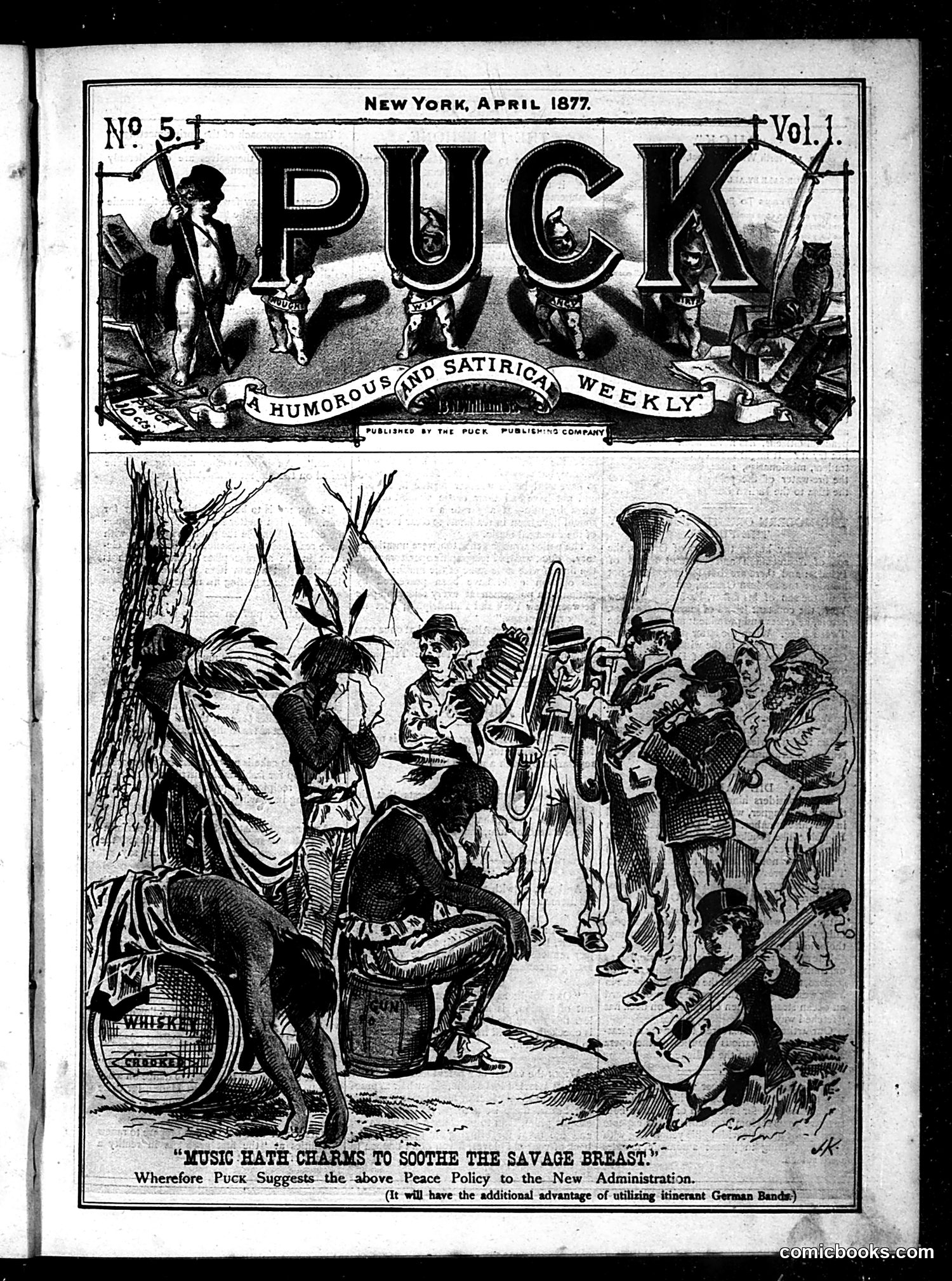
This satirical cartoon criticizes the incoming Hayes administration's approach to Native Americans. The main image shows a group of armed soldiers or officials confronting a Native American figure, with musicians playing instruments in the background. The caption reads: "Music Hath Charms to Soothe the Savage Beast," and the subtitle states Puck suggests using this "Peace Policy" with the new administration—sarcastically implying that music or cultural appeasement would be an absurd solution to conflicts with Native Americans. The satire mocks the government's proposed peaceful approach to Indian relations as naive or ineffective, suggesting it's equivalent to trying to calm violence with musical instruments. This reflects contemporary debates over Indian policy during the Reconstruction era's conclusion.
This page is primarily **text-based content rather than political cartoons**. It contains several short satirical articles and jokes typical of Puck's format: 1. **"Music Hath Charms"** - Satirizes a Philadelphia incident where the Telegraph office's music disturbed neighbors, mocking various proposed solutions (stationing policemen, replacing musicians). 2. **"The Modern Orestes"** - References the son of Agamemnon (Greek tragedy) to mock theatrical rivalries in New York's opera scene, suggesting dramatic family conflicts plague the stage. 3. **"Die Walkure"** - Critiques Wagner's opera's excessive length and technical complexity. The page also includes brief humorous observations about current events and social habits—typical Puck fare blending classical references with contemporary absurdities. **No identified political figures or major cartoon illustrations appear on this page.**
This page contains editorial commentary and humorous anecdotes rather than cartoons. The main satirical content includes: **"World-ly, But Not Wise"** critiques a dramatic critic's review of "The Princess Royal" at the World newspaper, mocking the critic's overwrought analysis and pretentious language. Puck suggests the critic mistakes verbosity for genuine insight. **"Simpson's Search"** is a lengthy anecdote about a man obsessively studying another's hair-cutting habits, finding nothing exceptional. The piece satirizes obsessive curiosity and the human tendency to read significance into trivial observations. The page also contains brief jokes mocking Louisiana voters' payment demands and Anglo-American cultural differences. The content reflects Puck's editorial voice: witty, skeptical of pretension, and focused on everyday absurdities rather than specific political figures.
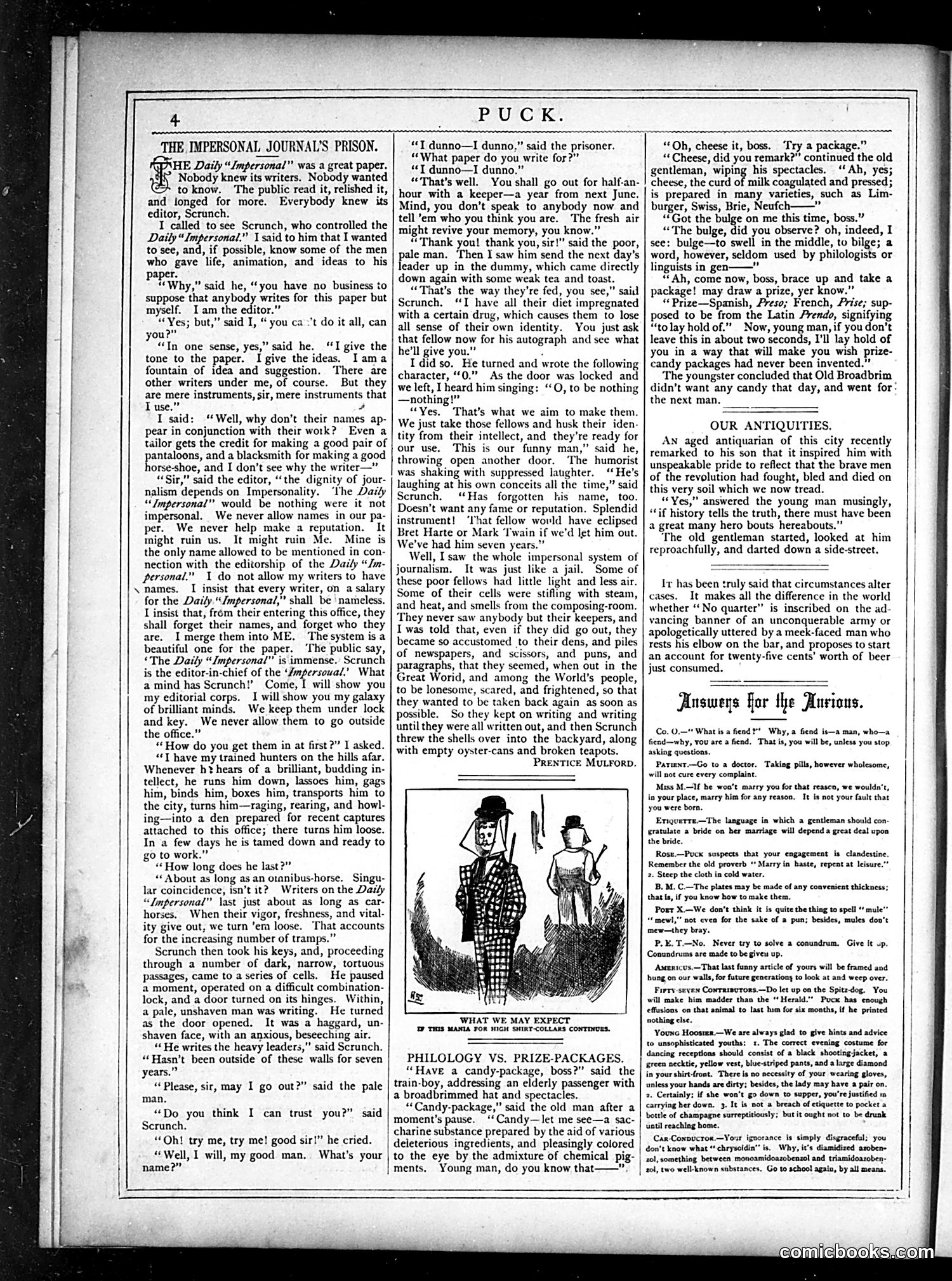
This satirical piece attacks the practice of major newspapers printing unsigned articles, which the text claims strips writers of individual identity and recognition. The editor argues that contributing to such publications is like being imprisoned—writers lose their names, reputation, and bylines while the newspaper profits from their labor. The cartoon depicts two figures in what appears to be prison garb, likely representing anonymous journalists confined by the impersonal publication system. The satire suggests that unsigned journalism treats skilled writers as interchangeable laborers rather than named professionals deserving credit and bylines. The piece advocates for attributing articles to specific writers, positioning this as fundamental to journalistic integrity and individual recognition.
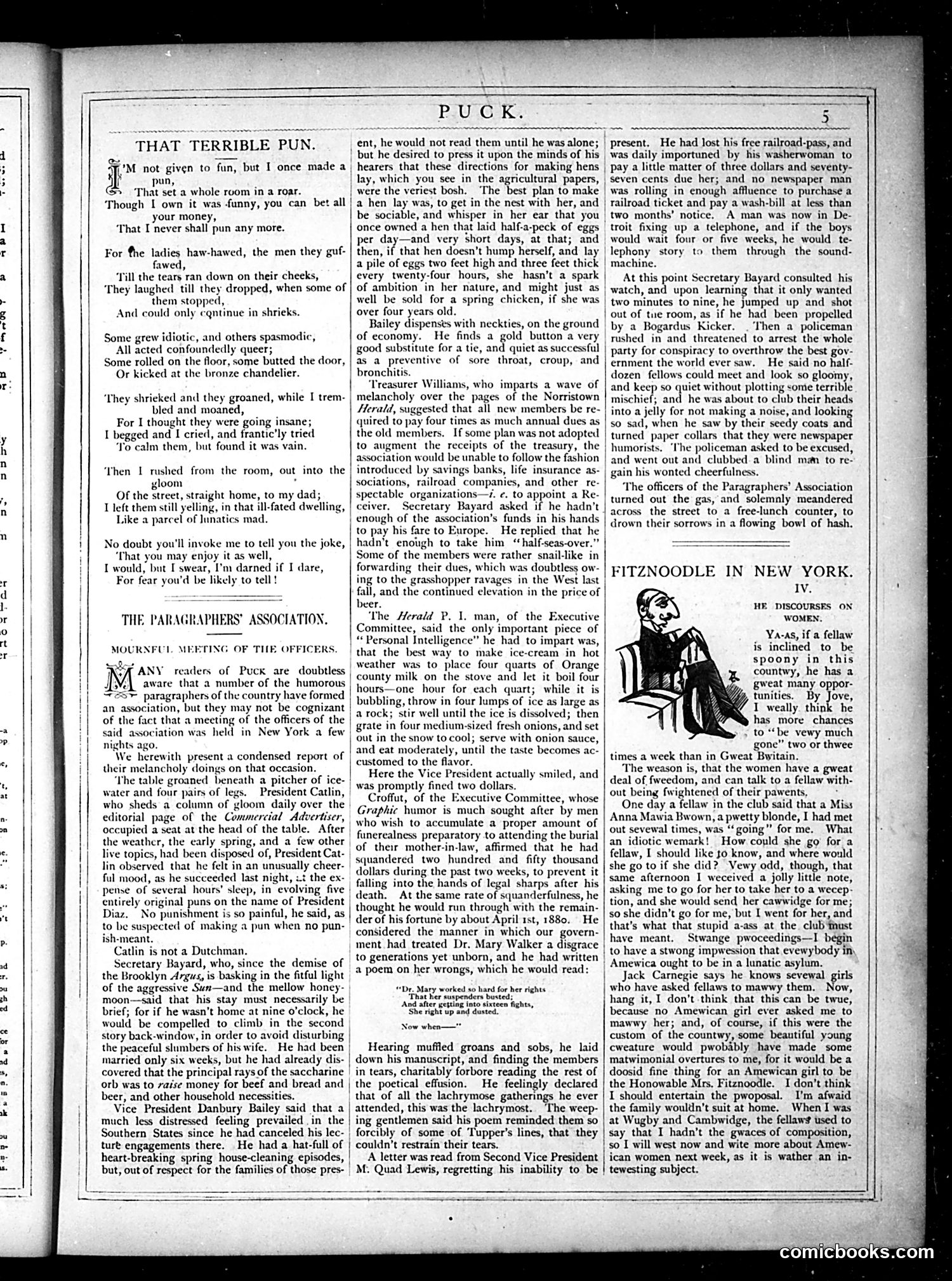
This page contains satirical articles rather than cartoons. The main piece, "The Paragraphers' Association," mocks newspaper columnists who recycled hackneyed puns and tired jokes—particularly criticizing one called "President Paz" for exhausted wordplay about punning. The right column, "Fitznoodle in New York: IV—He Discourses on Women," appears to be a serialized humorous column where the character discusses American women's independence compared to British women, portraying them as more assertive and less constrained by social convention. Both pieces are characteristic of Puck's satirical commentary on contemporary American society, media practices, and gender relations of the late 19th century.
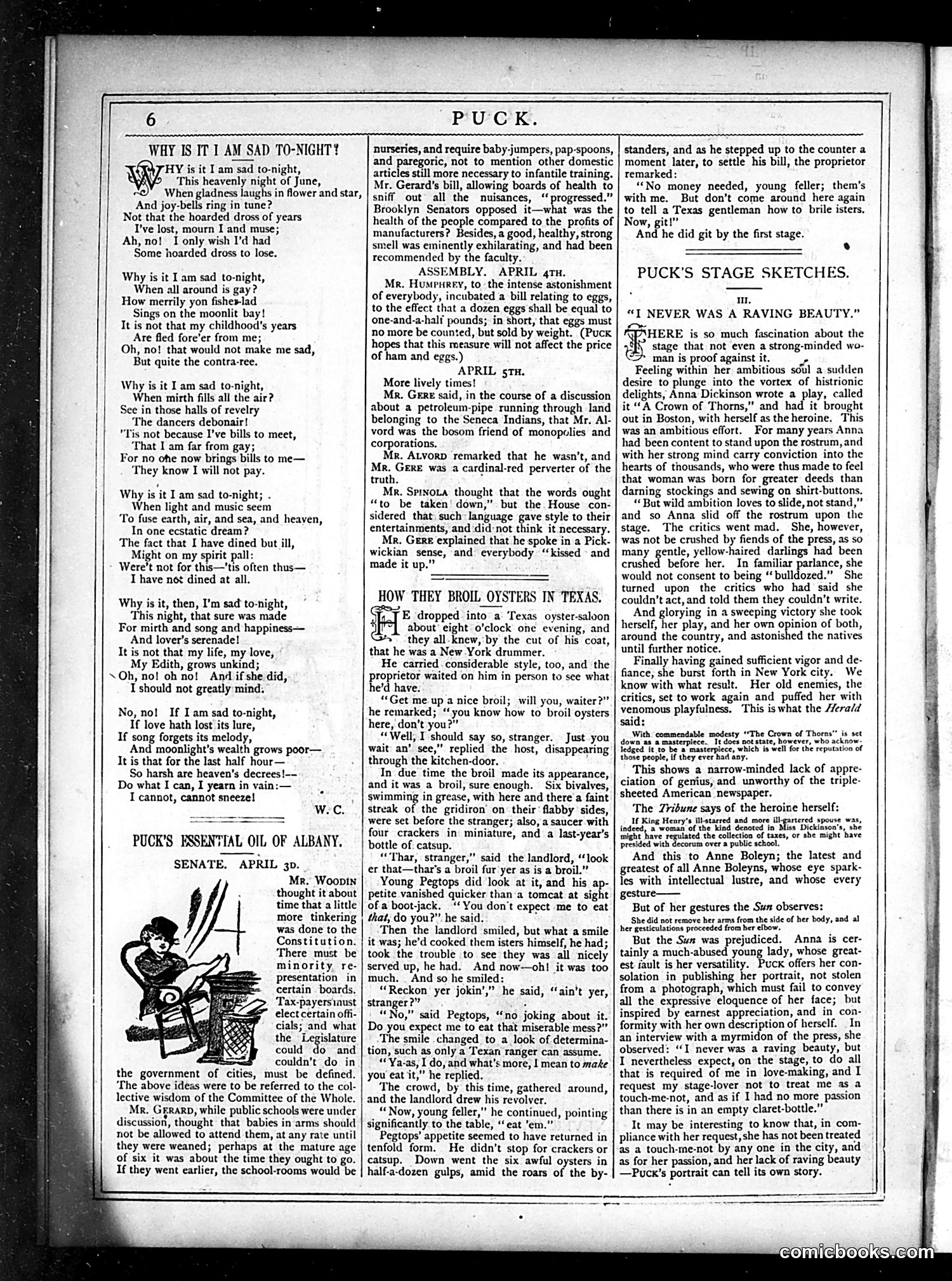
This page contains primarily **literary and social commentary** rather than political cartoons. The main content includes: 1. **"Why Is It I Am Sad To-Night?"** - A melancholic poem by W.C. about lost love and life's disappointments. 2. **"Puck's Stage Sketches"** - A theater review of Anna Dickinson's play "A Crown of Thorns," praising her ambitious dramatic work despite critical reception. The piece critiques those who dismissed her effort. 3. **"How They Broil Oysters in Texas"** - A humorous sketch depicting a Texas oyster-saloon scene with crude frontier characters and dialect humor, playing on regional stereotypes. 4. **"Puck's Essential Oil of Albany"** - A legislative satire about New York state politics discussing government structure and educational policy debates. The page reflects **late 19th-century Puck magazine**: mixing social satire with entertainment reviews and regional humor.
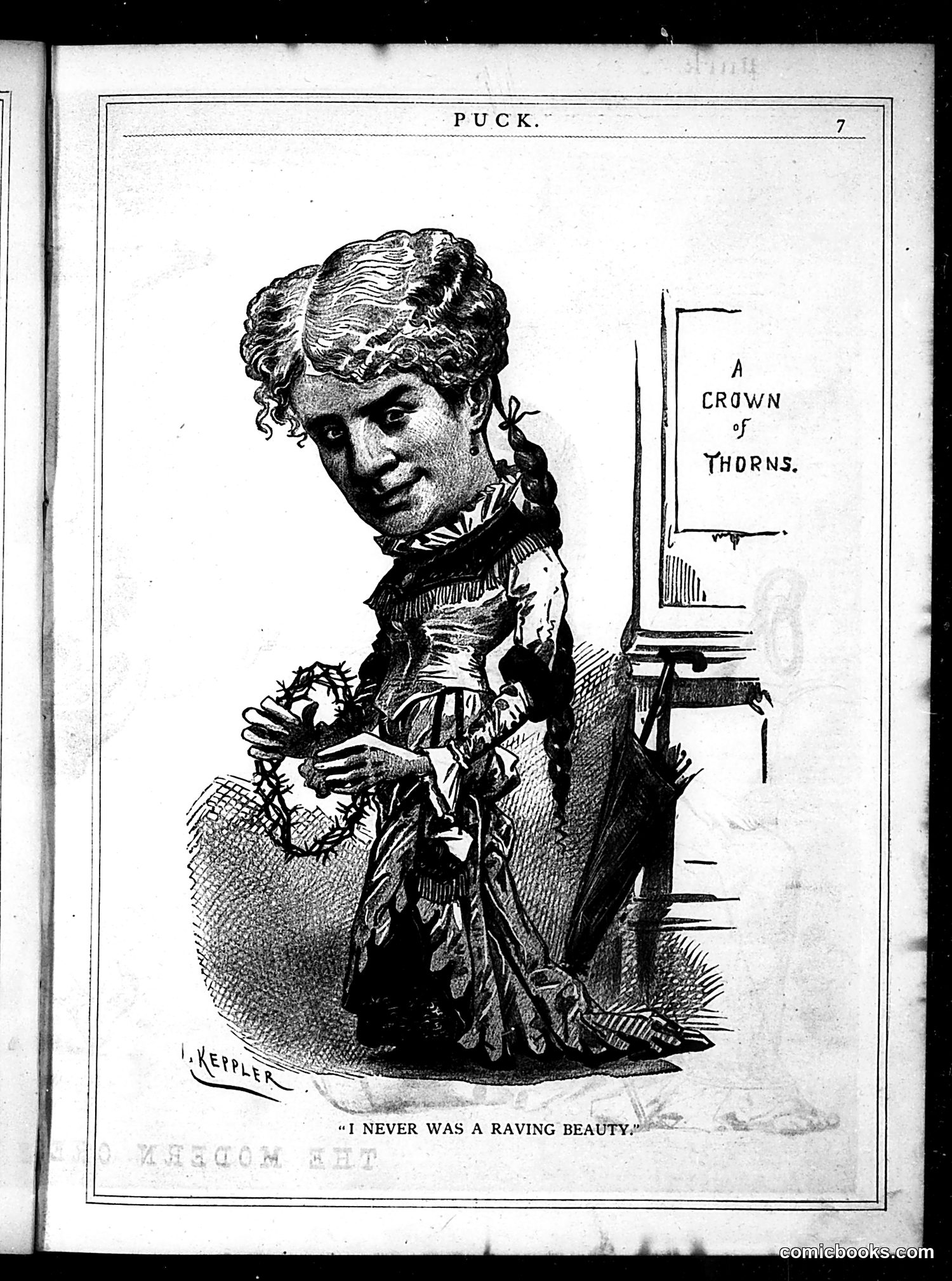
This satirical illustration depicts a woman holding wilted flowers, with a sign reading "A Crown of Thorns" beside her. The caption reads "I Never Was a Raving Beauty." The cartoon appears to be commentary on female vanity and aging. The woman—rendered in exaggerated caricature with an elaborate upswept hairstyle and fashionable dress—presents herself with apparent self-awareness about her diminished beauty. The "crown of thorns" reference suggests suffering or martyrdom, implying she endures the hardship of aging ungracefully in a society that values female beauty. The wilted flowers reinforce this theme of faded attractiveness. The satire likely mocks both women's preoccupation with appearance and society's cruel standards regarding aging. The artist's signature appears to read "Keppler."
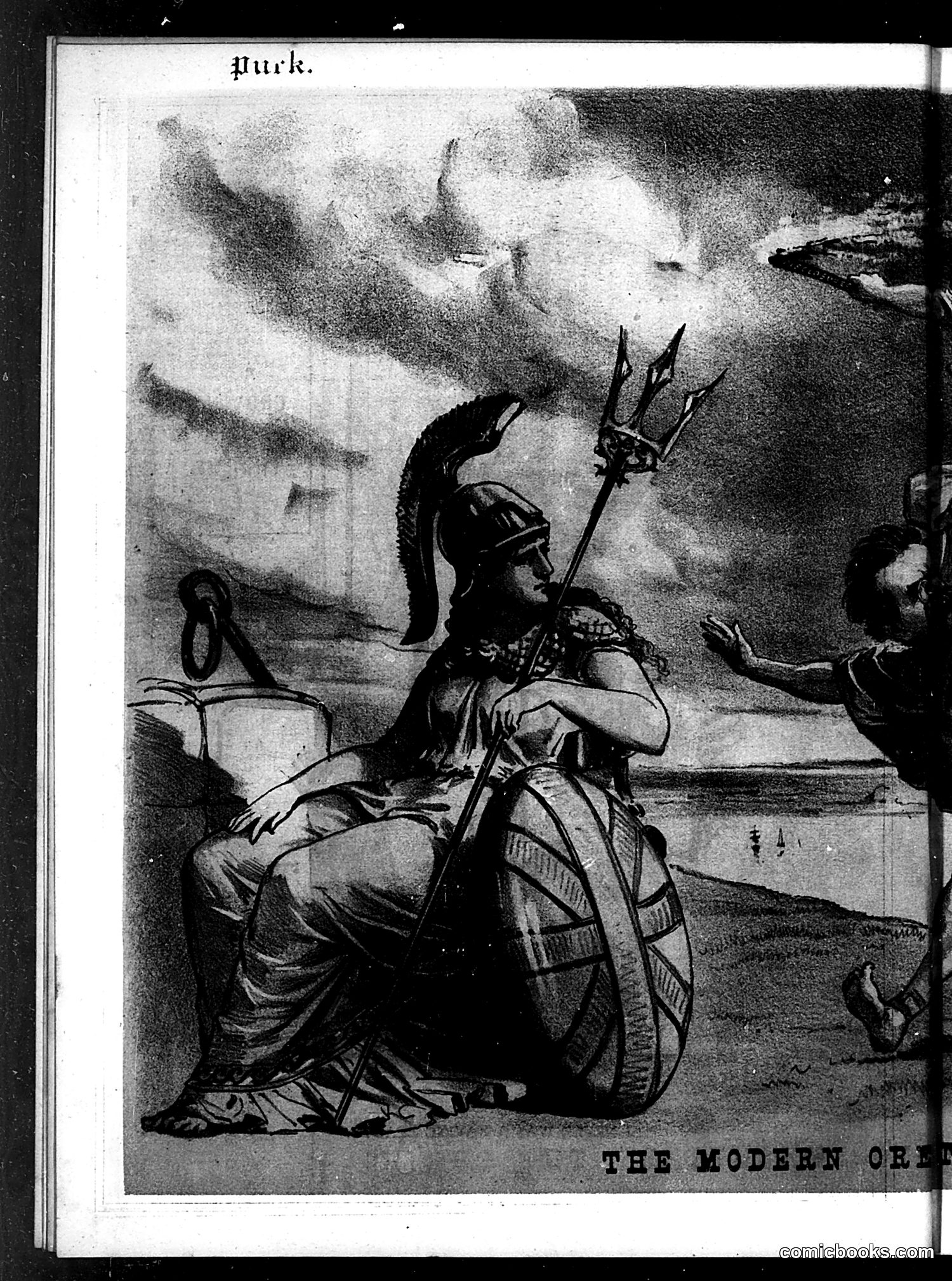
This page shows a classical allegorical figure—likely representing Neptune or a sea deity based on the trident and maritime imagery—seated regally beside what appears to be a wheel or ship's steering mechanism. The figure wears a Corinthian helmet and classical armor, establishing an ancient Greek or Roman reference. The title "THE MODERN ORI[ENT]" (text cut off) suggests political commentary about contemporary Eastern affairs, likely referencing late 19th/early 20th-century geopolitical tensions in the Ottoman Empire or Eastern Mediterranean region. The classical figure controlling maritime elements appears to satirize how modern Western powers (particularly naval powers) were dominating or "steering" Eastern affairs through colonial or imperial influence—juxtaposing timeless classical authority with contemporary political control. Without the complete text, the specific satirical target remains unclear.
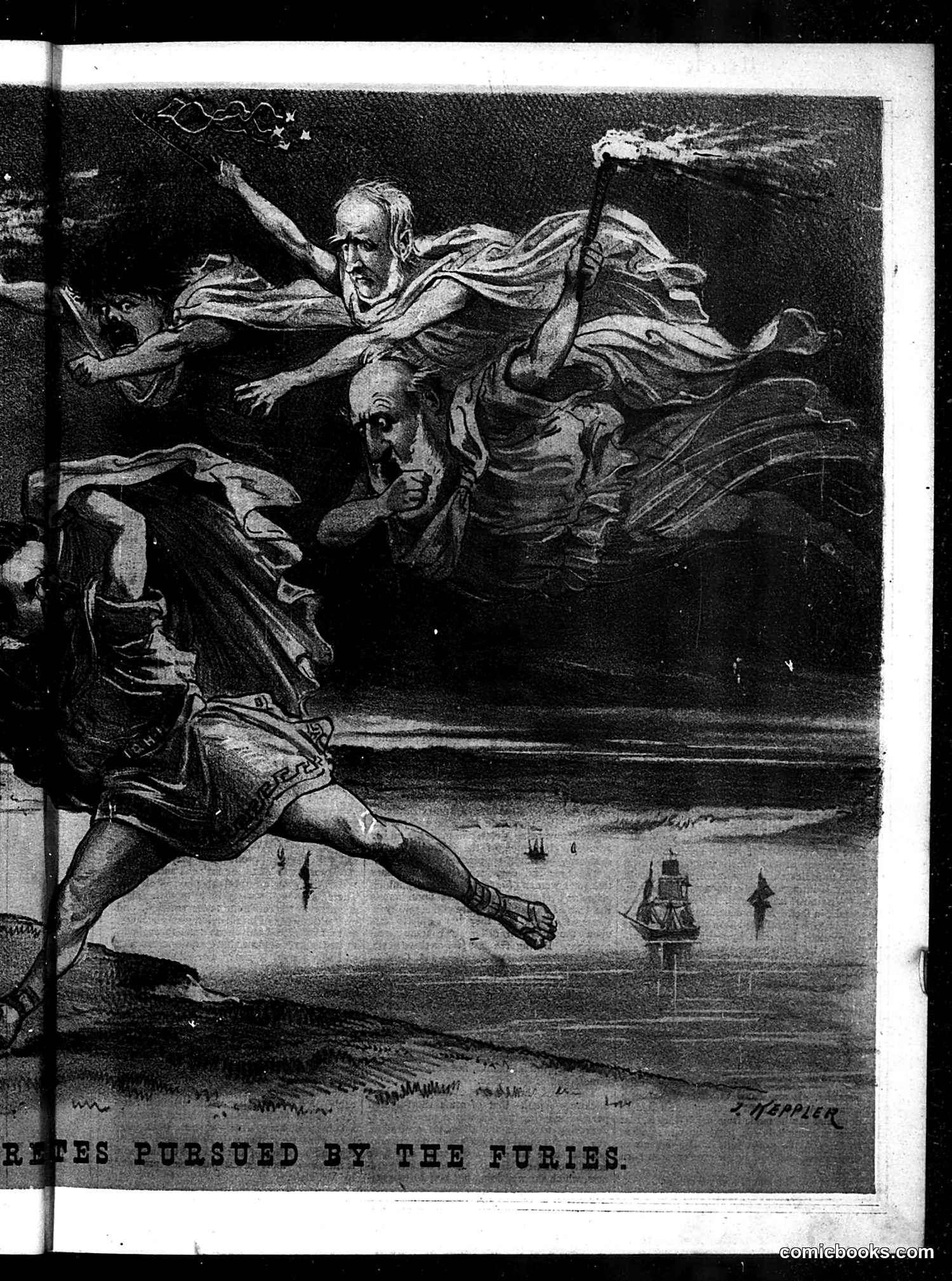
This engraving depicts classical mythology: figures representing the Furies (Greek avenging spirits) pursue a fleeing man across a landscape with ships in the distance. The composition uses the Furies as a metaphor for relentless punishment or consequence. In Puck's satirical context, this likely comments on political or social figures being hunted by retribution for their actions. The classical allusion elevates the criticism—suggesting the pursued figure faces inevitable, divine justice for wrongdoing. The dramatic chase scene and mythological framing indicate Puck is condemning someone's behavior as so egregious it warrants comparing their fate to legendary punishment. Without knowing the publication date, the specific identity of the pursued figure remains unclear.
This page consists primarily of **theatrical criticism and drama review**, not political satire. The main content includes: 1. **"The Lesson of a Tragedy"** - A review of John McCullough's performance in *Virginia* at Booth's Theatre, praising the actor's intensity and the play's moral lessons about restraint and propriety. 2. **"A Crown of Thorns"** - A review of a theatrical production, complimenting the playwright Hart for following precedent with works like *Led Astray* and *Sardanapalus*, while noting the play exposes "the folly and stupidity" of society. 3. **"The Princess Royal"** - A favorable review of a play featuring Fanny Davenport in a "breaking scene." The page represents **Puck's arts criticism section** rather than political cartooning. It reflects Victorian-era theatrical concerns about morality, propriety, and dramatic merit.
This page contains a short story rather than a political cartoon. The narrative describes a young man in November 1862 who discovers his dog "Pickle" possesses seemingly supernatural abilities — specifically, the animal can speak and appears to understand human language and thought. The story uses the dog as a vehicle for social satire, suggesting that even a dog's limited intelligence surpasses that of certain human authorities or public figures of the era. The repeated emphasis on the dog's unexpected capacities implies mockery of contemporary pseudoscience, spiritualism, and mesmerism fads that were popular during the Civil War period. The humor derives from treating an impossible premise (a talking dog) with complete seriousness, allowing Puck to satirize Victorian credulity toward paranormal claims.
This page is primarily **text fiction**, not a political cartoon. It's a short story titled "Pickle" about a dog, told from the dog's perspective. The narrative follows Pickle's adventures and reflections on her life, including encounters with her master, neighbors, and a young man who briefly steals her. The story appears to be light entertainment rather than political satire. It showcases Puck's typical use of humor and animal characters, but focuses on domestic comedy—a dog's observations about human behavior—rather than commentary on contemporary politics or social issues. The page includes a byline crediting George R. Sims, indicating this is a contributed literary piece rather than original Puck editorial content.
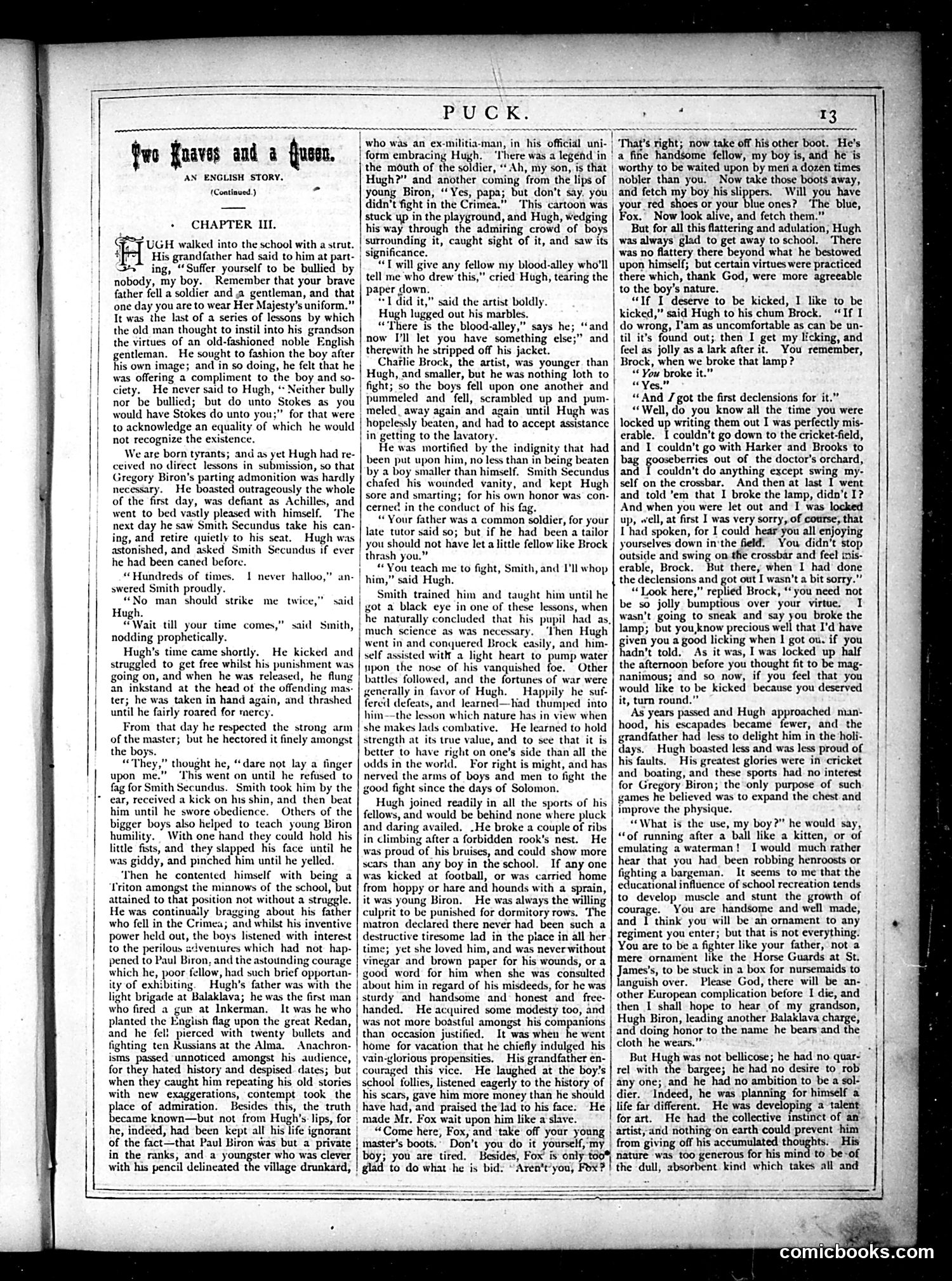
This page appears to be a serialized story titled "Two Knaves and a Queen: An English Story" (Chapter III), rather than a political cartoon. The text describes a narrative involving characters named Hugh, Smith, and Brock, discussing military training, social class distinctions, and personal honor among English soldiers and gentlemen. The story satirizes class differences in Victorian England—contrasting a working-class soldier (Hugh) with educated gentlemen (Smith, Brock), exploring themes of social mobility and respectability. References to cricket, military service, and social expectations reflect period concerns about English masculinity and class hierarchy. This appears to be serialized fiction rather than political satire focused on specific contemporary events or figures.
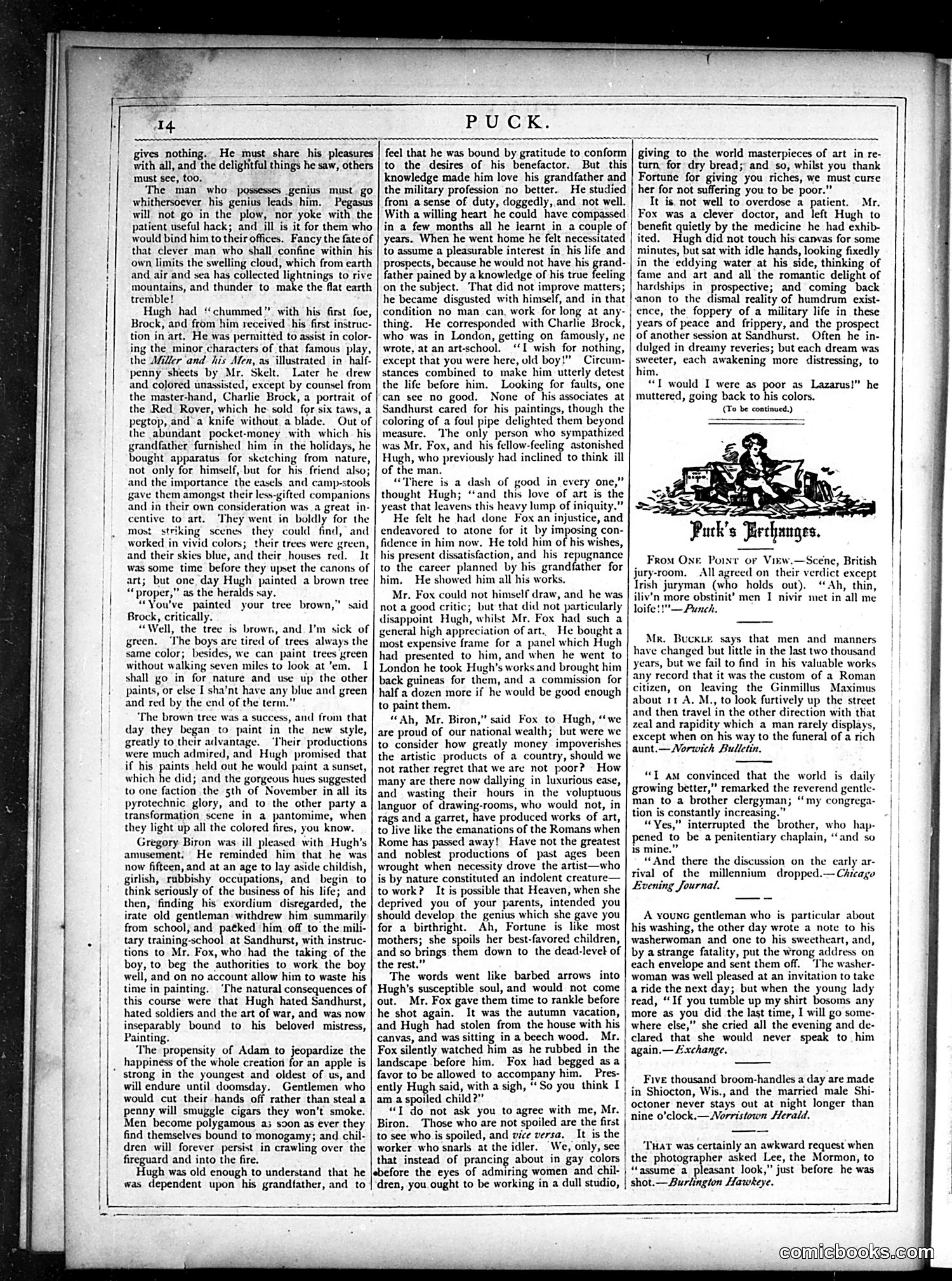
This page is primarily **text-based editorial content**, not a political cartoon. The main article discusses **Hugh**, an artist character who struggles with his grandfather's expectations and artistic integrity. The narrative criticizes those who prioritize commercial success over genuine artistic merit. The sidebar section titled "Puck's Jottings" contains brief social commentary items, including observations about: - Changing manners and customs over two thousand years - Artistic merit versus popular taste - A anecdote about a young gentleman's mishap with a washwoman The page appears to be **satirical social commentary** typical of Puck magazine's style—critiquing pretension, commercialism, and social hypocrisy through narrative and brief wit rather than visual caricature. No specific historical figures are identifiable from the visible content.
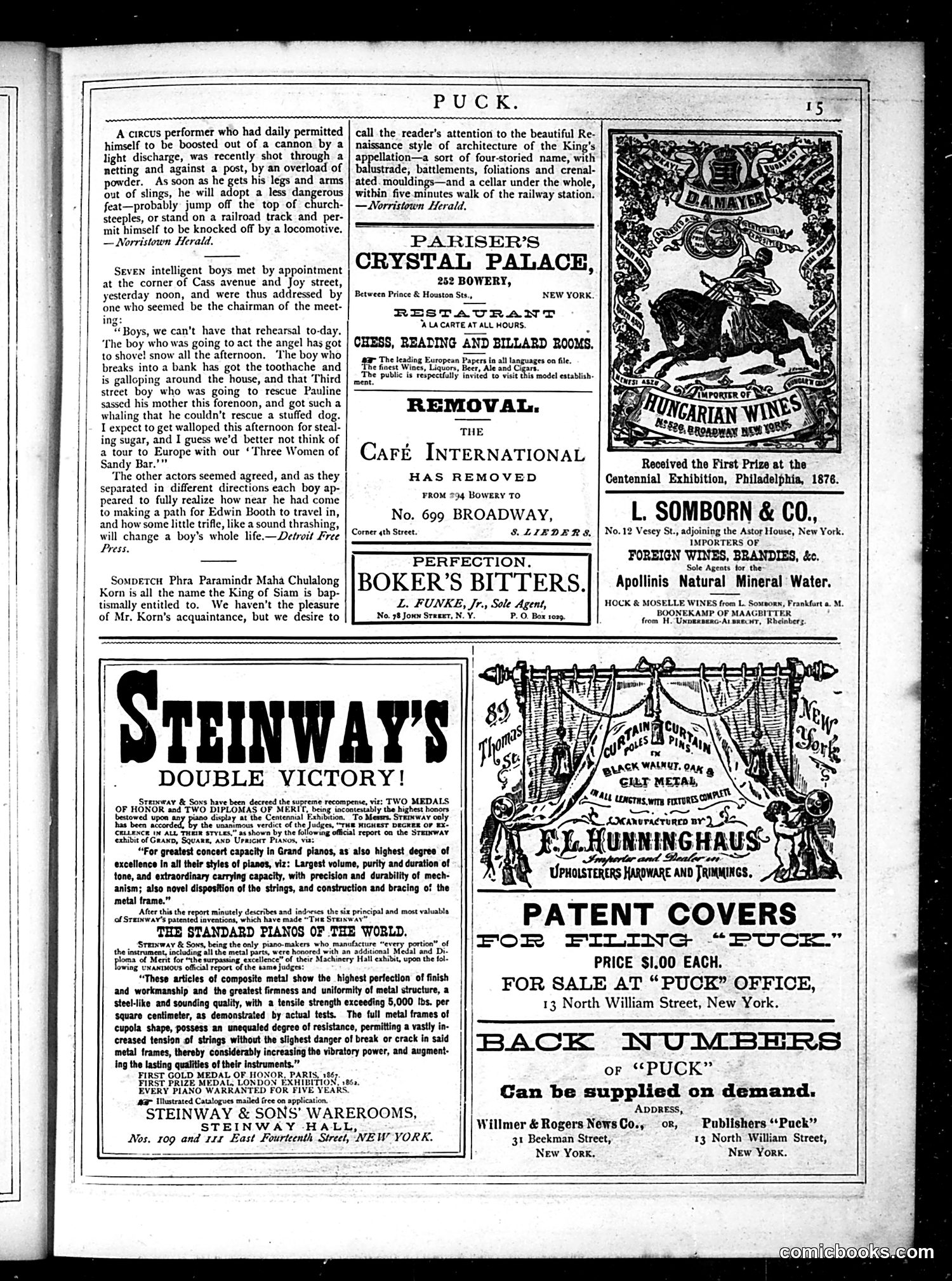
This page is primarily **advertising and announcements** rather than political cartoons. The content includes: - **Pariser's Crystal Palace** restaurant advertisement (New York) - **Café International** relocation notice to Broadway - **Boker's Bitters** product ad - **Steinway pianos** advertisement emphasizing their "Double Victory" at the Centennial Exhibition (1876) - **L. Hunninghaus** upholstery hardware company with decorative illustration - **Patent covers for Puck** magazine available for purchase The Steinway ad is the most substantive content, celebrating their prize-winning pianos and emphasizing American manufacturing quality and innovation—typical of Gilded Age advertising celebrating industrial achievement and international recognition. The page reflects late-19th-century Puck's business model: satire mixed with luxury goods advertising targeting affluent readers.
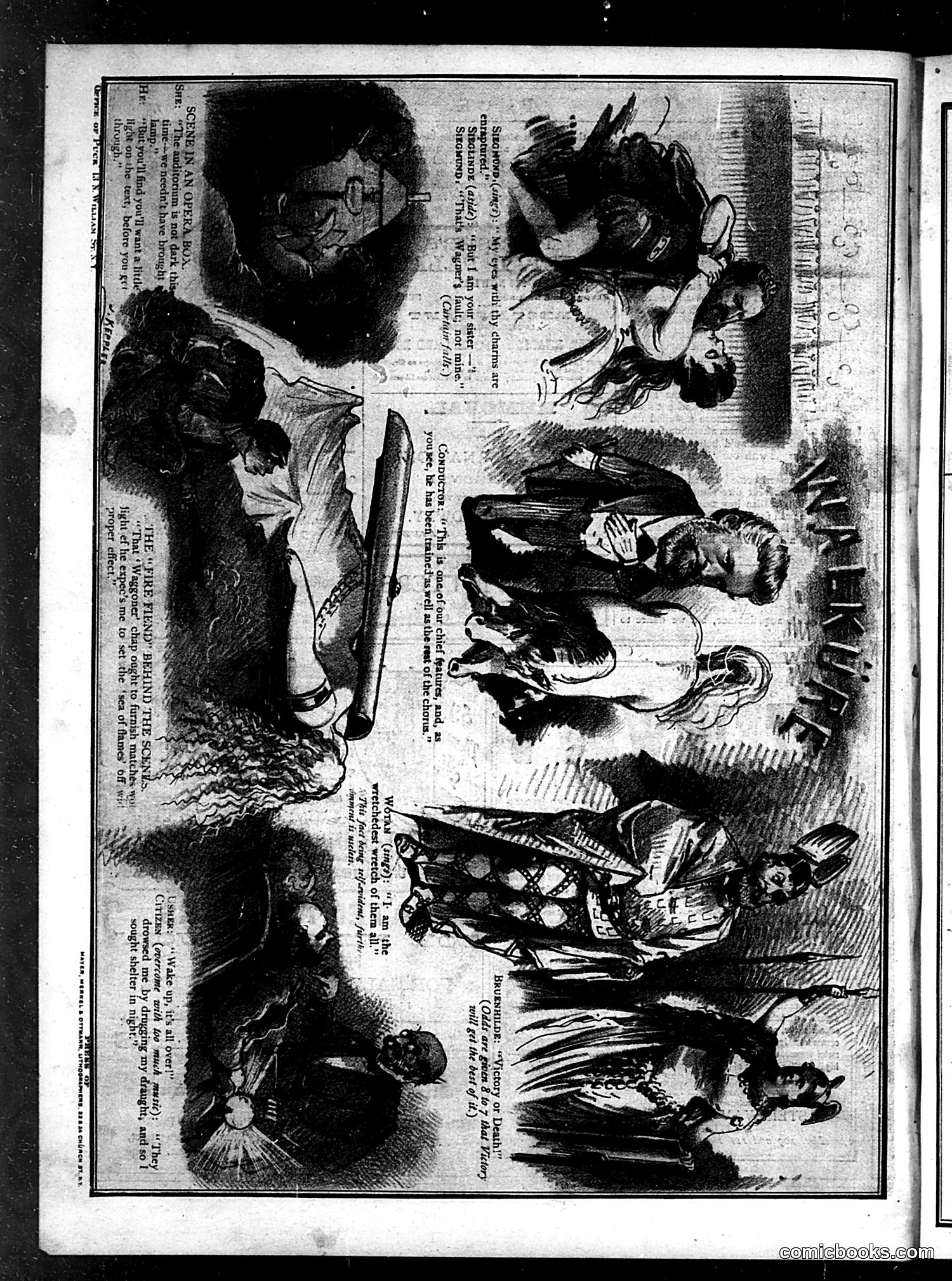
I can see this is a Puck magazine page with multiple satirical illustrations and dense text columns, but the image quality and orientation make it difficult to read the specific OCR text clearly or identify particular figures with certainty. The page appears to contain several cartoon vignettes with exaggerated character drawings typical of late 19th/early 20th-century American political satire. The style suggests commentary on contemporary politics or social issues, with caricatured figures in various scenes. However, without being able to reliably read the accompanying text or definitively identify the specific individuals depicted, I cannot accurately explain what political figures or events these cartoons reference or what satire they're making. To provide accurate historical context, I would need either clearer image resolution or confirmation of the publication date.