
Puck, 1877-04 · page 2 of 16
Puck — April 1877 — page 2: what you’re looking at
What you’re looking at
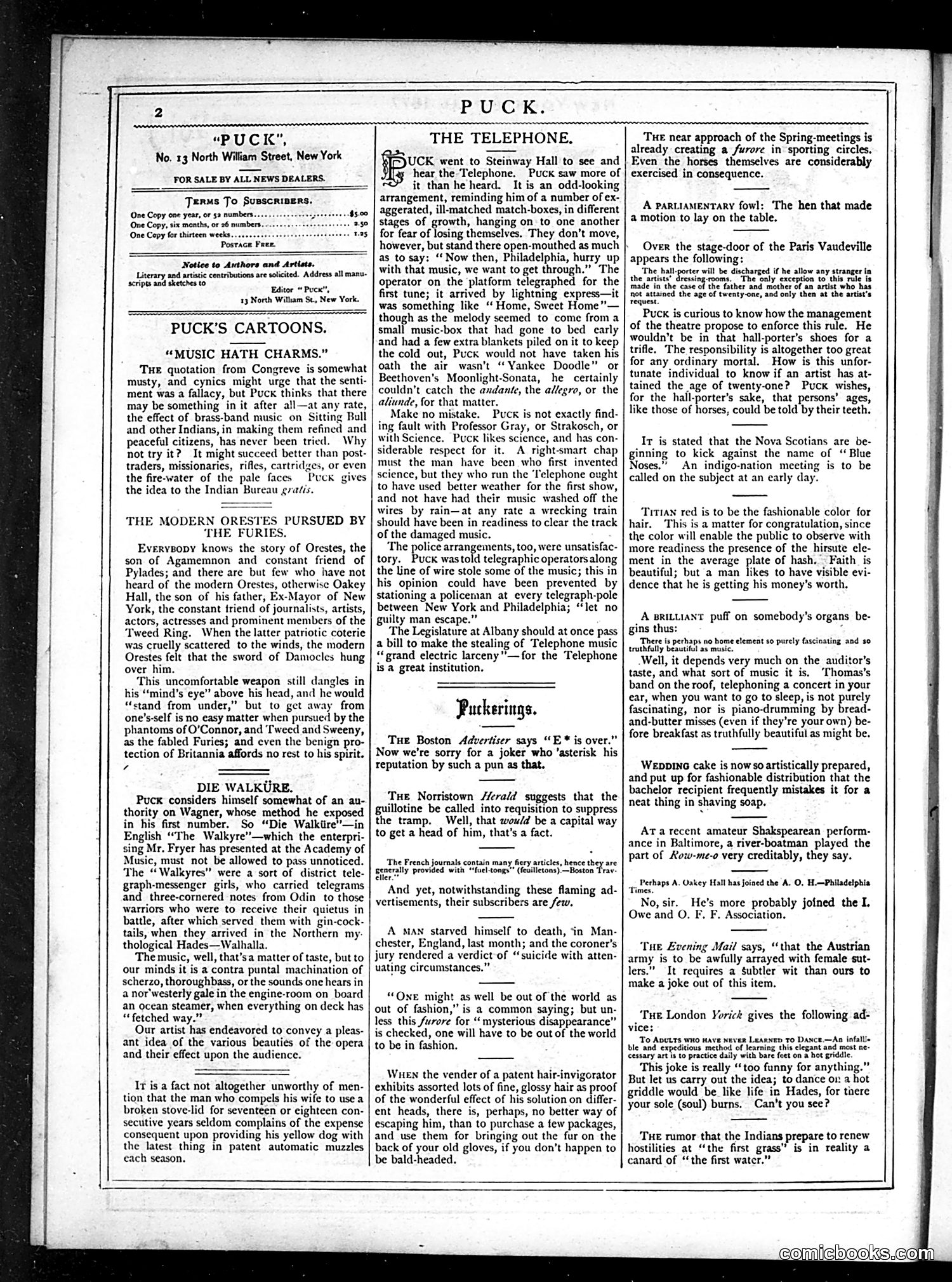
This page is primarily **text-based content rather than political cartoons**. It contains several short satirical articles and jokes typical of Puck's format: 1. **"Music Hath Charms"** - Satirizes a Philadelphia incident where the Telegraph office's music disturbed neighbors, mocking various proposed solutions (stationing policemen, replacing musicians). 2. **"The Modern Orestes"** - References the son of Agamemnon (Greek tragedy) to mock theatrical rivalries in New York's opera scene, suggesting dramatic family conflicts plague the stage. 3. **"Die Walkure"** - Critiques Wagner's opera's excessive length and technical complexity. The page also includes brief humorous observations about current events and social habits—typical Puck fare blending classical references with contemporary absurdities. **No identified political figures or major cartoon illustrations appear on this page.**
📄 Transcribed text from this page (OCR, searchable)
Machine-transcribed from the original scan — historical spelling and the odd misread are preserved.
PUCK. “PUCK”, No. 13 North William Street, New York FOR SALE BY ALL NEWS DEALERS. Terms To Supscri One Copy one year, or 52 numbers. One Copy, six months, or 26 n One Copy for thirteen weeks. Notice to Authors and Artists. Literary and artistic centributions are solicited. Address all manu- scripts and sketches to Editor “ Puck”, 13 North Wilham St, New York. PUCK’S CARTOONS. “MUSIC HATH CHARMS.” Tue quotation from Congreve is somewhat musty, and cynics might urge that the senti- ment was a fallacy, but Puck thinks that there may be something in it after all—at any rate, the effect of brass-band music on Sitting Bull and other Indians, in making them refined and peaceful citizens, has never been tried. Why not try it? It might succeed better than post- traders, missionaries, rifles, cartridges, or even the fire-water of the pale faces Puck gives the idea to the Indian Bureau gratis. THE MODERN ORESTES PURSUED BY ‘THE FURIES. Everyeopy knows the story of Orestes, the son of Agamemnon and constant friend of Pylades; and there are but few who have not heard of the modern Orestes, otherwise Oakey Hall, the son of his father, Ex-Mayor of New York, the constant friend of journalists, artists, actors, actresses and prominent members of the ‘Tweed Ring. When the latter patriotic coterie was cruelly scattered to the winds, the modern Orestes. felt that the sword of Damocles hung over him. This uncomfortable weapon still dangles in his “mind’s eye” above his head, and he would “stand from under,” but to get away from one’s-self is no easy matter when pursued by the phantoms of O'Connor, and ‘Tweed and Sweeny, as the fabled Furies; and even the benign pro- tection of Britannia affords no rest to his spirit. , DIE WALKURE. Puck considers himself somewhat of an au- thority on Wagner, whose method he exposed in his first number. So “Die Walkiire’—in English “The Walkyre’—which the enterpri- sing Mr. Fryer has presented at the Academy of Music, must not be allowed to pass unnoticed. The ‘Walkyres” were a sort of district tele- graph-messenger girls, who carried telegrams and three-cornered notes from Odin to those warriors who were to receive their quietus in battle, after which served them with gin-cock- tails, when they arrived in the Northern my- thological Hades—Walhalla. The music, well, that’sa matter of taste, but to our minds it is a contra puntal machination of scherzo, thoroughbass, or the sounds one hears in a nor'westerly gale in the engine-room on board an ocean steamer, when everything on deck has “fetched way.” Our artist has endeavored to convey a pleas- ant idea of the various beauties of the opera and their effect upon the audience. Tr is a fact not altogether unworthy of men- tion that the man who compels his wife to use a broken stove-lid for seventeen or cighteen con- secutive years seldom complains of the expense consequent upon providing his yellow dog with the latest thing in patent automatic muzzles each season. THE TELEPHONE, UCK went to Steinway Hall to see and hear the Telephone. Puck saw more of it than he heard. It is an odd-looking arrangement, reminding him of a number of ex- aggerated, ill-matched match-boxes, in different stages of growth, hanging on to one another for fear of losing themselves. They don’t move, however, but stand there open-mouthed as much as to say: “Now then, Philadelphia, hurry up with that music, we want to get through.” The operator on the platform telegraphed for the first tune; it arrived by lightning express— was something like ‘Home, Sweet Home though as the melody seemed to come from a small music-box that had gone to bed early and had a few extra blankets piled on it to keep the cold out, Puck would not have taken his oath the air wasn't ‘Yankee Doodle” or Beethoven's Moonlight-Sonata, he certainly couldn't catch the axdante, the allegro, or the aliunde, for that matter. Make no mistake. Puck is not exactly find- ing fault with Professor Gray, or Strakosch, or with Science. Puck likes science, and has con- siderable respect for it. A right-smart chap must the man have been who first invented science, but they who run the ‘Telephone ought to have used better weather for the first show, and not have had their music washed off the wires by rain—at any rate a wrecking train should have been in readiness to clear the track of the damaged music. The police arrangements, too, were unsatisfac- tory. Puce wastold telegraphic operators along the line of wire stole some of the music; this in his opinion could have been prevented by stationing a policeman at every telegraph-pole between New York and Philadelphia; ‘let no guilty man escape.” ‘The Legislature at Albany should at once pass a bill to make the stealing of Telephone music “grand electric larceny" —for the Telephone is a great institution. Puckerings. Tue Boston Advertiser says “E * is over.” Now we're sorry for a joker who ‘asterisk his reputation by such a pun as that. Tue Norristown Herald ests that the guillotine be called into requisition to suppress the tramp. Well, that wou/d be a capital way to get a head of him, that’s a fact. ‘The French journals contain many fiery articles, hence they are senerally provided with “fuel tongs” ((eilletons)'—Hoston ray And yet, notwithstanding these flaming ad- vertisements, their subscribers are few. A MAN starved himself to death, in Man- chester, England, last month; and the coroner’s jury rendered a verdict of “suicide with atten- uating circumstances.” “One might as well be out of the world as out of fashion,” is a common saying; but un- less this furore for “ mysterious disappearance” is checked, one will have to be out of the world to be in fashion. Wuen the vender of a patent hair-invigorator exhibits assorted lots of fine, glossy hair as proof of the wonderful effect of his solution on differ- ent heads, there is, perhaps, no better way of escaping him, than to purchase a few packages, and use them for bringing out the fur on the back of your old gloves, if you don’t happen to be bald-headed. Tue near approach of the Spring-meetings is already creating a furore in sporting circles. Even the horses themselves are considerably exercised in consequence. A PARLIAMENTARY fowl: The hen that made a motion to lay on the table. Over the stage-door of the Paris Vaudeville appears the following: “The hall-porter will be discharged if he allow any stranger in the artists’ dressing-rooms.. ‘The ‘only exception to this rule is made in the case of the father and mother of an artist who has ot attained the age of twenty-one, and only then at the artist's request. Puck is curious to know how the management of the theatre propose to enforce this rule. He wouldn’t be in that hall-porter’s shoes for a trifle, The responsibility is altogether too great for any ordinary mortal. How is this unfor- tunate individual to know if an artist has at- tained the age of twenty-one? Puck wishes, for the hall-porter’s sake, that persons’ ages, like those of horses, could be told by their teeth. Ir is stated that the Nova Scotians are be- ginning to kick against the name of “Blue Noses.” An indigo-nation meeting is to be called on the subject at an carly day. ‘Tittan is to be the fashionable color for hair. This is a matter for congratulation, since the color will enable the public to observe with more readiness the presence of the hirsute ele- ment in the average plate of hash. Faith is beautiful; but a man likes to have visible evi- dence that he is getting his money's worth. A pRILLIANT puff on somebody's organs be- gins thus: % ‘There is perhaps no home element so purely fascinating and so truthfully beautiful as music. Well, it depends very much on the auditor's taste, and what sort of music it is. ‘Thomas's band on the roof, telephoning a concert in your ear, when you want to go to sleep, is not purely fascinating, nor is piano-drumming by bread- and-butter misses (even if they’re your own) be- fore breakfast as truthfully beautiful as might be. Weppine cake is now so artistically prepared, and put up for fashionable distribution that the bachelor recipient frequently mistakes it for a neat thing in shaving soap. Ata recent amateur Shakspearean perform- ance in Baltimore, a river-boatman played the part of Kow-me-o very creditably, they say. opyhtihaps A. Oakey Hall has joined the A. 0, H.—Philadelphia mes. No, sir. He's more probably joined the I. Owe and O. F. F. Association. ‘Tue Evening Mail says, “that the Austrian army is to be awfully arrayed with female sut- lers.” It requires a Subtler wit than ours to make a joke out of this item. ‘THe London Yorick gives the following ad- vice: To Anvurs wno Have wever Leanwen ro Dance. —Aa infall'« ble and expeditious method of learning this elegant and mest ne- cessary artis to practice daily with bare feet on a het griddle ‘This joke is really “too funny for anything.” But let us carry out the idea; to dance o1: a hot griddle would be like life in Hades, for tere your sole (soul) burns. Can't you see? Tue rumor that the Indians prepare to renew hostilities at “the first grass” is in reality a canard of ‘the first water.””