
Puck, 1877-04 · page 6 of 16
Puck — April 1877 — page 6: what you’re looking at
What you’re looking at
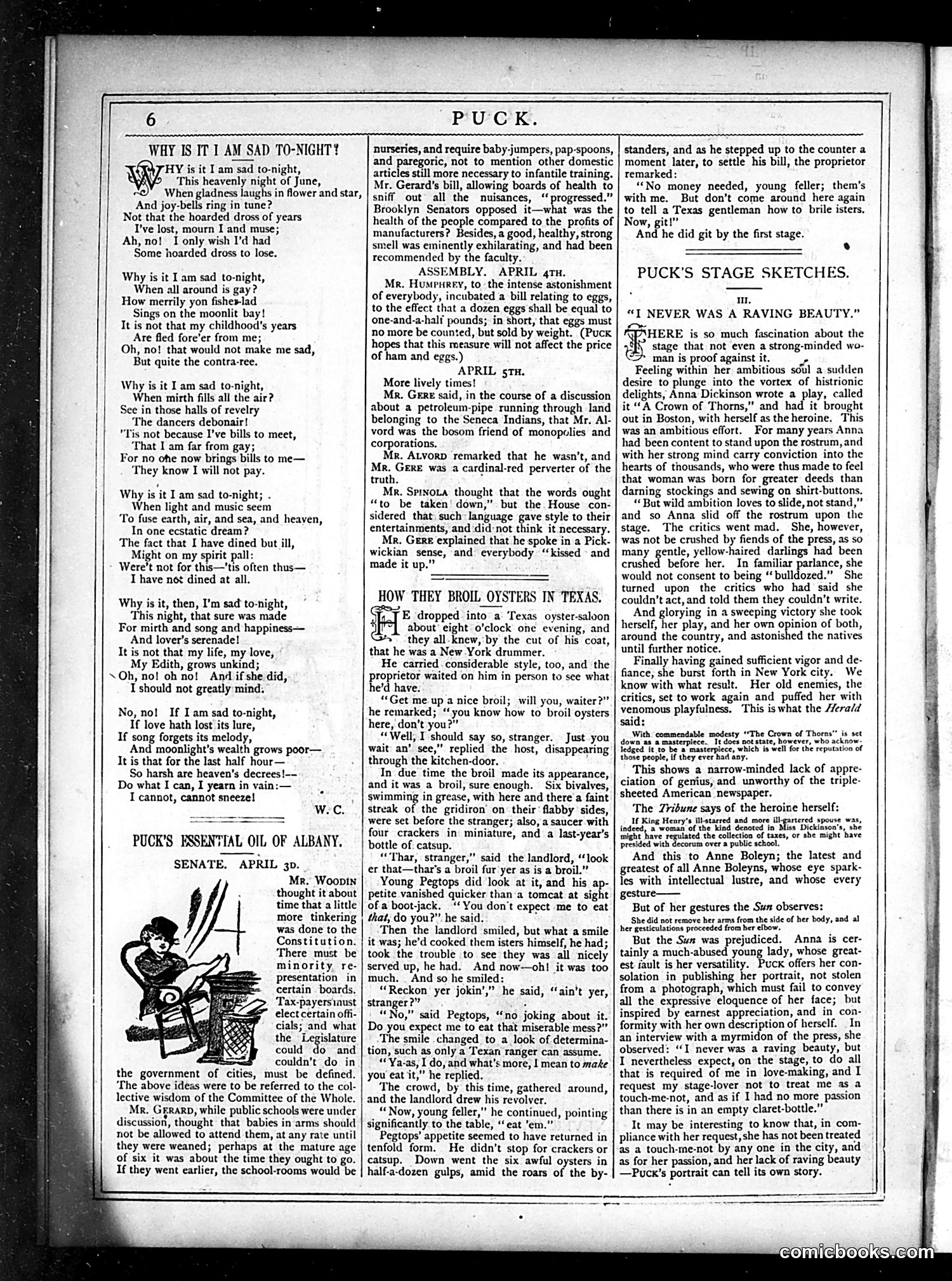
This page contains primarily **literary and social commentary** rather than political cartoons. The main content includes: 1. **"Why Is It I Am Sad To-Night?"** - A melancholic poem by W.C. about lost love and life's disappointments. 2. **"Puck's Stage Sketches"** - A theater review of Anna Dickinson's play "A Crown of Thorns," praising her ambitious dramatic work despite critical reception. The piece critiques those who dismissed her effort. 3. **"How They Broil Oysters in Texas"** - A humorous sketch depicting a Texas oyster-saloon scene with crude frontier characters and dialect humor, playing on regional stereotypes. 4. **"Puck's Essential Oil of Albany"** - A legislative satire about New York state politics discussing government structure and educational policy debates. The page reflects **late 19th-century Puck magazine**: mixing social satire with entertainment reviews and regional humor.
📄 Transcribed text from this page (OCR, searchable)
Machine-transcribed from the original scan — historical spelling and the odd misread are preserved.
6 PUCK. WAY IS IT 1 AM SAD TO-NIGHT? HY is it I am sad to-night, ‘This heavenly night of June, When gladness laughs in flower and star, And joy-bells ring in tune? Not that the hoarded dross of years T’ve lost, mourn I and muse; Ah, no! I only wish I’d had Some hoarded dross to lose. Why is it I am sad to-night, When all around is gay? How merrily yon fishes-lad Sings on the moonlit bay! It is not that my childhood’s years Are fled fore’er from me; Oh, no! that would not make me sad, But quite the contra-ree. Why is it Lam sad to-night, When mirth fills all the air? Sce in those halls of revelry he dancers debonair! ‘Tis not because I’ve bills to meet, ‘That I am far from gay; For no ohe now brings bills to me— ‘They know I will not pay. Why is it I am sad to-night; . When light and music seem To fuse earth, air, and sea, and heaven, In one ecstatic dream? The fact that I have dined but ill, Might on my spirit pall: Were't not for this—'tis often thus— T have nos dined at all. Why is it, then, I’m sad to-night, This night, that sure was made For mirth and song and happiness And lover's serenade! It is not that my life, my love, My Edith, grows unkind; Oh, no! oh no! And if she did, should not greatly mind. No, no! If I am sad to-night, If love hath lost its lure, If song forgets its melody, And moonlight’s wealth grows poor— It is that for the last half hour— So harsh are heaven’s decrees!-— Do what I can, I yearn in vain:— I cannot, cannot sneeze! W.C. PUCK’S ESSENTIAL OIL OF ALBANY, SENATE, APRIL 3p. Mr. Wooptn thought it about time that a little more tinkering was done to the Constitution. There must be minority, re- presentation in certain boards. Tax-payers aust elect certain offi- cials; and what the islature could do and couldn’t do in the government of cities, must be defined. ‘The above ideas were to be referred to the col- lective wisdom of the Committee of the Whole. Mr. Gerarb, while public schools were under discussion, thought that babies in arms should not be allowed to attend them, at any rate until they were weaned; perhaps at the mature age of six it was about the time they ought to go. If they went earlier, the school-rooms would be nurseries, and require baby-jumpers, aaa eset and as he stepped up to the counter a and paregoric, not to mention other domestic articles still more necessary to infantile training. Mr. Gerard's bill, allowing boards of health to sniff out all the nuisances, “progressed.” Brooklyn Senators opposed it—what was the health of the people compared to the profits of manufacturers? Besides, a good, healthy, strong smell was eminently exhilarating, and had been recommended by the faculty. ASSEMBLY. APRIL 4tTu. Mr. Humpueey, tothe intense astonishment of everybody, incubated a bill relating to eggs, to the effect that a dozen eggs shall be equal to one-and-a-half pounds; in short, that $ must no more be counted, but sold by weight. (Puck hopes that this measure will not affect the price of ham and eggs.) APRIL 5TH. More lively times! Mr. Gere said, in the course of a discussion about a petroleum-pipe running through land belonging to the Seneca Indians, that Mr. Al- vord was the bosom friend of monopolies and corporations. Mr. Atvorp remarked that he wasn’t, and Mr. Gere was a cardinal-red perverter of the truth. Mr. Spinoza thought that the words ought “to be taken! down,” but the. House con- sidered that. such language gave style to their entertainments, and did-not chink it necessary. Mr. Gere explained that he spoke in a Pick- wickian sense, and: everybody “kissed and made it up.” HOW THEY BROIL OYSTERS IN TEXAS. dropped into a ‘Texas oyster-saloon about eight o’clock one evening, and they all-knew, ‘by the cut of his coat, that he was a New York drummer. He carried considerable style, too, and the roprietor waited on him in person to sce what e'd have. “Get me up a nice broil; will you, waiter?” he remarked; ‘you know how to broil oysters here, don’t you?” “Well, I'should say so, stranger. Just you wait an’ see," replied the host, disappearing through the kitchen-door. In due time the broil made its appearance, and it was a broil, sure enough. Six bivalves, swimming in grease, with here and there’a faint streak of the gridiron’ on’ their’ flabby sides, were set before the stranger; also, a saucer with four crackers in miniature, and a last-year’s | bottle of. catsup. “Thar, stranger,” said. the landlord, “look er that—thar’s a broil fur yer as is a broil.” Young Pegtops did look at it, and his ap- petite vanished quicker than'a tomcat at sight of a boot-jack. ‘‘ You don’t expect me to eat that, do you?” he said. s Then the landlord smiled, but what a smile it was; he'd cooked them isters himself, he had; took the trouble to see they was all nicely served up, he had. And now—oh! it was too much. _ And so he smiled: “Reckon yer jokin’,” he said, “ain't yer, stranger?” s “No,” said Pegtops, “no joking about it. Do you expect me to eat that miserable mess?” ‘The smile changed to a look of determina- tion, such as only a Texan ranger can assume. “Ya-as, I do, and what’s more, | mean to make you eat it,” he replied. The crowd, by this time, gathered around, and the landlord drew his revolver. “Now, young feller,” he continued, pointing significantly to the table, “eat ’em.” Pegtops’ appetite seemed to have returned in tenfold form. He didn’t stop for crackers or catsup. Down went the six awful oysters in half-a-dozen gulps, amid the roars of the by- moment later, to settle his bill, the proprietor remarked: “No money needed, young feller; them’s with me. But don’t come around here again to tell a Texas gentleman how to brile isters. Now, git!” ‘And he did git by the first stage. PUCK’S STAGE SKETCHES. ml. “I NEVER WAS A RAVING BEAUTY.” = HERE is so much fascination about the res stage that not even a strong-minded wo- man is proof against it. o Feeling within her ambitious sdul a sudden desire to plunge into the vortex of histrionic delights, Anna Dickinson wrote a play, called it “A Crown of Thorns,” and had it brought out in Boston, with herself as the heroine. This was an ambitious effort. For many years Anna had been content to stand upon the rostrum, and with her strong mind carry conviction into the hearts of thousands, who were thus made to feel that woman was born for greater deeds than darning stockings and sewing on shirt-buttons. “But wild ambition loves to slide, not stand,” and so Anna slid off the rostrum upon the stage. The critics went mad. She, however, ‘was not be crushed by fiends of the press, as so many gentle, yellow-haired darlings had been crushed before her. In familiar parlance, she would not consent to being “bulldozed.” She turned upon the critics who had said she couldn’t act, and told them they couldn’t write. And glorying in a sweeping victory she took herself, her play, and her own opinion of both, around the country, and astonished the natives until further notice. Finally having gained sufficient vigor and de- fiance, she burst forth in New York city. We know with what result. Her old enemies, the critics, set to work again and puffed her with venomous playfulness. This iswhat the Hera/d said: With commendable modesty ‘The Crown of Thorns” is set down as a masterpiece. It does not state, however, who acknow- ledged it.to be a masterpiece, which is well for the reputation of those people, if they ever had any. This shows a narrow-minded lack of appre- ciation of genius, and unworthy of the triple- sheeted American newspaper. The Zribune says of the heroine herself: If King Henry's il-starred and more ill-gartered, spouse was, indeed, a'womaa of the Kind denoted in Miss Dickinson's, she might have regulated the collection of taxes, or she might have presided with im over a public school. And this to Anne Boleyn; the latest and greatest of all Anne Boleyns, whose eye spark- les with intellectual lustre, and whose every gesture—— But of her gestures the Sun observes: She did not remove her arms from the side of her body, and al her gesticulations proceeded from her elbow. But the Sun was prejudiced. Anna is cer- tainly a much-abused young lady, whose great- est jault is her versatility. Puck offers her con- solation in publishing her portrait, not stolen from a photograph, which must fail to convey all the expressive eloquence of her face; but inspired by earnest appreciation, and in con- formity with her own description of herself. In an interview with a myrmidon of the press, she observed: “I never was a raving beauty, but I nevertheless expect, on the stage, to do all that is required of me in love-making, and I request my stage-lover not to treat me as a touch-me-not, and as if I had no more passion than there is in an empty claret-bottle.”” It may be interesting to know that, in com- pliance with her request, she has not been treated as a touch-me-not by any one in the city, and as for her passion, and her lack of raving beauty —Pucx’s portrait can tell its own story. iComicbookssco