
Puck, 1877-04 · page 11 of 16
Puck — April 1877 — page 11: what you’re looking at
What you’re looking at
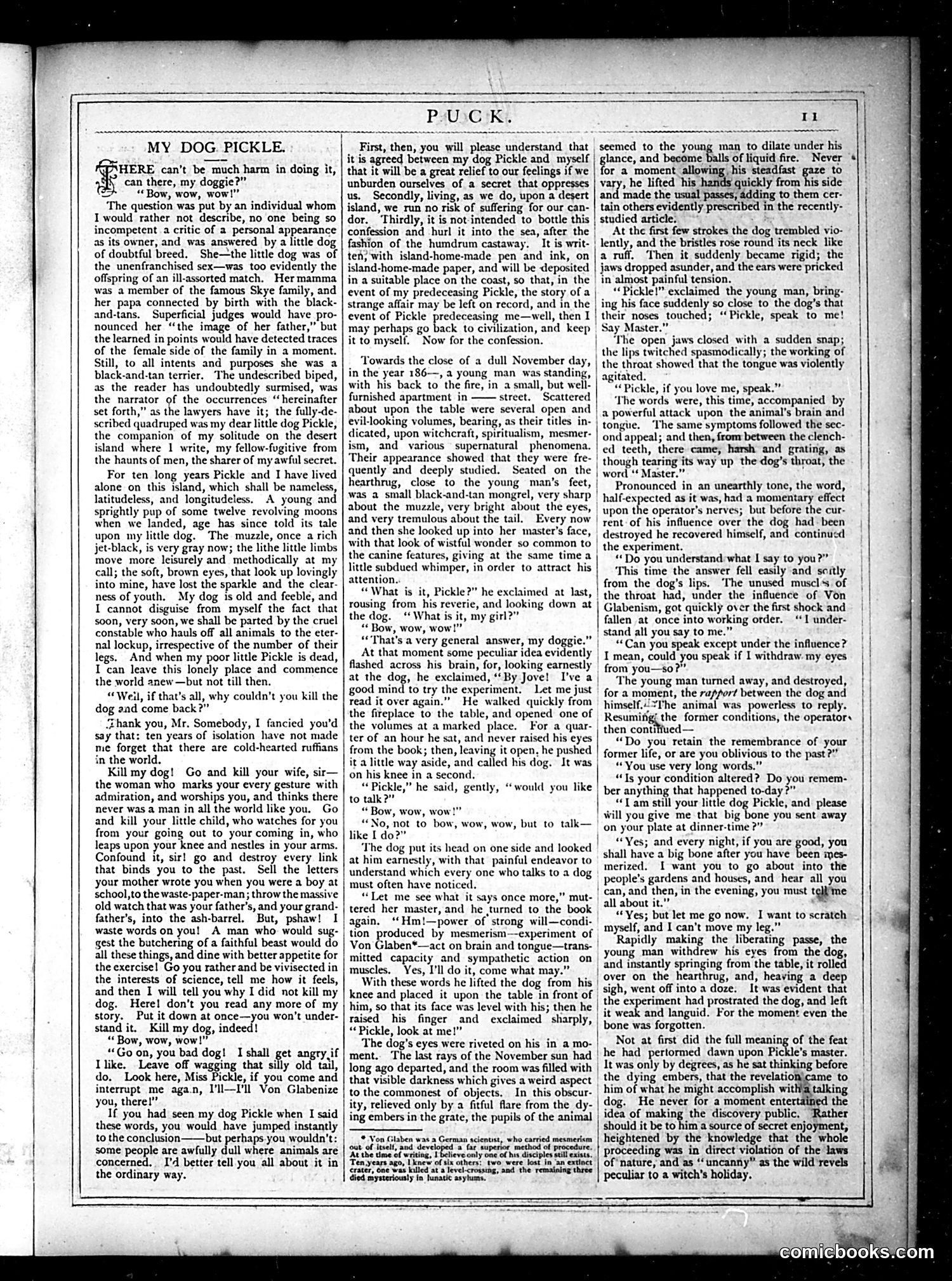
This page contains a short story rather than a political cartoon. The narrative describes a young man in November 1862 who discovers his dog "Pickle" possesses seemingly supernatural abilities — specifically, the animal can speak and appears to understand human language and thought. The story uses the dog as a vehicle for social satire, suggesting that even a dog's limited intelligence surpasses that of certain human authorities or public figures of the era. The repeated emphasis on the dog's unexpected capacities implies mockery of contemporary pseudoscience, spiritualism, and mesmerism fads that were popular during the Civil War period. The humor derives from treating an impossible premise (a talking dog) with complete seriousness, allowing Puck to satirize Victorian credulity toward paranormal claims.
📄 Transcribed text from this page (OCR, searchable)
Machine-transcribed from the original scan — historical spelling and the odd misread are preserved.
PUCK. MY DOG. PICKLE. HERE can’t be much harm in doing it, KY can there, my doggie?” “Bow, wow, wow!” ‘The question was put by an individual whom I would rather not describe, no one being so incompetent a critic of a personal appearance as its owner, and was answered by a little dog of doubtful breed. She—the little dog was of the unenfranchised sex—was too evidently the offspring of an ill-assorted match. Hermamma was a member of the famous Skye family, and her papa connected by birth with the black- and-tans. Superficial judges would have pro- nounced her ‘the image of her father,” but the learned in points would have detected traces of the female side of the family in a moment. Still, to all intents and purposes she was a black-and-tan terrier. The undescribed biped, as the reader has undoubtedly surmised, was the narrator of the occurrences “hereinafter set forth,” as the lawyers have it; the fully-de- scribed quadruped was my dear little dog Pickle, the companion of my solitude on the desert island where 1 write, my fellow-fugitive from the haunts of men, the sharer of my awful secret. For ten long years Pickle and I have lived alone on this island, which shall be nameless, latitudeless, and longitudeless. A young and sprightly pup of some twelve revolving moons when we landed, age has since told its tale upon my little dog. The muzzle, once a rich jet-black, is very gray now; the lithe little limbs move more leisurely and methodically at my call; the soft, brown eyes, that look up lovingly into mine, have lost the sparkle and the clear- ness of youth, My dog is old and feeble, and I cannot disguise from myself the fact that soon, very soon, we shall be parted by the cruel constable who hauls off all animals to the eter- nal lockup, irrespective of the number of their legs. And when my poor little Pickle is dead, I can leave this lonely place and commence the world anew —but not till then. “Weil, if that’s all, why couldn't you kill the dog and come back?” ‘Shank you, Mr. Somebody, I fancied you'd say that: ten years of isolation have not made me forget that there are cold-hearted ruffians in the world. Kill my dog! Go and kill your wife, sir— the woman who marks your every gesture with admiration, and worships you, and thinks there never was a man in all the world like you. Go and kill your little child, who watches for you from your going out to your coming in, who leaps upon your knee and nestles in your arms. Confound it, sir! go and destroy every link that binds you to the past. Sell the letters your mother wrote you when you were a boy at school,to the waste-paper-man ; throw the massive old watch that was your father’s, and your grand- father’s, into the ash-barrel. But, pshaw! I waste words on you! gest the butchering of a faithful beast would do all these things, and dine with better appetite for the exercise! Go you rather and be vivisected in the interests of science, tell me how it feels, and then I will tell you why I did not kill my dog. Here! don't you read any more of my story. Put it down at once—you won't under- stand it. Kill my dog, indeed! “Bow, wow, wow!” “Go on, you bad dog! I shall get angry if I like. Leave off wagging that silly old tail, do. Look here, Miss Pickle, if you come and interrupt me aga.n, I’ll—I’ll Von Glabenize you, there!” If you had seen my dog Pickle when I said these words, you would have jumped instantly to the conclusion——but perhaps.-you wouldn't: some people are awfully dull where animals are concerned. I'd better tell you all about it in the ordinary way. | again. A man who would sug- | First, then, you will please understand that it is agreed between my dog Pickle and myself that it will be a great relief to our feelings if we unburden ourselves of a secret that oppresses us, Secondly, living, as we do, upon a desert island, we run no risk of suffering for our can- dor. fashion of the humdrum castaway. It is writ- ten; with island-home-made pen and ink, on island-home-made paper, and will be deposited in a suitable place on the coast, so that, in the event of my predeceasing Pickle, the story of a strange affair may be left on record, and in the event of Pickle redeceasing me—well, then I may perhaps go Back to civilization, and keep it to myself. Now for the confession. ‘Towards the close of a dull November day, in the year 186—, a young man was standing, with his back to the fire, in a small, but well- furnished apartment in street, Scattered about upon the table were several open and | evil-looking volumes, bearing, as their titles in- dicated, upon witchcraft, spiritualism, mesmer- ism, and various supernatural phenomena. Their appearance showed that they were fre- quently and deeply studied. Seated on the hearthrug, close to the young man’s feet, was a small black-and-tan mongrel, very sharp about the muzzle, very bright about the eyes, and very tremulous about the tail. and then she looked up into her master’s face, with that look of wistful wonder so common to the canine features, giving at the same time a little subdued whimper, in order to attract his attention.. “What is it, Pickle?” he exclaimed at last, rousing from his reverie, and looking down at the dog. ‘* What is it, my girl?” “Bow, wow, wow!” “That's a very general answer, my doggie.” At that moment some peculiar idea evidently flashed across his brain, for, looking earnestly at the dog, he exclaimed, “By Jove! I’ve a good mind to try the experiment. Let me just read it over again.” He walked quickly from the fireplace to the table, and opened one of the volumes at a marked place. For a quar- ter of an hour he sat, and never raised his eyes from the book; then, leaving it open, he pushed it a little way aside, and called his dog. It was on his knee in a second, “Pickle,” he said, gently, “would you like to talk?” “Bow, wow, wow!” “No, not to bow, wow, wow, but to talk— like I do?” ‘The dog put its head on one side and looked at him earnestly, with that painful endeavor to understand which every one who talks to a dog must often have noticed. “Let me see what it says once more,” mut- tered her master, and he turned to the book in, “Hm!—power of’ strong will—condi- tion produced by mesmerism—experiment of Von Glaben*—act on brain and tongue—trans- mitted capacity and sympathetic action on muscles. Yes, I'll do it, come what may.” With these words he lifted the dog from his knee and placed it upon the table in front of him, so that its face was level with his; then he raised his finger and exclaimed sharply, “Pickle, look at me!” The dog's eyes were riveted on his in a mo- ment.. The last rays of the November sun had long ago departed, and the room was filled with that visible darkness which gives a weird aspect to the commonest of objects. In this obscur- ity, relieved only by a fitful flare from the. dy- ing embers in the grate, the pupils of the animal * Von Glaben was a German scientist, who carried mesmerismn out of itself, and developed a far superior method of ure. ‘At the time of writing, I believe only one of his disciples still exists. Ten,years ago, Iknew of six others: two. were lost in ‘an extinct rater, One was lulled at a level-crossing, and the remaining three ied mysteriously in hunatic asylums. Thirdly, it is not-intended to bottle this | confession and hurl it into the sea, after the | Every now | It seemed to the young man to dilate under his | glance, and become of liquid fire. Never for a_ moment allowing. his steadfast gaze to vary, he lifted his hands quickly from his side and. made the usual passes, adding to them cer- tain others evidently prescribed in the recently- studied article, At the first few strokes the dog trembled vio- | lently, and the bristles rose round its neck like a ruff, Then it suddenly became rigid; the jaws dropped asunder, and the ears were pricked in almost painful tension. “Pickle!” exclaimed the young man, bring- | ing his face suddenly so close to the dog’s that | their noses touched; ‘Pickle, speak to me! Say Master.” | ‘The open jaws closed with a sudden snap; the lips twitched spasmodically; the working of | the throat showed that the tongue was violently agitated. “Pickle, if you love me, speak.” ‘The words were, this time, accompanied by a powerful attack upon the animal’s brain and tongue. ‘The same symptoms followed the sec- ond appeal; and then, from between the clench- ed teeth, there came, harsh and grating, as | though tearing its way up the dog’s throat, the | word ‘* Master.” | Pronounced in an unearthly tone, the word, half-expected as it was, had a momentary effect upon the operator's nerves; but before the cur- rent of his influence over the dog had- been destroyed he recovered himself, and continued | the experiment. “Do you understand: what I say to you?” | This time the answer fell easily and scitly | from the dog's lips. ‘The unused muscl sof the throat had, under the influence of Von Glabenism, got quickly over the first shock and fallen at once into working order. ‘1 under- stand all you say to me.” “Can you speak except under the influence? I mean, could you speak if I withdraw: my eyes from you—so?”” The young man turned away, and destroyed, for a moment, the raffort between the dog and himself..7Phe animal was powerless to reply. Resumingi the former conditions, the operators then contifiued— “Do you retain the remembrance of your former life, or are you oblivious to the past ?"” “You use very long words.” “Js your condition altered? Do you remem- ber anything that happened to-day?” “Tam still your little dog Pickle, and please will you give me that big bone you sent away on your plate at dinner-time ?” “Yes; and every night, if you are good, you shall have a big bone after you have been mes- merized. I want you to go about into the people’s gardens and houses, and hear all you can, and then, in the evening, you must telk'me all about it."” “4 “Yes; but let me go now. I want to scratch myself, and I can’t move my leg.” Rapidly making the liberating passe, the young man withdrew his eyes from the dog, and instantly springing from the table, it rolled over on the hearthrug, and, heaving a deep sigh, went off into a doze. It was evident that | the Specaent had prostrated the dog, and left | it weak and languid. For the moment even the | bone was forgotten. Not at first did the full meaning of the feat |he had pertormed dawn upon Pickle’s master. It was only by degrees, as he sat thinking before the dying embers, that the ish ia to him of what he might accomplish witha talking | dog. He never for a moment entertained the idea of seeking the discovery public, “Rather should it be to hima source of secret enjoyment, heightened by the knowledge that the whole proceeding was in direct violation of the laws icomicbooks*e: of’ nature, and as “uncanny” as the wild revels peculiar to a witch's holiday. } om