
Puck, 1877-04 · page 3 of 16
Puck — April 1877 — page 3: what you’re looking at
What you’re looking at
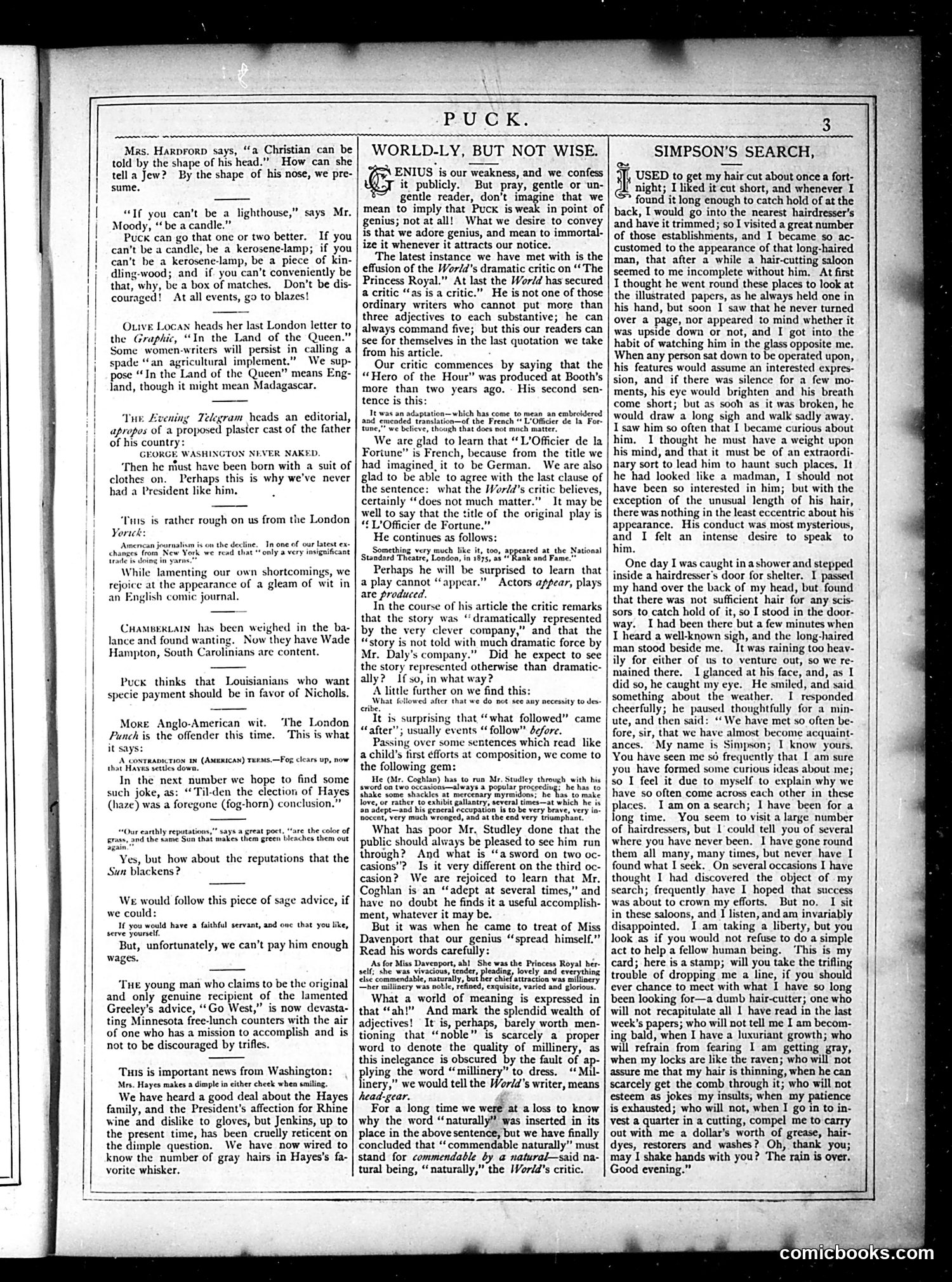
This page contains editorial commentary and humorous anecdotes rather than cartoons. The main satirical content includes: **"World-ly, But Not Wise"** critiques a dramatic critic's review of "The Princess Royal" at the World newspaper, mocking the critic's overwrought analysis and pretentious language. Puck suggests the critic mistakes verbosity for genuine insight. **"Simpson's Search"** is a lengthy anecdote about a man obsessively studying another's hair-cutting habits, finding nothing exceptional. The piece satirizes obsessive curiosity and the human tendency to read significance into trivial observations. The page also contains brief jokes mocking Louisiana voters' payment demands and Anglo-American cultural differences. The content reflects Puck's editorial voice: witty, skeptical of pretension, and focused on everyday absurdities rather than specific political figures.
📄 Transcribed text from this page (OCR, searchable)
Machine-transcribed from the original scan — historical spelling and the odd misread are preserved.
PUCK. Mas. Harprorp says, “a Christian can be told by the shape of his head.” How can she tella Jew? By the shape of his nose, we pre- sume. “If you can't be a lighthouse,” says Mr. Moody, ‘be a candle.” Puck can go that one or two better. If you can't be a candle, be a kerosene-lamp; if you can’t be a kerosene-lamp, be a piece of kin- dling-wood; and if you can’t conveniently be that, why, be a box of matches. Don’t be dis- couraged! At all events, go to blazes! Ouive Locan heads her last London letter to the Graphic, “In the Land of the Queen.” Some women-writers will persist in calling a spade “an agricultural implement.” We sup- pose “In the Land of the Queen” means Eng- Jand, though it might mean Madagascar. ‘Tur Evening Telegram heads an editorial, apropos of a proposed plaster cast of the father of his country: GEORGE WASHINGTON NEVER NAKED ‘Then he niust have been born with a suit of clothes on. Perhaps this is why we've never had a President like him, ‘lis is rather rough on us from the London Yoruch: .cnican joarnalicm is on the decline, Tn one of our latest ex- we read that “only a very insignificant While lamenting our own shortcomings, we rejoice at the appearance of a gleam of wit in an English comic journal. CHAMBERLAIN has becn weighed in the ba- lance and found wanting. Now they have Wade Hampton, South Carolinians are content. Puck thinks that Louisianians who want specie payment should be in favor of Nicholls. ‘The London More Anglo-American wit. This is what Punch is the offender this time. it says: A CONTRADICTION IN (AMERICAN) THEMS.—Fog clears up, now that Haves settles down. In the next number we hope to find some such joke, as: “Til-den the clection of Hayes (haze) was a foregone (fog-horn) conclusion.” “Que earthly reputations,"" says a great poet, “tare the color of grass, and the same Sun that makes them green bleaches them out Yes, but how about the reputations that the Sun blackens? We would follow this piece of sage advice, if we could: If you would have a faithful servant, apd one that you like, serve yourself But, unfortunately, we can’t pay him enough wages. ‘Tne young man who claims to be the original and only genuine recipient of the lamented Greeley’s advice, ‘‘Go West,” is now devasta- ting Minnesota free-lunch counters with the air of one who has a mission to accomplish and is not to be discouraged by trifles. Tuus is important news from Washington: Mrs. Hayes makes a dimple in either cheek when smiling. We have heard a good deal about the Hayes family, and the President's affection for Rhine wine and dislike to gloves, but Jenkins, up to the present time, has been cruelly reticent on the dimple question. We have now wired to know the number of gray hairs in Hayes’s fa- vorite whisker. WORLD.-LY, BUT NOT WISE. ENIUS is our weakness, and we confess J it publicly, But pray, gentle or un- gentle reader, don’t imagine that we mean to imply that Puck is weak in point of genius; not at all! What we desire to convey. is that we adore genius, and mean to immortal- ize it whenever it attracts our notice. The latest instance we have met with is the effusion of the World's dramatic critic on ‘The Princess Royal.” At last the World has secured a critic ‘as is a critic.” He is not one of those ordinary writers who cannot put more than three adjectives to each substantive; he can always command five; but this our readers can see for themselves in the last quotation we take from his article. Our critic commences by saying that the “Hero of the Hour” was produced at Booth’s more than two years ago. His second sen- tence is this: Tt was an adptation—which has come to mean an embroidered and emeaded translation—of the French * L’Officer de la For- tune,"” we believe, though that does pot mach matter, We are glad to learn that “ L’Officier de la Fortune” is French, because from the title we had imagined, it to be German. We are also glad to be able to agree with the last clause of the sentence: what the MWor/d’s critic believes, certainly “does not much matter.” It may be well to say that the title of the original play is “{L’Officier de Fortune.” He continues as follows: Something very much like it, too, appeared at_the National Standard Theatre, London, in 1875, a8 “* Rank and Fame.”* Perhaps he will be surprised to learn that a play cannot “appear.” Actors appear, plays are produced. In the course of his article the critic remarks that the story was ‘dramatically represented by the very clever company,” and that the “story is not told with much dramatic force by Mr. Daly’s company.” Did he expect to see the story represented otherwise than dramatic- ally? ifso, in what way? A little further on we find this: What fellowed after that we do not see any necessity to dex: eri It is surprising that “what followed” came “after”; usually events “ follow” before. Passing over some sentences which read like a child’s first ¢fforts at composition, we come to the following gem: He (Mr. Coghlan) has to run Mr. Studley through with his sword oa two occasions—always a popular proceeding: he shake some shackles at mercenary myrmidons; he love, or rather to exhibit gallantry, several times—at an adept—and his general eccupation is to be very brave, very in- oceat, very much wronged, and at the end very triumphant. What has poor Mr, Studley done that the public should always be pleased to see him run through? And what is “a sword on two oc- casions’”? Is it very different on the third oc- casion? We are rejoiced to learn that Mr. Coghlan is an ‘adept at several times,” and have no doubt he finds it a useful accomplish- ment, whatever it may be. But it was when he came to treat of Miss Davenport that our genius “spread himself.” Read his words carefully: As for Miss Davenport, ah! She was the Princess Royal her- self; she was vivacious, tender, pleading, lovely and everything ‘lie commendable, naturally, but her chief attraction was millinery Sher millinery was potle, refined, exquisite, varied and glorious. What a world of meaning is expressed in that “ah!” And mark the splendid wealth of adjectives! It is, perhaps, barely worth men- tioning that “noble” is scarcely a proper word to denote the quality of millinery, as this inelegance is obscured by the fault of ap- lying the word “millinery” to dress.“ Mil- finery,’” we would tell the Morda’s writer, means head-gear. ¢ For a long time we were at a loss to know why the word “naturally” was inserted in its place in the above sentence, but we have finally concluded that ‘‘ commendable naturally” must stand for commendable by a natural—said na- tural being, “naturally,” the World's critic. SIMPSON’S SEARCH, c= USED to pet my hair cut about once a fort- night; I liked it cut short, and whenever I found it long enough to catch hold of at the back, I would go into the nearest hairdresser’s and have it trimmed; so I visited a great number of those establishments, and I became so ac- customed to the appearance of that long-haired man, that after a while a hair-cutting saloon seemed to me incomplete without him. At first I thought he went round these places to look at the illustrated papers, as he always held one in his hand, but soon I saw that he never turned over a page, nor appeared to mind whether it was upside down or not, and I got into the habit of watching him in the glass opposite me. When any person sat down to be operated upon, his features would assume an interested expres- sion, and if there was silence for a few mo- ments, his eye would brighten and his breath come short; but as sooh as it was broken, he would draw a long sigh and walk sadly away. I saw him so often that I became curious about him. I thought he must have a weight upon his mind, and that it must be of an extraordi- nary sort to lead him to haunt such places, It he had looked like a madman, I should not have been so interested in him; but with the exception of the unusual length of his hair, there was nothing in the least eccentric about his appearance. His conduct was most mysterious, and I felt an intense desire to speak to him. One day I was caught ina shower and stepped inside a hairdresser’s door for shelter. I passed my hand over the back of my head, but found that there was not sufficient hair for any scis- sors to catch hold of it, so I stood in the door- way. I had been there but a few minutes when I heard a well-known sigh, and the long-haired man stood beside me. It was raining too heav- ily for cither of us to venture out, so we re- mained there. I glanced at his face, and, as I did so, he caught my eye. He smiled, and said something about the weather. I responded cheerfully; he paused thoughtfully for a min- ute, and then said: ‘‘ We have met so often be- fore, sir, that we have almost become acquaint- ances. "My name is Simpson; I know yours. You have seen me so frequently that I am sure you have formed some curious ideas about me; so I feel it due to myself to explain why we have so often come across each other in these laces. I am ona search; I have been for a long time. You seem to visit a large number of fairdressers, but I could tell you of several where you have never been. I have gone round them all many, many times, but never have I found what I seek. On several occasions I have thought I had discovered the object of my search; frequently have I hoped that success was about to crown my efforts. But no. I sit in these saloons, and J listen, and am invariably disappointed. I am taking’a liberty, but you look as if you would not refuse to do a simple act to help a fellow human being. ‘This is my card; here is a stamp; will you take the trifling trouble of dropping me a line, if you should ever chance to mect with what I have so long been looking for—a dumb hair-cutter; one who will not recapitulate all I have read in the last week's papers; who will not tell me I am becom- ing bald, when I have a luxuriant growth; who will refrain from fearing I am getting gray, when my locks are like the raven; who will not assure me that my hair is thinning, when he can scarcely get the comb through it; who will not esteem as jokes my insults, when my patience is exhausted; who will not, when I go in to in- vest a quarter in a cutting, compel me to carry out with me a dollar’s worth of grease, hair- dyes, restorers and washes? Oh, thank you; may I shake hands with you? The rain is over. Good evening.”