
Puck, 1877-04 · page 10 of 16
Puck — April 1877 — page 10: what you’re looking at
What you’re looking at
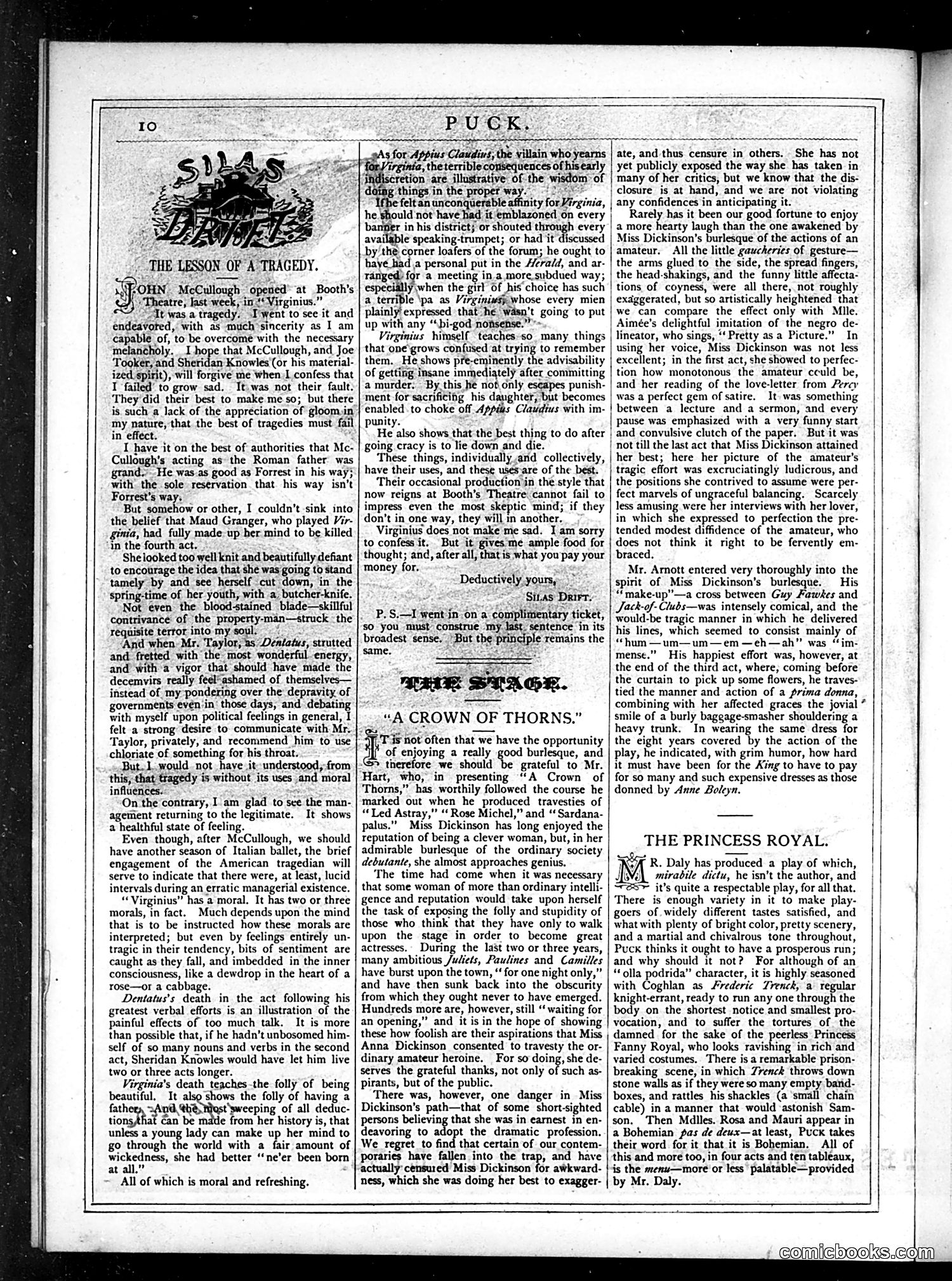
This page consists primarily of **theatrical criticism and drama review**, not political satire. The main content includes: 1. **"The Lesson of a Tragedy"** - A review of John McCullough's performance in *Virginia* at Booth's Theatre, praising the actor's intensity and the play's moral lessons about restraint and propriety. 2. **"A Crown of Thorns"** - A review of a theatrical production, complimenting the playwright Hart for following precedent with works like *Led Astray* and *Sardanapalus*, while noting the play exposes "the folly and stupidity" of society. 3. **"The Princess Royal"** - A favorable review of a play featuring Fanny Davenport in a "breaking scene." The page represents **Puck's arts criticism section** rather than political cartooning. It reflects Victorian-era theatrical concerns about morality, propriety, and dramatic merit.
📄 Transcribed text from this page (OCR, searchable)
Machine-transcribed from the original scan — historical spelling and the odd misread are preserved.
g THE LESSON OF A“TRAGEDY. go McCullough opened at Boot’ r ingtVirginius.” At was a tragedy, .T'went to see it and endeavored, with as much*sincerity as I am ¢apable of, to be overcome with the necessary melancholy. I hope that McCullough, and Joe Tooker, and Sheridan Knowles (or his material- ized spirit), will forgive me when I confess that I failed’ to grow sad. It. was not their fault. They'did their best to make me so; but there is such a lack of the appreciation of gloom.in my nature, that the best of tragedies must fail in effect. K I have it on the best of authorities that Mc- Cullough’s acting as the Roman father was grand.’-He was.as good as Forrest in his way} with: the sole reservation that his way isn’t Forrest’s ways But somehow or other, I couldn’t sink into the belief that Maud Granger, who played Vir- giia, had fully made-up her mind to be killed “in the fourth act. She looked too well knit and beautifully defiant to encourage the idea that she was’going to stand tamely by and see herself cut down, in the spring-time of her youth, with a, butcher-knife. Not éven the blood-stained blade—skillful contrivance of ‘the property-man—struck «the requisite tertor into my soul; { ‘And when Mr. Taylor, 3s‘ Dentatus, strutted and. fretted with ‘the most wonderful.-energy, and with a vigor that should have made the decemvirs really feélashamed of themselves— instead of. my-pondering over the: depravity of governments even‘in’ those days, and debating with myself upon political feelings in general, I felt a strong desire to communicate with Mr. Taylor, privately, and recommend him to use chloriate of something for his throat. But..1..would not have it: understood,:from this, that tragedy is without its uses and moral influences. On the contrary, I am glad to see the man- agement returning to the legitimate. It shows a healthful state of feeling. Even though, after McCullough, we should have another season of Italian ballet, the brief engagement of the American tragedian will serve to indicate that there were, at least, lucid || intervals during an erratic managerial existence. | “Virginius” has a moral. It has two or three morals, in fact. Much depends upon the mind that is to be instructed how these morals are interpreted; but even by feelings entirely un- tragic in their tendency, bits of sentiment are caught as they fall, and imbedded in the inner consciousness, like a dewdrop in the heart of a rose—or a cabbage. Dentatus’s death in the act following his greatest verbal efforts is an illustration of the painful effects of too much talk. It is more than possible that, if he hadn’t unbosomed him- self of so many nouns and verbs in the second act, Sheridan Knowles would have let him live two or three acts longer. Virginia’s death teaches-the folly of being beautiful. It als shows the folly of having a fathe Seawe) sweeping of all deduc- tionsAha éan be le from her history is, that unless a young lady can make up her mind to go through the world with a fair amount of wickedness, she had better ‘‘ne’er been born at all.” . All of which is moral and refreshing. iS datng pelnde the enible a f his earl) inta, the terrible consequences of hisearly retion “are. illustrative. of-the wisdom: of things in the proper way. i feltenuncontderble nity for Virginia, he Should not have had it emblazoned on every banger in his district; or shouted ¢! ch every available speaking-trumpet; or had it discussed by/the: corner loafers of the forum; he ought to haye_had a personal put in the Hera/d, and ar- ranged) for a meeting ina more,subdued way; especiallyiwhen the girl of his‘ choice has such a terrible \pa as Virgininsywhose every mien plainly! expressed that he ‘wasn’t going to put up with any ‘“bi-god nofsense.””’~ Virginius hitoself teaches-so_ many things that one'grows confused at trying to remember them. He shows pre-eminently the advisability of getting’insane immediately after committing a murder. By. this he not only es¢apes punish- ment for sacrificing his daughter, but becomes enabled. to choke off Appius Claudius with im- punity. 2 He also shows that the best thing to do after going cracy is to lie down and die. ‘These things, individually and collectively, have their uses, and these uses.are of the best. Their occasional production in the style that now reigns at Booth’s Theatre cannot fail to impress even the most skeptic mind; if they don’t in one way, they will in another. Virginius does not make me sad. I am sorry to confess it. But it gives me ample food for thought; and, after all, thatis what you’pay your money for. Deductively yours, )> renee “=~ -Sitas Drirt. P, S.—I went in.on a complimentary ticket, ‘so you ‘must’ construe ‘my last. sentence ‘in its broadest sense. /But the principle remains the same. Sere oe) «A CROWN OF THORNS.” pee often that we have the opportunity of enjoying a really good burlesque, and therefore we should grateful to Mr. Hart, who, in presenting “A Crown of Thorns,” has worthily followed the course he marked out when he produced travesties of “Led Astray,” ‘‘ Rose Michel,” and “ Sardana- palus.” Miss Dickinson has long enjoyed the reputation of being a clever woman, but, in her admirable burlesque of the ordinary society debutante, she almost approaches genius. The time had come when it was necessary that some woman of more than ordinary intelli- gence and reputation would take upon herself the task of exposing the folly and stupidity of those who think that they have only to walk upon the stage in order to become great actresses. During the last two or three years, many ambitious Juéiets, Paulines and Camilles have burst upon the town, “for one night only,” and have then sunk back into the obscurity from which they ought never to have emerged. Hundreds more are, however, still “ waiting for an opening,” and it is in the hope of showing these how foolish are their aspirations that Miss Anna Dickinson consented to travesty the or- dinary amateur heroine. For so doing, she de- serves the grateful thanks, not only of such as- pirants, but of the public. There was, however, one danger in Miss Dickinson's path—that of some short-sighted persons believing that she was in earnest in en- deavoring to adopt the dramatic profession. We regret to find that certain of our contem- poraries have fallen into the trap, and have actually censured Miss Dickinson for awkward- ness, which she was doing her best to exagger- ate, and thus censure in others. She has not yet publicly exposed the way she has taken in many of her critics, but we know that the dis- | closure is at hand, and we are not violating any confidences in anticipating it. Rarely has it been our good fortune to enjoy a more hearty laugh than the one awakened by Miss Dickinson's burlesque of the actions of an amateur. All the little gaucheries of gesture— the arms glued to the side, the spread fingers, the head-shakings, and the funny little affecta- tions of coyness, were all there, not roughly exaggerated, but so artistically heightened that we can compare the effect only with Mlle. Aimée’s delightful imitation of the negro de- lineator, who sings, “Pretty as a Picture.” In using her voice, Miss Dickinson was not less excellent; in the first act, she showed to perfec- tion how monotonous the amateur cculd be, and her reading of the love-letter from Percy was a perfect gem of satire. It. was something between a lecture and a sermon, and every pause was emphasized with a very funny start and convulsive clutch of the paper. But it was not till the last act that Miss Dickinson attained | her best; here her picture of the amateur’s tragic effort was excruciatingly ludicrous, and the positions she contrived to assume were per- fect marvels of ungraceful balancing. Scarcely less amusing were her interviews with her lover, in which she expressed to perfection the pre- | tended modest diffidence of the amateur, who does not think it right to be fervently em- braced. Mr. Arnott entered very thoroughly into the spirit of Miss Dickinson’s burlesque. His “make-up"—a cross between Guy Fawkes and JSack-of- Clubs—was intensely comical, and the would-be tragic manner in which he delivered his lines, which seemed to consist mainly of “hum —um—um—em —eh—ah" was “im- mense.” His happiest effort was, however, at the end of the third act, where, coming before the curtain to pick up some flowers, he traves- tied the manner and action of a prima donna, combining with her affected graces the jovial smile of a burly baggage-smasher shouldering a heavy trunk. In wearing the same dress for the eight years covered by the action of the play, he indicated, with grim humor, how hard it must have been for the King to have to pay for so many and such expensive dresses as those donned by Anne Boleyn, THE PRINCESS ROYAL. MM’: Daly has produced a play of which, J[Me]_ mirabile dictu, he isn’t the author, and <s™ it’s quite a respectable play, for all that. There is enough variety in it to make play- goers of widely different tastes satisfied, and what with plenty of bright color, pretty scenery, and a martial and chivalrous tone throughout, Puck thinks it ought to have a prosperous run; and why should it not? For although of an “olla podrida” character, it is highly seasoned with Coghlan as Frederic Trenck, a regular knight-errant, ready to run any one through the body on the shortest notice and smallest pro- vocation, and to suffer the tortures of the damned for the sake of the pees Princess Fanny Royal, who looks ravishing in rich and varied costumes. There is a remarkable prison- breaking scene, in which Zrenck throws down stone walls as if they were so many empty barid- boxes, and rattles his shackles (a ‘small chain cable) in a manner that would ‘astonish Sam- son. Then Mdlles. Rosa and Mauri appear in a Bohemian pas de deuwx—at least, Puck takes their word for it that it is Bohemian. All of this and more too, in four acts and ten tableaux, is the menu—more or less’ palatable—provided by Mr. Daly. ,