
Puck, 1877-04 · page 12 of 16
Puck — April 1877 — page 12: what you’re looking at
What you’re looking at
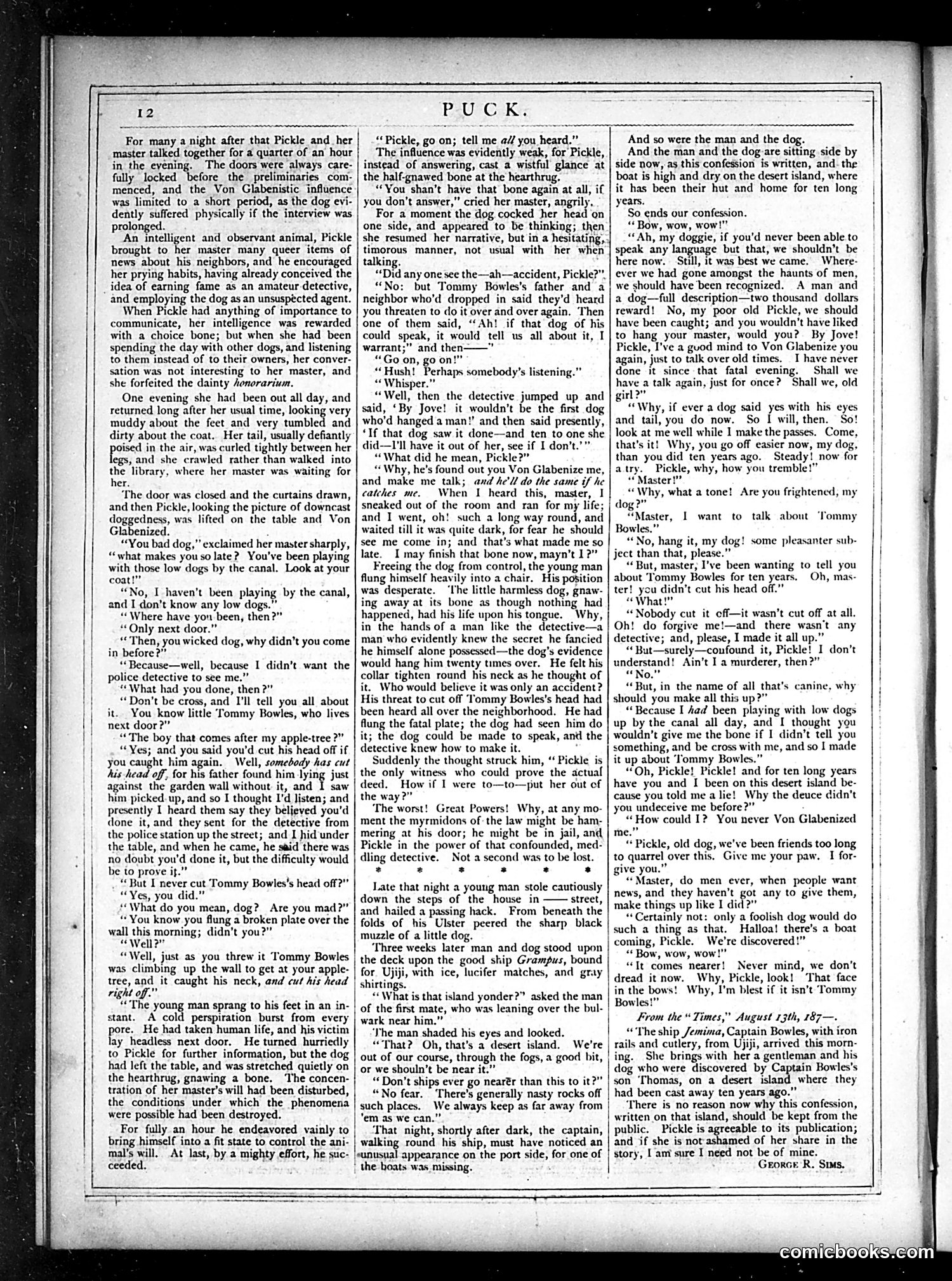
This page is primarily **text fiction**, not a political cartoon. It's a short story titled "Pickle" about a dog, told from the dog's perspective. The narrative follows Pickle's adventures and reflections on her life, including encounters with her master, neighbors, and a young man who briefly steals her. The story appears to be light entertainment rather than political satire. It showcases Puck's typical use of humor and animal characters, but focuses on domestic comedy—a dog's observations about human behavior—rather than commentary on contemporary politics or social issues. The page includes a byline crediting George R. Sims, indicating this is a contributed literary piece rather than original Puck editorial content.
📄 Transcribed text from this page (OCR, searchable)
Machine-transcribed from the original scan — historical spelling and the odd misread are preserved.
For many a night after that Pickle and. her master talked together for a quarter of an hour in the evening. The doors were always care- fully locked before the preliminaries com- menced, and the Von Glabenistic influence was limited to a short period, as the dog evi- dently suffered physically if the interview was prolonged. An intelligent and observant animal, Pickle brought to her master many queer items of news about his neighbors, and he encouraged her prying habits, having already conceived the _ idea of earning fame as an amateur detective, and employing the dog as an unsuspected agent. When Pickle had anything of importance to communicate, her intelligence was rewarded with a choice bone; but when she had been spending the day with other dogs, and listening to them instead of to their owners, her conver- sation was not interesting to her master, and she forfeited the dainty honorarium, One evening she had been out all day, and returned long after her usual time, looking very muddy about the feet and very tumbled and dirty about the coat. Her tail, usually defiantly ised in the air, was curled tightly between her legs, and she crawled rather than walked into the library, where her master was waiting for her. ‘The door was closed and the curtains drawn, and then Pickle, looking the picture of downcast doggedness, was lifted on the table and Von Glabenized. : “You bad dog,” exclaimed her master sharply, “what makes you so late? You've been playing with those low dogs by the canal. Look at your coat!” “No, I haven't been playing by the canal, and I don’t know any low dogs.” “Where have yon been, then?” “Only next door.” “Then, you wicked dog, why didn’t you come in before?” “Because—well, because I didn’t want the police detective to see me.” “What had you done, then?” “Don’t be cross, and I'll tell you all about it. You know little Tommy Bowles, who lives next door?” “The boy that comes after my apple-tree ?” “Yes; and you said you'd cut his head off if you caught him again. Well, somebody has cut his head off, for his father found him lying just against the garden wall without it, and I saw him picked. up, and so I thought I'd listen; and presently I heard them say they believed you'd done it, and they sent for the detective from the police station up the street; and I hid under the table, and when he came, he said there was no doubt you'd done it, but the difficulty would be to prove it.” “But I never cut Tommy Bowles's head off?” “Yes, you did.” ‘What do you mean, dog? Are you mad?” “You know you flung a broken plate over the wall this morning; didn’t you?” “Well?” “Well, just as you threw it Tommy Bowles | was climbing up the wall to get at your apple- tree, and it caught his neck, and cut his head right off” “The young man sprang to his feet in an in- stant. A cold perspiration burst from every pore. He had taken human life, and his victim lay headless next door. He turned hurriedly to Pickle for further information, but the dog had left the table, and was stretched quietly on the hearthrug, gnawing a bone. ‘The concen- tration of her master’s will had been disturbed, the conditions under which the phenomena were possible had been destroyed. For fully an hour he endeavored vainly to bring himself into a fit state to control the ani- mal’s will. At last, by a mighty effort, he suc- ceeded. v PUCK. “Pickle, go on; tell me a// you heard.” The influence was evidently weak, for Pickle, instead of answering, cast a wistful glance at the half-gnawed bone at the hearthrug. “You shan’t have that bone again at all, if you don’t answer,” cried her master, angrily, For a moment the dog cocked her ead Go one side, and appeared to be thinking; then she resumed her narrative, but in a hesitating, timorous manner, not usual with her when talking. “Did any one see the—ah—accident, Pickle?" “No: but Tommy Bowles’s father and a neighbor who'd dropped in said they'd heard you threaten to do it over and over again. Then one of them said, “Ah! if that dog of his could speak, it would tell us all about it, I warrant;” and then——” “Go on, go on!” “Hush! Perhaps somebody’s listening.” “Whisper.” “Well, then the detective jumped up and said, ‘By Jove! it wouldn’t be the first dog who'd hanged a man!’ and then said presently, ‘If that dog saw it done—and ten to one she did—I'll have it out of her, see if I don’t.’” “What did he mean, Pickle?” “Why, he’s found out you Von Glabenize me, and make me talk; and he'/ do the same if he catches me. When I heard this, master, I sneaked out of the room and ran for my life; and I went, oh! such a long way round, and waited till it was quite dark, for fear he should see me come in; and that’s what made me so late. I may finish that bone now, mayn’t 1?” Freeing the dog from control, the young man flung himself heavily into a chair. His position was desperate. ‘The little harmless dog, gnaw- ing away at its bone as though nothing had happened, had his life upon his tongue. Why, in the hands of a man like the detective—a man who evidently knew the secret he fancied he himself alone possessed—the dog’s evidence would hang him twenty times over. He felt his collar tighten round his neck as he thought of it. Who would believe it was only an accident? His threat to cut off ‘Tommy Bowles’s head had been heard all over the neighborhood. He had flung the fatal plate; the dog had seen him do it; the dog could be made to speak, and the detective knew how to make it. Suddenly the thought struck him, “Pickle is the only witness who could prove the actual deed. How if I were to—to—put her out cf the way?” ‘The worst! Great Powers! Why, at any mo- ment the myrmidons ofthe law might be ham- mering at his door; he might be in jail, and Pickle in the power of that confounded, med- dling detective. Not a second was to be lost. 2 By * 2 * * Late that night a young man stole cautiously down the steps of the house in —— street, and hailed a passing hack. From beneath the folds of his Ulster peered the sharp black muzzle of a little dog. ‘Three weeks later man and dog stood upon the deck upon the good ship Grampus, bound for Ujiji, with ice, lucifer matches, and gray shirtings. “What is that island yonder?” asked the man wark near him.” ‘The man shaded his eyes and looked. “That? Oh, that’s a desert island. We're out of our course, through the fogs, a good bit, or we shouln’t be near it.” “Don’t ships ever go nearér than this to it?” “No fear. There’s generally nasty rocks off such places. We always keep as far away from ‘em as we can.” That night, shortly after dark, the captain, ane round his ship, must have noticed an eunusual appearance on the port side, for one of | the boats was missing. of the first mate, who was leaning over the bul- | | dread it no And so were the man and the dog. And the man and the dog-are sitting side by side now, as this confession is written, and. the boat is high and dry on the desert island, where it has been their hut and home for ten long years. So ends our confession. “Bow, wow, wow!" “Ah, my doggie, if you'd never been able to speak any language but that, we shouldn't be here now. Still, it was best we came. Where- ever we had gone amongst the haunts of men, we should have’been recognized. A man and a dog—full description—two thousand dollars reward! No, my poor old Pickle, we should have been caught; and you wouldn’t have liked to hang your master, would you? By Jove! Pickle, I've a guod mind to Von Glabenize you in, just to talk over old times. I have never it since that fatal evening. Shall we a talk again, just for once? Shall we, old irl 2" “Why, if ever a dog said yes with his eyes and tail, you do now. So i will, then. So! look at me well while 1 make the passes. Come, that’s it! Why, you go off easier now, my dog, than you did ten years ago. Steady! now for atry. Pickle, why, how you tremble!” “Master!” “Why, what a tone! Are you frightened, my dog?” “Master, I want to talk about ‘Tommy Bowles.”” “No, hang it, my dog! some pleasanter sub- ject than that, please.” “But, master; I've been wanting to tell you about Tommy Bowles for ten years. Oh, mas- ter! you didn’t cut his head off.” “What!” “Nobody cut it eff—it wasn’t cut off at all. Oh! do forgive me!—and there wasn’t any detective; and, please, I made it all up.” “ But—surely—confound it, Pickle! I don’t understand! Ain’t I a murderer, then?” “No.” “But, in the name of all that’s canine, why should you make all this up?” “Because I had been playing with low dogs up by the canal all day, and [ thought you wouldn’t give me the bone if I didn’t tell you something, and be cross with me, and so I made it up about ‘'ommy Bowles.” “Oh, Pickle! Pickle! and for ten long years have you and I been on this desert island be- cause you told me a lie! Why the deuce didn’t you undeceive me before?” “How could 1? You never Von Glabenized me.” “ Pickle, old dog, we'v to quarrel over this. Gi give you.” “Master, do men ever, when people want news, and they haven’t got any to give them, make things up like I did?” “Certainly not: only a foolish dog would do such a thing as that. Halloa! there's a boat coming, Pickle. We're discovered!” “Bow, wow, wow!” “Tt comes nearer! Never mind, we don’t Why, Pickle, lool That face in the bows! Why, I'm blest if it isn’t Tommy Bowles!” From the “ Times,” August 13th, 187—. “The ship Jemima, Captain Bowles, with iron been friends too long ¢ me your paw. I for: | rails and cutlery, from Ujiji, arrived this morn- ing. She brings with her a gentleman and his dog who were discovered by Captain Bowles’s son Thomas, on a desert island where they had been cast away ten years ago.” ‘There is no reason now why this confession, | written on that island, should be kept from the public. Pickle is agrecable to its publication; and if she is not med of her share in the story, Lam sure I need not be of mine. Gerorcer R. Sumas. comicbooks-com