
Puck, 1877-04 · page 4 of 16
Puck — April 1877 — page 4: what you’re looking at
What you’re looking at
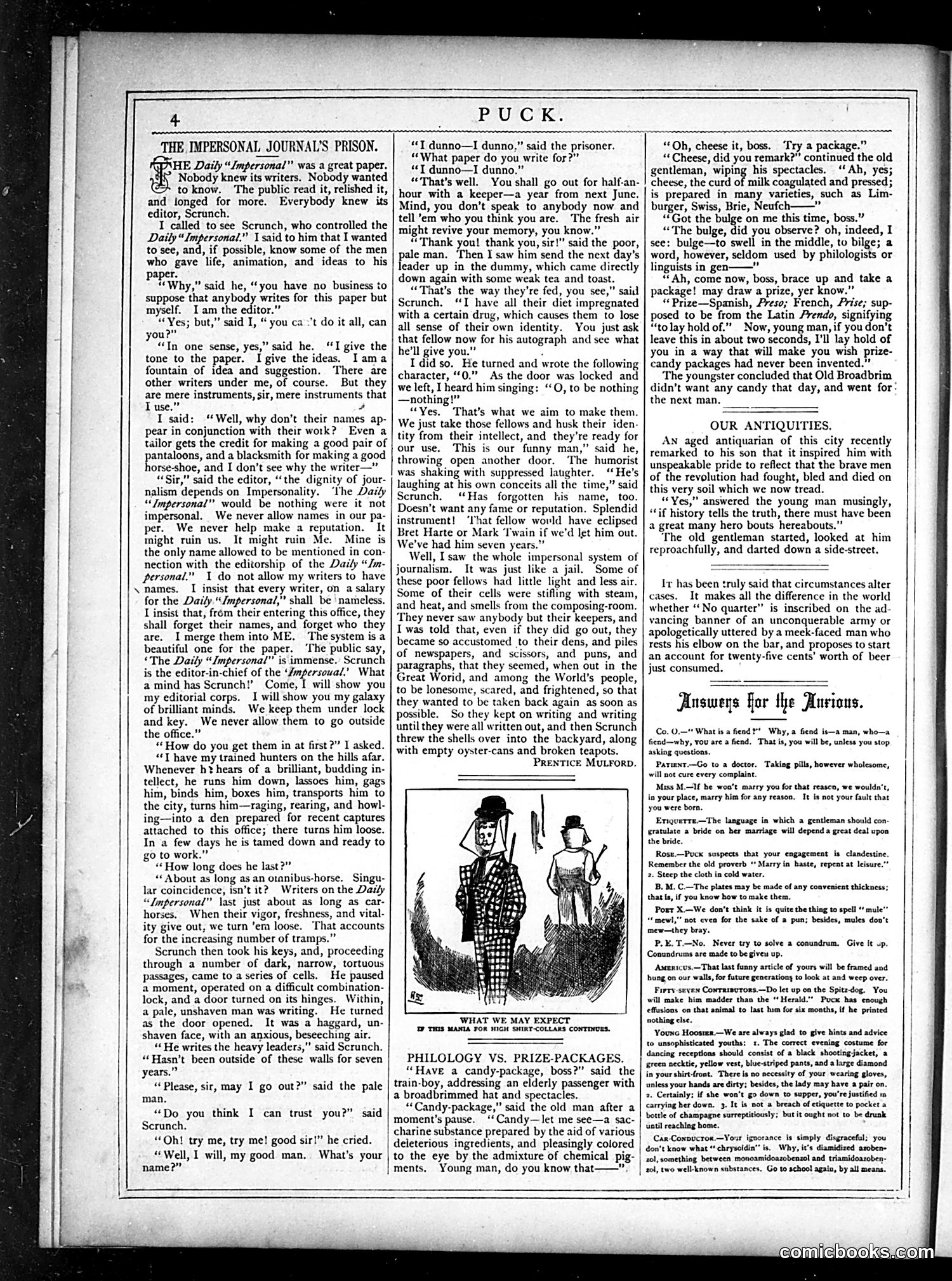
This satirical piece attacks the practice of major newspapers printing unsigned articles, which the text claims strips writers of individual identity and recognition. The editor argues that contributing to such publications is like being imprisoned—writers lose their names, reputation, and bylines while the newspaper profits from their labor. The cartoon depicts two figures in what appears to be prison garb, likely representing anonymous journalists confined by the impersonal publication system. The satire suggests that unsigned journalism treats skilled writers as interchangeable laborers rather than named professionals deserving credit and bylines. The piece advocates for attributing articles to specific writers, positioning this as fundamental to journalistic integrity and individual recognition.
📄 Transcribed text from this page (OCR, searchable)
Machine-transcribed from the original scan — historical spelling and the odd misread are preserved.
PUCK. THE IMPERSONAL JOURNAL'S PRISON. \HE Daily “Impersonal” was a great paper. Nobody ier its writers. Nobody wanted to know. The public read it, relished it, and longed for more. Everybody knew its editor, Scrunch. I called to see Scrunch, who controlled the Daily “Impersonal.” \ said to him that I wanted to see, and, if possible, know some of the men who gave life, animation, and ideas to his aper. E “Why,” said he, “you have no business to suppose that anybody writes for this paper but myself. Iam the editor.” “Yes; but,” said I, “ you ca -'t do it all, can you?” “In one sense, yes,” said he. “I give the tone to the paper. I give the ideas. Iama fountain of idea and suggestion. There are other writers under me, of course. But they are mere instruments, sir, mere instruments that 4 I said: “Well, why don’t their names ap- pear in conjunction with their work? Even a tailor gets the credit for making a good pair of pantaloons, and a blacksmith for making a good jorse-shoe, and I don’t see why the writer—” “Sir,” said the editor, “the dignity of jour- nalism depends on Impersonality. ‘Ihe Daily “Impersonal” would be nothing were it not impersonal. We never allow names in our pa- per. We never help make a reputation. It might ruin us. It might ruin Me. Mine is the only name allowed to be mentioned in con- nection with the editorship of the Daily “Jn- personal.” 1 do not allow my writers to have names. I insist that every writer, on a salary for the Daily. “/mpersonal,” shall be ‘nameless. I insist that, from their entering this office, they shall forget their names, and forget who they are. I merge them into ME. The system is a beautiful one for the paper. ‘I'he public say, “The Daily “Impersonal” is immense. Scrunch is the editor-in-chief of the ‘Jmpersoual.’’ What a mind has Scrunch!’ Come, I will show you my editorial corps. _I will show you my galaxy of brilliant minds. We keep them under lock and key. We never allow them to go outside the office.” “ How do you get them in at first?” I asked. “T have my trained hunters on the hills afar. Whenever ht hears of a brilliant, budding in- tellect, he runs him down, lassoes him, gags him, binds him, boxes him, transports him to the city, turns him—raging, rearing, and howl- ing—into a den prepared for recent captures attached to this office; there turns him loose. In a few days he is tamed down and ready to go to work.” “How long does he last?” “About as long as an oranibus-horse. Singu- lar coincidence, isn’t it? Writers on the Daély “Impersonal” \ast just about as long as car- horses. When their vigor, freshness, and vital- ity give out, we turn ‘era loose. That accounts for the increasing number of tramps.” Scrunch then took his keys, and, proceeding through a number of dark, narrow, tortuous passages, came to a series of cells. He paused a moment, operated on a difficult combination- lock, and a door turned on its hinges. Within, a pale, unshaven man was writing. He turned as the door opened. It was a haggard, un- shaven face, with an anxious, beseeching air. “ He writes the heavy leaders,” said Scrunch. “‘Hasn’t been outside of these walls for seven years.” “Please, sit, may I go out?” man. “Do you think I can trust you?” said Scrunch. “Oh! try me, try me! good sir!” he cried. “Well, I will, my good man.. What's your name?” said the pale “J dunno—I dunno,” said the prisoner. “What paper do you write for?” “T dunno—I dunno.” “That's well. You shall go out for half-an- hour with a keeper—a year from next June. Mind, you don't speak to anybody now and tell ’em who you think you are. The fresh air might revive your memory, you know.” “Thank you! thank you, sir!” said the poor, pale man. ‘Then I saw him send the next day’s leader up in the dummy, which came directly down again with some weak tea and toast. “That's the way they’re fed, you see,” said Scrunch. “TI have all their diet impregnated with a certain drug, which causes them to lose all sense of their own identity. You just ask that fellow now for his autograph and see what he'll give you.” 4 I did so. He turned and wrote the following character, “0.” As the door was locked and we left, I heard him singing: ‘O, to be nothing —nothing!”” “Yes. That's what we aim to make them. We just take those fellows and husk their iden- tity from their intellect, and they’re ready for our use. This is our funny man,” said he, throwing open another door. The humorist was shaking with suppressed laughter. “He's laughing at his own conccits all the time,” said Scrunch. ‘Has forgotten his name, too. Doesn't want any fame or reputation. Splendid instrument! ‘Ihat fellow wovld have eclipsed Bret Harte or Mark ‘Twain if we'd Jet him out. We've had him seven years.” Well, I saw the whole impersonal system of journalism. It was just like a jail. Some of these poor fellows had little light and less air. Some of their cells were stifling with steam, and heat, and smells from the composing-room. They never saw anybody but their keepers, and I was told that, even if they did go out, they became so accustomed to their dens, and piles of newspapers, and scissors, and puns, and paragraphs, that they seemed, when out in the Great Worid, and among the World's people, to be lonesome, scared, and frightened, so that they wanted to be taken back again as soon as possible. So they kept on writing and writing until they were all written out, and then Scrunch threw the shells over into the backyard, along with empty oyster-cans and broken teapots. Prentice MuLForp. MAY EXPECT SMIRT-COLLARS CONTINUES. PHILOLOGY VS. PRIZE-PACKAGES. “Have a candy-package, boss?” said the train-boy, addressing an elderly passenger with a broadbrimmed hat and spectacles. “Candy-package,” said the old man after a moment’s pause. ‘‘Candy—let me see—a sac- charine eabstanice to the eye by the admixture of chemical pig- ments, Young man, do you know that——”. prepared by the aid of various | deleterious ingredients, and pleasingly colored | “Oh, cheese it, boss. ‘Try a package.” “Cheese, did you remark?” continued the old gentleman, wiping his spectacles. ‘Ah, yes; cheese, the curd of milk coagulated and pressed; is prepared in many varieties, such as Lim- burger, Swiss, Brie, Neufch——” “Got the bulge on me this time, boss.” “The bulge, did you observe? oh, indeed, I see: bulge—to swell in the middle, to bilge; a word, however, seldom used by philologists or linguists in gen——” “Ah, come now, boss, brace up and take a package! may draw a prize, yer know.” “Prize—Spanish, Preso; French, Prise; sup- posed to be from the Latin Prendo, signifying “to lay hold of.” Now, young man, if you don’t leave this in about two seconds, I'll lay hold of you in a way that will make you wish prize- candy packages had never been invented.” ‘The youngster concluded that Old Broadbrim didn’t want any candy that day, and went for: the next man. OUR ANTIQUITIES. AN aged antiquarian of this city recently remarked to his son that it inspired him with unspeakable pride to reflect that the brave men of the revolution had fought, bled and died on this very soil which we now tread. “Yes,” answered the young man musingly, ‘if history tells the truth, there must have been a great many hero bouts hereabouts.” The old gentleman started, looked at him reproachfully, and darted down a side-street. Ir has been truly said that circumstances alter cases. It makes all the difference in the world whether ‘No quarter” is inscribed on the ad. vancing banner of an unconquerable army or apologetically uttered by a meek-faced man who rests his elbow on the bar, and proposes to start an account for twenty-five cents’ worth of beer just consumed, Answers for the Anvious. Co. 0.—"* What isa fiend!" Why, a fiend is—a man, who—a fiend—why, vou are a fiend. That is, you will be, unless you stop asking questions. Parinet.—Go to a doctor. Taking pills, however wholesome, will not cure every complaint. Miss M.—If he won't marry you for that reasco, we wouldn't, in your place, marry him for any reason. It is not your fault that you were born. Eniquerre.—The language in which a gentleman should con- gratulate a bride on ber marriage will depend a great deal upon the bride. Rosu.—Puck suspects that your engagement is clandestine. Remember the old proverb ‘ Marry in haste, repent at leisure.”* 2. Steep the cloth in cold water. B, M. C.—The plates may be made of any coavenient thickness; thatls, if you know how to make them, Port X.—We don't think it is quite the thing to spell “mule” “+ mew,” not even for the sake of a pun; besides, mules doo't mew—they bray. PLE. T.—No. Never try to solve a conundrum. Give it up. Conundrums are made to be giveu up. Aseenicus.—That last funny article of yours will be framed and hung on our walls, for future generations to look at and weep over. Firry-seyan Cowraisvrons.—Do let up oa the Spitzdog. You will make him madder than the “Herald.” Puck has enough effusions on that animal to last him for six months, if he printed nothing else. Younc Hosa. —We are always glad to give hints and advice to unsophisticated youths: 1. The correct evening costume for dancing receptions should consist of a black shootingjacket, a ‘green necktie, yellow vest, blue-striped pants, and a large diamond in yourshirt-front. There is no necessity of your wearing gloves, unless your hands are dirty; besides, the lady may have a pair on. 2. Certainly; if the won't go down to supper, you're justified im carrying her down. 3. It is pot a breach of etiquette to pocket a bottle of champagne surreptitiously; but it ought not to be drunk until reaching home, Can-Conpuctor.—Your ignorance is | don’t know what ‘*chrysoldin”’ is. Why, 20l, something between monoamidoazobenzol and triamidoazoben- | tol, two well-known substances. Go to school again, by all means.