
Puck, 1877-04 · page 13 of 16
Puck — April 1877 — page 13: what you’re looking at
What you’re looking at
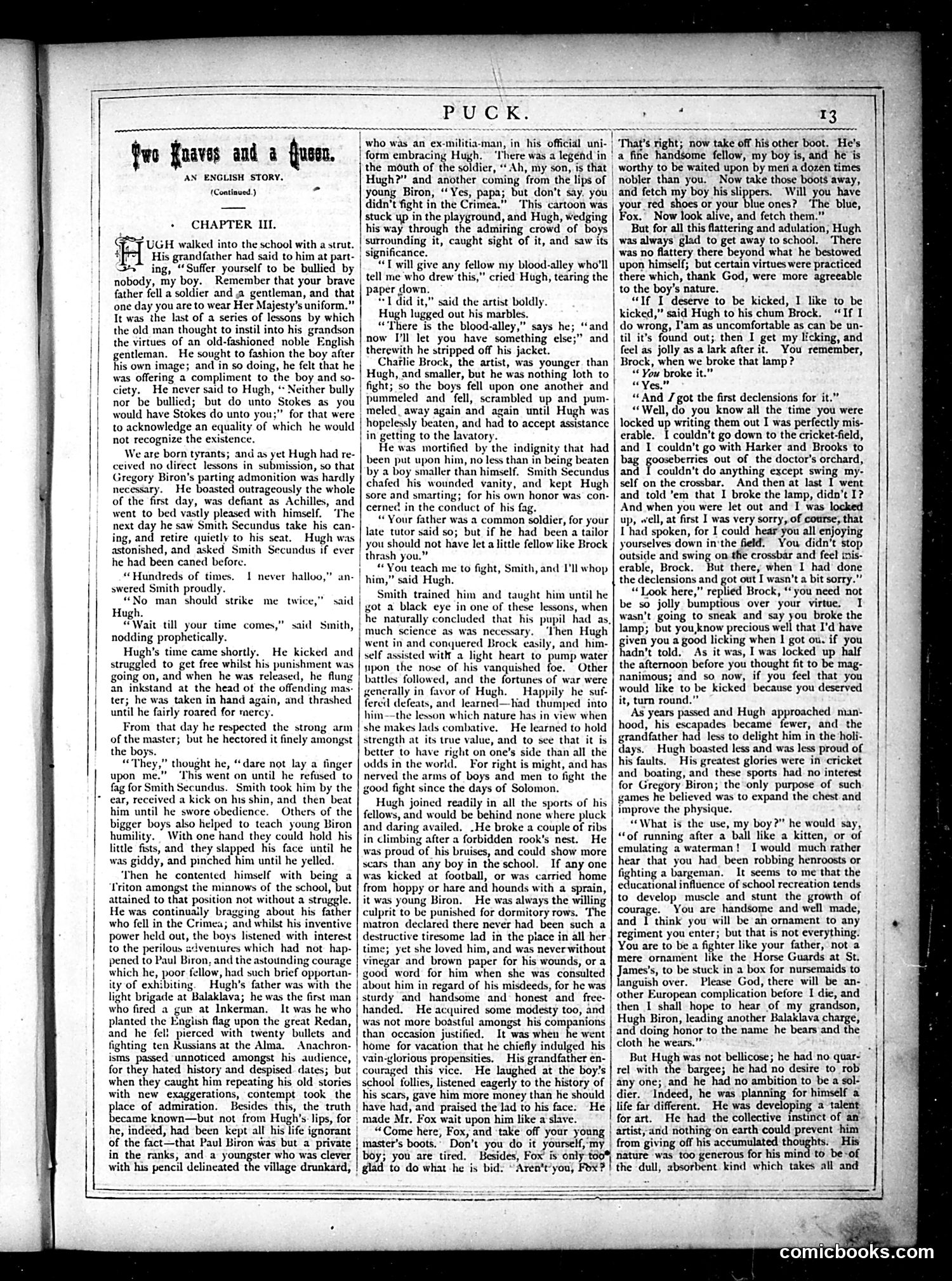
This page appears to be a serialized story titled "Two Knaves and a Queen: An English Story" (Chapter III), rather than a political cartoon. The text describes a narrative involving characters named Hugh, Smith, and Brock, discussing military training, social class distinctions, and personal honor among English soldiers and gentlemen. The story satirizes class differences in Victorian England—contrasting a working-class soldier (Hugh) with educated gentlemen (Smith, Brock), exploring themes of social mobility and respectability. References to cricket, military service, and social expectations reflect period concerns about English masculinity and class hierarchy. This appears to be serialized fiction rather than political satire focused on specific contemporary events or figures.
📄 Transcribed text from this page (OCR, searchable)
Machine-transcribed from the original scan — historical spelling and the odd misread are preserved.
wo foaves and a Queen. AN ENGLISH STORY. (Continued) t + CHAPTER III. | UGH walked into the school with a strut. 4]? ] His grandfather had said to him at part- s+" ing, “Suffer yourself to be bullied by nobody, my boy. Remember that your brave father fell a soldier and .a gentleman, and that one day you are to wear Her Majesty's uniform.” It was the last of a series of lessons by which the old man thought to instil into his grandson the virtues of an old-fashioned noble English gentleman. He sought to fashion the boy after his own image; and in so doing, he felt that he was offering a compliment to the boy and so- er said to Hugh, ; but do unto Stokes as you would have Stokes do unto you;” for that were to acknowledge an equality of which he would not recognize the existence. We are born tyrants; and as yet Hugh had re- ceived no direct lessons in submission, so that Gregory Biron’s parting admonition was hardly necessary. He boasted outrageously the whole of the first day, was defiant as Achilles, and went to bed vastly pleased with himself. | ‘The next day he saw Smith Secundus take his can- ing, and retire quietly to his seat. Hugh was astonished, and asked Smith Secundus if ever he had been caned before. “Hundreds of times. swered Smith proudly. “No man should strike Hugh. “Wait till your time comes,” said Smith, nodding prophetically. Hugh's time came shortly, He kicked and struggled to get free whilst his punishment was going on, and when he was released, he flung an inkstand at the head of the offending mas- ter; he was taken in hand again, and thrashed. until he fairly roared for mercy. From that day he respected the strong arm of the master; but he hectored it finely amongst the boys. “They,” thought he, “dare not lay a finger upon me.” ‘This went on until he refused to fag for Smith Secundus. Smith took him by the ear, received a kick on his shin, and then beat him until he swore obedience. Others of the bigger boys also helped to teach young Biron humility. With one hand they could hold his little fists, and they slapped his face until he was giddy, and pinched him until he yelled. Then he contented himself with being a Lriton amongst the minnows of the school, but attained to that position not without a struggle. He was continually bragging about his father who fell in the Crimea; and whilst his inventive power held out, the boys listened with interest to the perilous sdventures which had not hap- pened to Paul Biron, and the astounding courage which he, poor fellow, had such brief opportan- ity of exhibiting. Hugh’s father was with the light brigade at Balaklava; he was the first man who fired a gur at Inkerman. It was he who planted the English flag upon the great Redan, and he fel pierced with twenty bullets and fighting ten Russians at the Alma. Anachron- isms passed unnoticed amongst his audience, for they hated history and despised dates; but when they caught him repeating his old stories with new exaggerations, contempt took the place of admiration. Besides this, the truth became known—but not from Hugh’s: lips, for 1 never halloo,” an- me twice,” he, indeed, had been kept all his life ignorant | | master’s boots.’ Don't you do it yourself,-my | from giving off his accumulated tho boy; you are tired. Besides, Fox’ is only Set nature was too generous for his mind to be-of of the fact—that Paul Biron was but a private in the ranks, and a youngster who was clever with his pencil delineated tl , who was an ex-militia-man, in his official un’ either bully | said | ¢ village drunkard, | glad | form embracing Hugh. ‘There was a legend in the mouth of the soldier, ‘Ah, my son, is that Hugh?” and another coming from the lips of young Biron, “Yes, papa; but don’t say. you didn’t fight in the Crimea.” ‘This cartoon was stuck up in the playground, and Hugh, wedging his way through the admiring crowd of boys | surrounding it, caught sight of it, and saw its | significance. “Twill give any fellow my blood-alley who'll tell me who drew this,” cried Hugh, tearing the paper down. “1 did it,” said the artist boldly. Hugh lugged out his marbles. “There is the blood-alley,” says he. now I'll let you have something else: therewith he stripped off his jacket. and and Hugh, and smaller, but he was nothing loth to fight; so the boys fell upon one another and | pummeled and fell, scrambled up and pum- meled. away again and again until Hugh was hopelessly beaten, and had to accept assistance in getting to the lavatory. He was mortified by the indignity that had been put upon him, no less than in being beaten by a boy smaller than himself. Smith Secundus chafed his wounded vanity, and kept Hugh sore and smarting; for his own honor was con- cerned in the conduct of his fag. “Your father was a common soldier, for your late tutor said so; but if he had been a tailor you should not have let a little fellow like Brock thrash you.” | “You teach me to fight, Smith, and I'll whop him,” said Hugh. Smith trained him and taught him until he | got a black eye in one of these lessons, when he naturally concluded that his pupil had as, | much science as was necessary. ‘Then Hugh went in and conquered Brock easily, and him- self assisted with a light heart to pump water npon the nose of his vanquished foe. Other | battles followed, and the fortunes of war were zenerally in favor of Hugh. Happily he suf- fered defeats, and learned—had thumped into him-the lesson which nature has in view when she makes lads combative. He learned to hold strength at its true value, and to see that it is better to have right on one’s side than all the odds in the world. For right is might, and has nerved the arms of boys and men to fight the good fight since the days of Solomon. Hugh joined readily in all the sports of hi fellows, and would be behind none where pluck and daring availed. .He broke a couple of ribs in climbing after a forbidden rook's nest. He was proud of his bruises, and could show more scars than any boy in the school. If any one was kicked at football, or was carried home from hoppy or hare and hounds with a sprain, it was young Biron. He was always the willing culprit to be punished for dormitory rows. The matron declared there never had been such a destructive tiresome lad in the piace in all her time; yet she loved him, and was neverwithout vinegar and brown paper for his wounds, or a good word for him when she was consulted about him in regard of his misdeeds, for he was sturdy and handsome and honest and. free- handed. He acquired some modesty too, and was not more boastful amongst his companions than occasion justified. It was when he went | home for vacation that he chiefly indulged his vain-glorious propensities. His grandfather en- | couraged this vice. He laughed at the boy's school follies, listened eagerly to the history of | have had, and praised the lad to his face: “He made Mr. Fox wait upon him like a’slave. “Come here, Fox, and ‘take off your young to do what he is bid: “Aren't’you, Fox? | Charlie Brock, the artist, was younger than | | his scars, gave him more money than he should | , o 13 ‘That's right; now take off his other boot. He's a fine handsome fellow, my boy is, and he is | worthy to be waited upon by men a dozen times nobler than you. Now take those boots away, and fetch my boy his slippers. Will you have our red shoes or your blue ones? The blue, Fox. Now look alive, and fetch them.” But for all this flattering and adulation, Hugh was always glad to get away to school. There was no flattery there beyond what he bestowed. upon himself; but certain virtues were practiced there which, thank God, were more agreeable to the boy’s nature. “If I deserve to be kicked, I like to be kicked,” said Hugh to his chum Brock. “If I do wrong, I'am as uncomfortable as can be un- | til it’s found out; then I get my licking, and feel as jolly as a lark after it. You remember, Brock, when we broke that lamp? “ You broke it.” “Yes,” “And J got the first declensions for it.” “Well, do you know all the time you were locked up writing them out I was perfectly mis- erable. I couldn’t go down to the cricket-field, and I couldn’t go with Harker and Brooks to bag gooseberries out of the doctor's orchard, and I couldn't do anything except swing my- self on the crossbar, And then at last I went and told ’em that I broke the lamp, didn’t 1? ‘And when you were let out and I was locked up, well, at first I was very sorry, of course, that Thad spoken, for I could hear you all enjoying yourselves down in'the field. You didn’t stop outside and swing on the crossbar and feel inis- erable, Brock. But there, when I had done the declensions and got out I wasn’t a bit sorry.” “Look here,” replied Brock, ‘you need ‘not be so jolly bumptious over your virtue. I wasn’t going to sneak and say you broke the lamp; but you,know precious well that I'd have iven you a good licking when I got ou. if you adn't told. As it was, I was locked up half the afternoon before you thought fit to be mag- nanimous; and so now, if you feel that you would like to be kicked because you deserved it, turn round.” ‘As years passed and Hugh approached. man* hood, his escapades became fewer, and the grandfather had less to delight him in the ‘holi- days. Hugh boasted less and was less proud of his faults. His greatest glories were in cricket and boating, and these sports had. no interest | for Gregory Biron; the only purpose of such | games he believed was to expand the chest and improve the physique. “What is the use, my boy?” he would say, “of running after a ball like a kitten, or of emulating a waterman! I would much rather hear that you had been robbing henroosts or fighting a bargeman. It seems to me that the educational influence of school recreation tends to develop muscle and stunt the growth of courage. You are handsome and well made, and I think you will be an ornament to any regiment you enter; but that is not everything. You are to be a fighter like your father, not a mere ornament like the Horse Guards at St. James's, to be stuck in a box for nursemaids to languish over. Please God, there will be an- other European complication before I die, and then I shall hope to hear of my grandson, Hugh Biron, leading another Balaklava charge, and doing honor to the name he bears and the cloth he wears.” But Hugh was not bellicose; he had no quar- rel with the bargee; he had no desire to rob any one; and he had no ambition to be a sol- dier. ‘Indeed, he was planning for himself a life far different. He was developing a talent for art. He had the collective instinct of an | artist, and nothing’on earth could prevent him hts. His the dull, absorbent kind which takes all and Comicbooks.com | | eee