
A complete issue · 16 pages · 1877
Puck — April 1877
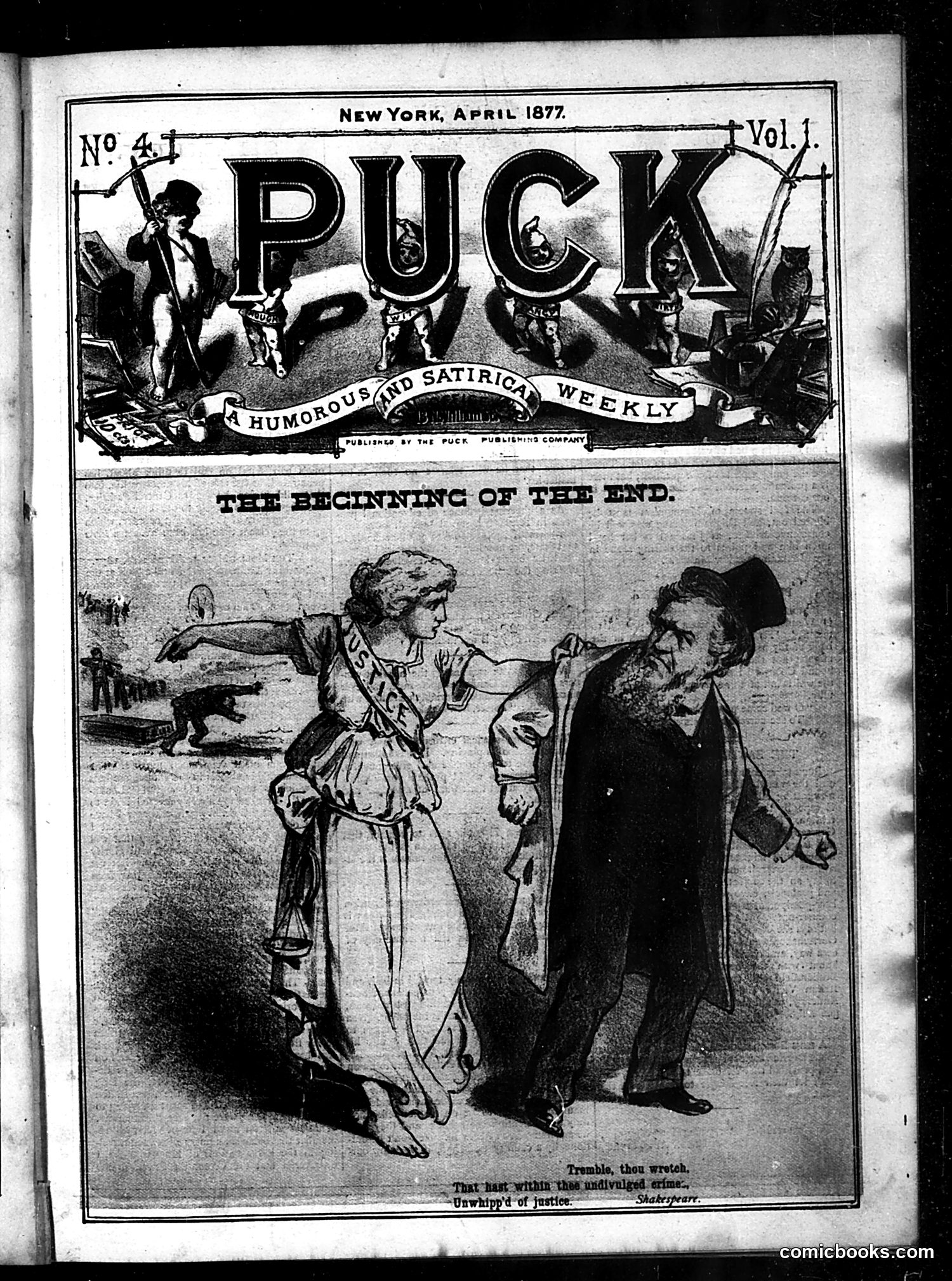
This cartoon depicts a woman (labeled with a sash, likely representing Justice or Lady Liberty) pointing accusingly at a bearded man in formal dress, while soldiers appear in the background. The Shakespeare quote beneath—"Tremble, thou wretch, / That hast within thee undivulged crime— / Unwhipp'd of justice"—suggests the cartoon critiques unpunished wrongdoing. The specific historical context remains unclear from the image alone, but given the 1877 date and invocation of justice, this likely references post-Reconstruction politics, possibly commenting on corruption or crimes by political figures escaping accountability. The woman's pointing gesture and the soldiers suggest themes of law enforcement and moral reckoning. Without additional context about contemporary scandals, the exact target cannot be definitively identified.
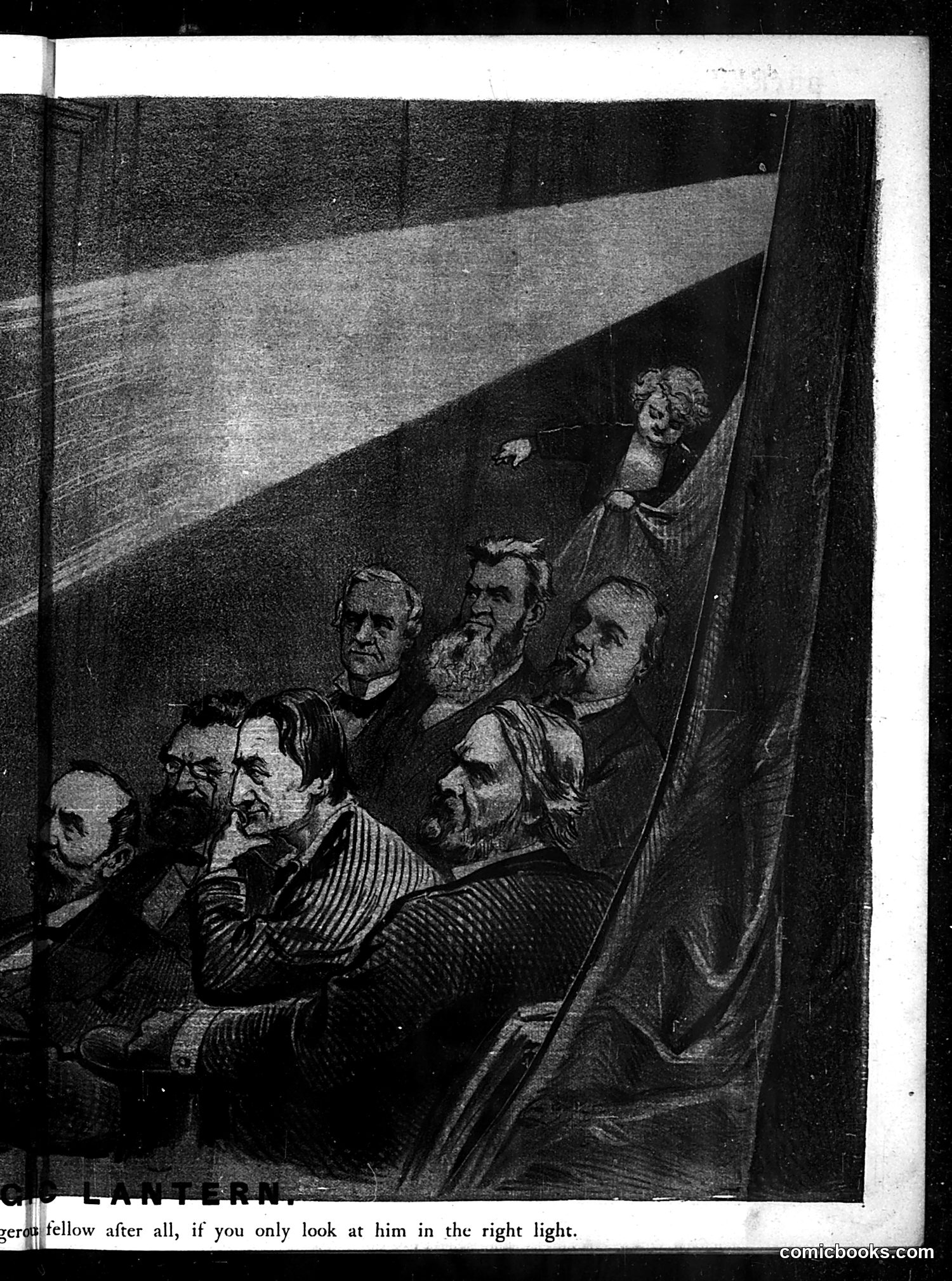
This page is primarily **editorial content and articles rather than political cartoons**. The visible sections include: **"Puck's Cartoons"** section contains several brief satirical pieces: - "The Beginning of the End" mocks Ward's remarks about Brigham Young - "Puck's Magic Lantern" is a comedic piece about shadows - "The Eastern Question" discusses European political tensions - Various humor pieces about Boston critics, horse racing, and contemporary social topics The cartoons themselves are not clearly visible in this image reproduction—the page shows mostly text columns. The satire targets include religious figures (Young), musical critics, and general social foibles of the era. Without clearer images of the actual illustrations, the specific visual satire and caricatures cannot be definitively identified.
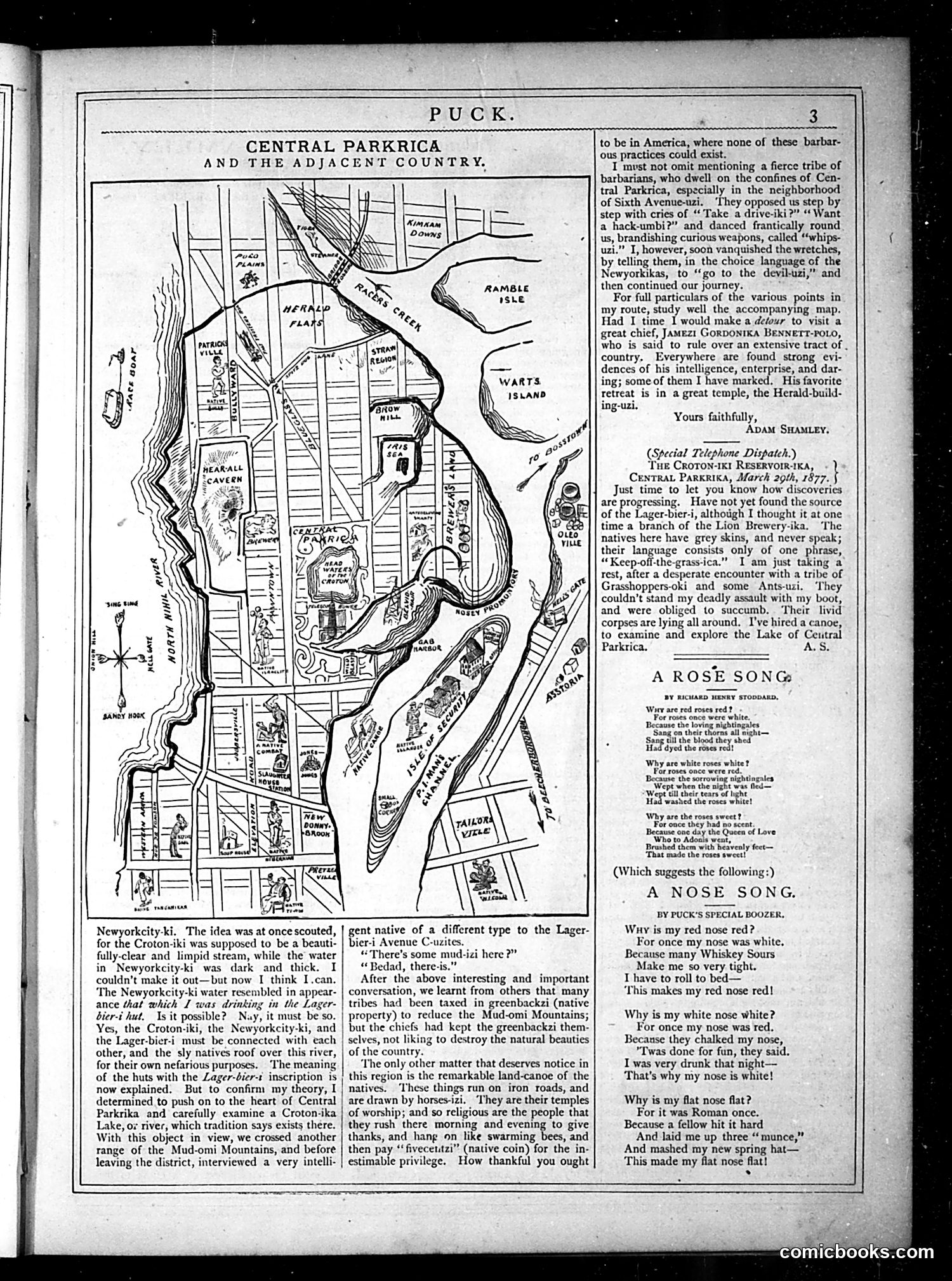
This page contains a map of Central Parkrica (a fictional location) and adjacent commentary, rather than political satire. The map depicts various named locations like "Heraco Plain," "Warts Island," and "Ramble Isle," appearing to be a humorous illustrated geography. The accompanying text includes travel dispatches and a poem titled "A Rose Song" with a follow-up "A Nose Song"—likely a playful pun. The nose song jokes about red, white, and flat noses through humorous verse, suggesting physical comedy rather than political commentary. The content appears primarily illustrative and whimsical rather than satirical of current events or political figures. It represents Puck's lighter, more fantastical editorial content alongside its better-known political cartoons.
This page contains two distinct sections: "The Voice of Horace Greeley" (a poem) and "Poker's Pictorial Poets" (prose essay with illustration). The Greeley poem appears to reference **Horace Greeley**, the famous 19th-century newspaper editor and politician. The poem's themes of triumph, flag, jubilee, and "master" suggest it's either praising or satirizing Greeley's political positions or legacy. The "Poker's Pictorial Poets" essay discusses collecting bound volumes of Puck magazine itself—a meta-commentary where Puck humorously describes the challenges of storing and preserving its own publications. The writer jokes about space constraints and the nuisance value of maintaining a complete collection, while simultaneously promoting the idea that Puck's illustrated poetry deserves preservation as fine literature. The illustration shows a caricatured face in Puck's characteristic style but the specific figure is unclear from the image alone.
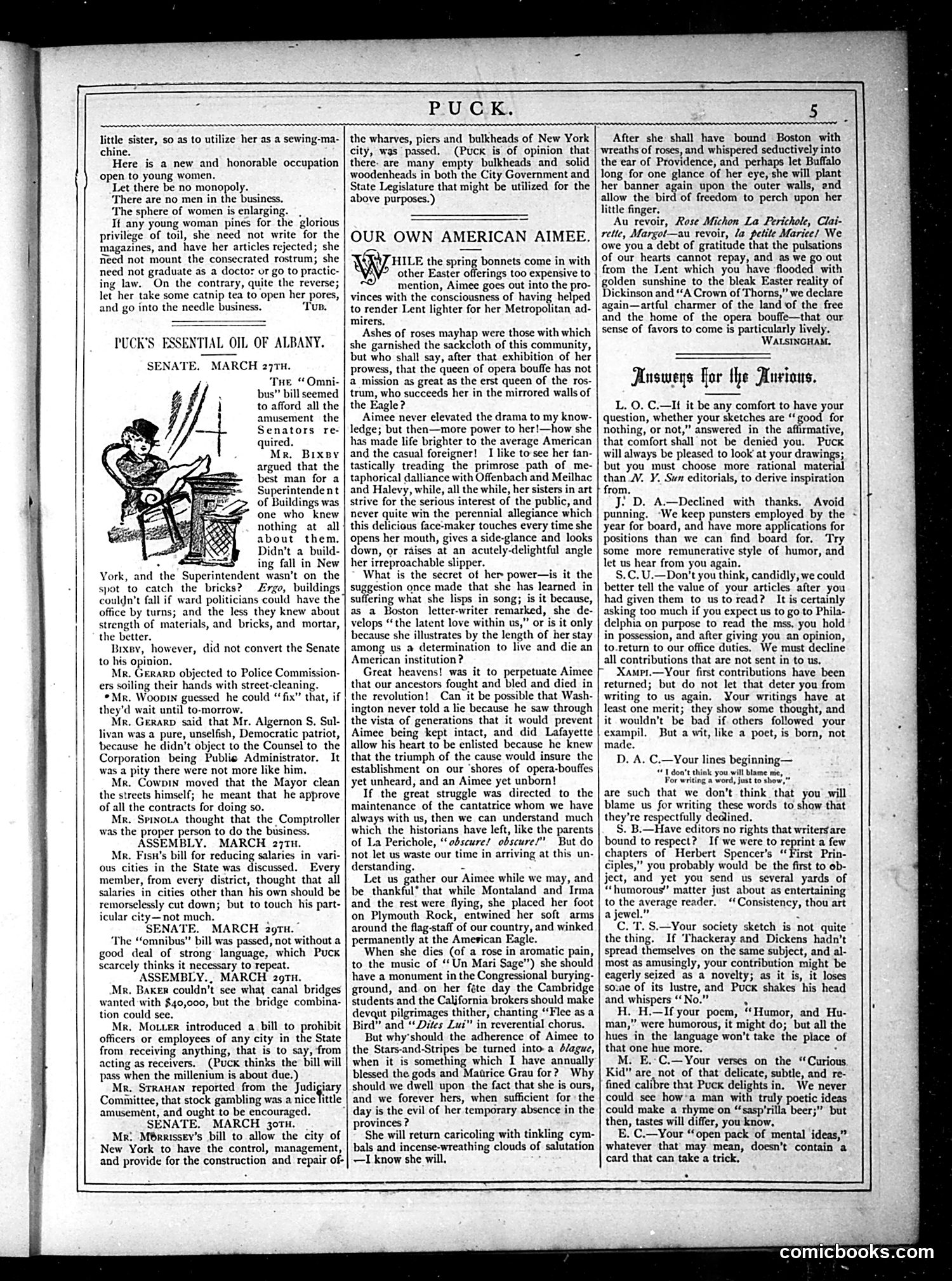
This political cartoon satirizes New York State legislative corruption. The illustration shows a figure (likely a politician) being squeezed like a lemon or fruit press, with money and bribes literally flowing out. The accompanying Senate debate discusses various scandals: bribery among legislators, bridge construction kickbacks, and officials enriching themselves through public works contracts. The cartoon's title suggests Albany politics are fundamentally corrupt—the "essential oil" extracted from the capital is pure graft. References to specific incidents (canal bridges, the Superintendent's bribes) indicate this targets actual contemporary scandals rather than hypothetical corruption. The satire's point: New York's legislative system produces corruption as naturally as fruit yields oil—it's systemic, not incidental.
This page contains primarily **editorial text** rather than political cartoons. The main sections are: 1. **"Causerie and Censure"** by Silas Drift—a column addressing theatrical censorship and a actress's disappearance, discussing press freedom and theatrical propriety. 2. **"Puck's Stage Sketches"**—theater criticism praising a contemporary female leading actress for her brilliance and range, comparing her favorably to classic theatrical figures. The remaining content covers theatrical news, including Booth's Theatre closure and Brother Moody's newspaper career. **No clear political satire or caricatures are visible in this image.** The page appears focused on **theater criticism and industry commentary** rather than political commentary, which was Puck's typical focus.
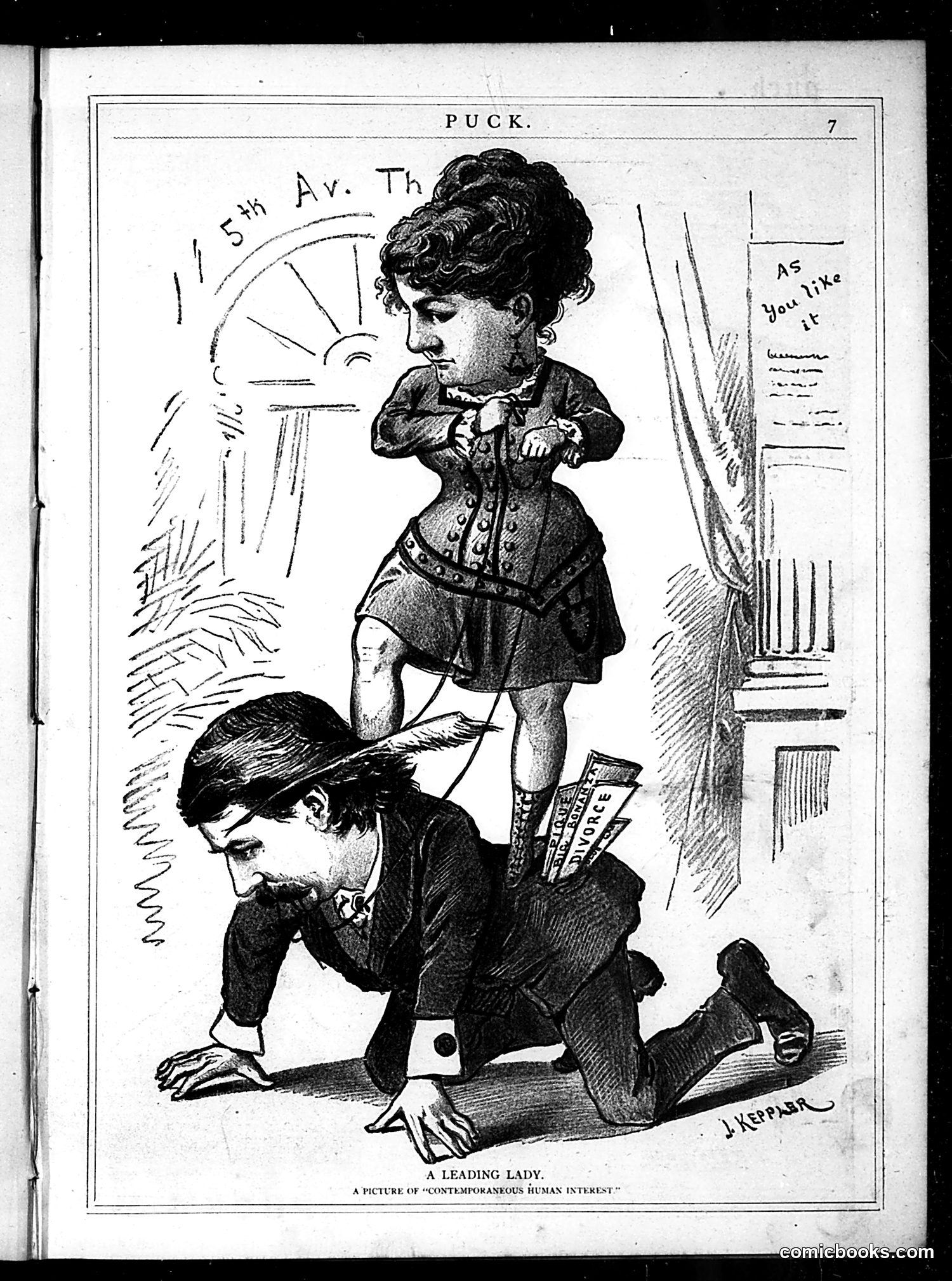
This Puck cartoon satirizes a woman of contemporary social prominence, labeled "A Picture of 'Contemporary Human Interest'" at the location "5th Av. Th[eatre]." The image shows a fashionably dressed woman standing atop a man on all fours, literally dominating him. The phrase "As you like it" (visible on the right) references Shakespeare's play, suggesting theatrical or performative aspects of their relationship. The satire critiques the power dynamics of a fashionable society woman, depicting her as controlling and emasculating her male companion. This reflects Gilded Age anxieties about women's increasing social independence and influence in high society. The cartoon mocks both the woman's presumed arrogance and the man's willingness to be dominated, using physical exaggeration to ridicule contemporary gender relations among the wealthy elite.
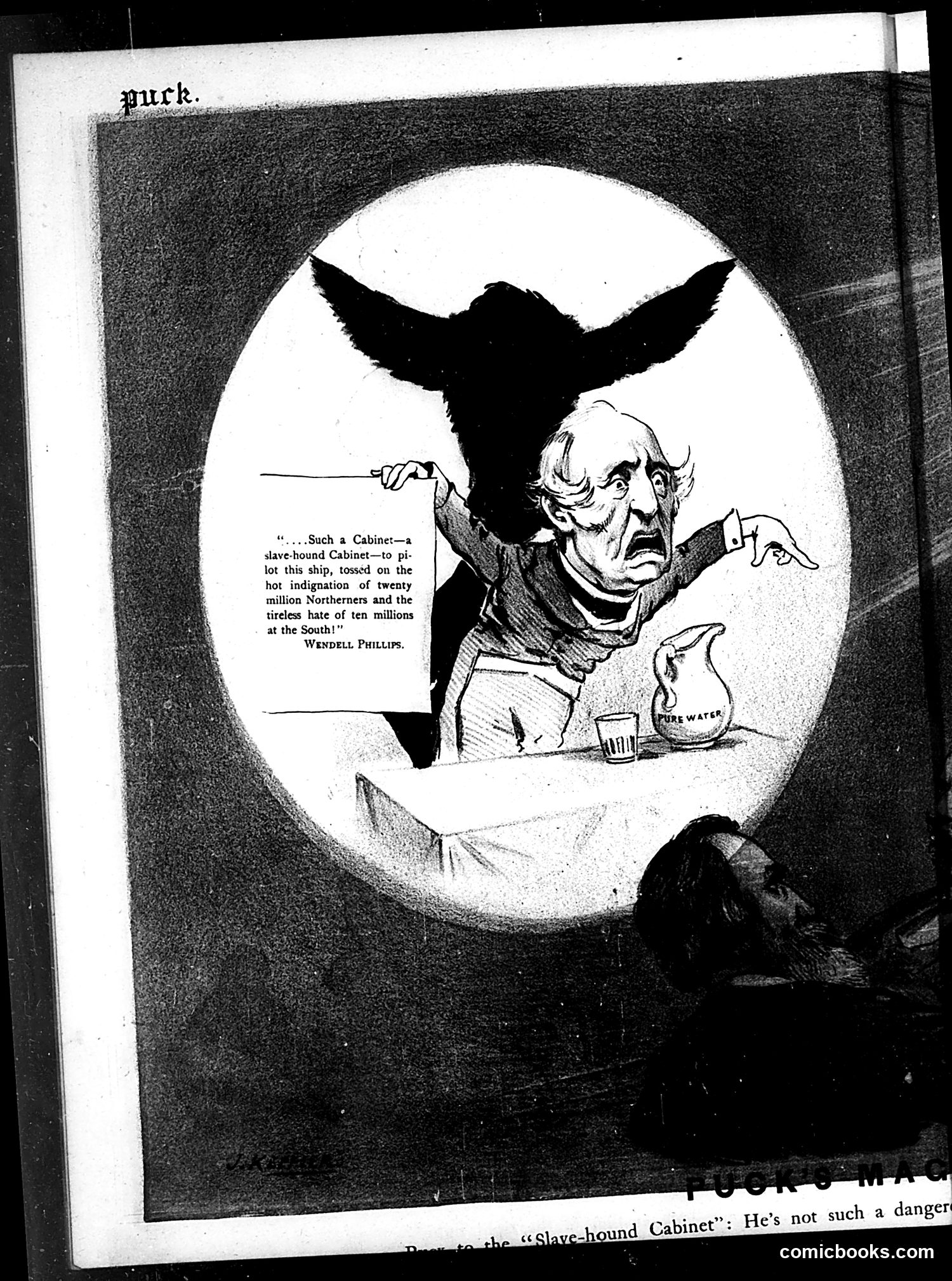
This cartoon satirizes a political figure (caricatured with an elderly, stern appearance) through the metaphor of a "Cabinet" — likely referencing a government official's controversial cabinet appointments or policies. The quote attributed to Wendell Phillips criticizes how "this ship" (the nation) was "tossed on the hot indignation of twenty million Northerners and the tireless hate of ten millions at the South." This suggests the cartoon addresses sectional tensions, possibly during Reconstruction or a related period of North-South conflict. The devil figure looming above implies the cartoon portrays the politician as serving evil or destructive purposes. The "Pure Water" pitcher suggests hypocrisy — a contrast between claimed virtues and actual conduct. Without the specific date or clearer identification, the precise political target remains unclear.
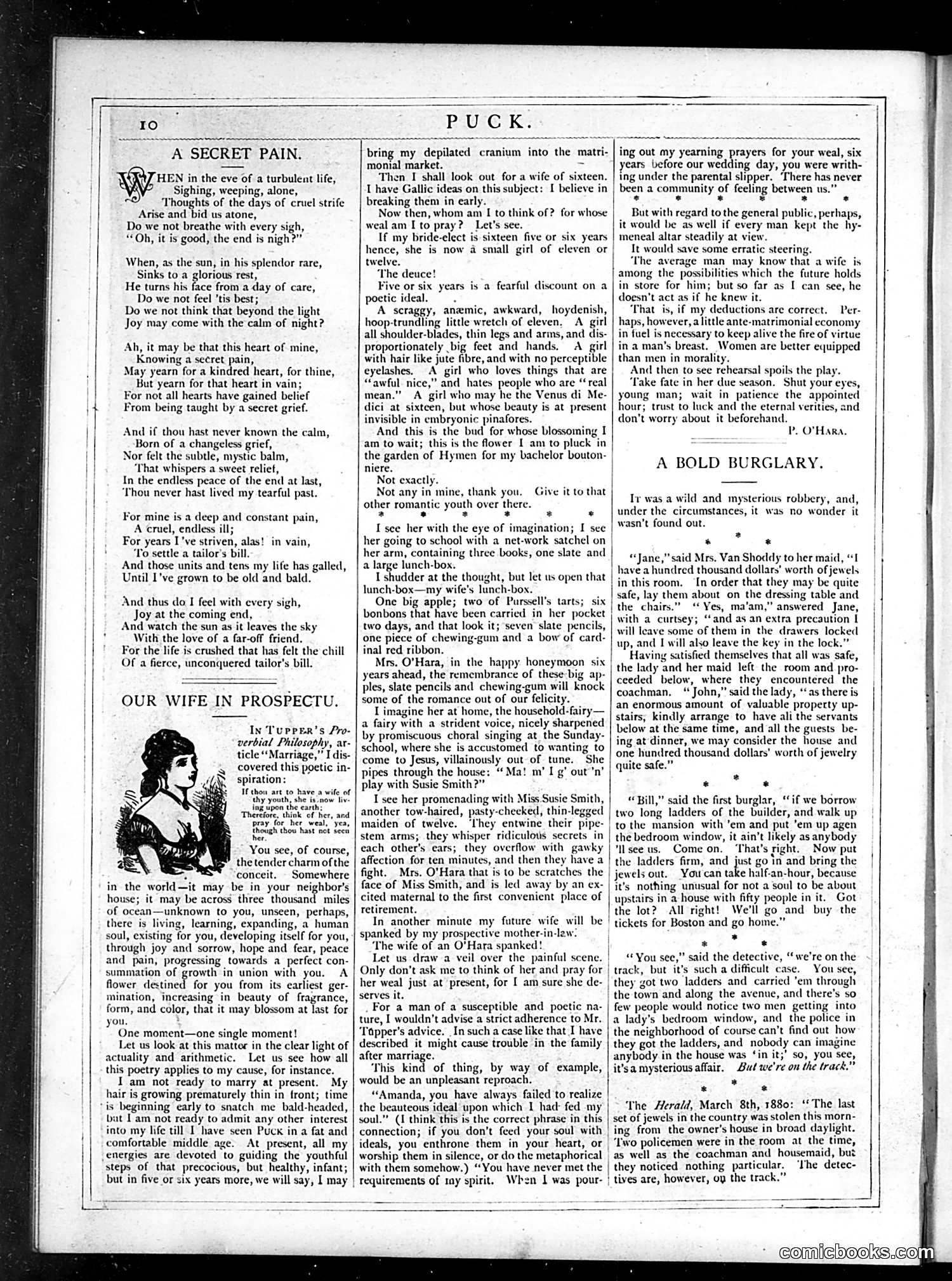
This page contains three distinct pieces: a poem titled "A Secret Pain," an illustrated article "Our Wife in Prospectus," and a story called "A Bold Burglary." The main illustration shows a woman's profile portrait accompanying "Our Wife in Prospectus." The article appears to be satirical commentary on marriage prospects and women's roles, using the device of describing an ideal wife for a bachelor. The text discusses selecting a wife by specific criteria—her age, appearance, accomplishments, and domestic skills—reflecting Victorian attitudes about matrimonial compatibility. "A Bold Burglary" is a humorous crime story about jewel thieves, apparently a serialized fiction piece common to such magazines. The content satirizes contemporary social attitudes about marriage, domesticity, and gender roles through both poetry and prose fiction.
This page contains the opening chapters of a serialized fiction story, not a political cartoon. "Two Knaves and a Queen" is labeled "AN ENGLISH STORY" and tells of Paul Biron, a soldier, and his wife Beatrice during what appears to be the Napoleonic Wars era. The narrative concerns domestic tensions: Paul receives mysterious letters, his wife grows anxious about his activities, and he eventually leaves for military service. A secondary character, Gregory Biron, is introduced as Paul's brother—a proud, quarrelsome man living in Berkshire. This appears to be serialized entertainment fiction typical of Puck magazine's content, rather than political satire. The "knaves and queen" likely refer to the main characters in this domestic drama.
This page is primarily **text narrative**, not a political cartoon. It appears to be a serialized story titled "Puck" (visible at page top), likely a fictional account about a character named Gregory Biron and his tutor, Mr. Fox. The narrative describes Gregory's misbehavior and disciplinary issues at school, his tutor's frustrations, and interactions with neighbors including "Sir Humphrey Clinker." The story involves discussions about property disputes, fishing rights, and social standing among English gentry. **Without visible illustrations or explicit political commentary**, this reads as **satirical fiction** rather than topical satire. The humor appears to target social pretensions and class dynamics of rural English life, but specific contemporary political references aren't evident from this excerpt alone.
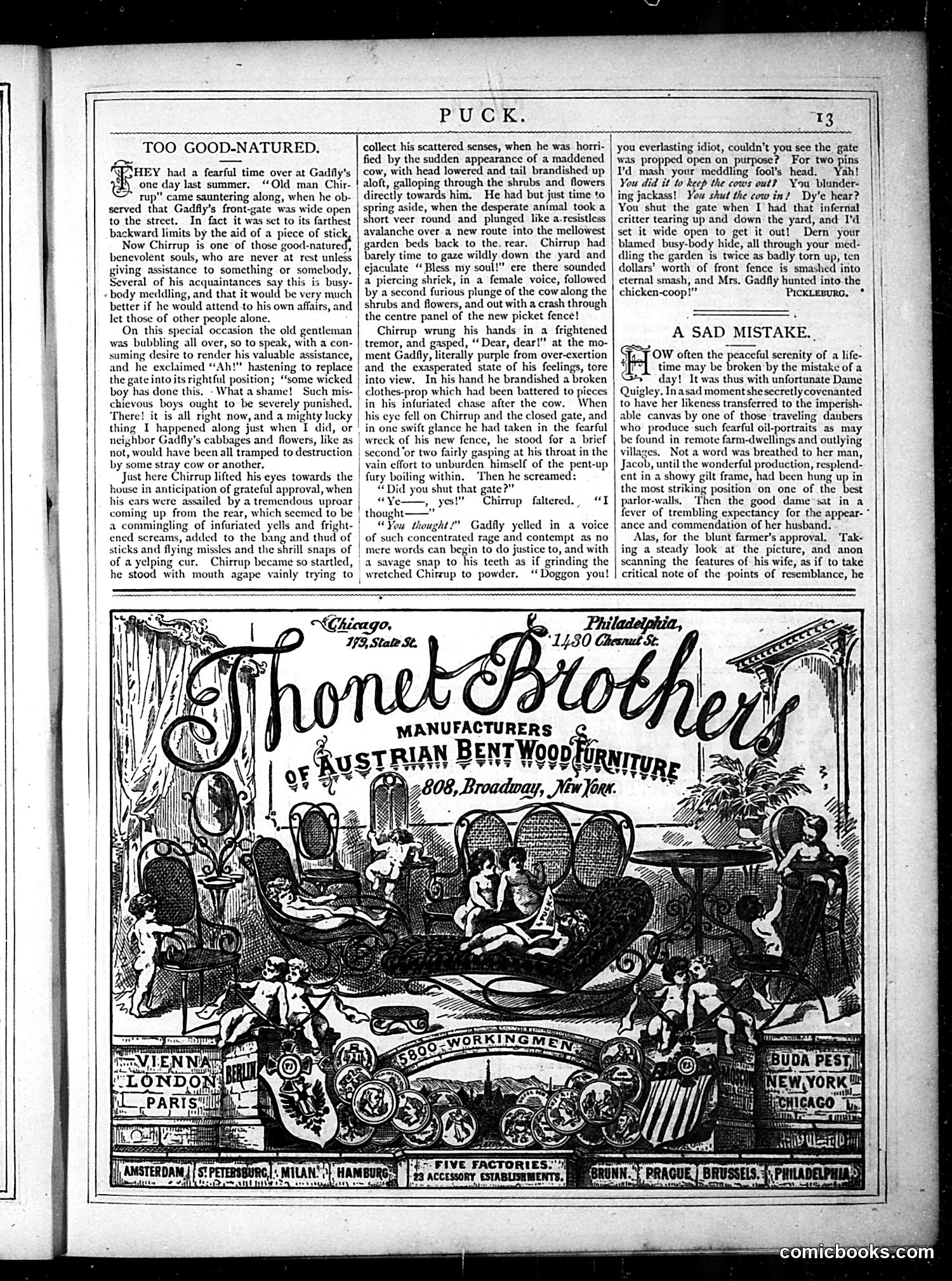
This page contains two distinct elements: **Upper Section:** Two short stories titled "Too Good-Natured" and "A Sad Mistake." These appear to be humorous fictional vignettes rather than political satire—the first describes a farmer's cow escaping and causing chaos, the second involves a man mistaken for someone else. No identifiable political figures or commentary appears present. **Lower Section:** A full-page advertisement for Ethonel Brothers, manufacturers of Austrian bentwood furniture. The ornate engraving showcases their product line with cherubs, decorative flourishes, and lists multiple international factory locations (Vienna, London, Paris, New York, etc.). This is purely commercial advertising with no satirical content. The page represents typical Puck magazine content mixing light fiction with substantial paid advertising rather than political cartooning.
This page is primarily **advertising and miscellaneous content** rather than political cartoons. The main illustrated feature is "Puck's Arrivals," a small comic showing a couple in bed, captioned with domestic humor about the "annoyance of a squeaking bed." The dominant visual element is a **Steinway piano advertisement** highlighting "Double Victory"—two gold medals won at expositions. The ad emphasizes the piano's superior craftsmanship and durability. The text sections contain brief satirical anecdotes (common to Puck) about a stranger seeking money, social observations about marriage, and a mysterious death story. These are light humor pieces typical of the magazine's format. The remaining space features advertisements for fire insurance, wine merchants, and other goods—standard for Puck's revenue model.
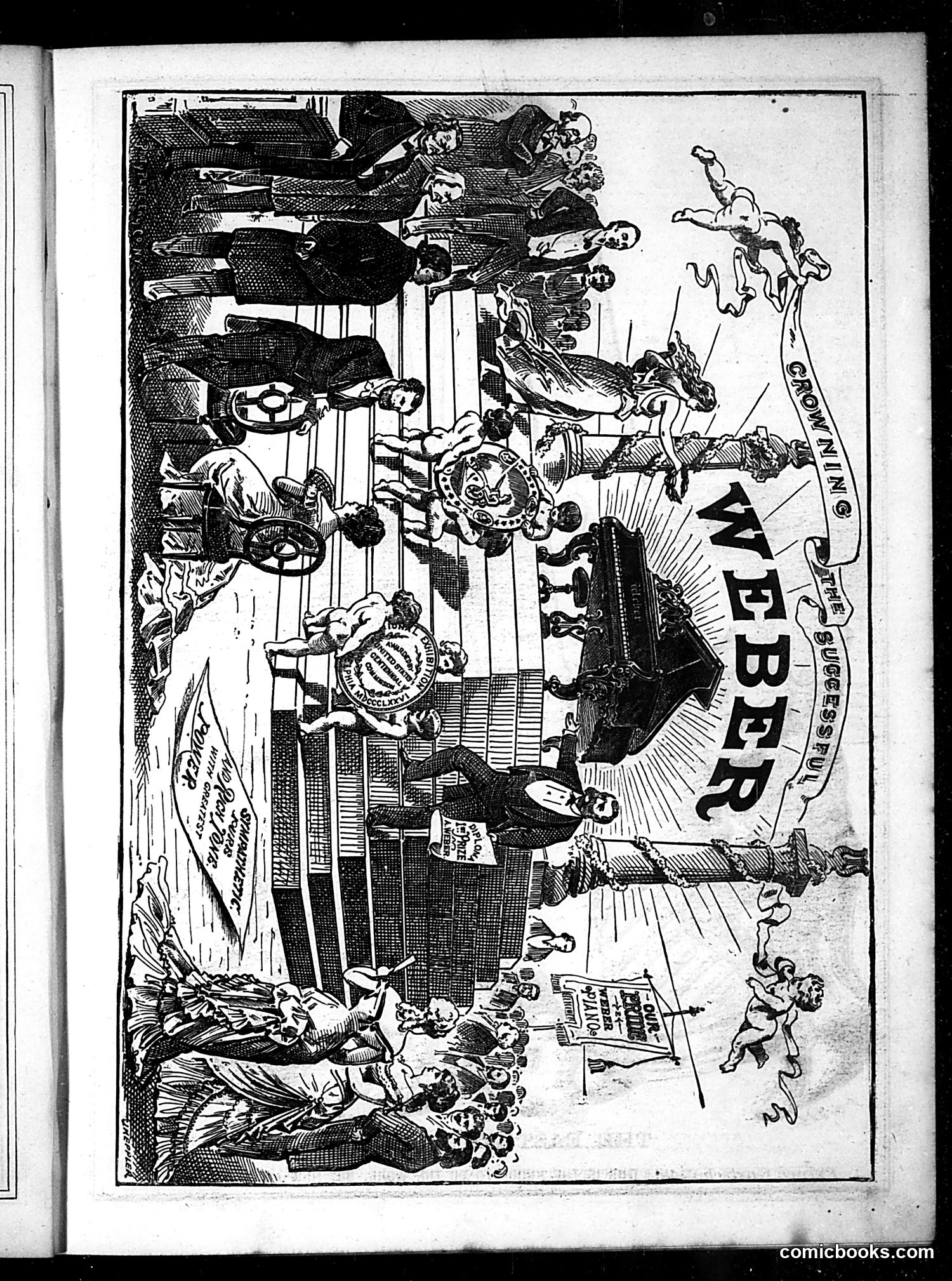
This appears to be a satirical illustration titled "WEB**ER" (text partially visible), rotated 90 degrees on the page. The cartoon depicts a large spider web or trap-like structure with numerous figures caught within it. The central figure appears to be a wealthy or powerful person (possibly representing a businessman or political figure), while smaller figures—some appearing distressed or struggling—surround the web. The satire likely critiques monopolistic business practices or political corruption, using the spider-web metaphor to suggest how a powerful individual "traps" or exploits others economically or politically. The specific identity of the central figure and exact historical context remain unclear without additional publication details, but the imagery suggests turn-of-century critique of industrial power concentration.
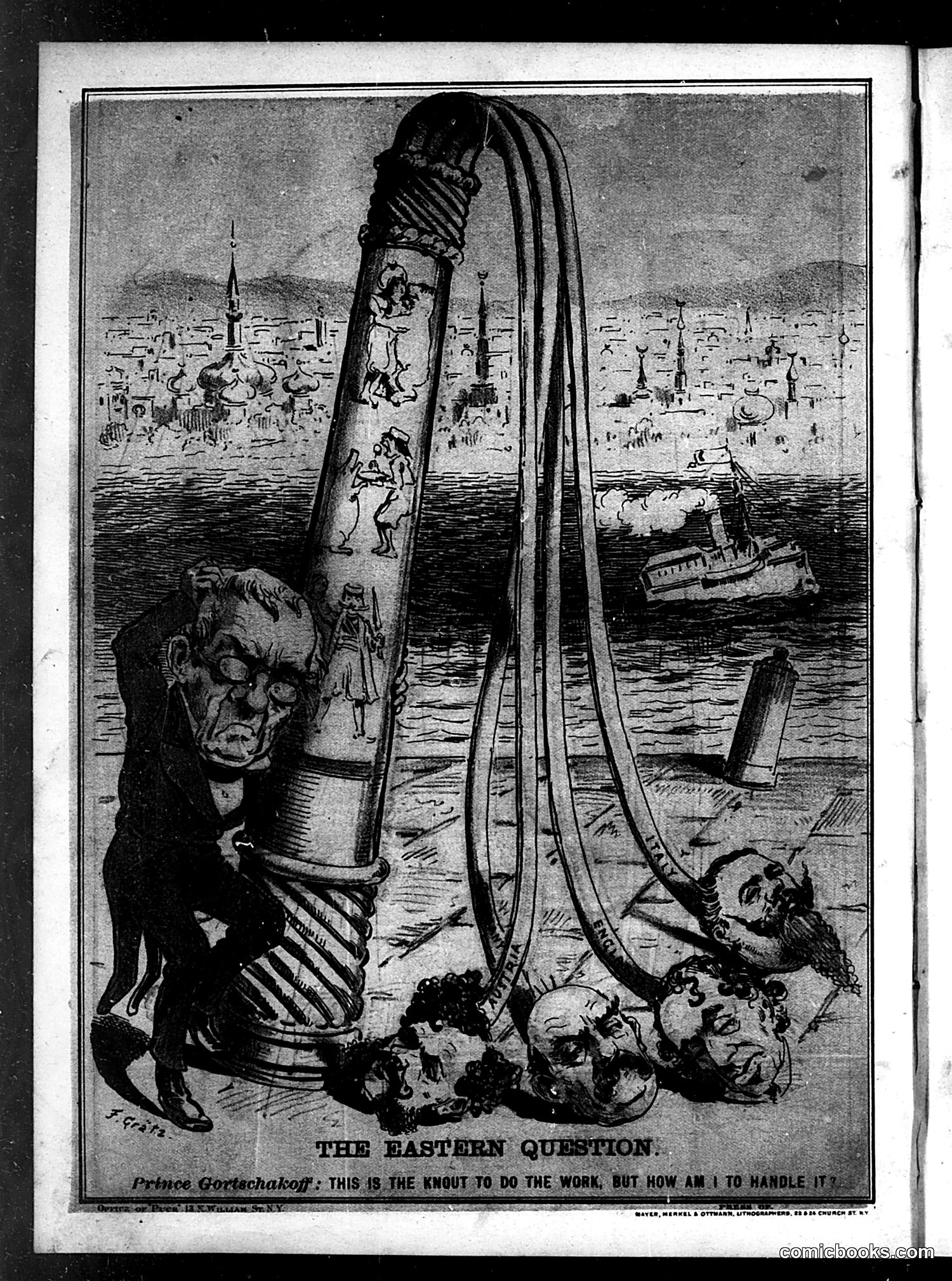
This Puck cartoon satirizes Russia's geopolitical ambitions in Eastern Europe. The central figure appears to be a Russian leader (identified in the caption as "Prince Gortschakoff," Russia's foreign minister) holding a noose made from a rope. The rope is decorated with figures representing various Eastern territories or peoples, while severed heads lie at the base—likely representing victims or conquered lands. The caption reads: "THIS IS THE KNOT TO DO THE WORK, BUT HOW AM I TO HANDLE IT?" This expresses Russia's dilemma: while the Eastern Question (control of Ottoman territories and influence in the Balkans) presented opportunity, executing such ambitions proved diplomatically and militarily complex. The cartoon critiques Russian imperial overreach and the human cost of great-power competition.