
Puck, 1877-04 · page 10 of 16
Puck — April 1877 — page 10: what you’re looking at
What you’re looking at
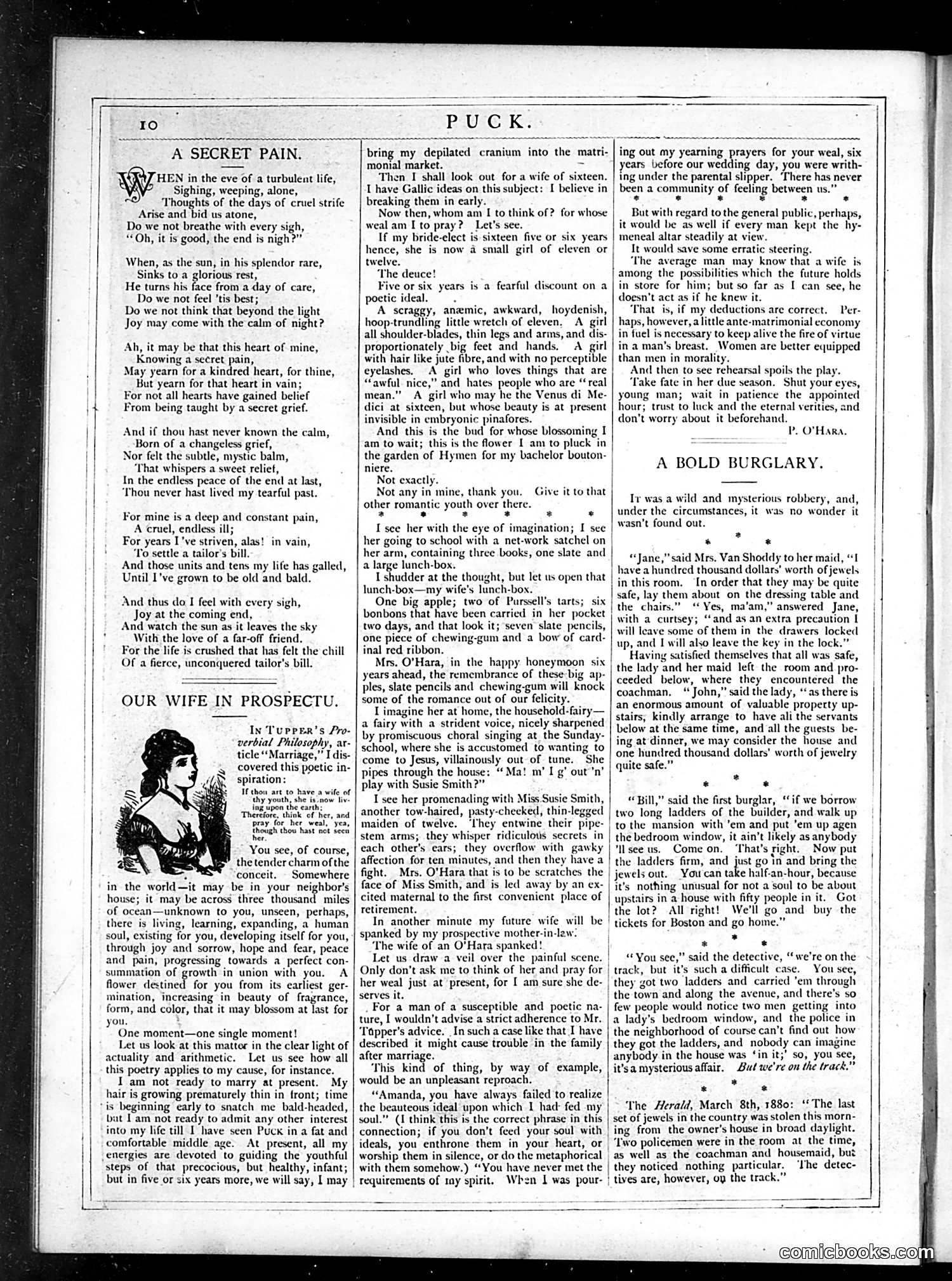
This page contains three distinct pieces: a poem titled "A Secret Pain," an illustrated article "Our Wife in Prospectus," and a story called "A Bold Burglary." The main illustration shows a woman's profile portrait accompanying "Our Wife in Prospectus." The article appears to be satirical commentary on marriage prospects and women's roles, using the device of describing an ideal wife for a bachelor. The text discusses selecting a wife by specific criteria—her age, appearance, accomplishments, and domestic skills—reflecting Victorian attitudes about matrimonial compatibility. "A Bold Burglary" is a humorous crime story about jewel thieves, apparently a serialized fiction piece common to such magazines. The content satirizes contemporary social attitudes about marriage, domesticity, and gender roles through both poetry and prose fiction.
📄 Transcribed text from this page (OCR, searchable)
Machine-transcribed from the original scan — historical spelling and the odd misread are preserved.
po} A SECRET PAIN. HEN in the eve of a turbulent life, Sighing, weeping, alone, ‘Thoughts of the days of cruel strife Arise and bid us atone, Do we not breathe with every “Oh, it is good, the end is When, as the sun, in his splendor rare, Sinks to a glorious rest, He turns his face from a day of care, Do we not feel 'tis best; Do we not think that beyond the light Joy may come with the calm of night? Ah, it may be that this heart of mine, Knowing a secret pain, May yearn for a kindred heart, for thine, But yearn for that heart in vain For not all hearts have gained belief From being taught by a secret grief. And if thou hast never known the calm, Born of a changeless grief, Nor felt the subtle, mystic balm, ‘That whispers a sweet reliet, In the endless peace of the end at last, ‘Thou never hast lived my tearful past. For mine is a deep and constant pain, A cruel, endless ill; For years I've striven, alas! in vain, ‘To settle a tailor’s bill. And those units and tens my life has galled, Until I’ve grown to be old and bald. And thus do I feel with every sigh, Joy at the coming end, And watch the sun as it leaves the sky With the love of a far-off friend. For the life is crushed that has felt the chill Of a fierce, unconquered tailor’s bill. OUR WIFE IN PROSPECTU. In TuPPER’s Pro- verbial Philosophy, ar- ticle “Marriage,” I dis- covered this poetic in- spiration: If thou art to have a wife of thy youth, she is-now liv= Ther tik ef hee, and oat how hast ast deed You see, of course, the tender charm ofthe % conceit. _ Somewhere in the world—it may be in your neighbor's house; it may be across three thousand miles of ocean—unknown to you, unseen, perhaps, there is living, learning, expanding, a human soul, existing for you, developing itself for you, through joy and sorrow, hope and fear, peace and pain, progressing towards a perfect con- summation of growth in union with you. A flower deuined for you from its earliest ger- mination, increasing in beauty of fragrance, form, and color, that it may blossom at last for you. One moment—one single moment! Let us look at this matter in the clear light of actuality and arithmetic. Let us see how all this poetry applies to my cause, for instance. I am not ready to marry at present. My hair is growing prematurely thin in front; time is beginning early to snatch me bald-headed, but Iam not ready to admit any other interest into my life till I have seen Puck ina fat and comfortable middle age. At present, all my energies are devoted to guiding the youthful steps of that precocious, but healthy, infant; but in five or six years more, we will say, I may | bring my depilated cranium into the matri- monial market. a Then I shall look out for a wife of sixteen. | I have Gallic ideas on this subject: I believe in breaking them in early. Now then, whom am I to think of? for whose weal am I to pray? Let's see. If my bride-elect teen five or hence, she is now a small girl of ele twelve ‘The deuce! Five or six years is a fearful discount on a poctic ideal. A scraggy, anemic, awkward, hoydenish, hoop-trundling little wretch of eleven. A girl all shoulder-blades, thin legs and arms, and dis- proportionately big feet and hands. A girl with hair like jute fibre, and with no perceptible eyelashes. A girl who loves things that are “awful nice,” and hates people who are “real mean.” A girl who may he the Venus di Me- dici at sixteen, but whose beauty is at present invisible in embryonic pinafores. And this is the bud for whose blossoming I am to wait; this is the flower [ am to pluck in the garden of Hymen for my bachelor bouton- niere. Not exactly. Not any in mine, thank you. other romantic youth over there. * * = * * . I see her with the eye of imagination; I see her going to school with a net-work satchel on her arm, containing three books, one slate and a large lunch-box. I shudder at the thought, but let us open that lunch-box—my wife’s lunch-box. One big apple; two of Purssell’s tarts; si bonbons that have been carried in her pocket two days, and that look it; seven slate pencils, one piece of chewing-gum and a bow of card: inal red ribbon. Mrs. O'Hara, in the happy. honeymoon six | years ahead, the remembrance of these-big ap- ples, slate pencils and chewing-gum will knock some of the romance out of our felicity. I imagine her at home, the household-fairy— a fairy with a strident voice, nicely sharpened by promiscuous choral singing at the Sunday- school, where she is accustomed to wanting to come to Jesus, villainously out of tune. She pipes through the house: “Ma! m’ I g’ out ’n’ play with Susie Smith?” I see her promenading with Miss Susie Smith, another tow-haired, pasty-checked, thin-legged maiden of twelve. ‘They entwine their pipe- stem arms; they whisper ridiculots secrets in each other's cars; they overflow with gav affection for ten minutes, and then they have a fight. Mrs. O'Hara that is to be scratches the | face of Miss Smith, and is led away by an ex- cited maternal to the first convenient place of retirement. In another minute my future wife will be | spanked by my prospective mother-in-law: ‘The wife of an O'Hara spanked! Let us draw a veil over the painful scene. | Only don’t ask me to think of her and pray for her weal just at present, for [ am sure she de- serves it. "For a man of a susceptible and poetic na- ture, I wouldn’t advise a strict adherence to Mr. Tapper's advice. In such a case like that I have described it might cause trouble in the family after marriage. ‘This kind of thing, by way of example, would be an unpleasant reproach. “Amanda, you have always failed to realize the beauteous ideal upon which I had: fed my soul.” (1 think this is the correct phrase in this ‘onnection; if you don’t feed your soul with ideals, you enthrone them in your heart, or worship them in silence, or do the metaphorical with them somehow.) ‘You have never met the | requirements of toy spirit. When I was pour- | Give it to that | ; among the possibi | the lot? ing out my yearning prayers for your weal, six years before our wedding day, you were writh- ing under the parental slipper. There has never been a community of feeling between us.” * * * 8 * * But with regard to the general public, perhaps, it would be as well if every man kept the hy- meneal altar steadily at vi It would save some erratic steering. ‘The average man may know that a wife is i ch the future holds in store for him; but so far as I can see, he doesn't act as if he knew it. ‘That is, if my deductions are correc Per- haps, however, a little ante-matrimonial economy in fuel is necessary to keep alive the fire of virtue ina man's breast. Women are better equipped than men in moralit: And then to see rehearsal spoils the play. ‘Take fate in her due season. Shut your eyes, young man; wait in patience the appointed hour; trust to luck and the eternal verities, and don't worry about it beforehand. P. O'Hara, A BOLD BURGLARY. Ir was a wild and mysterious robbery, and, under the circumstances, it was no wonder it wasn’t found out. * * * “Jane,"said Mrs. Van Shoddy to her maid, “1 | have a hundred thousand dollars’ worth of jewels in this room. ‘In order that they may be quite safe, lay them about on the dressing table and the ‘chairs.” “Yes, ma'am,” answered Jane, with a curtsey; ‘and as an extra precaution L will leave some of them in the drawers locked up, and I will also leave the in the lock.” Having satisfied themselves that all was safe, | the lady and her maid left the room and pro- ceeded below, where they encountered the coachman, “ John,” said the lady, “as there is an enormous amount of valuable property up- stairs, kindly arrange to have ali the servants below at the same time, and all the guests be- ing at dinner, we may consider the house and one hundred thousand dollars’ worth of jewelry quite safe.” * * * “Bill,” said the first burglar, “if we borrow two long ladders of the builder, and walk up to the mansion with 'em and put 'em up agen the bedroom window, it ain’t likely as anybody ‘Wsee us. Come on. ‘That's right. Now put the ladders firm, and just go in and bring the jewels out. You can take half-an-hour, because it's nothing unusual for not a soul to be about upstairs in a house with fifty people in it. Got All right! We'll go and buy the tickets for Boston and go home.” * * * “You see,” said the detective, “we're on the track, but it’s such a difficult case. You see, they got two ladders and carried 'em through | the town and along the avenue, and there's so few people would notice two men getting into a lady's bedroom window, and the police in the neighborhood of course can’t find out how they got the ladders, and nobody can imagine anybody in the house was ‘in it;’ so, you see, it’sa mysterious affair, But we're on the track.” * * * ‘The Herald, March 8th, 1880: ‘The last set of jewels in the country was stolen this morn- ing from the owner's house in broad daylight. ‘Ewo policemen were in the room at the time, as well as the coachman and housemaid, but they noticed nothing particular. ‘Ihe detec- tives are, however, oy the track.” comichooks.