
Puck, 1877-04 · page 5 of 16
Puck — April 1877 — page 5: what you’re looking at
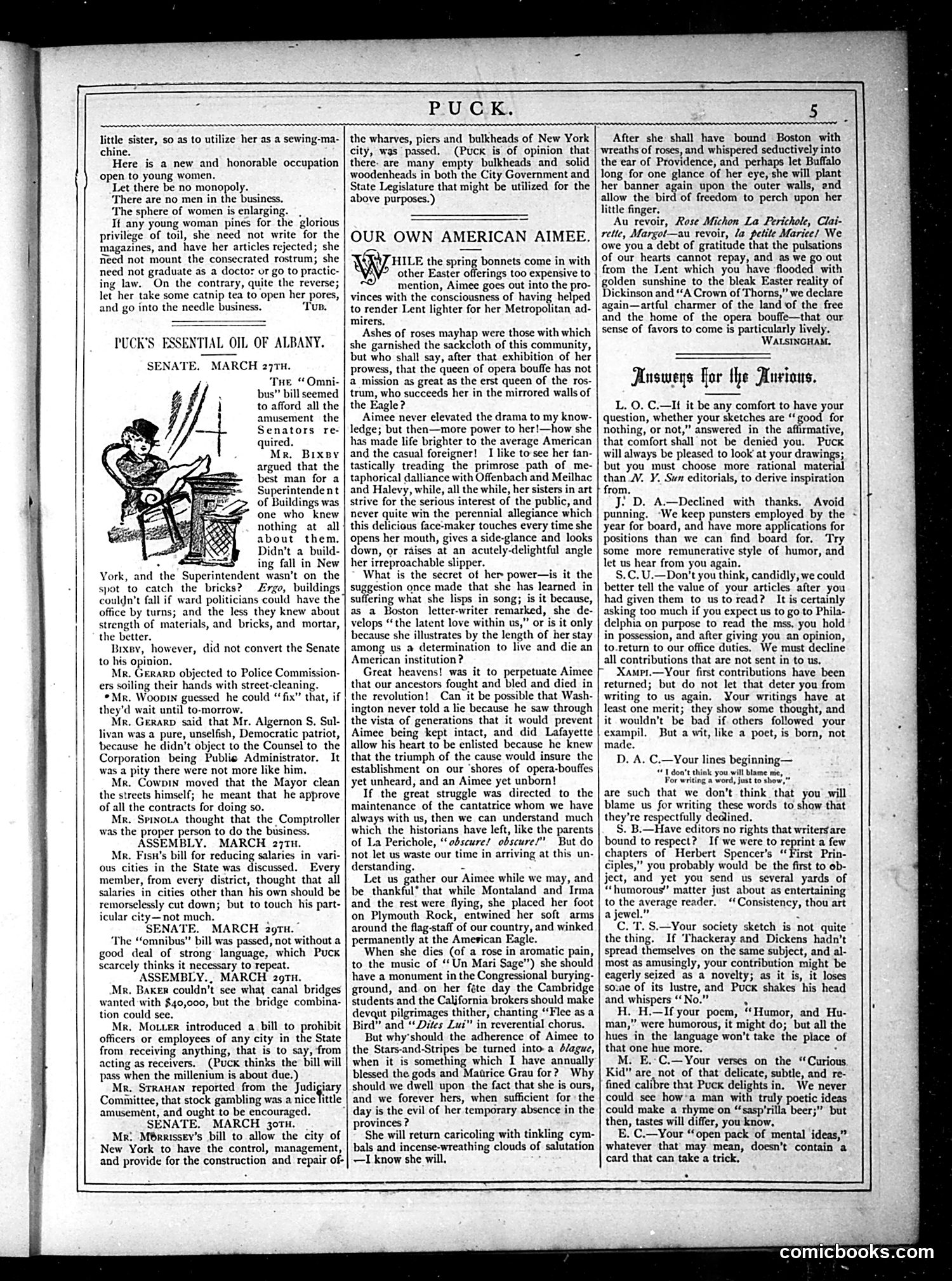
What you’re looking at
This political cartoon satirizes New York State legislative corruption. The illustration shows a figure (likely a politician) being squeezed like a lemon or fruit press, with money and bribes literally flowing out. The accompanying Senate debate discusses various scandals: bribery among legislators, bridge construction kickbacks, and officials enriching themselves through public works contracts. The cartoon's title suggests Albany politics are fundamentally corrupt—the "essential oil" extracted from the capital is pure graft. References to specific incidents (canal bridges, the Superintendent's bribes) indicate this targets actual contemporary scandals rather than hypothetical corruption. The satire's point: New York's legislative system produces corruption as naturally as fruit yields oil—it's systemic, not incidental.
📄 Transcribed text from this page (OCR, searchable)
Machine-transcribed from the original scan — historical spelling and the odd misread are preserved.
PUCK. little sister, so as to utilize her as a sewing-ma- chine. Here is a new and honorable occupation open to young women. Let there be no monopoly. ‘There are no men in the business. ‘The sphere of women is enlarging. , If any young woman pines for the glorious privilege of toil, she need not write for the magazines, and have her articles rejected; she need not mount the consecrated rostrum; she need not graduate as a doctor or go to practic- ing law. On the contrary, quite the reverse; let her take some catnip tea to open her pores, and go into the needle business. ‘Tun. PUCK’S ESSENTIAL OIL OF ALBANY. MARCH 27TH. Tue “Omni- . bus" bill seemed 1 to afford all the amusement the Senators re- quired. Mr. Bixsy argued that the best man for a Superintendent of Buildings was one who knew nothing at all about them. Didn't a build- . ing fall in New | York, and the Superintendent wasn’t on the to catch the bricks? Z£rgo, buildings couldn't fall if ward politicians could have the office by turns; and the less they knew about strength of materials, and bricks, and mortar, the better, Bixsy, however, did not convert the Senate to his opinion. Mr. Gerarp objected to Police Commission- ers soiling their hands with street-cleaning. *Mr. Wooptn guessed he could “fix” that, if they'd wait until to-morrow. Mr. Gerarp said that Mr. Algernon S. Sul- livan was a pure, unselfish, Democratic patriot, because he didn’t object to the Counsel to the Corporation being Publie Administrator. It was a pity there were not more like him, | Mr. Cowpin moved that the Mayor clean the str himself; he meant that he approve of all the contracts for doing so. Mr. Spinota thought that the Comptroller was the proper person to do the business. ASSEMBLY. MARCH 27TH. Mr. Fisn’s bill for reducing salaries in_vari- ous cities in the State was discussed. Every member, from every district, thought that all salaries in cities other than his own should be remorselessly cut down; but to touch his part- icular —not much. R SENATE. MARCH 2gtu. ‘The “omnibus” bill was passed, not without a good deal of strong language, which Puck scarcely thinks it necessary to repeat. ASSEMBLY., MARCH zortn. Mr. Baker couldn’t see what canal bridges wanted with $40,000, but the bridge combina- tion could see. Mr. Motter introduced a bill to prohibit officers or employees of any city in the State from receiving anything, that is to say, from acting as receivers. (Puck thinks the bill will pass when the millenium is about due.) Mr. Srranan reported from the Judigiary Committee, that stock gambling was a nice little amusement, and ought to be encouraged. SENATE. MARCH 30TH. Mr: -Mbrrissev’s Dill to allow the city of New York to have the control, management, and provide for the construction and repair of- SENATE. the wharves, piers and bulkheads of New York city, was passed. (Puck is of opinion that there. are many empty bulkheads and solid woodenheads in both the City Government and State Legislature that might be utilized for the above purposes.) OUR OWN AMERICAN AIMEE. Wyte the spring bonnets come in with other Easter offerings too expensive to mention, Aimee goes out into the pro- vinces with the consciousness of having helped to render Lent lighter for her Metropolitan ad- mirers, ‘Ashes of roses mayhap were those with which she garnished the sackcloth of this community, but who shall say, after that exhibition of her prowess, that the queen of opera bouffe has not a mission as great as the erst queen of the ros- trum, who succeeds her in the mirrored walls of the Eagle? Aimee never elevated the drama to my know- ledge; but then—more power to her!—how she has made life brighter to the average American and the casual foreigner! I like to see her fan- tastically treading the primrose path of me- taphorical dalliance with Offenbach and Meilhac and Halevy, while, all the while, her sisters in art strive for the serious interest of the public, and never quite win the perennial allegiance which this delicious face-maker touches every time she opens her mouth, gives a side-glance and looks down, or raises at an acutely-delightful angle her irreproachable slipper. What is the secret of her power—is it the suggestion once made that she has learned in suffering what she lisps in song; is it because, as a Boston letter-writer remarked, she de- velops “the latent love within us,” or is it only because she illustrates by the length of her stay among us a determination to live and die an American institution ? Great heavens! was it to perpetuate Aimee [ that our ancestors fought and bled and died in the revolution! Can it be possible that Wash- ington never told a lie because he saw through the vista of generations that it would prevent Aimee being kept intact, and did Lafayette allow his heart to be enlisted because he knew that the triumph of the cause would insure the establishment on our ‘shores of opera-bouffes yet unheard, and an Aimee yet unborn! If the great struggle was directed to the maintenance of the cantatrice whom we have always with us, then we can understand much which the historians have left, like the parents of La Perichole, “‘obseure! obscure!’ But do not let us waste our time in arriving at this un- derstanding. as Let us gather our Aimce while we may, and be thankful® that while Montaland and Irma and the rest were flying, she placed her foot on Plymouth Rock, entwined her soft arms around the flag-staff of our country, and winked permanently at the American Eagle. When she dies (of a rose in aromatic pain, to the music of ‘‘Un Mari Sage”) she should have a monument in the Congressional burying- ground, and on her féte day the Cambridge students and the Caljfornia brokers should make devqut pilgrimages thither, chanting ‘‘Flee as a Bird” and ‘“Dites Lui” in reverential chorus. But why’should the adherence of Aimee to the Stars-and-Stripes be turned into a d/ague, when it is something which I have annually blessed the gods and Matrice Grau for? Why should we dwell upon the fact that she is ours, and we forever hers, when sufficient for the day is the evil of her temporary absence in the provinces ? She will return caricoling with tinkling cym- bals and incense-wreathing clouds of salutation —I know she will, After she shall have bound Boston with wreaths of roses, and whispered seductively into the ear of Providence, and perhaps let Buffalo long for one glance of her eye, she will plant her banner again upon the outer walls, end allow the bird of freedom to perch upon her little finger, Au revoir, Rose Michon La Perichole, Clai- rette, Margot—au revoir, la petite Marice! We owe you a debt of gratitude that the pulsations of our hearts cannot repay, and as we go out from the Lent which you have flooded with golden sunshine to the bleak Easter reality of Dickinson and ‘‘A Crown of Thorns,” we declare again—artful charmer of the land of the free and the home of the opera bouffe—that our sense of favors to come is particularly lively. WALSINGHAM, Answeys for the Auriaus. L. O. C.—If it be any comfort to have your question, whether your sketches are “good for nothing, or not,” answered in the affirmative, that comfort shall not be denied you. Puck will always be pleased to look at your drawings; but you must choose more rational material than WV. Y. Sun editorials, to derive inspiration from. J: D. A.—Declined with thanks. Avoid punning. ‘We keep punsters employed by the year for board, and have more applications for positions than we can find board for. Try some more remunerative style of humor, and let us hear from you again. S.C. U.—Don'’t you think, candidly, we could better tell the value of your articles after you had given them to us to read? It is certainly asking too much if you expect us to go to Phila- delphia on purpose to read the mss, you hold in possession, and after giving you an opinion, to.return to our office duties. We must decline all contributions that are not sent in to us. Xampr.—Your first contributions have been returned; but do not let that deter you from writing to us again. Your writings have at least one merit; they show some thought, and it wouldn't be bad if others followed your exampil. But a wit, like a poet, is born, not made. D. A. C.—Your lines beginning— doa't think you will blame me, For writing a word, just to show,” are such that we don’t think that you will blame us for writing these words to show that they’re respectfully declined. S. B.—Have editors no rights that writers are bound to respect? If we were to reprint a few chapters of Herbert Spencer's “First. Prin- ciples,” you probably would be the first to ob- ject, and yet you send us several yards of ‘humorous’ matter just about as entertaining to the average reader. ‘Consistency, thou art —Your society sketch is not quite ‘3 If Thackeray and Dickens hadn't spread themselves on the same subject, and al- most as amusingly, your contribution might be eagerly seized as a novelty; as it is, it loses some of its lustre, and Puck shakes his head and whispers “No.” ; H. H.—If your poem, “Humor, and Hu- man,” were humorous, it might do; but all the hues in the language won't take the place of that one hue more. : M. E.-C.—Your verses on the ‘Curious, Kid” are not of that delicate, subtle, and re- fined calibre that Puck delights in. We never could see how-a man with truly poetic ideas could make a rhyme on “sasp'rilla beer; but then, tastes will differ, you know. E. C.—Your “open pack of mental ideas,” whatever that’ may mean, doesn’t contain a card that can take a trick, —_$—$ $$ $$$ <_< comicbooks.com