
Puck, 1877-04 · page 2 of 16
Puck — April 1877 — page 2: what you’re looking at
What you’re looking at
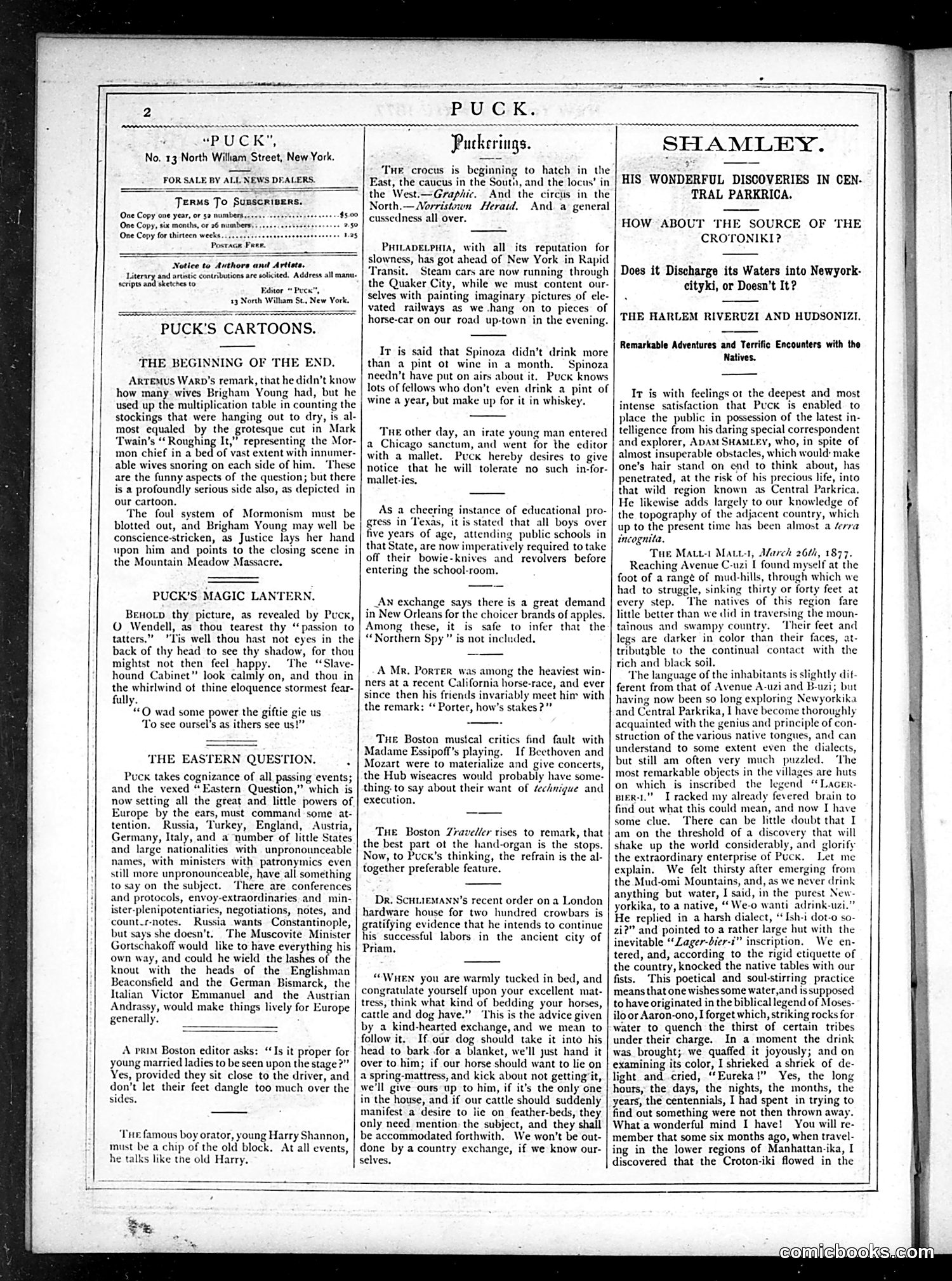
This page is primarily **editorial content and articles rather than political cartoons**. The visible sections include: **"Puck's Cartoons"** section contains several brief satirical pieces: - "The Beginning of the End" mocks Ward's remarks about Brigham Young - "Puck's Magic Lantern" is a comedic piece about shadows - "The Eastern Question" discusses European political tensions - Various humor pieces about Boston critics, horse racing, and contemporary social topics The cartoons themselves are not clearly visible in this image reproduction—the page shows mostly text columns. The satire targets include religious figures (Young), musical critics, and general social foibles of the era. Without clearer images of the actual illustrations, the specific visual satire and caricatures cannot be definitively identified.
📄 Transcribed text from this page (OCR, searchable)
Machine-transcribed from the original scan — historical spelling and the odd misread are preserved.
—. PUCK. “PUCK”, No. 13 North Willam Street, New York. FOR SALE BY AL EWS DEALERS. Terms To Sunscripers. ‘One Copy one year, or 2 numbers One Copy, six months, or 26 numbers ‘One Copy for thirteen weeks. Postace Peer. se$5.00 + 250 + 1s Notice to Authors and Artieta. Literary and artistic contributions are solicited. Address all manu- scripts and sketches to Béitor Pecx’ 13 North Wilham St., New York, PUCK’S CARTOONS. THE BEGINNING OF THE END. Artemus Warp's remark, that he didn’t know how many wives Brigham Young had, but he used up the multiplication table in counting the stockings that were hanging out to dry, is al- | most equaled by the grotesque cut in Mark ‘Twain’s “Roughing It,” representing the Mor- mon chief in a bed of vast extent with innumer- able wives snoring on each side of him. ‘These are the funny aspects of the question; but there is a profoundly serious side also, as depicted in our cartoon. The foul system of Mormonism must be blotted out, and Brigham Young may well be conscience-stricken, as Justice lays her hand upon him and points to the closing scene in the Mountain Meadow Massacre. PUCK’S MAGIC LANTERN. Benoup thy picture, as revealed by Puck, O Wendell, as thou tearest thy ‘passion to tatters.” "Tis well thou hast not eyes in the back of thy head to see thy shadow, for thou mightst not then feel happy. ‘The “Slave- hound Cabinet” look calmly on, and thou in the whirlwind of thine eloquence stormest fear- fully. “O wad some power the giftie gie us ‘To see oursel’s as ithers see us!” THE EASTERN QUESTION. 25 Puck takes cognizance of all passing events; and the vexed “Eastern Question,” which is now setting all the great and little powers of Europe by the ears, must command some at- tention. Russia, Turkey, England, Austria, Germany, Italy, and a number of little States and large nationalities with unpronounceable names, with ministers with patronymics even still more unpronounceable, have all something to say on the subject. ‘There are conferences and protocols, envoy-extraordinaries and min- ister-plenipotentiaries, negotiations, notes, and count.r-notes. Russia wants Constantinople, but says she doesn’t. The Muscovite Minister Gortschakoff would like to have everything his own way, and could he wield the lashes of the knout with the heads of the Englishman Beaconsfield and the German Bismarck, the Italian Victor Emmanuel and the Austrian Andrassy, would make things lively for Europe generally. A prim Boston editor asks: ‘Is it proper for young married ladies to be seen upon the stage?” Yes, provided they sit close to the driver, and gout let their feet dangle too much over the sides. ‘Tur famous boy orator, young Harry Shannon, must be a chip of the old block. At all events, he talks like the old Harry. 3 Purkerings. Tre crocus is beginning to hatch in the East, the caucus in the South, and the locus’ in the West.—Graphic. And the circus in the North.—Norristown Heratd. And a general cussedness all over. PHILADELPHIA, with all its reputation for slowness, has got ahead of New York in Rapid Transit. Steam cars are now running through the Quaker City, while we must content our- selves with painting imaginary pictures of ele- vated railways as we hang on to pieces of horse-car on our road up-town in the evening. Ir is said that Spinoza didn’t drink more than a pint ot wine in a month. Spinoza needn’t have put on airs about it. Puck knows lots of fellows who don’t even drink a pint of wine a year, but make up for it in whiskey. E other day, an irate young man entered a Chicago sanctum, and went for the editor with a mallet. Pvcx hereby desires to give notice that he will tolerate no such in-for- mallet-ies, As a cheering instance of educational pro- gress in ‘Texas, it is stated that all boys over five years of age, attending public schools in that State, are now imperatively required to take off their bowie-knives and revolvers before entering the school-room. _An exchange says there is a great demand in New Orleans for the choicer brands of apples. Among these, it is safe to infer that the “Northern Spy” is not included, A Mr. Porter was among the heaviest win- ners at a recent California horse-race, and ever since then his friends invariably meet him with the remark: “Porter, how's stakes?” Tue Boston mustcal critics find fault with Madame Essipoff’s playing. If Beethoven and Mozart were to materialize and give concerts, the Hub wiseacres would probably have some- thing. to say about their want of éechnique and execution. Tue Boston Zraveller rises to remark, that the best part ot the hand-organ is the stops. Now, to Puck’s thinking, the refrain is the al- together preferable feature. Dr. SCHLIEMANN’s recent order on a London hardware house for two hundred crowbars is gratifying evidence that he intends to continue his successful labors in the ancient city of Priam. “When you are warmly tucked in bed, and congratulate yourself upon your excellent mat- tress, think what kind of bedding your horses, cattle and dog have.” This is the advice given by a kind-hearted exchange, and we mean to follow it. If.our dog should take it into his head to bark for a blanket, we'll just hand it over to him; if our horse should want to lie on a spring-mattress, and kick about not getting’it, we'll give ours up to him, if it's the only one in the house, and if our cattle should suddenly manifest a desire to lie on feather-beds, they only need mention: the subject, and they shall be accommodated forthwith, We won't be out- done by a country exchange, if we know our- selves, SHAMLEY. HIS WONDERFUL DISCOVERIES IN CEN- TRAL PARKRICA. HOW ABOUT THE SOURCE OF THE CROTONIKI? Does it Discharge its Waters into Newyork- cityki, or Doesn’t It? THE HARLEM RIVERUZI AND HUDSONIZI. Remarkable Adventures and Terrific Encounters with the Natives. Ir is with feelings ot the deepest and most intense satisfaction that Puck is enabled to place the public in possession of the latest in- telligence from his daring special correspondent and explorer, ADAM SHAMLEY, who, in spite of almost insuperable obstacles, which would: make one’s hair stand on end to think about, has penetrated, at the risk of his precious life, into that wild region known as Central Parkrica. He likewise adds largely to our knowledge of the topography of the adjacent country, which up to the present time has been almost a ferra incognita, Tue Maut-t March 26th, 1877. Reaching Avenue C-uzi I found myself at the foot of a range of mud-hills, through which we had to struggle, sinking thirty or forty feet at every step. "The natives of this region fare little better than we did in traversing the moun- tainous and swampy country. ‘Their feet and legs are darker in color than their faces, at- tributgble to the continual contact with the rich and black soil. ‘The language of the inhabitants is slightly dit ferent from that of Avenue A-uzi and B-uzi; but having now been so long exploring Newyorkika and Central Parkrika, I have become thoroughly acquainted with the genius and principle of con- struction of the various native tongues, and can understand to some extent even the dialects, but still am often very much puzzled. ‘The most remarkable objects in the villages are huts on which is inscribed the legend “ Lacer- pier-t.”” [racked my already fevered brain to find out what this could mean, and now I have some clue. There can be little doubt that I am on the threshold of a discovery that will shake up the world considerably, and glorify the extraordinary enterprise of Pu Let me explain. We felt thirsty after emerging from the Mud-omi Mountains, and, as we never drink anything but water, I said, in the purest New- yorkika, to a native, “W wanti adrink-uzi.”” He replied in a harsh dialect, ‘‘Ish-i dot-o so- zi?” and pointed to a rather large hut with the inevitable “‘Lager-dier-#” inscription, We en- tered, and, according to the rigid etiquette of the country, knocked the native tables with our fists. ‘This poetical and soul-stirring practice means that one wishes some water,and is supposed to have originated in the biblical legend of Moses- ilo or Aaron-ono, I forget which, striking rocks for water to quench the thirst of certain tribes under their charge. In a moment the drink was brought; we quaffed it joyously; and on examining its color, I shrieked a shriek of de- light and cried, “Eureka!” Yes, the long hours, the days, the nights, the months, the years, the centennials, I had spent in trying to find out something were not then thrown away. What a wonderful mind I have! You will re- member that some six months ago, when travel- ing in the lower regions of Manhattan-ika, I discovered that the Croton-iki flowed in the icomicbooksseon