
Puck, 1877-04 · page 4 of 16
Puck — April 1877 — page 4: what you’re looking at
What you’re looking at
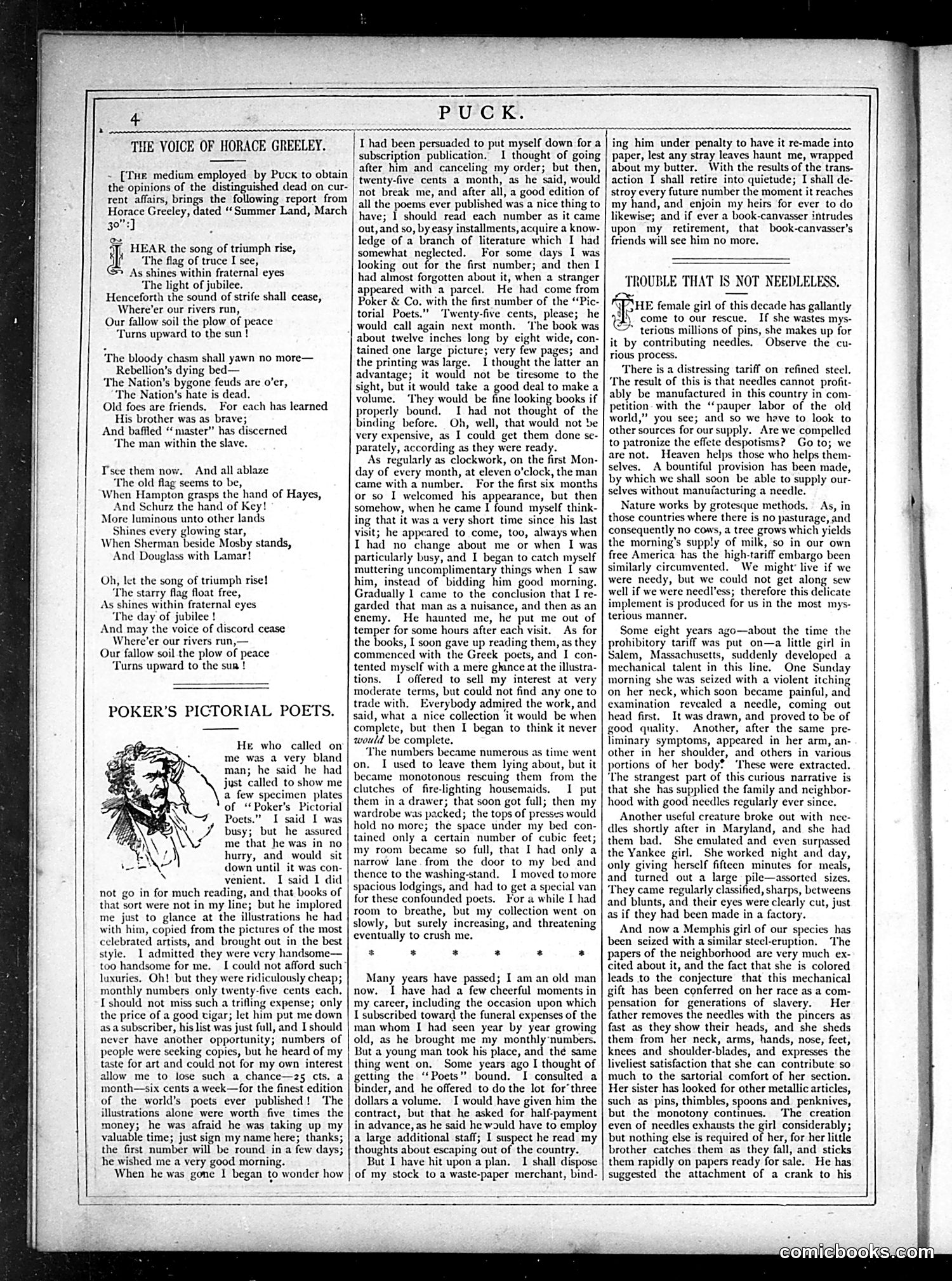
This page contains two distinct sections: "The Voice of Horace Greeley" (a poem) and "Poker's Pictorial Poets" (prose essay with illustration). The Greeley poem appears to reference **Horace Greeley**, the famous 19th-century newspaper editor and politician. The poem's themes of triumph, flag, jubilee, and "master" suggest it's either praising or satirizing Greeley's political positions or legacy. The "Poker's Pictorial Poets" essay discusses collecting bound volumes of Puck magazine itself—a meta-commentary where Puck humorously describes the challenges of storing and preserving its own publications. The writer jokes about space constraints and the nuisance value of maintaining a complete collection, while simultaneously promoting the idea that Puck's illustrated poetry deserves preservation as fine literature. The illustration shows a caricatured face in Puck's characteristic style but the specific figure is unclear from the image alone.
📄 Transcribed text from this page (OCR, searchable)
Machine-transcribed from the original scan — historical spelling and the odd misread are preserved.
4 PUCK. THE VOICE OF HORACE GREELEY. [THe medium employed by Puck to obtain the opinions of the distinguished dead on cur- rent affairs, brings the following report from Horace Greeley, dated ‘ Summer Land, March 30”:] a As shines within fraternal eyes The light of jubilee. Henceforth the sound of strife shall cease, Where’er our rivers run, Our fallow soil the plow of peace ‘Turns upward to the sun! HEAR the song of triumph rise, The flag of truce I see, ‘The bloody chasm shall yawn no more— Rebellion’s dying bed— ‘The Nation’s bygone feuds are o'er, The Nation's hate is dead. Old foes are friends, For each has learned His brother was as brave; And bafiled “master” has discerned ‘The man within the slave. T'sce them now, And all ablaze The old flag seems to be, When Hampton grasps the hand of Hayes, And Schurz the hand of Key! More luminous unto other lands Shines every glowing star, When Sherman beside Mosby stands, And Douglass with Lamar! Oh, let the song of triumph rise! ‘The starry flag float free, As shines within fraternal eyes The day of jubilee ! And may the voice of discord cease Where’er our rivers run,— Our fallow soil the plow of peace Turns upward to the sua! POKER’S PICTORIAL POETS. He who called on me was a very bland man; he said he had just called to show me ‘a few specimen plates of ‘Poker’s Pictorial Poets.” I said I was busy; but he assured me that he was in no hurry, and would. sit down until it was con- venient. I said 1 did not go in for much reading, and that books of that sort were not in my line; but he implored me just to glance at the illustrations he had with him, copied from the pictures of the most celebrated artists, and brought out in the best style. 1 admitted they were very handsome— too handsome for me. I could not afford such luxuries. Oh! but they were ridiculously cheap; monthly numbers only twenty-five cents each, I should not miss such a trifling expense; only the price of a good vigar; let him put me down as a subscriber, his list was just full, and I should never have another opportunity; numbers of people were seeking copies, but he heard of my taste for art and could not for my own interest allow me to lose such a chance—25 cts, a month—six cents a week—for the finest edition of the world’s poets ever published! The illustrations alone were worth five times the money; he was afraid he was taking up my valuable time; just sign my name here; thanks; the first number will be round in a few days; he wished me a very good morning. Thad been Race to put myself down for a subscription publication. 1 thought of going after him and canceling my order; but then, | twenty-five cents a month, as he said, would not break me, and after all, a good edition of | all the poems ever published was a nice thing to have; 1 should read each number as it came out, and so, by easy installments, acquire a know- ledge of a branch of literature which I had somewhat neglected. For some days I was looking out for the first number; and then I had almost forgotten about it, when a stranger appeared with a parcel. He had come from Poker & Co. with the first number of the ‘Pic- torial Poets.” ‘I'wenty-five cents, please; he would call again next month. ‘The book was about twelve inches long by eight wide, con- tained one large picture; very few pages; and the printing was large. 1 thought the latter an advantage; it would not be tiresome to the sight, but it would take a good deal to make a volume. ‘They would be fine looking books if properly bound. I had not thought of the binding before. Oh, well, that would not be very expensive, as I could get them done se- parately, according as they were ready. As regularly as clockwork, on the first Mon- day of every month, at eleven o'clock, the man came with a number. _ For the first six months or so I welcomed his appearance, but then somehow, when he came I found myself think- ing that it was a very short time since his last visit; he appeared to come, too, always when I had no change about me or when I was particularly busy, and I began to catch myself muttering uncomplimentary things when I saw him, instead of bidding him good morning. Gradually 1 came to the conclusion that I re- garded that man as a nuisance, and then as an enemy. He haunted me, he put me out of temper for some hours after each visit. As for the books, I soon gave up reading them, as they commenced with the Greek poets, and I con- tented myself with a mere ghince at the illustra- tions. I offered to sell my interest at very moderate terms, but could not find any one to trade with. Everybody admired the work, and said, what a nice collection ‘it would be when complete, but then I began to think it never would be complete. ‘The numbers became numerous as time went on. I used to leave them lying about, but it became monotonous rescuing them from the clutches of fire-lighting housemaids. I put them in a drawer; that soon got full; then my wardrobe was packed; the tops of presses would hold no more; the space under my bed con- tained only a certain number of cubic feet; my room became so full, that I had only a narrow lane. from the door to my bed and thence to the washing-stand. I moved to more spacious lodgings, and had to get a special van for these confounded poets. For a while I had room to breathe, but my collection went on slowly, but surely increasing, and threatening eventually to crush me. * * * Pa * * Many years have passed; I am an old man now. I have had a few cheerful moments in my career, including the occasion upon which I subscribed toward the funeral expenses of the man whom I had seen year by year growing old, as he brought me my monthly‘numbers. But a young man took his place, and thé same thing went on. Some years ago I thought of getting the “Poets” bound. I consulted a binder, and he offered to do the lot for’ three dollars a volume. I would have given him the contract, but that he asked for half-payment in advance, as he said he would have to employ a large additional staff; I suspect he read my thoughts about escaping out of the country. But I have hit upona plan. 1 shall dispose When he was gone I began to wonder how of my stock to a waste-paper merchant, bind- ing him under penalty to have it re-made into paper, lest any stray leaves haunt me, wrapped about my butter. With the results of the trans- action I shall retire into quietude; I shall de- stroy every future number the moment it reaches my hand, and enjoin my heirs for ever to do likewise; and if ever a book-canvasser intrudes upon my retirement, that book-canvasser’s friends will see him no more. TROUBLE THAT IS NOT NEEDLELESS. ‘pre female girl of this decade has gallantly come to our rescue. If she wastes mys- ~* terious millions of pins, it by contributing needles. rious process. There is a distressing tariff on refined steel. ‘The result of this is that needles cannot profit- ably be manufactured in this country in com- petition with the “pauper labor of the old world,” you see; and so we have to look to other sources for our supply. Are we compelled to patronize the effete despotisms? Go to; we are not. Heaven helps those who helps them- selves. A bountiful provision has been made, by which we shall soon be able to supply our- selves without manujacturing a needle. Nature works by grotesque methods. As, in those countries where there is no pasturage, and consequently no cows, a tree grows which yields the morning's supp!y of so in our own free America has the high-tariff embargo been similarly circumvented. We might live if we were needy, but we could not get along sew well if we were needl’ess; therefore this delicate implement is produced for us in the most mys- terious manner. Some eight years ago—about the time the prohibitory tariff was put on—a little girl in Salem, Massachusetts, suddenly developed a mechanical talent in this line. One Sunday morning she was seized with a violent itching on her neck, which soon became painful, and examination revealed a needle, coming out head first. It was drawn, and proved to be of good quality, Another, after the same pre- liminary symptoms, appeared in her arm, an- other in her shoulder, and others in various portions of her body? ‘hese were extracted. ‘The strangest part of this curious narrative is that she has supplied the family and neighbor- hood with good needles regularly ever since. Another useful creature broke out with nec- dles shortly after in Maryland, and she had them bad. She emulated and even surpassed the Yankee girl. She worked night and day, only giving herself fifteen minutes for meals, and turned out a large pile—assorted sizes. ‘They came regularly classified, sharps, betweens and blunts, and their eyes were clearly cut, just as if they had been made in a factory. And now a Memphis girl of our species has been seized with a similar stecl-eruption. The papers of the neighborhood are very much ex- cited about it, and the fact that she is colored leads to the conjecture that this mechanical gift has been conferred on her race as a com- pensation for generations of slavery. Her father removes the needles with the pincers as fast as they show their heads, and she sheds them from her neck, arms, hands, nose, feet, knees and shoulder-blades, and expresses the liveliest satisfaction that she can contribute so much to the sartorial comfort of her section. Her sister has looked for other metallic articles, such as pins, thimbles, spoons and. penknives, but the monotony continues. The creation even of needles exhausts the girl considerably; but nothing else is required of her, for her little brother catches them as they fall, and sticks them rapidly on papers ready for sale. He has suggested the attachment of a crank to his she makes up for Observe the cu-