
Puck, 1877-04 · page 6 of 16
Puck — April 1877 — page 6: what you’re looking at
What you’re looking at
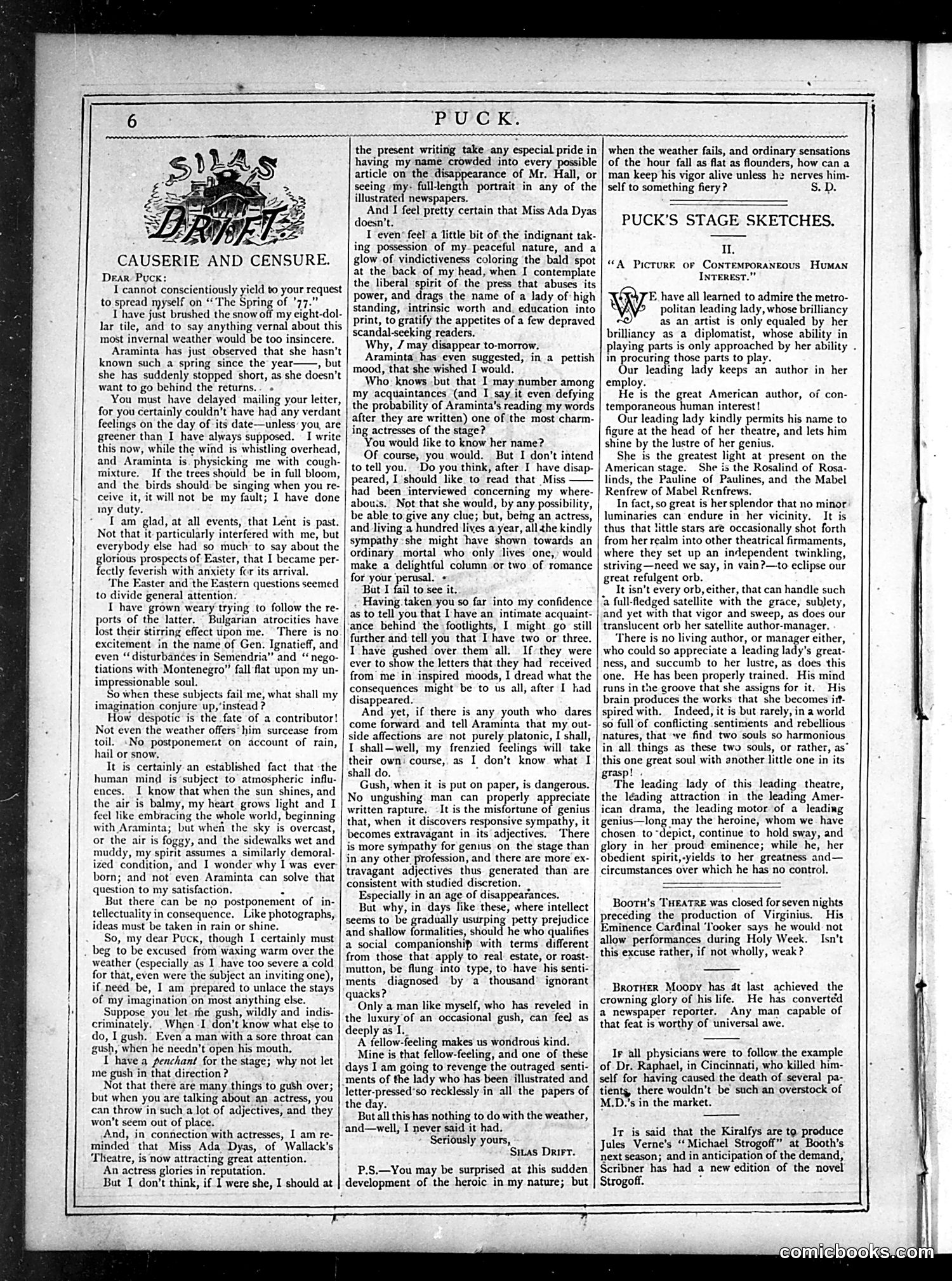
This page contains primarily **editorial text** rather than political cartoons. The main sections are: 1. **"Causerie and Censure"** by Silas Drift—a column addressing theatrical censorship and a actress's disappearance, discussing press freedom and theatrical propriety. 2. **"Puck's Stage Sketches"**—theater criticism praising a contemporary female leading actress for her brilliance and range, comparing her favorably to classic theatrical figures. The remaining content covers theatrical news, including Booth's Theatre closure and Brother Moody's newspaper career. **No clear political satire or caricatures are visible in this image.** The page appears focused on **theater criticism and industry commentary** rather than political commentary, which was Puck's typical focus.
📄 Transcribed text from this page (OCR, searchable)
Machine-transcribed from the original scan — historical spelling and the odd misread are preserved.
PUCK. — CAUSERIE AND CENSURE. Dear Puck: I cannot conscientiously yield to your request to spread myself on ‘The Spring of '77.” T have just brushed the snow off my eight-dol- lar tile, and to say anything vernal about this most invernal weather would be too insincere, Araminta has just observed that she hasn't known such a spring since the year—, but she has suddenly stopped short, as she doesn’t want to go behind the returns...» You must have delayed mailing your letter, for you certainly couldn’t have had any verdant feelings on the day of its date—unless’ you, are greener than I have always supposed. * I write this now, while the wind is whistling overhead, and Araminta is. physicking me with cough. mixture. If the trees should be in full bloom, and the birds should: be singing when you re- ceive it, it will not be my fault; 1 have done any duty. I am glad, at all events, that Lent is past. Not that it particularly interfered with me, but everybody else had so much to say about the glorious prospects of Easter, that I became per- fectly feverish with anxiety for its arrival. Phe Easter and the Eastern questions seemed to divide general attention. I have grown weary trying to follow the re- ports of the latter. © Bulgarian atrocities have lost their stirring effect upon me. ‘There is no excitement in the name of Gen. Ignatieff, and even ‘disturbances in Semendria” and “ nego- tiations with Montenegro” fall flat upon my un- impressionable soul. So when these subjects fail me, what shall my imagination conjure up,’instead ? How despotic is the fate of a contributor! Not even the weather offers’ him surcease from toil. ‘No postponement on account of rain, hail or snow, It is certainly an established fact that ‘the human mind is ‘subject to atmospheric influ- ences. I know that when the sun shines, and the air is balmy, my heart grows light and I feel like embracing the whole world, beginning with Araminta; but when the sky is overcast, or the air is foggy, and the sidewalks wet and muddy, my spirit assumes a. similarly demoral- ized condition, and I wonder why I was ever born; and not even Araminta can solve that question to my satisfaction. : But there can be no postponement of in- tellectuality in consequence. Like photographs, ideas must be taken in rain or shine. So, my dear Puck, though I certainly must beg to be excused from waxing warm over the weather (especially as I have too severe a cold for that, even were the subject an inviting one), if need be, I am prepared to unlace the stays of my imagination on most anything else. Suppose you let the gush, wildly and indis- criminately, _ When I don’t know what else to do, I gush. Even a man with a sore throat can gush, when he needn’t open his mouth, I have a penchant for the stage; why not let me gush in that direction? Not that there are many things to gush over; but when you are talking about an actress, you can throw in such a lot of adjectives, and they won't seem out of place. And, in connection with actresses, I am re- minded that Miss Ada Dyas, of Wallack’s ‘Theatre, is now attracting great attention. An actress glories in'reputation. —~ But I don’t think, if I were she, I should at the present writing take any especial pride in having my name crowded into every possible article on the disap) ince of Mr. Hall, or seeing my: full-length portrait in any of the illustrated newspapers. And I feel pretty certain that Miss Ada Dyas doesn’t. I even® feel a little bit of the indignant tak- ing possession of my-peaceful nature, and a glow of vindictiveness coloring ‘the bald spot at the back of my head, when I contemplate the liberal spirit of the press that abuses its power, and drags the name of a lady of high standing, intrinsic worth and, education into print, to gratify the appetites of a few depraved scandal-seeking readers. Why, / may disappear to-morrow. Araminta has even suggested, in a pettish mood, that she wished I would. Who: knows -but that I may number among my acquaintances (and I say it even defying the probability of Araminta’s reading my words after they are written) one of the most charm- ing actresses of the stage? You would like to know her name? Of course, you would. But I don’t intend to tell you. Do you think, after I have disap- peared, I should like to read that Miss had been interviewed concerning my w abouts. Not that she would, by any possibility, be able to. give any clue; but, being an actress, and living a hundred lives a year, all the kindly sympathy -she might have shown towards an ordinary. mortal who only lives one,» would make a delightful column or two of romance for your perusal. + But I fail to see it. Having.taken you so far into my confidence as to tell you that I have an intimate acquaint- ance behind the footlights, I might go still further and tell you that I have two or three. Ihave gushed over them all. If they were ever to show the letters that they had received from’ me in inspired moods, I dread what the consequences might be to us all, after I kad disappeared. And yet, if there is any youth who dares come forward and tell Araminta that my out- side affections are not purely platonic, I shall, I shall—well, my frenzied feelings will take their own! course, as I don’t know what I shall do. 5 Gush, when it is put on paper, is dangerous. No ungushing man can properly appreciate written rapture, -It is the misfortune of genius that, when it discovers responsive sympathy, it becomes extravagant in its adjectives. ‘There is more sympathy for genius on the stage than in any other profession, and there are more ex- travagant adjectives thus generated than are consistent with studied discretion. Especially in an age of disappearances. But why, in days like these, where intellect seems to be gradually aerping petty prejudice and shallow formalities, should he who qualifies a social companionship with terms different from those that apply to real: estate, or roast- mutton, be flung into type, to have his senti- ments diagnosed by a thousand’ ignorant quacks? Only a man like myself, who has reveled in the luxury’of an occasional gush, can fee) as deeply as I._ A fellow-feeling makes us wondrous kind. Mine is that fellow-feeling, and one of these days Iam going to revenge the outraged senti- ments of the lady who has been illustrated and letter-pressed'so recklessly in all the papers of the day. Butall this has nothing to do with the weather, and—well, I never said it had. Seriously yours, Sitas Drirt. P.S.—You may be surprised at this sudden development of the heroic in my nature; but when the weather fails, and ordinary sensations of the hour fall as flat as flounders, how can a man keep his vigor alive unless he nerves him- self to something fiery ? Ss. PUCK’S STAGE SKETCHES. Il. “A Picrurk or ConTEMPoRANEOUS HuMAN INTEREST.” Ww have all learned to admire the metro- politan leading lady, whose brilliancy as an artist is only equaled by her brilliancy as a diplomatist, whose ability in playing parts is only approached by her ability . in procuring those parts to play. Our leading lady keeps an author in her employ. He is the great American author, of con- temporaneous human interest! Our leading lady kindly permits his name to figure at the head of her theatre, and lets him shine by the lustre of her genius. She is the greatest light at present on the American stage. She is the Rosalind of Rosa- linds, the Pauline of Paulines, and the Mabel Renfrew of Mabel Renfrews. In fact, so great is her splendor that no minor. luminaries can endure in her vicinity. It is thus that little stars are occasionally shot forth from her realm into other theatrical firmaments, where they set up an independent twinkling, striving —need we say, in vain?—to eclipse our great refulgent orb. It isn't every orb, either, that can handle such ‘a full-fledged satellite with the grace, sublety, and yet with that vigor and sweep, as does our translucent orb her satellite author-manager. ‘There is no living author, or manager either, who could so appreciate a leading lady's great. ness, and succumb to her lustre, as does this one. He has been properly trained. His mind runs in the groove that she assigns for it. His brain produces the works that she becomes spired with. Indeed, it is but rarely, in a world so full of conflicting sentiments and rebellious natures, that we find two souls so harmonious in all things as these two souls, or rather, as* this one great soul with another little one in its grasp! The leading lady of this leading theatre, the léading attraction in the leading Amer- ican drama, the leading motor of a leading genius—long may the heroine, whom we have chosen to depict, continue to hold sway, and glory in her proud eminence; while he, her obedient spirit,-yields to her greatness and— circumstances over which he has no control. Bootn’s THEATRE was closed for seven nights preceding the production of Virginius. His Eminence Cardinal ‘looker says he would: not allow performances during Holy Week. Isn't this excuse rather, if not wholly, weak? BroTHeR Moopy has dt last achieved the crowning glory of his life. He has converted a newspaper reporter. Any man capable of that feat is worthy of universal awe. Ir all physicians were to follow the example of Dr. Raphael, in Cincinnati, who killed him- self for having caused the death of several pa- tients, there wouldn’t be’ such an overstock of M.D.’s in the market. Ir is said that the Kiralfys are to produce Jules Verne'’s “ ael Strogoff” at Booth’s next season; and in anticipation of the demand, Scribner has had a new edition of the novel Strogoff.